 Important Notice— Our url is




Top Rated Full Stack Training Bootcamp in San Francisco, California: A Job-Placement-Focused Guide
Your first engineering role needs a launch plan, not another collection of tutorials.
For jobseekers researching a Top rated Full stack training Bootcamp in San Francisco, California, the real question goes beyond learning React or building a website: will the program help turn technical knowledge into credible projects, interviews, and employment opportunities?
SynergisticIT’s Java DevOps Full Stack Job Placement Program—JOPP—combines technical instruction with assessments, certification preparation, resume development, employer outreach, and interview scheduling. Full-stack training sits inside this broader employment-focused program rather than operating as an isolated short course. SynergisticIT has operated since 2010 and offers remote participation across the United States.
For readers searching for a Top rated Full Stack Bootcamp in San Francisco, California with job placement, this guide explains the curriculum, costs, hiring landscape, alternatives, and questions worth asking before enrolling. “Top rated” is a search phrase here—not an independently established ranking.
Companies hiring full-stack developers
These 25 non-staffing employers have advertised San Francisco full-stack or closely related product-engineering opportunities. Openings change frequently; the available evidence does not establish junior, mid-level, and senior vacancies at every company simultaneously.
Campfire, HealthLeap, BlackRock Investments, Oura, Verse Medical, Krea, Strella, Fab2, OneCrew, and Bobyard advertise full-stack positions in San Francisco, including hybrid opportunities. Their products span financial software, healthcare, wearables, AI, and construction technology.
OpenAI, Rippling, Affirm, Salesforce, and Stripe provide another five employers to investigate. Current listings identify full-stack hiring at the first four, while Stripe advertises a Full Stack Engineer, Builder Experience position in San Francisco.
HUD, Metriport, Readily, Freed, Abby Care, Onos Health, Midi, Butterfly Security, Centralize, and Vercel complete the 25-company selection. These advertised opportunities include full-stack, senior, staff, founding-engineer, and product-engineering positions; some permit remote work or alternative Bay Area offices.
Salaries by experience
Salary figures below are annual USD base pay, not total compensation. Complete company-specific junior/mid/senior bands were unavailable, so presenting 75 purported employer offers would be misleading. Practical market benchmarks are junior: $120,000–$150,000; mid-level: $140,000–$200,000; senior: $180,000–$250,000. These are directional engineering benchmarks, not guaranteed offers from every employer above.
Actual advertised examples provide firmer anchors. Verse Medical’s emerging-talent full-stack role offers $130,000–$140,000; BlackRock’s associate position offers $132,500–$162,000. Broader full-stack bands include Oura at $127,500–$178,000, Bobyard at $140,000–$165,000, OneCrew at $150,000–$210,000, Campfire at $150,000–$220,000, and HealthLeap at $175,000–$275,000. These postings should not automatically be relabeled by seniority.
For experienced candidates, Metriport advertises $180,000–$220,000, Freed $160,000–$250,000, and Abby Care $170,000–$220,000. Midi’s staff-level full-stack position offers $210,000–$250,000 plus equity.
Employment situation and notable people
San Francisco’s technology economy remains selective rather than uniformly booming. San Francisco and San Mateo counties lost 4,400 jobs during 2025; information-sector employment fell by 4,500. AI investment therefore coexists with restructuring and layoffs, rather than guaranteeing broad hiring growth.
Four prominent technology figures associated with San Francisco—not necessarily born there—are OpenAI’s Sam Altman, Salesforce cofounder Marc Benioff, Airbnb cofounder Brian Chesky, and Twitter cofounder Jack Dorsey. Their businesses connect the city’s AI, enterprise-software, marketplace, and social-platform ecosystems.
Benefits, equity, bonuses, and competing metros
San Jose can outpay San Francisco: May 2025 developer median wages were $213,110 versus $186,640 across San Francisco–Oakland–Fremont. These occupation-wide wages are not full-stack-specific total-compensation figures. Oakland belongs to the latter statistical metro, making a separate citywide comparison inappropriate from these data.
Benefits vary more by employer than municipal boundary. OpenAI illustrates premium packages: equity, eligible performance bonuses, retirement matching, family healthcare, and parental leave reaching 24 weeks. Campfire advertises full employee premium coverage; HealthLeap advertises a 4% retirement match. Compare guaranteed cash, recurring versus sign-on bonuses, annual equity vesting, liquidity restrictions, dependent premiums, and commuting requirements—not headline salary alone. Public-company shares and private-company equity should not be treated as equally spendable compensation.
What Is a Full Stack Bootcamp?
A full-stack bootcamp is an intensive training program covering the connected layers of a software application: the interface users see, server-side business logic, databases, and deployment.
A meaningful curriculum should connect these layers through working applications. SynergisticIT’s published Java JOPP syllabus includes Java, Spring Boot, microservices, SQL, MERN, MEAN, DevOps, cloud deployment, and data structures and algorithms. Its projects include e-commerce applications, APIs, dashboards, and microservices.
The distinction is depth. Recognizing framework names is different from explaining transaction failures, securing an API, optimizing a query, or diagnosing a broken deployment.
For employment, candidates need to demonstrate how their applications behave—not merely display certificates or reproduce tutorial code.
Which Full Stack Bootcamp Options Serve San Francisco Jobseekers?
San Francisco’s bootcamp landscape includes local-origin schools, nationwide online providers, self-paced courses, and training-plus-placement programs. However, old directory listings can be misleading.
SynergisticIT: Java, Full Stack, DevOps, and Placement
SynergisticIT positions JOPP as training plus staffing-style employer outreach. The Java program advertises live instruction, small batches, projects, technical assessments, certification preparation, interview coaching, and active resume marketing.
Its current Java page lists five to seven hours of daily live instruction over five to seven months. Other sections describe four to five classroom hours plus assignments. Applicants should obtain their cohort’s actual timetable rather than assume a five-month completion date.
Hack Reactor: Immersive Software Engineering
Hack Reactor is a longstanding San Francisco-origin bootcamp brand. A published Galvanize program page describes a 19-week beginner course covering JavaScript and Python, with tuition of $17,980 and several payment options.
That page is historical, not a verified October 2026 enrollment quote. Confirm current ownership, course availability, delivery format, tuition, financing, and career services directly before applying.
App Academy: Structured and Self-Paced Alternatives
App Academy’s current website promotes software engineering and other technology courses, flexible payment arrangements, and financing. Its free Open offering is described as self-paced coursework powered by Coding Temple.
Older pages list substantially different programs, including a 48-week part-time course and $22,000 upfront tuition. Those legacy figures should not be treated as current quotations.
Historical Providers Require Extra Caution
Rithm School was known for small-cohort full-stack instruction; archived information describes a 16-week program costing approximately $24,000 before its closure.
California’s Office of Student Assistance and Relief separately confirms that BloomTech closed on December 31, 2025. Neither should be presented as an available current enrollment option without contrary verified information.
What Should Applicants Compare Beyond Tuition?
Program formats serve different candidates. Full-time immersive courses demand substantial weekday availability. Part-time programs accommodate employment but extend the timeline. Self-paced courses provide flexibility, while placement-oriented programs add assessments and employer outreach.
Before committing, request written answers covering:
- Live teaching hours versus recordings and independent exercises.
- Instructor experience and access to specialist feedback.
- Total tuition, financing charges, installment terms, and living expenses.
- Projects completed individually and collaboratively.
- Career coaching versus actual resume marketing and interview scheduling.
- Placement definitions, reporting periods, exclusions, and refund conditions.
Success rates are not automatically comparable. A percentage calculated from selected graduates differs from one calculated from everyone who enrolled. Historical testimonials cannot establish current cohort outcomes.
What Do Alumni Reviews Actually Reveal?
Public feedback contains useful contrasts.
Hack Reactor reviewers praise structure, peer learning, supportive staff, and career transitions. Some also describe insufficient access to experienced technical reviewers. Reddit discussions contain reports of difficult job searches and uneven outcomes; these are unverified individual accounts, not representative placement statistics.
On the SynergisticIT reviews page, alumni describe interview preparation, active marketing, multiple offers, and improved technical confidence. Criticisms include high fees, demanding workloads, and training that one reviewer considered less exceptional than the marketing support.
Read recent and older feedback, ask reviewers about their starting experience, and distinguish Java-program results from data-science outcomes. No provider should dismiss criticism automatically.
Perks of joining our Top Rated Full Stack Training Bootcamp in San Francisco, California
Why Does Java Matter Alongside MERN and MEAN?
MERN combines MongoDB, Express, React, and Node.js; MEAN substitutes Angular for React. Both remain useful application-development stacks.
However, the research reviewed does not establish that San Francisco’s MERN or MEAN hiring demand is uniformly “cooling.” A more defensible conclusion is that a JavaScript-only portfolio can restrict the roles a candidate can target.
Java provides access to enterprise-oriented backend development. Its typed, object-oriented structure supports explicit interfaces and organized codebases, while the Spring ecosystem addresses security, persistence, APIs, and distributed services. SynergisticIT’s curriculum combines those capabilities with JavaScript frameworks rather than treating them as competing career choices.
Node.js also requires nuance. Its event-driven model suits I/O-heavy applications. CPU-intensive work can block the event loop if poorly designed, but worker threads and separate processes allow computational work to run elsewhere. “Node cannot handle heavy workloads” is therefore too broad.
For candidates targeting banking, fintech, government contractors, or other enterprise environments, Java can be a valuable additional pathway—not a guarantee that every employer prefers it.
Is Learning MERN Alone Enough to Get Hired?
A MERN course can establish a foundation, but SynergisticIT’s published curriculum aims further:
- Core and advanced Java, concurrency, testing, and clean-code principles.
- Spring Boot, security, REST APIs, persistence, and microservices.
- React, Angular, Node.js, Express, MongoDB, and GraphQL.
- SQL, PL/SQL, transactions, indexing, and query optimization.
- Git, Docker, Kubernetes, CI/CD, and infrastructure automation.
- Cloud deployment, algorithms, system design, and interview preparation.
Not every vacancy requires every technology. The advantage is broader eligibility and the ability to contribute across application layers.
Explore SynergisticIT’s Java DevOps Full Stack JOPP for the current syllabus and SynergisticIT’s Job Placement Program for the associated hiring services.
Will AI Reduce the Need for Full Stack Developers?
AI changes the work; it does not eliminate the need to understand systems.
SignalFire’s 2026 report found that software engineers represented 55% of hiring at its selected major technology companies, compared with 46% in 2019. Nevertheless, engineering hiring remained below its 2019 pace, and entry-level opportunities had contracted sharply. These are broad technology-market findings, not San Francisco-only full-stack statistics.
The implication is practical: candidates should learn to evaluate generated code, integrate services, protect data, investigate failures, and explain architectural tradeoffs.
Relevant directions include AI-enabled applications, model integration, agent workflows, cloud infrastructure, security, observability, and customer-facing technical implementation. SignalFire identifies increasing emphasis on AI/ML and forward-deployed engineering, while SynergisticIT’s syllabus includes cloud deployment, DevSecOps, containers, and monitoring.
AI fluency strengthens fundamentals; it should not replace them.
Six Ways JOPP Can Help Candidates Returning After a Career Gap
- Refresh outdated skills. A structured syllabus can replace scattered revision with current Java, frontend, database, and deployment practice.
- Establish recent evidence. Completed applications give returning candidates current work to discuss without pretending the career gap never happened.
- Build an honest resume. SynergisticIT states that resumes should reflect technologies and projects candidates actually completed—not fabricated employment.
- Rehearse the return-to-work explanation. Interview coaching can help candidates explain their break briefly and redirect attention toward readiness.
- Practice technical communication. Repeated assessments and mock interviews can rebuild confidence in explaining code and design decisions.
- Restore hiring momentum. Employer outreach and scheduled interviews provide a more organized process than restarting an unsupported search. These services are described by SynergisticIT; individual outcomes still vary.
Six Ways JOPP Can Help Recent Graduates Without Experience
- Extend academic knowledge into applications. Projects connect programming concepts with APIs, databases, authentication, and deployment.
- Strengthen engineering discipline. Testing, Git, troubleshooting, and code organization make project work more credible.
- Prepare for independent certifications. Relevant credentials can supplement demonstrated ability, although they do not replace it.
- Improve technical interview readiness. DSA, system design, behavioral preparation, and feedback address different stages of selection.
- Make applications more relevant. Resume and LinkedIn support can present genuine projects against appropriate role requirements.
- Connect training with employer outreach. SynergisticIT describes marketing to a network exceeding 24,000 contacts and arranging interviews after preparation. That is a company-reported network size, not a promise that every participant interviews with thousands of employers.
How Is SynergisticIT Different From a Conventional Bootcamp or Staffing Agency?
The intended distinction is continuity.
A course primarily teaches. A staffing agency primarily matches available candidates with client requirements. JOPP combines skill development, projects, assessment, interview preparation, and employer marketing within one process. SynergisticIT also advertises post-placement technical support.
Industry Feedback and Specialist Teaching
SynergisticIT reports participation in Oracle CloudWorld, JavaOne, and Gartner Data & Analytics events, alongside feedback from interviewing candidates and clients. It says these interactions inform curriculum updates.
The company describes instructors averaging approximately ten years of industry experience and small batches, including references to four to seven participants. However, the reviewed pages do not establish a universal 5:1 instructor ratio or exactly five to six instructors per cohort. Ask for the assigned faculty roster and teaching responsibilities.
Projects and Certifications
Project work should demonstrate individual contribution, not imply paid production experience where none exists.
The company advertises certification preparation involving Oracle, AWS, Microsoft, Azure, Power BI, and Snowflake across its programs. That does not mean every Java graduate holds every credential. Confirm which examinations, vouchers, retakes, and certification costs are included in the signed agreement.
What Do Employers Gain From Fully Prepared JOPP Candidates?
The strongest employer proposition is verifiable preparation.
A candidate who can demonstrate frontend development, Java services, database work, testing, and deployment may contribute across several responsibilities. Structured assessments and project demonstrations also give employers more evidence than a resume alone.
SynergisticIT describes technical screening, repeated assessments, interview preparation, and genuine project-based resumes. These practices can support better matching and potentially reduce remedial training.
However, no evidence reviewed establishes that all JOPP graduates outperform developers with three to five years’ experience, receive faster promotions, eliminate hiring risk, or cost two to three times less than equivalent talent.
Employers should verify program completion, actual certifications, code ownership, and interview performance. Incomplete participation does not establish poor ability; completed participation does not remove the need for onboarding.
For the company’s perspective, read why SynergisticIT advocates alternatives to staffing firms and job boards. Its comparative claims remain the company’s position.
What Are the Fees, Salary Outcomes, and Placement Conditions?
SynergisticIT’s published general JOPP terms describe:
- $10,000 upfront.
- A conditional remaining payment obligation capped at $26,000.
- Repayment linked to 24 monthly gross payrolls at 15%.
- A qualifying salary threshold of $81,000.
- No remaining payments until the stated employment condition is met.
The agreement should explain when an accepted offer triggers repayment, payment pauses, termination, and any additional charges.
The website also publishes a conditional refund policy for eligible U.S. citizens and permanent residents, with attendance, assessment, certification, interview, and marketing requirements. It would be inaccurate to describe this as unconditional or without clauses.
SynergisticIT reports a 91.5% placement rate and promotes salary outcomes around $95,000–$155,000 on its Java pages. Other sections publish different ranges and averages. These are company-reported figures, not independently audited San Francisco-specific outcomes.
Its general page says 90% of placed candidates are entering their first job in the United States—not necessarily their first technology job anywhere. It also reports that approximately 20%–30% of entrants previously attended other bootcamps.
Which Companies Does SynergisticIT Name?
SynergisticIT identifies alumni employers including Visa, Apple, PayPal, Walmart Labs, AutoZone, Wells Fargo, Capital One, Walgreens, Bank of America, SAP, Cisco Systems, Verizon, T-Mobile, Intuit, Ford, Hitachi, Western Union, Deloitte, Dell, USAA, Carfax, and Humana. Its broader placement page also names Google, Intel, and eBay.
These are company-reported alumni examples across locations and years. They do not establish current San Francisco vacancies, exclusive recruiting relationships, or identical salaries at each employer.
Testimonials describe multiple offers and compensation above $100,000, but outcomes depend on preparation, interview performance, authorization, geography, and available positions.
Do Startups, Mid-Size Businesses, or Enterprises Hire More?
No reliable citywide dataset reviewed settles which category hires the most full-stack developers in San Francisco.
Large employers provide substantial engineering organizations; smaller businesses offer opportunities to own broader product responsibilities. SignalFire finds early-stage startup hiring closer to its pre-pandemic baseline than major-company hiring, but also finds sharply reduced entry-level hiring in both groups.
Salesforce, Uber, Airbnb, and Adobe are examples of established employers with San Francisco employment activity reflected in immigration filings. OpenAI and Anthropic illustrate the growing AI-company segment discussed in technology talent research. These examples are not a verified list of current junior full-stack openings.
Newcomers should search by team, mentorship, and actual responsibilities—not company size alone.
How Do Full-Time, Contract, Staffing, and Freelance Roles Compare?
There is no defensible percentage split available here for San Francisco full-stack employment. The categories also overlap: a staffing agency can place someone into either permanent employment or a contract.
- Full-time roles offer continuing employment and potentially structured development.
- Contract roles address defined projects or temporary capacity.
- Agency roles involve an intermediary and require clarity about the legal employer.
- Freelancing involves independently finding clients and delivering agreed work.
Robert Half advertises full-time, freelance, and temporary Java full-stack opportunities locally. SynergisticIT’s current Java JOPP page emphasizes direct-client, full-time interviews.
For newcomers, mentored employment is generally a more suitable target than unsupported freelance delivery. However, the reviewed evidence does not establish the statistically most common entry route.

A peek into our Top Rated Full Stack Training Bootcamp in San Francisco, California
The tech stack covered in the Java DevOps Full Stack JOPP (why it fits full stack hiring)
Employers want more than “basic JavaScript + MERN.” Landing high-paying roles requires more than basic skills and clients have expectations like advanced Java, frameworks such as Spring Boot, microservices, DevOps practices, and cloud integration.
So the stack which Employers need and which Synergisticit’s Java JOPP has is:
- Core Full Stack (MERN/MEAN): MongoDB, Express, React, Node + plus MEAN stack exposure
- Java + Spring Boot: enterprise backend, APIs, security patterns, performance
- Microservices: service boundaries, resilience patterns, integration, scalability
- SQL + data modeling: relational fundamentals employers still test heavily
- DevOps: CI/CD, Docker, Kubernetes, release pipelines, cloud basics
- DSA + interview preparation: because SF interviews often include structured problem-solving
This is exactly why “just MERN” is not enough: full stack hiring in San Francisco regularly tests fundamentals across backend + data + deployment, not only UI.
Why choose SynergisticIT's Top Rated Full Stack Training Bootcamp in San Francisco, California
Why most bootcamps don’t work: “train and leave students to fend for themselves”
A common pattern is: recorded lessons, a few small projects, and minimal job-search execution. SynergisticIT JOPP contrasts this by emphasizing marketing and interview enablement rather than leaving candidates to “sink or swim.”
Also almost 30% of candidates speak with us first, try another bootcamp, and then come back and Join JOPP after 6–9 months when they fail to get hired—because training without placement execution doesn’t convert into offers.
That’s the real ROI: JOPP even though seemingly more expensive, can save massive time and money compared with doing multiple bootcamps that don’t lead to interviews and offers.
- Read the SynergisticIT ROI vs Colleges blog
SynergisticIT’s Java JOPP candidates are hired by companies like Visa, Apple, PayPal, Walmart Labs, AutoZone, Wells Fargo, Capital One, Walgreens, Bank of America, SAP, Cisco Systems, Verizon, T-Mobile, Intuit, Ford, Hitachi, Western Union, Deloitte, Dell, USAA, Carfax, Humana, and more) at salary ranges up to the $90K–$155K band.
Partial fee model: pay balance after you get hired at $81K+
SynergisticIT’s JOPP requires only take partial fees and the balance fees are payable upon helping the candidate secure a job offer of $81K or higher, with “no payment of balance fees until a job offer is obtained.”
This structure is part of the ROI narrative: JOPP ties the largest part of its cost to the job outcome, rather than charging everything upfront like most bootcamps.
“Unlike fancy ads—we have results” (OCW, Gartner, and media links)
SynergisticIT’s also has participation/sponsorship at major events such as Oracle CloudWorld (OCW), JavaOne, and Gartner Data & Analytics Summit/
We have a world-class MERN Stack faculty with 10+ years of professional field experience.
A major part of our online training sessions includes live projects, case studies, and group discussions that deepen your MERN Stack understanding.

SynergisticIT JOPP candidates consistently outperform peers with 3–5 years of experience, earning higher salaries and advancing rapidly within organizations. Employers recognize the unique value that SynergisticIT graduates bring:
- Superior Technical Skills: Mastery of multiple stacks, frameworks, and tools
- Certified and Tested: Industry-recognized certifications and rigorous assessments
- Hands-On Experience: Real-world project work that mirrors enterprise environments
- Leadership Potential: Training in soft skills, communication, and teamwork
- Faster Promotions: Demonstrated ability to deliver results and drive innovation
- Multi-Skilled Capabilities: Flexibility to contribute across frontend, backend, DevOps, and cloud domains
Companies hiring SynergisticIT candidates report:
- Faster onboarding and reduced training costs
- Higher retention rates and lower turnover
- Immediate impact on project delivery and team performance
- Ability to fill multiple roles with a single hire
Companies Hiring SynergisticIT Graduates and Salary Ranges
SynergisticIT’s employer network includes some of the world’s most prestigious companies, offering salaries ranging from $95,000 to $155,000
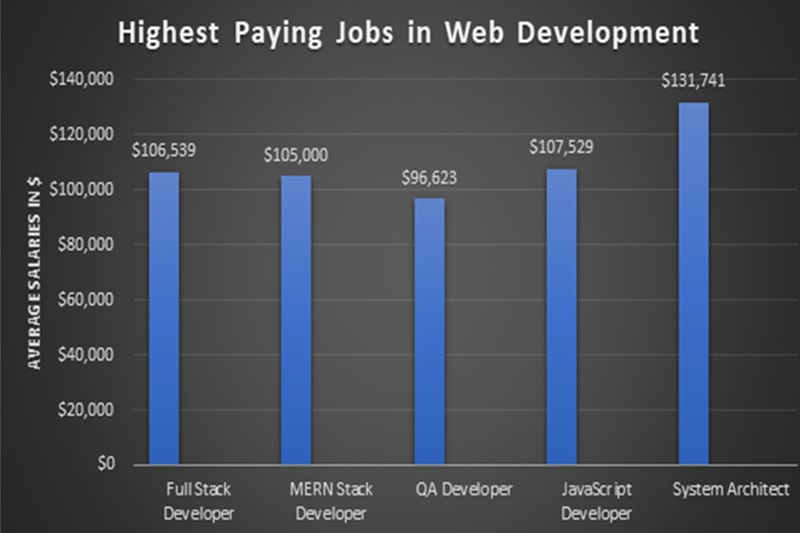
Career Prospects after Synergisticit's best full stack bootcamp in San francisco, California
MERN Stack Developer ($105,000)
JavaScript Developer ($107,529)
Full Stack Developer ($106,539)
System Architect ($131,741)
Back End Web Developer ($123,770)
Front End Web Developer ($79,735)
Java Devops Developer ($146,623)
What Percentage of Jobs Are Remote, Hybrid, or Onsite?
A report summarizing CBRE’s 2026 analysis puts remote postings at 7% of Bay Area technology openings in April 2026, down from 24% in mid-2022. That is broader than San Francisco full-stack hiring and is a secondary report.
It does not provide a verified hybrid-versus-onsite breakdown, so a three-way percentage split would be speculative.
Remote training and remote employment are separate decisions. Candidates can complete JOPP remotely while considering hybrid or onsite jobs that meet their location preferences.
Which Job Boards and Staffing Channels Deserve Attention?
Built In San Francisco maintains a regional technology and startup jobs directory. Robert Half publishes local Java full-stack listings, while Motion Recruitment appears in San Francisco full-stack recruitment listings.
LinkedIn, Indeed, Dice, Wellfound, and employer career pages are additional channels to evaluate, but this research does not establish their local popularity ranking.
Use job boards to discover employers, then verify openings on company websites. Avoid equating application volume with progress. SynergisticIT’s related article on whether coding bootcamps are worth it amid technology layoffs discusses the importance of post-training support.
What About Relocation and Visa Sponsorship?
Relocation assistance is offer-specific; applicants should request written details about reimbursements, moving allowances, repayment clauses, and required office attendance.
San Francisco immigration-filing data identifies Salesforce, Uber, Airbnb, and Adobe among employers with H-1B-related LCA activity. An LCA is not an approved visa or a promise to sponsor every applicant.
OPT-to-H-1B changes require employer participation and immigration eligibility. Existing H-1B workers may qualify for portability when a new employer properly files an eligible petition. Training enrollment itself does not create work authorization. Candidates should consult their DSO and qualified immigration counsel.
How Vulnerable Is the Market to Layoffs and Closures?
San Francisco participates in a technology market where cuts and selective expansion coexist. SignalFire describes reduced major-company hiring alongside investment in AI infrastructure, cybersecurity, and technically leveraged roles.
A new office or campus does not automatically mean junior hiring, just as one company’s layoffs do not eliminate demand elsewhere. The reviewed evidence does not support a numerical balance of local closures against openings.
Bootcamp closures reinforce the need to verify institutional stability. BloomTech’s closure is documented, but it would be misleading to attribute every bootcamp shutdown to broken placement promises.
Is JOPP the Right Next Step?
Review the company’s ROI comparison with colleges, alumni reviews, event videos, and USA Today contributor-content feature. These provide context, not independent proof of the highest ROI or guaranteed employment.
Postponing preparation does not remove the work ahead. Skills, projects, assessments, interviews, and employer outreach still require sustained effort. Starting a realistic plan sooner can move that work forward.
San Francisco jobseekers have multiple training choices. For those prioritizing comprehensive Java, DevOps, full-stack preparation, and active placement services, SynergisticIT’s JOPP deserves serious consideration—not as a sure-shot guarantee, but as a structured employment-focused option.
Contact SynergisticIT to discuss eligibility, fees, and your career plan, or call (510) 550-7200. Request the current syllabus, written contract, and applicable outcome definitions before beginning your technology career journey.