 Important Notice— Our url is


Full stack Bootcamp in Boston, Massachusetts with Job Placement is not a classroom-only course. For jobseekers chasing full stack, software developer, technology, and IT jobs, SynergisticIT’s Java DevOps Full Stack Job Placement Program (JOPP) is training plus staffing, interview scheduling, and handholding until a $81k+ offer.
Boston employers that hire Full Stack, MERN, and MEAN developers (not staffing firms) include HubSpot, Klaviyo, Wayfair, Toast, TripAdvisor, DraftKings, WHOOP, InterSystems, CarGurus, Datadog, Bose, SimpliSafe, Fidelity, State Street, Google, Amazon, Moderna, Vertex Pharmaceuticals, Biogen, Recorded Future, Lightmatter, Suno, Anduril, ClickHouse, and Gradient AI. These product, SaaS, fintech, biotech, and defense firms keep software openings in Boston and Cambridge rather than filling them through agencies.
Across that market, junior full-stack and MERN/MEAN engineers commonly see $80,000–$125,000, with many postings clustering near $95,000–$125,000. Mid-level engineers who own features end to end typically land $120,000–$175,000, while product companies such as HubSpot, Klaviyo, Wayfair, and Toast often quote $145,000–$190,000 at mid-to-senior bands. Senior full-stack engineers usually range $150,000–$200,000, with some senior bands $160,000–$195,000 and total pay at large tech offices stretching $185,000–$240,000. Financial firms like Fidelity and State Street often pay $140,000–$185,000 cash-heavy mid-to-senior packages. Citywide full-stack averages sit near $144,000–$147,000, with typical spreads $120,600–$171,600.
Why Boston jobseekers need more than a bootcamp
Boston’s market still posts full stack and software developer roles across fintech, healthcare, government contractors, and product companies. Hiring managers rarely buy a React demo and a GitHub clone. They want Java, Spring Boot, SQL, DevOps, and enough MERN/MEAN to ship a feature across backend, frontend, and deployment.
Many coding bootcamps train, issue a certificate, and leave job hunting to the enrollee. SynergisticIT JOPP is full stack training + staffing, available from anywhere in the USA, including Boston. The same model is the Full stack Bootcamp training in Cincinnati, Ohio—not because the city is the product, but because the Job placement program is the product.
30% of people who join JOPP already tried other bootcamps, Udemy, Coursera, or university short courses and still did not get hired. Repeating a cheaper promise is expensive. One complete Java DevOps Full Stack JOPP—Java, Spring Boot, microservices, SQL, DSA, interview prep, MERN, MEAN, and certifications—covers what employers actually screen.
AI will not retire full stack demand
AI tools write snippets. They do not own mission-critical systems, security reviews, data contracts, or production incidents. Companies still need people who can design APIs, model data, secure sessions, ship CI/CD, and debug what a generator invented.
Emerging full stack asks now include:
- Spring Boot microservices, REST, and event-driven backends
- React or Angular with TypeScript, not tutorial JSX
- SQL plus NoSQL, transactions, and query plans
- Docker, Kubernetes, Jenkins or GitHub Actions, Terraform
- AWS / Azure deploy, secrets, and observability
- AI-assisted coding inside enterprise workflows, with human ownership of quality
MERN for employment should be learned in depth, not from a weekend coding bootcamp. Learn it from a company in the tech industry for over 15 years: SynergisticIT, which hears what employers reject in interviews and updates the curriculum in real time.
Why MERN and MEAN are cooling vs Java
MERN and MEAN still appear on junior postings, but demand has cooled where Node is asked to carry banking, fintech, government, and other mission-critical platforms. Java keeps enterprise dominance there. Its object-oriented structure helps large teams manage massive codebases. Node.js excels at lightweight I/O; it struggles when workloads get heavy, stateful, and compliance-bound.
Employers also refuse to hire three people for one role. They want Java + Spring Boot + DevOps + SQL, with MERN/MEAN as extra coverage so one hire can move across teams. That is why full stack training sits inside SynergisticIT’s Java DevOps Full Stack Job Placement Program, not as a thin MERN-only course.
Career gap: six ways JOPP helps
- Skills are reassessed against live job specs, not a 2019 resume.
- Hands-on projects replace the empty years on paper.
- Certifications (Oracle, AWS, Azure, and others) signal current competence.
- Client marketing to 24,000+ company contacts bypasses “gap” filters on job boards.
- Interview prep and scheduled interviews rebuild confidence with real rounds.
- Support continues until hire, so a break does not become a second stall.
Recent graduates, no experience: six ways JOPP helps
- Tech skills employers list, not only campus theory.
- Project work that can sit on a resume without fiction.
- DSA and interview labs for coding rounds.
- Multi-stack coverage so a junior is not one-framework-deep.
- Placement into companies that otherwise demand “2–3 years.”
- 91.5% success framing for those who complete the full program and certifications—not dropouts.
About 90% of JOPP graduates hired into tech jobs had never held a tech job. The other 10% are career changers and people with gaps. Recent graduates join because JOPP supplies skills, projects, and the missing piece: getting hired at strong tech companies.
Why employers pay high salaries for real JOPP grads
Hiring managers are tired of fake or ineffective candidates, job-board noise, and staffing resumes that collapse in the first technical screen. They do not want to second-guess performance.
SynergisticIT JOPP candidates who completed the whole program and certifications are a different product. If someone did not finish JOPP, they are not that product and will not be as strong. Completers are certified, have worked on projects, and can contribute from day one. They are pre-screened for technical and job fit before interviews. They are often quality-compared to 3–5 year hires, with deeper multi-stack coverage. Open-market equivalents can cost employers 2–3 times the salary. Jobseekers win because they enter companies that would otherwise pay much more for the same capability.
Visa, Intel, eBay, Citi, Apple, PayPal, Walmart Labs, AutoZone, Wells Fargo, Capital One, Walgreens, Bank of America, SAP, Cisco Systems, Verizon, T-Mobile, Intuit, Ford, Hitachi, Western Union, Deloitte, Dell, USAA, Carfax, Humana, and others hire SynergisticIT candidates at $95k to $155k (company materials also cite $95k–$154k). Alumni report multiple offers. Completers who perform can be promoted faster and move toward leadership because they already span backend, frontend, and deployment.
Rewritten employer value:
- Current stack alignment: JOPP is shaped by tech-client demand and industry interaction, so ramp-up is shorter.
- Pre-screened talent: companies meet people already checked for technical and job fit.
- Certifications: Java, DevOps, AWS, Azure, Power BI, Snowflake, and more, at no extra cost from Microsoft, Oracle, Snowflake, Databricks, Azure, AWS.
- Multi-stack skill: one junior who can work backend, frontend, and deployment—or a data path across engineering, analytics, and ML/AI.
- Lower hiring risk: structured training, projects, interview prep, and screening.
- Day-one contribution: practical, job-ready work from the first week.
- Genuine project resumes: real work, not embellished titles.
- More value per dollar: multiskilled people who can hold multiple responsibilities.
Read the SynergisticIT Job Placement Program (JOPP) and the Java DevOps Full Stack JOPP in the middle of this search journey, not as an afterthought.
How SynergisticIT differs from bootcamps and staffing shops
Curriculum quality. SynergisticIT is in the industry at Oracle CloudWorld, Gartner Data Analytics, and similar events, and candidates interview continuously, so the syllabus moves with the market.
Instructor quality. Many bootcamps use alumni, recordings, or a few hours a week. JOPP uses industry professionals; the average instructor has 10+ years.
Number of instructors. Typical bootcamps use 1–2 people for every topic. Java JOPP and Data Science JOPP use 5–6 specialists—separate instructors for analytics, data engineering, data science/ML; separate for Java, databases, advanced Java, and DevOps.
Cost and payment. Transparent: about $10k before, balance $26k after a job offer, payable over 2 years. If no job offer, no payments accrue. Most bootcamps take all fees upfront and advertise refunds with clauses that are hard to redeem. JOPP takes partial fees before and the balance once the jobseeker is hired for an $81k job or higher.
Duration. 4–5 hours a day, 5 days a week, about 5 months. Live lectures, no recorded sessions. Ask any bootcamp this in writing.
Student-to-instructor ratio. About 5:1, versus 20:1 elsewhere.
Projects. Tailored to company tech stacks and live demand. Only projects you work go on the resume.
Alumni success. Photos, audio, and video reviews. Offers in the $95k to $155k range, often multiple offers. 91.5% success rate is cited for completers.
Certifications included at no extra cost.
Career help after training. Marketing to 24,000+ company contacts. SynergisticIT owns outreach, resume, interview prep, and scheduling. Bootcamps often stop at tips. Get their offer in writing.
Why trust this. Photographs of successful alumni on the JOPP page, video reviews, offer letters, years in business, and no hidden “guarantee” clauses. Compare reviews at [https://www.synergisticit.com/reviews], the USA Today feature, and the ROI of the Job Placement Program versus college paths: [https://www.synergisticit.com/roi-of-job-placement-program/].
Many bootcamps shut down after promises they could not keep. JOPP’s kept promise is placement for people who successfully complete the program.

Full Stack Bootcamp in Boston, Massachusetts Overview
Key technologies include:
- Core Java & Advanced Java
- Spring, Spring Boot, Hibernate
- REST APIs & Microservices
- SQL & NoSQL Databases
- Frontend Technologies (HTML, CSS, JavaScript, React)
- DevOps Tools (AWS, Docker, Kubernetes, CI/CD, Jenkins)
- Linux, Git, Cloud Deployment
- System Design & Performance Optimization
This diverse skill set ensures candidates are not limited to backend roles alone. Employers today expect developers to understand frontend, backend, cloud, and deployment workflows.
Our Best Full Stack Coding Bootcamp in Boston, Massachusetts is curated to meet the learning goals of both freshers and professionals. Its curriculum aligns well with the latest industrial trends and best development practices.
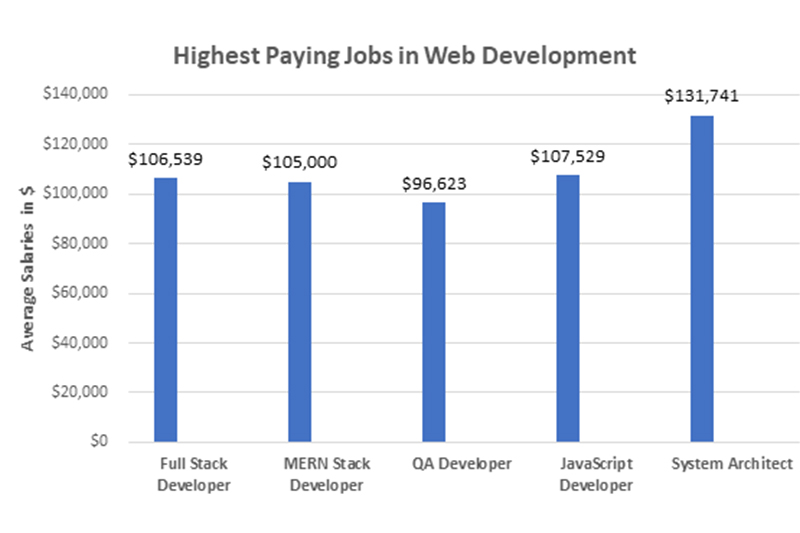
JavaScript Developer ($107,529)
MERN Stack Developer (105,000)
Full Stack Developer ($106,539)
System Architect ($131,741)
Front End Web Developer ($79,735)
Back End Web Developer ($83,770)
Core Programming & Backend Technologies:
Java (Core & Advanced Java), Object-Oriented Programming (OOP), Data Structures & Algorithms, Multithreading & Concurrency, Java 8+ features, Spring Framework, Spring Boot, Spring MVC, Spring Security, Hibernate/JPA, RESTful Web Services, Microservices Architecture
Frontend & Full Stack Technologies:
HTML5, CSS3, JavaScript (ES6+), React.js, UI Integration, Client-Server Architecture, API Consumption, Responsive Web Design
Database & Data Technologies:
SQL, MySQL, PostgreSQL, Oracle DB, NoSQL Databases (MongoDB), Database Design, Query Optimization
DevOps, Cloud & Deployment:
Linux/Unix, Git & Version Control, Maven, Jenkins (CI/CD), Docker, Kubernetes, AWS (EC2, S3, RDS, IAM), Cloud Deployment & Monitoring
Testing, System Design & Enterprise Skills:
JUnit, Mockito, Integration Testing, Logging & Monitoring, System Design Fundamentals, Performance Optimization, Agile/Scrum Methodologies
Job Readiness & Placement Support:
Resume Optimization, Technical Interview Preparation, Mock Interviews, Client Screening Readiness, Interview Scheduling, End-to-End Job Placement Support
This full-stack + DevOps technology line ensures candidates are prepared for Java Full Stack Developer, Backend Engineer, DevOps Engineer, and Cloud Engineer roles, aligning directly with enterprise hiring requirements rather than just academic training.

Boston Jobseekers Should Start Now
Boston has no shortage of “full stack” ads. It has a shortage of programs that stay in the fight until an employer says yes. Coding bootcamps that only train leave graduates to compete for software developer jobs with the same thin MERN resume as everyone else. SynergisticIT’s Java DevOps Full Stack Job Placement Program schedules interviews, prepares candidates for those interviews, and works the client network until offers come from serious tech companies.
Delaying does not shrink JOPP. It only postpones the offer. The program is long because it has to be: skills, projects, interviews, and client marketing all have to happen before placement. That demanding stretch is exactly what employers pay $95k to $155k for. Begin while the hiring window is open. The road is not short, but the destination is a full-time job offer.
For a related view of why a wide stack beats a trendy one, see Is a Full-Stack Development Career Worth It?. Then look at real alumni proof on SynergisticIT Reviews.
There may be many full stack bootcamps or coding bootcamps in Boston. If your goal is to get hired after the bootcamp, there is one serious choice: SynergisticIT’s Full stack training Bootcamp in Boston, Massachusetts. There may be many coding bootcamps that offer full stack training in Boston; if employment is the finish line, SynergisticIT’s full stack training Bootcamp in Boston, Massachusetts is the program built around that finish line. The same Java DevOps Full Stack JOPP—training plus staffing, not train-and-release—is the reliable way a jobseeker gets hired after a bootcamp-style program, whether they log in from Boston or another U.S. city.
Ready to start the tech career journey? Contact SynergisticIT and apply for the Job Placement Program.