 Important Notice— Our url is



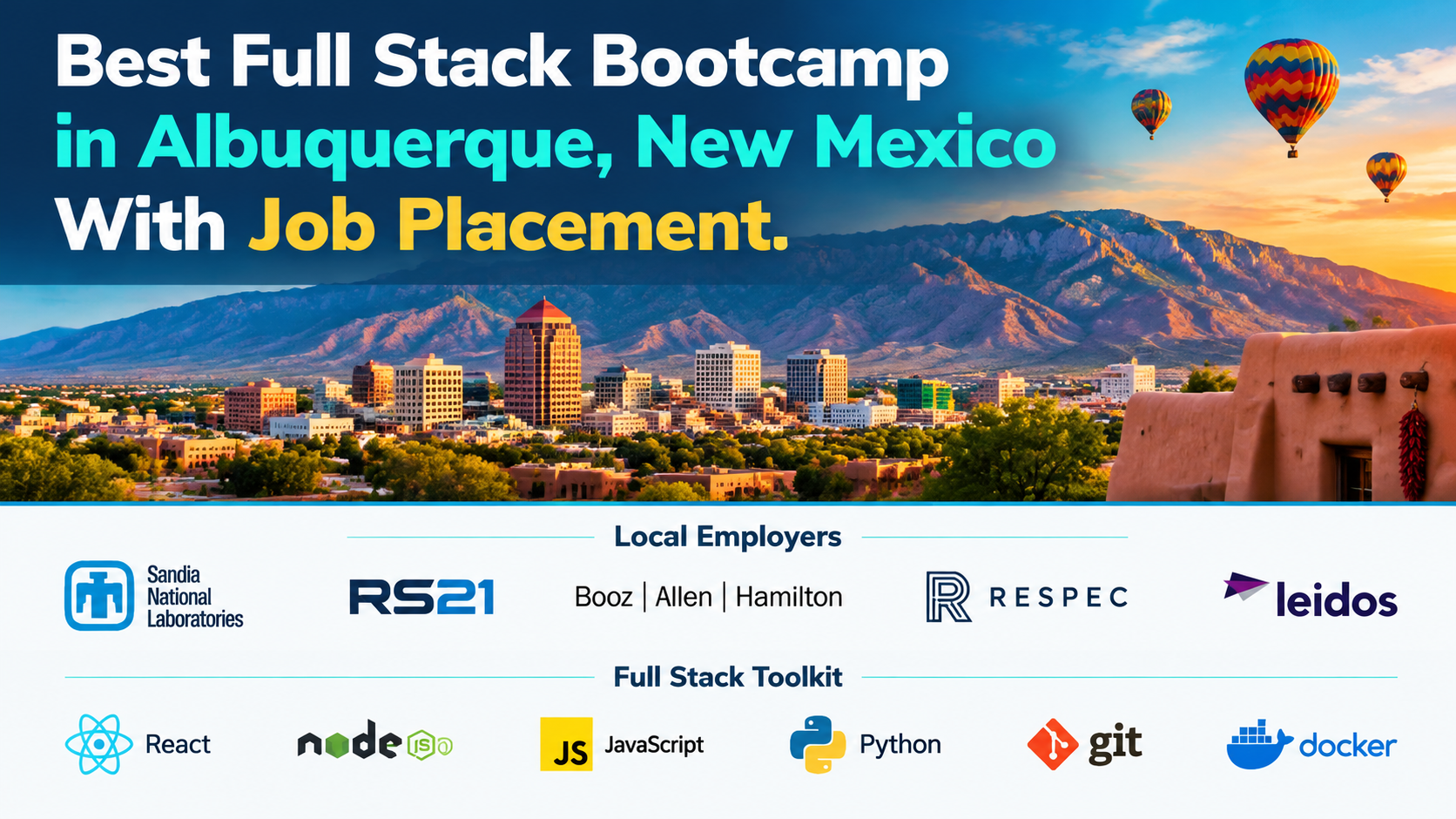
Best Full Stack Bootcamp in Albuquerque, New Mexico With Job Placement
Albuquerque jobseekers who want a tech job, not another certificate, should treat the Best Full stack training Bootcamp in Albuquerque, New Mexico as SynergisticIT’s Java DevOps Full Stack Job Placement Program, not a short coding class. The phrase people search, Best Full Stack Bootcamp in Albuquerque, New Mexico with job placement, is the same model: live training, real projects, and staffing until a hire. It can be done from anywhere in the USA, including Albuquerque, because it is training plus employer marketing. That is why it is a Job Placement Program, not a coding bootcamp that trains and then leaves people to hunt alone.
What a full stack bootcamp is
A full stack bootcamp is a compressed course covering the front end a user sees and the back end that stores data, runs business rules, and ships the app. A typical path includes HTML, CSS, JavaScript, React or Angular, a server language, SQL, APIs, and light cloud or DevOps. Some tracks add Python and Django. Others stop at MERN (MongoDB, Express, React, Node.js) or MEAN (Angular instead of React). A certificate proves attendance. It does not prove an interview.
Albuquerque bootcamp guide
Albuquerque has no large national-chain campus. Local choices fall into a few types, and public feedback is mixed.
Immersive community programs. Deep Dive Coding, tied to CNM Ingenuity, runs Albuquerque bootcamps in web development, Java-related software, data, and other fields. Its Web Development and AI Tools track is listed around $11,999, with a 12-week full-time cohort and a longer part-time option, plus tuition assistance. Older listings showed a shorter fullstack price nearer $6,495. Instruction is cohort-based and has often been in person, not a pile of recordings. The group has cited strong graduate employment and an NCCET award. Forum comments cut both ways. Some alumni reported offers or internships and liked the basics plus coaching. Others were not hired locally and returned to old work. Hiring managers on those threads treated grads as junior or intern level, not as degree-equivalent engineers.
University self-paced courses. UNM Continuing Education lists Full Stack Software Developer with AI Coding at $4,695, about 500 hours, with 12 months of access and open enrollment. It is online and self-paced, ending in a certificate of completion, not a vendor exam. Coverage includes HTML, CSS, JavaScript, Bootstrap, Git, React or Vue, SQL, and either Python/Django or PHP/MySQL, plus AI coding tools. Pay by card, TuitionFlex installments, or, for some students, workforce funding. The catalog states there is no job guarantee. The usual review follows from that design: useful projects, almost no hiring machinery.
Partner and national online programs. A UNM / QuickStart AI-centric software engineering bootcamp has been listed at 19 weeks, part time, fully online, about $8,900. Confirm live time and hiring help in writing. National brands such as Flatiron, Nucamp, and Springboard accept Albuquerque residents but are not local employers. Tuition often runs from a few thousand dollars to above $15,000, sometimes past $20,000, collected up front. Many mix recordings with one or two generalist instructors and a resume checklist. Refund “guarantees” often hide clauses. Several well-known bootcamps have shut or shrunk after job promises they could not keep. Joiners are career changers, new graduates, and people returning from a break. Praise usually concerns structure. Complaints concern silence after graduation.
Albuquerque’s full-stack market is smaller than Denver, Phoenix, or Austin, but specialized rather than empty. In May 2025, mean pay across all local jobs was $31.00 an hour, below the U.S. figure of $33.54. Computer and mathematical work was 2.7 percent of employment, versus 3.4 percent nationally, at a lower mean of $50.09 an hour. Engineering jobs were twice the national share and paid a mean of $63.45 an hour. About 2,280 software developers worked in the metro, at a median of $123,700, roughly 9 percent under the national median of $135,980. Hiring clusters around laboratories, Kirtland Air Force Base, Intel’s Rio Rancho fabs, and health systems.
Non-staffing employers that recruit full-stack and software developers here include Sandia National Laboratories, Boeing, Rocket Lab, Northrop Grumman, Intel, BAE Systems, Leidos, Presbyterian Healthcare Services, University of New Mexico, UNM Hospital, Lovelace Health System, Applied Research Associates, Array Technologies, Verus Research, Air Force Research Laboratory, Lavu, RS21, Ideum, Stellar Science, Great River Technology, PNM, Nusenda Credit Union, City of Albuquerque, Blue Cross Blue Shield of New Mexico, and Optum. Laboratories, defense primes, and health systems supply most sustained openings.
Typical offered ranges, not a guaranteed band at each employer, are about $70,000–$95,000 for junior developers, $100,000–$145,000 for mid-level developers, and $140,000–$200,000 in base pay for senior developers. May 2025 software-developer wages ran from $78,290 at the 10th percentile through $99,780, $123,700, and $159,780 to $182,580 at the 90th. Posted ceilings run higher: Sandia National Laboratories full-stack bands have been about $102,400–$199,700, with some senior research roles near $235,700; Boeing experienced roles about $126,650–$171,350 and senior roles about $160,650–$217,350; Rocket Lab roles about $94,000–$129,000 and $118,000–$156,000.
Well-known technology figures from Albuquerque include Jeff Bezos, born in the city and later founder of Amazon; Joel Spolsky, also born here, co-founder of Stack Overflow and Trello; Jack Moffitt, a University of New Mexico-linked computer scientist behind Icecast and XMPP who later led Mozilla’s Servo effort; Tom Chavez, founder of the data firms Rapt and Krux; and R. Martin Chávez, the Albuquerque-raised technology executive associated with Goldman Sachs.
Benefits and total compensation still lag nearby metros. Local offers are mostly base pay. Laboratory and federal roles can add strong health coverage, retirement contributions, relocation help, and clearance pay, but almost no equity. Boeing and Intel may add a match, a bonus, and limited stock, though Intel’s equity-heavy national packages are not the Rio Rancho norm. Denver, Austin, and Phoenix more often add bonuses around 10 to 20 percent and stock worth tens of thousands a year. Levels.fyi’s U.S. software-engineer median total compensation is about $199,520. New Mexico’s 1.5 to 5.9 percent income tax also trails Austin, which has no state income tax. Cheaper housing narrows the gap with Denver, so $160,000 here can feel competitive after rent, but it rarely matches those metros once stock is counted.
Who hires, and how
Labs, federal contractors, healthcare systems, and established mid-size firms do more full-stack hiring here than startups. Albuquerque is not a venture-capital cluster. Sandia National Laboratories lists dozens of Albuquerque computer-science openings, many onsite, including software and full-stack work, with published ranges that can sit well above $100,000 for qualified staff. Contractors posting related work include Booz Allen Hamilton, SAIC, Amentum, Edgewater Federal Solutions, and Contact Government Services. Other names in the metro mix include Rocket Lab, Presbyterian Healthcare Services, the University of New Mexico, PNM, Speridian Technologies, and Intel’s Rio Rancho footprint. Quantinuum has announced a local expansion tied to the state’s quantum push. Startups exist. They are not the volume employers.
Full-time work is the most common path for newcomers and recent graduates. Contract and staffing-agency roles are the main second path, especially on federal programs, and some convert to permanent seats. Freelance is the least common entry. New grads rarely win solo clients without a portfolio, references, and, near the labs, clearance eligibility. A supervised full-time or contract-to-hire role is the realistic first step.
Onsite work dominates cleared and mission roles. Sandia and Kirtland-area posts often require a desk on site. Hybrid appears in some commercial and early-career listings. Fully remote ads often belong to national employers who will hire an Albuquerque resident, not to lab policy. No official citywide percentage exists, so any precise remote-hybrid-onsite split is a guess.
Boards local tech seekers actually use include Indeed, LinkedIn, ZipRecruiter, and Glassdoor, plus USAJOBS, Sandia’s career site, and the New Mexico Technology Council board. Dice still matters for national IT contracts. Those boards create volume and noise, which is why many newcomers apply for months without a technical screen.
Staffing firms in the metro include Robert Half, KORE1 for cleared IT and software, Sabio Systems, Aerotek, ITSQuest, and recruiters such as DevsData. They can open a contract door. They do not rebuild a weak stack.
Relocation, visa sponsorship, and H-1B conversion are selective. Labor Department filings show 2,532 certified Albuquerque H-1B applications from FY 2020 through FY 2026, with a median wage of $82,000. Leading sponsors include Presbyterian Healthcare Services, the University of New Mexico, Speridian Technologies, Cognizant, NTESS, CitiusTech, Infosys, and PNM. Software-engineer filings in that set cluster nearer $78,650. Many lab roles need U.S. citizenship for clearance, so H-1B is a poor fit there. Commercial and healthcare employers sponsor some specialty roles and may support transfers. A new lottery petition or green-card step depends on the employer, the job, and budget. Relocation help shows up more often for onsite lab and contractor roles than for junior startups. A job-board line that says sponsorship is available is not a promise.
Layoff exposure is lower than in consumer-tech hubs, and it is not zero. National tech firms kept cutting through 2025 and 2026, while technology occupations still grew as non-tech employers hired for AI and infrastructure. Albuquerque’s base is labs, healthcare, utilities, and federal contracting, so it sees fewer startup shutdowns. The local risks are budget cycles, contract recompetes, and hiring pauses, not a wave of office closures. Growth signals include quantum investment, Quantinuum’s expansion, and continued Sandia hiring. A thin JavaScript tutorial still loses when teams hire fewer juniors.
Why join our Best Full Stack Bootcamp in Albuquerque, New Mexico With Job Placement ?
Why Java full stack still hires
AI tools speed boilerplate. They do not own production. Companies still need people who design APIs, secure data, review generated code, and ship features. Federal projections still show strong growth for web developers and digital designers. Emerging full-stack asks include AI-assisted development, AWS or Azure, microservices, Kubernetes, CI/CD, DevSecOps, and solid SQL.
MERN and MEAN demand is cooling as a standalone ticket. Those stacks still help with interfaces and lighter services. Node.js excels at lightweight, I/O-heavy work and struggles as the default for heavy transactional loads. Java holds enterprise dominance in mission-critical systems across banking, fintech, insurance, and government. Its object-oriented structure makes massive codebases easier for large engineering teams to manage. A short MERN bootcamp does not close that gap.
Employment-level full stack should be learned in depth from a company with more than 15 years in the tech industry. SynergisticIT, in business since 2010, puts full stack inside the Java DevOps Full Stack Job Placement Program, shaped by live client demand rather than a frozen deck. The stack includes Core and Advanced Java, Spring Boot, microservices, SQL and PL/SQL, data structures and algorithms, Git, Maven or Gradle, Jenkins, Docker, Kubernetes, AWS, Azure, and React, Angular, or Node where a role still wants MERN or MEAN. Employers want that mix so one hire covers backend, frontend, and deployment and saves headcount. Just learning MERN is not enough to get hired.
Career gaps and new graduates
SynergisticIT’s Job Placement Program helps a career gap in six ways.
- It replaces a stale line with current Java, DevOps, and full-stack projects so the break is not the headline.
- It uses only work you actually did, which survives a background check.
- Live sessions of about four to seven hours a day, five days a week, for roughly five months, rebuild stamina.
- Specialist instructors, not one generalist, cover Java, databases, advanced Java, and DevOps.
- The team markets you to 24,000-plus company contacts, schedules interviews, and stays until an offer.
- Soft skills and interview presence are coached with the code. A break makes that coaching more important, which is why the importance of soft skills in tech jobs belongs in the same plan.
Recent graduates should join because a degree rarely matches a requisition. JOPP supplies skills, project work, and the hire.
- It turns classwork into employer-shaped projects.
- It adds the Java, Spring Boot, SQL, and DevOps layer junior MERN certificates skip.
- It prepares Oracle, AWS, Azure, and related certifications without a second tuition bill.
- It runs mock interviews before a client sees the resume.
- It handholds from enrollment through day one, including scheduled interviews.
- Program reporting says about 90 percent of hired graduates had never held a U.S. tech job, with the rest career changers and people with gaps.
About 30 percent who join already tried another bootcamp, Udemy, Coursera, or a university certificate and were not hired. Four or five cheap courses repeat that loop. One Java DevOps full stack placement program covers the combined stack employers keep requesting. The program also reports a higher return than a typical degree path; the comparison is on the ROI versus colleges page.
Why employers choose completers
Companies hire completed JOPP candidates at strong salaries because finishers are screened, certified, and tested on real projects, so they can contribute on day one. They are not people who attended a few weeks and left. If the program was not finished, that advantage does not exist.
Employers get technical and job-fit checks before interviews, plus coverage of Java, DevOps, AWS, Azure, Power BI, Snowflake, and related tools. Multi-skilled candidates can cover backend, frontend, and release work, or support analytics, data engineering, and applied AI, which is more value for the salary. Hiring risk drops because training, projects, interview prep, and screening already happened. Ramp-up shrinks because the curriculum follows client demand and industry contact at Oracle CloudWorld and the Gartner Data and Analytics Summit. Resumes reflect genuine projects, not embellished titles. Clips from those events are in the tech event gallery.
Hiring managers who are tired of fake candidates, and of wasting time on job boards and staffing submittals, choose completers they do not have to second-guess. Program materials report offers from $95,000 to $155,000, a 91.5 percent success rate for people who finish the requirements, and repeat hiring by Visa, Intel, eBay, Citi, Apple, PayPal, Walmart Labs, AutoZone, Wells Fargo, Capital One, Walgreens, Bank of America, SAP, Cisco Systems, Verizon, T-Mobile, Intuit, Ford, Hitachi, Western Union, Deloitte, Dell, USAA, Carfax, and Humana. Completers are often described as deeper on the current stack than a narrow three-to-five-year resume, and as people who take responsibility faster. A similar open-market search, once failed interviews and months of onboarding are counted, can cost two or three times as much. The employer gets a ready contributor. The jobseeker gets companies that usually pay experienced talent much more. Public notes sit on the reviews page and in the USA Today feature.
Fees are $10,000 up front. The balance, capped at $26,000, starts only after an offer of $81,000 or higher and is paid over about two years. No qualifying offer means that balance does not accrue.


Best Career Options after our Best Full Stack Bootcamp in Albuquerque, New Mexico With Job Placement
-
Full Stack Web Developer
-
JavaScript Developer
-
Quality Assurance Developer
-
MERN Stack Developer
-
Back End Web Developer
-
Front End Web Developer
-
System Architect
How this path is different
SynergisticIT is different from bootcamps and staffing shops on the points that decide a hire.
Curriculum tracks live requisitions. The firm meets clients at industry events and in active interviews, then adjusts topics in real time. Bootcamp decks often do not.
Instructors are industry practitioners averaging more than 10 years, not recent alumni teaching a weekly hour from recordings. The Java track uses five or six specialists, covering Java, databases, advanced Java, and DevOps, instead of one or two people teaching every subject.
Cost is transparent and tied to an offer. Most bootcamps collect everything up front and attach a refund that is hard to redeem.
Format is immersive and live, about four to seven hours a day, five days a week, for roughly five months. Ask any local program whether the core is live or recorded, and get the answer in writing.
Class size stays near five learners per instructor, not twenty to one. Projects match current stacks, and only those projects hit the resume. Alumni reviews, photos, and offer letters are public, with reported pay from $95,000 to $155,000 and multiple offers for many completers. Microsoft, Oracle, Snowflake, Databricks, Azure, and AWS certification preparation sits inside the fee.
After training, the firm markets the candidate, rewrites the resume, prepares interviews, and schedules them, then stays through the offer. Most bootcamps stop at tips. Trust rests on years in business since 2010, visible alumni, and terms without hidden exits. For a wider look at language demand, see why Java still wins hiring comparisons against Python and C++.
Waiting will not make the program shorter. It only delays the offer. The time exists because skills, projects, interviews, and client marketing have to be finished before a company will bet a salary on you. That demanding stretch is what employers pay for. Start now. The journey is long, and the reward the program is built to deliver is a full-time job offer.
Albuquerque has more than one place to study full stack. If the goal is to get hired afterward, the practical choice is SynergisticIT’s Best Full stack training Bootcamp in Albuquerque, New Mexico. Contact SynergisticIT or call (510) 550-7200 and start the tech career with a team that stays until the offer.