 Important Notice— Our url is



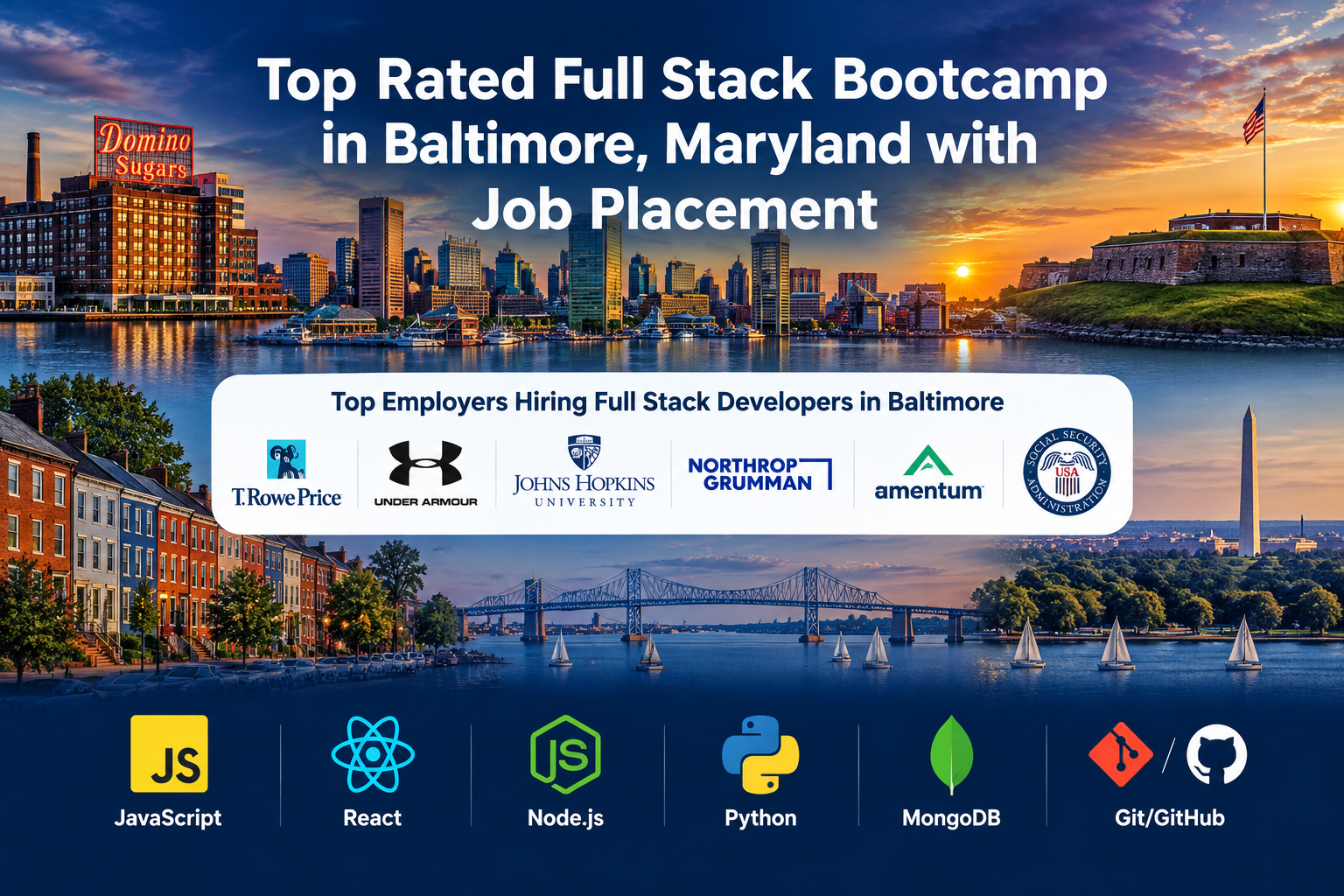
Top Rated Full Stack Bootcamp in Baltimore, Maryland
A top rated full stack bootcamp in Baltimore, Maryland is only useful if it ends in a hire. For jobseekers who want training plus employer outreach, the practical path is SynergisticIT’s Java DevOps JOPP, the company’s Job Placement Program, which combines deep full-stack training with staffing-style marketing. It can be completed from anywhere in the United States, including Baltimore, and it is built to get people hired rather than to hand them a certificate and a job-board login.
What a full stack bootcamp is
A full stack bootcamp is a compressed program that teaches both the browser side and the server side of software. A typical track covers a front-end framework, an API layer, a database, version control, and a little deployment. Some add cloud, testing, and interview drills. The promise is speed: months instead of a four-year degree.
That promise is also the weakness. A short course can show you how a page talks to an API. It rarely builds the depth employers use on mission-critical systems. In Baltimore, those systems sit in healthcare, finance, insurance, utilities, universities, and the defense corridor that runs through the city and nearby Maryland counties. Hiring managers there still ask for Java, Spring, SQL, cloud, and DevOps alongside any JavaScript stack.
Full stack bootcamps reachable from Baltimore fall into a few types:
- University-affiliated short courses. UMBC Training Centers offers a Full Stack Software Developer with AI Coding program listed around $4,900, plus a much shorter Full Stack Development Foundation workshop measured in days, not months. These are useful introductions. They are not a substitute for daily, multi-month project work and employer marketing.
- National live-online immersives. Hack Reactor’s beginner full-time track is about 16 weeks of live online instruction, with a published tuition near $19,480, career coaching, and a mix of JavaScript and Python. Students in Baltimore can join without moving. Outcomes are national, not Baltimore-specific, and coaching is not the same as a firm scheduling interviews until an offer arrives.
- Part-time and recorded hybrids. Many brands stretch 12 to 30 weeks, mix live calls with recorded lessons, and run cohorts of 20 or more per instructor. Financing often means loans, income-share agreements, or “pay after you earn” contracts with clauses that are hard to redeem.
- Local apprenticeships and staffing academies. Models such as Catalyte, long associated with Baltimore, screen for aptitude and then train people into client work. That is closer to employment than a classroom bootcamp, but the tech stack and client mix are set by the operator, not by the learner.
Fees for serious immersives commonly land between roughly $5,000 and $20,000, almost always collected up front or financed. Duration runs from a weekend workshop to six months. Formats are live, recorded, or mixed. Hiring support is usually resume tips, a Slack channel, and a partner list. Who joins is a mix of career changers, recent graduates, and people already employed who study at night. Public feedback praises structure and community. Negative reviews, on forums and review sites, repeat the same complaints: outdated JavaScript-only curricula, large classes, recorded content, and job guarantees that do not survive the fine print. Published local success rates for Baltimore full-stack bootcamps are scarce. Treat any city-specific placement percentage you cannot audit as marketing, not evidence.
SynergisticIT does not position JOPP as one more certificate mill. The company has operated in tech since 2010, so the training sits inside a firm that already talks to employers. That is why SynergisticIT’s Job Placement Program is named a placement program, not a coding bootcamp. Training without a hire is an expense. Training that is marketed until an offer is a career move.
Full-stack hiring in Baltimore is concentrated in hospitals, finance, energy, defense, and a smaller set of product firms, not in staffing agencies. Employers that maintain in-house engineering teams and hire full-stack developers across the city and nearby Columbia, Hunt Valley, Owings Mills, and the Fort Meade corridor include Johns Hopkins Medicine, Johns Hopkins University, University of Maryland Medical System, MedStar Health, LifeBridge Health, T. Rowe Price, Under Armour, Constellation Energy, BGE, McCormick & Company, CareFirst BlueCross BlueShield, Stanley Black & Decker, Northrop Grumman, Lockheed Martin, Fearless, ZeroFox, Huntress, Tenable, Dragos, SmartLogic, Mindgrub, Protenus, Catalyte, OneMain, and emocha Health. These are operators and product companies. Pay is not published as one identical ladder at all twenty-five, so the ranges below are the local market bands those employers compete within.
For software developers in the Baltimore-Columbia-Towson area, the May 2025 federal wage survey is the cleanest public benchmark. Junior full-stack offers commonly fall around $87,000 to $110,000, near the 10th percentile of $87,290 and the 25th of $105,670. Mid-level pay centers on the metro median of $138,900, typically about $115,000 to $155,000. Senior and staff cash pay more often runs $160,000 to $224,000, with the 75th percentile at $200,910 and the 90th at $223,550. About 16,850 software developers were employed in the metro. Cleared defense roles can exceed those cash bands. Hospital and university ranges are usually tighter, while a Built In sample of Baltimore software engineers averaged about $115,200 in base pay and only $2,500 in extra cash, which understates finance and senior cyber packages.
Baltimore’s recognizable technology names are ecosystem builders more than celebrity founders. Michael Bloomberg, a Johns Hopkins graduate rather than a Baltimore native, built Bloomberg L.P. and has funded major Hopkins science and health-technology work. Jess Gartner founded the education-finance company Allovue. Christy Wyskiel leads Johns Hopkins Technology Ventures. Deb Tillett long led the Emerging Technology Centers. Anisah Best, born in East Baltimore and a former senior software engineer, founded Baltimore Technology Hub. The employment picture is steady but specialized. Computer and mathematical jobs were 4.9 percent of local employment in May 2025, above the national 3.4 percent, and paid a higher mean wage. The metro unemployment rate was a preliminary 3.5 percent in September 2026. Information-industry payrolls are small, while health systems, asset management, energy, and the cyber corridor carry most technical demand.
On total compensation, Baltimore usually trails Washington and Northern Virginia on cash and trails large coastal tech markets on equity, then closes part of the gap with benefits and living costs. The May 2025 software-developer median was about $154,930 in Washington-Arlington-Alexandria and $133,040 in Philadelphia, against Baltimore’s $138,900. Philadelphia’s 75th percentile, about $165,140, also sits below Baltimore’s $200,910, so Baltimore’s upper half is stronger than Philadelphia’s even though the medians are close. Product firms such as Huntress, Tenable, Dragos, and ZeroFox grant equity, but those grants are smaller and less liquid than Bay Area or New York packages. Most seats at Johns Hopkins, T. Rowe Price, CareFirst, Constellation Energy, and Under Armour emphasize salary, annual bonus, retirement match or pension, health coverage, and tuition aid rather than stock. A higher D.C. base often buys less after housing costs, so a benefits-rich Baltimore offer can match it for many mid-level engineers. Senior cleared talent still captures a larger cash premium by working toward Fort Meade or Northern Virginia.
Who hires full stack developers in Baltimore
Mid-size and large employers do most of the durable hiring for full-stack and Java full-stack work around Baltimore. Startups post roles, and a few product companies hire aggressively, but the steady requisitions come from institutions that already run large codebases.
Names that show up again and again in the regional market include Johns Hopkins University and Johns Hopkins Medicine, the University of Maryland, T. Rowe Price in Owings Mills, Under Armour, CareFirst, Constellation Energy and utility affiliates, McCormick, and digital firms such as Fearless and Mindgrub. The wider Maryland tech belt adds Northrop Grumman, Leidos, Booz Allen Hamilton, CACI, Amentum, and other contractors that need cleared or hybrid on-site developers. National enterprises that have hired SynergisticIT candidates, and that also recruit across Maryland finance, retail, telecom, and healthcare, include Visa, Apple, PayPal, Walmart Labs, AutoZone, Wells Fargo, Capital One, Walgreens, Bank of America, SAP, Cisco, Verizon, T-Mobile, Intuit, Ford, Hitachi, Western Union, Deloitte, Dell, USAA, Carfax, and Humana.
Dice’s late-2026 tech jobs report showed Maryland postings up sharply year over year, with the Baltimore metro among the faster-growing hiring markets. That does not mean every startup is scaling. It means the region still has requisitions, especially where software supports regulated operations.
How roles split is not published as a clean Baltimore percentage. Listings on Indeed, LinkedIn, and staffing sites show four patterns:
- Full-time employment is the most common and the right target for newcomers. Benefits, a manager, and a codebase you can learn from matter more than a higher hourly rate.
- Contract and contract-to-hire are very visible because agencies repost the same role. A six-month contract can teach production habits, but it is a weak first choice if you need stability or visa-related employment.
- Staffing-agency placements are a distribution channel, not a career. Allegis Group, the parent of TEKsystems and Aerotek, is based in Hanover, so this channel is unusually strong in Maryland. Robert Half, Sparks Group, Insight Global, Randstad, Kforce, INSPYR, Mondo, and nTech also staff the corridor.
- Freelance is the least realistic path for a recent graduate. Clients want a portfolio, references, and the ability to own production incidents. Very few first jobs arrive that way.
Newcomers should aim for full-time roles inside mid-size or enterprise teams, then use contract work only if a direct offer is not available and the stack is real.
Remote, hybrid, and onsite also lack a single official split. Healthcare, finance, and cleared defense work in this region still lean hybrid or onsite. Fully remote roles exist, often posted by companies outside the city, and they draw national competition. A new graduate who can accept a hybrid Baltimore or Maryland office will usually see more interviews than someone who filters for remote only.
Relocation and visa support are role-specific. Johns Hopkins and the University of Maryland are among Maryland’s better-known sponsors, and university employment can be cap-exempt, which is different from a private lottery filing. T. Rowe Price has a documented H-1B history. Large contractors sometimes relocate cleared talent, but many Baltimore roles expect you to already live in the area. Sponsorship is never automatic. Employers sponsor people they already trust technically. That is one reason a finished, tested candidate is easier to move forward than a resume that only lists a bootcamp.
Layoff exposure is real and should not be waved away. Maryland’s WARN log records closures and layoffs, and national tech cuts remained large through 2025. Baltimore is not, however, a one-industry campus town. Hospitals, asset managers, insurers, utilities, universities, and federal contractors keep hiring even when a consumer app company freezes. The risk is highest in venture-funded startups and in contractor programs that lose a recompete. The hedge is a stack those institutions already run, which is why Java and DevOps travel better here than a narrow JavaScript-only certificate.
Why pursue our Top Rated Full Stack Bootcamp in Baltimore, Maryland with Job Placement
Why full stack still matters, and why Java should lead
AI coding tools write boilerplate. They do not own a payments ledger, a clinical workflow, or a trading batch that has to reconcile overnight. Companies still need people who can design an API, read a slow SQL plan, trace a production defect, and explain a tradeoff in a design review. Full stack work is shifting toward integration: AI features inside existing apps, event-driven services, cloud deployment, observability, and security reviews. Employers ask for Spring Boot, microservices, SQL, Docker, Kubernetes, CI/CD, AWS or Azure, React, and the judgment to know when a generated snippet is wrong.
MERN and MEAN demand is cooling relative to the hype years. Both stacks are fine for prototypes and lighter web products. Node.js is excellent at I/O-heavy, lightweight services. It is a weaker default for heavy, long-running enterprise workloads, where teams already standardized on the JVM. Java’s object-oriented structure, mature frameworks, and tooling make massive codebases easier for large teams to share. Banking, fintech, government, and healthcare did not rip out Java because a bootcamp taught Mongo and Express. If the goal is employment, MERN should be learned properly, inside a broader enterprise curriculum, not as a standalone camp.
That broader curriculum is what SynergisticIT’s Java DevOps full stack Job Placement Program teaches: Core and Advanced Java, Spring Boot, microservices, SQL and PL/SQL, data structures and algorithms, DevOps and cloud, plus MERN and MEAN, with certification preparation that can include Oracle Java, AWS, Azure, Microsoft, Snowflake, Databricks, and Power BI at no extra course fee. Companies want one junior who can touch the API, the database, and the pipeline. They hire that profile to save headcount, not to collect another React-only resume. Learning only MERN is not enough.
The skills employers screen for in juniors are laid out in the skills junior developers need to get hired. Pair that with ongoing career and interview guidance on the SynergisticIT blog so the search itself is as current as the code.
How placement helps three kinds of jobseekers
Career gaps or breaks
- The gap stops being the headline once the resume shows current projects instead of a silent year.
- Daily live instruction rebuilds interview stamina that a long break erodes.
- A structured stack gives a clean answer to “what have you been doing?”
- Screening happens before a client sees the profile, so the first conversation is technical, not apologetic.
- Marketing to a large client network creates interviews a gap makes hard to win on a job board.
- Offers are tied to completed work and assessments, not to a promise that the gap will be ignored.
Recent graduates with no tech job
- Coursework becomes production-style projects a hiring manager can discuss.
- Java, Spring, SQL, and DevOps cover what campus electives often skip.
- Mock interviews and a large question bank reduce the shock of the first onsites.
- The firm schedules conversations instead of leaving a new graduate to spray applications.
- A first full-time offer in the published alumni range, often $95,000 to $155,000 after successful completion, beats a string of unpaid projects.
- SynergisticIT states that about 90% of JOPP graduates who get hired had not held a tech job before. The other slice is career changers and people returning from a gap. The program is aimed at that first door, not at people who already have five quiet years in production.
People who simply want to get hired
- Partial fees up front, with the balance only after an offer of $81,000 or higher, align the operator with the outcome.
- Multi-stack skill lets one person cover backend, front end, and deployment, which is what budget-conscious teams buy.
- Certification adds a third-party signal on top of projects.
- Interview prep is included, not sold as a second product.
- Hand-holding runs through resume, scheduling, and the offer, then support continues after the start date.
- Completing the program is the filter. Someone who enrolls and does not finish the projects, certifications, and assessments is not the candidate clients keep requesting.
Why employers take completed JOPP candidates
Employers do not pay for potential they cannot test. A finished SynergisticIT JOPP candidate has already been screened, certified, and put through projects. The profile is pre-screened talent: technical fit and role fit are checked before the resume is sent, so interview time is not spent discovering that the person cannot write a join or explain a REST call.
Current stack alignment comes from client demand and from the company’s presence at events such as Oracle CloudWorld and the Gartner Data and Analytics Summit. Curriculum moves when job descriptions move. That is why ramp-up can be shorter. The person has already built the kind of service the team is hiring for.
Day-one contribution does not mean a junior runs the architecture. It means they can clone the repo, run the tests, read the ticket, and ship a small change without a month of tool training. Project-based resumes list work that was actually done. Clients who are tired of embellished bootcamp portfolios notice the difference.
Reduced hiring risk is the commercial point. Structured training, assessments, interview prep, and screening sit in front of the offer. Multi-stack candidates can cover more than one queue, so the salary buys backend, front end, and deployment capacity. Certifications in Java, DevOps, AWS, Azure, Power BI, Snowflake, and related tools make that breadth easier to trust.
SynergisticIT’s public positioning, echoed in its USA Today contributor article, is that properly upskilled and tested graduates can perform close to experienced developers and move into responsibility quickly. Hiring managers who do not want to second-guess basic competence use that filter. The advantage disappears if the person did not finish. Only candidates who completed JOPP, the projects, and the certifications are the ones the firm describes as tested. A partial attendee is not that product.
On salary, the company’s published range for successful Java track graduates runs roughly $95,000 to $155,000, with a stated 91.5% success rate among those who complete the program. Client names on the program pages include the enterprises listed above, plus Intel, eBay, Citi, Google, JPMorgan Chase, and Wells Fargo. The economic claim is straightforward: a comparable open-market hire with the same demonstrated stack often costs more, sometimes described by the firm as two to three times the salary once true experience and scarcity are priced in. The company gets a contributing developer without a long vacancy. The jobseeker gets a full-time seat that would have been hard to win alone. That is the win-win, and it only holds for people who actually finished.
How JOPP differs from bootcamps and staffing firms
Curriculum. SynergisticIT adjusts topics from live client interviews and from industry events, not from a syllabus frozen two years ago. Bootcamps often teach one JavaScript path because it is easy to staff. Staffing firms rarely teach at all.
Instructors. Many camps use recent alumni or a single generalist for a few hours a week, with recordings filling the rest. JOPP uses industry professionals, with an average around ten years, and about five or six specialists across the Java track and a similar specialist bench on the data track: separate depth for Java, databases, advanced Java, and DevOps, rather than one person skimming every topic.
Ratio and time. The working ratio is about five students to one instructor, against cohorts closer to twenty to one elsewhere. Instruction runs about four to five hours a day, five days a week, for roughly five months, live, with projects that match what is being requested now. Those projects are what land on the resume. Ask any other camp, in writing, whether every session is live and how many hours a specialist actually teaches.
Money. Published terms are $10,000 before the program and up to $26,000 after an offer of $81,000 or higher, spread over about two years. If that offer does not happen, the balance does not start. Many bootcamps collect full tuition first and advertise a refund that the conditions make rare.
After the last class. Camps issue a certificate and wish you luck. JOPP markets into a stated network of 24,000+ company contacts, rewrites the resume, prepares interviews, and schedules interviews until an offer. Reviews, offer context, and alumni photos are collected on the SynergisticIT reviews page. The ROI comparison with college degrees is the right page if you are weighing a degree’s cost against a placement program. The firm’s own figures put alumni offers in the $95,000 to $155,000 band, sometimes with more than one offer.
About 30% of people who join have already finished another bootcamp, a university extension, or a stack of Udemy and Coursera courses and still were not hired. Doing four cheap camps is more expensive than one program that covers Java, Spring Boot, microservices, SQL, DSA, interview prep, MERN, MEAN, and certifications. Bootcamps have closed in large numbers because the job promise outran the placement machinery. JOPP’s promise is narrower and more testable: people who finish get marketed until they are hired.

Career Options after our Top Rated Full Stack Bootcamp in Baltimore, Maryland with Job Placement
-
MERN Stack Developer
-
JavaScript Developer
-
Full Stack Web Developer
-
Quality Assurance Developer
-
Back End Web Developer
-
Front End Web Developer
-
System Architect

Where Baltimore jobseekers actually look
The boards that matter locally are LinkedIn, Indeed, ZipRecruiter, Glassdoor, Dice, Built In, ClearedJobs.net for cleared work, USAJobs for federal roles, and the Maryland Workforce Exchange. County and hospital career sites, especially Johns Hopkins and Baltimore County government technology pages, are worth checking directly because those roles are not always mirrored well on aggregators.
Boards are necessary and insufficient. They are crowded, recycled by agencies, and blind to whether you can pass a Spring and SQL screen. That is why a placement program that already knows the hiring manager is a different motion from refreshing Indeed every morning.
Start while the market is moving
Waiting does not compress the work. The months exist because skills, projects, interview reps, and client marketing have to stack before an offer can be real. Skipping that stretch is how people collect certificates and stay unemployed. Begin, stay through the assessments, and treat the length as the part employers are willing to pay for. The outcome on the other side is a full-time offer, not another login to a learning portal.
There are many places in and around Baltimore that will teach a slice of full stack. If the goal is to get hired after the training, the choice the firm argues for is SynergisticIT’s top rated full stack training bootcamp in Baltimore, Maryland: the Java DevOps full stack Job Placement Program, available nationwide, with partial fees first and the balance only after a qualifying hire. Contact SynergisticIT or call (510) 550-7200 and start the tech career while the requisitions are still open.