 Important Notice— Our url is



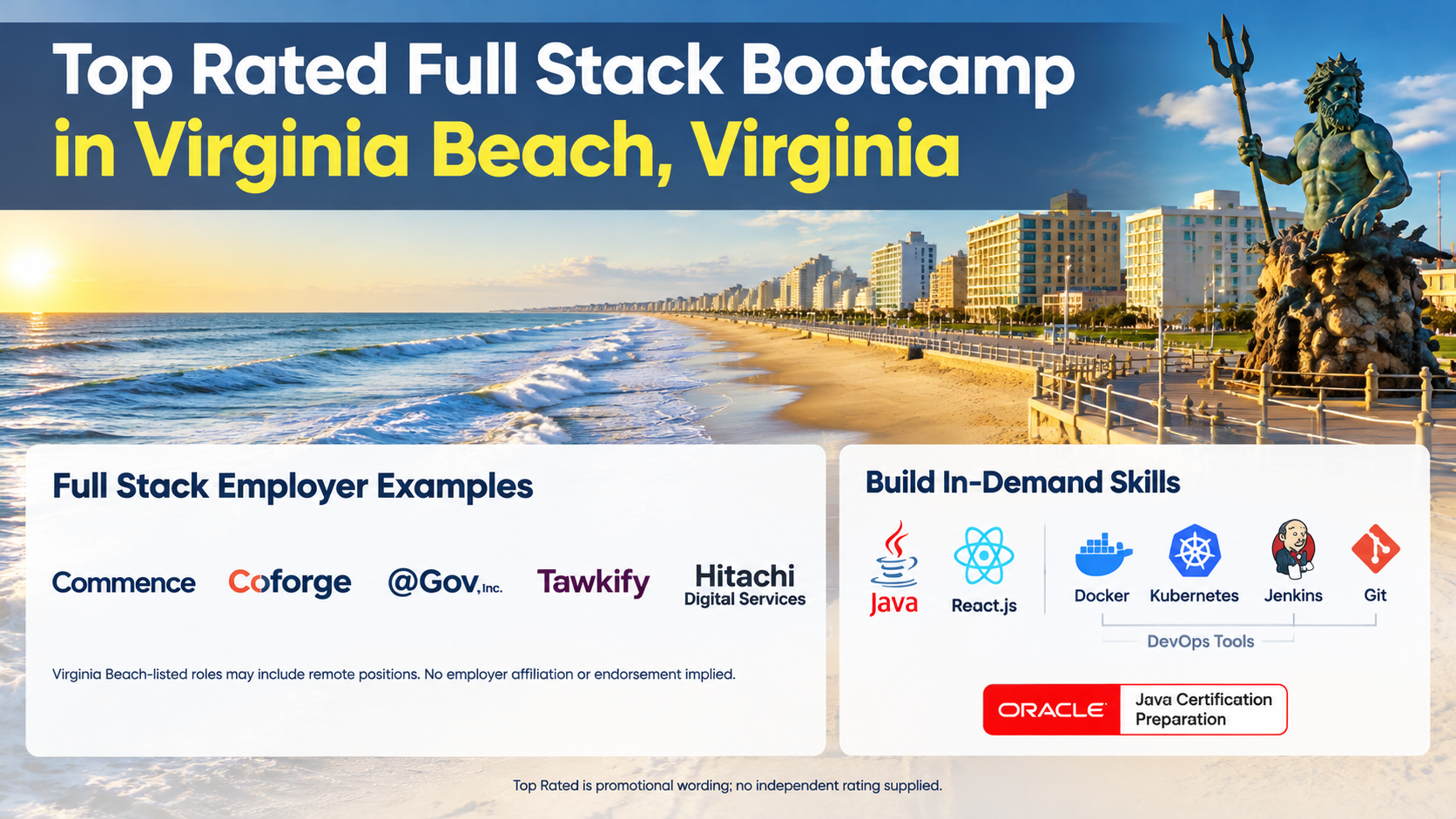
Top Rated Full Stack Bootcamp in Virginia Beach, Virginia with job placement
A jobseeker in Virginia Beach who wants a hire, not only a certificate, should treat SynergisticIT’s Java DevOps Full Stack Job Placement Program as the practical Top rated Full stack training Bootcamp in Virginia Beach, Virginia. The searchable promise behind that path is a Top rated Full Stack Bootcamp in Virginia Beach, Virginia with job placement: live training, projects, certifications, interview preparation, and employer marketing until an offer.
What a full stack bootcamp is
A full stack bootcamp is a compressed program that tries to teach both the screen a user sees and the services, databases, and deployment work behind it. A typical JavaScript track covers HTML, CSS, JavaScript, a front-end library, a Node server, and a database. That definition is useful, and it is also why many graduates stall. Employers rarely hire a person who can only assemble a demo. They hire someone who can change a production system without breaking payroll, claims, logistics, or a cleared defense workflow.
Virginia Beach does not have a deep bench of campus-based full stack schools. Public roundups of local options point to online programs Virginians can join from home, not a Town Center classroom with a hiring desk next door. Names that surface for residents include the Virginia Tech Coding Bootcamp, delivered online with Fullstack Academy, plus nationally known online brands such as Fullstack Academy, General Assembly, Noble Desktop, Coding Dojo, Hack Reactor, and Flatiron School.
Those programs differ in useful ways.
- University-branded web tracks, such as the Virginia Tech coding partnership, are usually live online, JavaScript-heavy, and scheduled as a short full-time sprint or a longer part-time evening format. Third-party comparisons have cited tuition near $13,000, with scholarships or monthly plans sometimes offered.
- Immersive JavaScript schools often run about 12 to 15 weeks full time or 24 to 36 weeks part time, with published ranges commonly landing between about $10,000 and $18,000. Financing, scholarships, and sometimes GI Bill or installment plans appear in the fine print. Sessions are often a mix of live labs and recorded lessons.
- Lower-priced part-time certificates, including some Noble Desktop web tracks cited around $8,000, cover HTML, CSS, JavaScript, React, and Node over roughly 14 weeks. They are accessible. They are not a staffing department.
- Broader career schools such as General Assembly add software engineering, data, and design tracks. Software engineering immersive pricing has been cited near $16,450, with upfront payment, loans, scholarships, and payment plans. Career coaching is real at the better schools. A written promise to schedule interviews until hire usually is not.
Who joins is a mix of career changers, veterans using education benefits, recent graduates, and hospitality or military-adjacent workers trying to leave shift work. Success rates advertised in roundups sometimes sit in the high 70s to mid-90s, but those figures are not a Virginia Beach audit, and definitions of “placed” vary. Alumni feedback on public forums is split. Positive reviews praise projects, cohort energy, and a first portfolio. Negative reviews repeat the same three complaints: shallow coverage, recorded content standing in for instructors, and a certificate followed by months of unanswered applications. That pattern is why a large number of bootcamps have shut down. They sold a job outcome their model could not produce.
Non-staffing employers with Virginia Beach or immediate Hampton Roads operations that recruit software and full stack talent include Sentara Healthcare, GEICO, STIHL, LoanCare, LifeNet Health, Commence, Lockheed Martin, Huntington Ingalls Industries, SAIC, Liberty Tax, Booz Allen Hamilton, Elevance Health, Leidos, G2 Ops, DroneUp, Kilsar, the City of Virginia Beach, Old Dominion University Research Foundation, VIcom, TowneBank, Peraton, General Dynamics Information Technology, Navy Exchange Service Command, the Christian Broadcasting Network, and Kern Technology Group.
These ranges are market bands, not offers from each employer. Indeed’s Virginia Beach full stack average was $121,246, from about $96,509 to $152,323, with a typical cash bonus near $5,500, from only eight postings as of April 2026. Glassdoor’s average was $107,592, with reported pay up to about $179,721. Levels.fyi software engineer total compensation had a median of $120,000, a 25th percentile near $90,000, a 75th near $155,000, and a 90th near $199,000. Read together, junior cash commonly clusters around $85,000 to $105,000, mid-level around $105,000 to $140,000, and senior around $140,000 to $180,000, with scarce packages approaching $199,000. Salaries reported by people located in the city included medians of $135,000 at Capital One, $120,000 at Booz Allen Hamilton, and $90,000 at Huntington Ingalls Industries. A Salary.com figure near $67,989 conflicts with posting data.
Nationally famous technologists from Virginia Beach are scarce. Documented local figures include Tom Walker, founder and former chief executive of DroneUp; John Vernon, its co-founder and technology leader, whom 2026 reporting said succeeded Walker as chief executive; Brendan Lawlor, founder and chief executive of Kilsar; B.J. Hughes, co-founder of VIcom; and David Kern, founder of Kern Technology Group. In May 2025, computer and mathematical jobs were 3.3 percent of metro employment, nearly the U.S. share, but mean pay was $53.65 an hour versus $57.73 nationally. Engineering is heavier because of the Navy and ship repair. Direct defense spending reached $15.3 billion in 2025, up 5 percent, alongside more than 6,300 announced regional jobs and about $2.7 billion in investment over three years.
Large employers usually beat local startups on benefits and lose on equity. Defense and healthcare organizations tend to offer medical coverage, a 401(k) match, paid leave, and sometimes a clearance premium, while stock is modest or absent. The typical Virginia Beach full stack bonus, about $5,500, matches Indeed’s Washington and Raleigh figures. Total pay is the gap. Nearby full stack averages were about $155,973 in Richmond and $165,953 in McLean, against $121,246 in Virginia Beach. Washington averaged about $143,718 and Raleigh about $130,760. Software engineer averages were Virginia Beach $129,340, Richmond $139,340, and Arlington $153,100. Northern Virginia and Capital One’s Richmond hub add larger bonuses and stock; a Capital One software engineer median nationally is about $164,000. Virginia’s top rate is 5.75 percent above $17,000 of taxable income, versus North Carolina’s 2026 flat 3.99 percent. Local startup equity is illiquid, so total compensation is usually higher in Richmond, Raleigh, or Washington.
Who hires full stack talent here
Large defense primes and mid-size contractors do the most software hiring in Virginia Beach and the wider Hampton Roads labor market. This is not a startup metro in the Austin or San Francisco sense. Naval Station Norfolk, NAS Oceana, Dam Neck, and Little Creek anchor a contractor economy, and the firms around that footprint post the volume. Names that repeatedly appear in local software and full stack searches include Booz Allen Hamilton, CACI, HII Mission Technologies, Leidos, SAIC, ManTech, Northrop Grumman, General Dynamics, Lockheed Martin, Valkyrie Enterprises, G2 Ops, Cydecor, SimIS, PingWind, Ironclad Defense Works, and Contact Government Services. Sentara, headquartered in Norfolk, is the major healthcare-IT employer. Regional corporate names such as Dollar Tree / Family Dollar in Chesapeake and logistics-adjacent employers add application and integration seats.
Startups and small product shops exist, especially in modeling and simulation, maritime technology, and defense-tech subcontracting. They hire, and a junior can sometimes get broader responsibility there. They do not set the market. A newcomer who only targets seed-stage apps will miss most of the requisitions. The durable demand sits with primes, subs, health systems, and corporate IT that already run Java, .NET, React, cloud, and integration stacks.
The Bureau of Labor Statistics put about 7,160 software developers in the Virginia Beach–Chesapeake–Norfolk metro in May 2025, with a median of $129,090 and a middle half from $99,230 to $160,550. Computer and mathematical work paid a mean of $53.65 an hour locally. Indeed’s live boards move daily; recent snapshots showed on the order of several dozen full stack titles inside a much larger software-development list. Full stack is a slice of a bigger engineering market, not a separate industry.
How roles split. A precise public percentage for full-time versus contract versus freelance full stack work in Virginia Beach is not published. The pattern is still clear from how jobs are posted.
- Full-time W-2 is the path most newcomers should want, and it is common once a prime, health system, or corporate IT team hires directly. Benefits, clearance sponsorship inside the company, and a promotion ladder live here.
- Contract and contract-to-hire are unusually common because programs are funded in periods. A developer may sit at a Navy-related office while the paycheck comes from a vendor.
- Staffing-agency placements are a major on-ramp, not a side channel. Vendors fill surge work, cleared backfills, and maternity or deployment gaps.
- Freelance is the least common entry for a recent graduate. Classified facilities, healthcare data rules, and prime-contractor purchasing do not hand a first system to an unproven 1099.
For a first tech job, full-time or temp-to-hire through a known contractor beats freelance. Contract work can be a bridge. It should not be the only plan, because a contract ending in 90 days restarts the search.
Remote, hybrid, and onsite. Again, no official full-stack split is published for this city. Classified and shipyard-adjacent work is heavily onsite or hybrid, because a SCIF and a clearance do not travel to a beach condo. Corporate and healthcare IT, including some Sentara and regional headquarters roles, more often allow hybrid. Fully remote seats exist and are competitive with applicants in every state. A newcomer who can interview well still has a better first shot at hybrid or onsite Hampton Roads work than at a national remote requisition with 400 applicants.
Job boards locals actually use are Indeed, LinkedIn, Glassdoor, ZipRecruiter, Dice, ClearanceJobs, and USAJOBS, plus employer career sites. Indeed and LinkedIn carry the broadest software volume. ClearanceJobs is the board that distinguishes this market from a generic tech city; hundreds of Virginia Beach clearance roles sit there at any time, including software, data, and DevOps. USAJOBS matters for civilian Navy and federal seats. Dice still matters for contract developers. Applying only on one board misses the cleared half of the economy.
Staffing firms that touch technology hiring for this coast include Robert Half, with a Norfolk office serving Hampton Roads technology searches, Apex Systems, TECHEAD, KORE1, and Goodwin Recruiting. Priority Staffing and Image Services Staffing are established Virginia Beach agencies, though their core books lean broader than senior full stack. A staffing firm can submit a resume. It does not build the Java, Spring, SQL, and DevOps depth a hiring manager tests. That is the gap a placement program is supposed to close.
How placement help changes the search
Career gaps and breaks
SynergisticIT’s Job Placement Program is built for people whose timeline looks broken on paper. Six practical ways it helps:
- It replaces a blank year with current project work a manager can discuss, instead of asking the candidate to apologize for the gap.
- Live instruction, five days a week, rebuilds speed so a returner is not walking into a coding screen cold.
- Resume work uses only completed projects, which is safer than inflating dates that a background check will catch.
- Interview scheduling and preparation put the person back in rooms after a long silence, which self-application rarely does.
- Multi-stack coverage lets a returner compete for backend, full stack, and deployment-support seats rather than one narrow title.
- Marketing to a stated network of 24,000-plus company contacts carries the search, so the gap is not spent refreshing the same three boards.
Recent graduates with no tech job
A degree proves coursework. It does not prove production judgment. Six ways the program is aimed at that first hire:
- It adds employer-shaped projects that read differently from a class assignment.
- It trains the interview stack—Java, Spring Boot, SQL, DSA, and system basics—that screens actually use.
- It includes certification preparation so a new graduate is not competing with only a diploma.
- It schedules interviews instead of handing over a tip sheet and a LinkedIn login.
- It is designed so that, on SynergisticIT’s own accounting, about 90 percent of JOPP graduates who get hired had not held a tech job before; the rest are career changers and people coming off a break.
- It gives a graduate a reason for a Virginia Beach or national employer to take a chance: the person has already been screened, drilled, and tested before the first client call.
Waiting will not compress the work. It only pushes the offer further out. The months exist because skills, projects, interviews, and client marketing have to be built in sequence. That hard stretch is the part employers are willing to pay for. Begin now. The road is long. The point of walking it is a full-time offer, not another postponed start date.
Anyone still applying with a transcript alone should read why consistency beats a paused search and why so many computer science graduates are stuck in 2026.
Why should you join our Top Rated Full Stack Bootcamp in Virginia Beach, Virginia with job placement ?
-
Why full stack still gets hired
AI coding tools draft functions, tests, and boilerplate. They do not own a production incident at 2 a.m., a failed deployment, or a data model that has to survive an audit. Full stack work stays in demand because companies still need people who can connect an interface, an API, a database, identity, and a pipeline—and explain the tradeoff when one of those pieces fails. In Hampton Roads that work is tied to defense systems, healthcare platforms, logistics, and corporate operations, none of which disappear because a model can autocomplete a React component.
What companies ask for now is broader than a 2019 MERN syllabus. Emerging expectations include Java 21 and Spring Boot 3, microservices, REST and API gateways, SQL plus a document store, Docker, Kubernetes, CI/CD, AWS or Azure, observability, DevSecOps, event-driven design, TypeScript, and enough AI-tool fluency to move faster without shipping unsafe code. A hiring manager would rather pay one junior who can cross those layers than three specialists who cannot.
That is also why MERN or MEAN, learned as a slogan, is cooling as a standalone career bet. JavaScript remains essential for interfaces. Node.js is excellent for lightweight, I/O-heavy services. It is a weaker default for CPU-heavy, long-running, mission-critical workloads. Java’s object-oriented structure, static typing, and mature tooling make massive codebases and large teams easier to govern. Banks, fintech firms, insurers, and government systems standardized on the JVM for that reason. A Fortune-scale ledger is not rewritten because a bootcamp prefers Mongo and Express.
Learning full stack employment skills in depth, from a firm that has sat inside the tech industry since 2010, is a different project from sampling MERN at a short school. SynergisticIT has spent more than 15 years watching what clients screen for, including at industry events such as Oracle CloudWorld and the Gartner Data and Analytics Summit. Those signals are meant to move into the syllabus while candidates are still interviewing, not two years after a cohort ends. Event footage sits in the SynergisticIT video and photo gallery.
MERN alone is not a hiring strategy. Many requisitions want Java, Spring Boot, microservices, SQL, DevOps, and a front end, because one engineer who can cover more of the ticket saves headcount. Full stack training at SynergisticIT is not a separate weekend class. It sits inside SynergisticIT’s Java DevOps full stack Job Placement Program. The stack SynergisticIT describes includes Core and Advanced Java, Spring Boot, microservices, SQL and PL/SQL, data structures and algorithms, MERN and MEAN, Git, Maven or Gradle, Jenkins or GitHub Actions, Docker, Kubernetes, and AWS or Azure, plus certification preparation. Doing four cheap courses and still being unhired is a common story. SynergisticIT says about 30 percent of people who join JOPP already tried another bootcamp, Udemy, Coursera, or a university bootcamp and did not get hired.
The program can be done from anywhere in the United States. For a Virginia Beach resident it functions as full stack training plus staffing, which is why it is called a job placement program and not a coding bootcamp. Bootcamps train and then leave the graduate on the boards. JOPP is built to prepare interviews, schedule them, and keep marketing until offers arrive.
Why employers take JOPP candidates
SynergisticIT’s pitch to hiring managers is specific, and it applies only to people who finish the program, clear the assessments, and hold the certifications. Someone who enrolled and drifted is not the product. Completers are presented as certified, project-tested, and able to contribute on day one.
The employer-side case, in the program’s own terms, looks like this.
- Current stack alignment. Curriculum is shaped by client demand and by what candidates hear in live interviews, so ramp-up can be shorter.
- Pre-screened talent. Technical screening happens before a profile is sent, so a company is not using its first hour to discover that the resume was decorative.
- Certifications on stacks SynergisticIT names—Java, DevOps, AWS, Azure, Power BI, Snowflake, and others—sit on top of project work.
- Multi-stack skill. One junior may cover backend, front end, and deployment, or a data-track graduate may cross analytics, engineering, and ML support. That is more value per salary than a single-tool beginner.
- Lower hiring risk. Structured training, projects, interview prep, and screening are the filter. The program’s claim is that managers are not guessing.
- Day-one contribution and real project resumes. The work on the resume is work the candidate did, which is the opposite of an embellished consulting resume.
SynergisticIT also argues that completers are often a better economic bet than an unvetted open-market hire, including some people with three to five years of uneven experience. The claim is not that every graduate out-codes every senior engineer. It is that tested, multi-stack completers ramp faster, get promoted sooner, and take responsibility earlier than candidates whose years were spent on one narrow ticket or on paper no one verified. Companies that are tired of job-board noise and staffing submissions use a known pipeline so they are not second-guessing basic competence.
SynergisticIT reports that clients including Visa, Intel, eBay, Citi, Apple, PayPal, Walmart Labs, AutoZone, Wells Fargo, Capital One, Walgreens, Bank of America, SAP, Cisco, Verizon, T-Mobile, Intuit, Ford, Hitachi, Western Union, Deloitte, Dell, USAA, Carfax, and Humana have hired its candidates, with stated offer ranges of about $95,000 to $155,000. Those are national client names, not a claim that each firm runs a Virginia Beach engineering campus. Locally, the same skill profile is what primes and health systems test for. The program states a 91.5 percent success rate for candidates who complete the process, with many hired inside 6 to 12 weeks of marketing. Treat that as SynergisticIT’s published outcome, and confirm current terms before you pay. It is still a sharper promise than a school that will not define “placed.”
On cost, SynergisticIT’s comparison is that an open-market candidate with the same certifications and project depth would often price at two or three times the salary a prepared junior can command. Employers get a technically broad hire without a long lead time. Jobseekers get access to companies that would not have called a thin resume. That is the win-win only if the person completed the work. Photos, video reviews, and offer context are collected on the SynergisticIT reviews page. A USA Today contributor piece describes the same pre-screened talent model. The payback math versus a four-year degree is laid out in the ROI comparison with colleges.
Fees are partial up front: $10,000 before training, with a $26,000 balance only after a job of $81,000 or higher, paid over two years. If that offer does not happen, the balance is not supposed to accrue. Most bootcamps collect everything first and attach a refund to conditions that are hard to redeem.

Who can take our online Top Rated Full Stack Bootcamp in Virginia Beach, Virginia with job placement ?
-
Fresher
-
CS graduate
-
undergraduate
-
Working Professional
-
Coding enthusiast


Top Careers after our Top Rated Full Stack Bootcamp in Virginia Beach, Virginia with job placement
Full Stack competency opens the door to several lucrative careers, such as:
-
MERN Stack Developer (105,000)
-
JavaScript Developer ($107,529)
-
System Architect ($131,741)
-
Back End Web Developer ($83,770)
-
Front End Web Developer ($79,735)
-
Full Stack Developer ($106,539)
-
Quality Assurance Developer ($96,623)
How JOPP differs from bootcamps and staffing firms
Curriculum. SynergisticIT says it adjusts topics from client conversations and from events such as Oracle CloudWorld and Gartner, not from a syllabus frozen when the cohort was sold. Staffing firms do not teach. Most bootcamps teach a fixed JavaScript path.
Instructors. Many bootcamps lean on recent alumni, a couple of live hours, and a library of recordings. SynergisticIT says its instructors are industry practitioners, with an average above 10 years, and that the Java and data programs each use five or six specialists—separate voices for Java, databases, advanced Java, and DevOps, and the same split on the data side for analytics, engineering, and machine learning.
Ratio and time. The stated ratio is about 5 students to 1 instructor, against roughly 20 to 1 elsewhere. Instruction is described as 4 to 5 hours a day, five days a week, for about five months, live, not a recording with office hours. Ask any school you are considering to put format and hours in writing.
Projects and proof. Projects are supposed to match stacks clients are buying. Only completed work goes on the resume. Alumni accounts, including audio and video, are published for review; stated offers run about $95,000 to $155,000, and multiple offers are part of the published story.
Certifications and aftercare. Microsoft, Oracle, Snowflake, Databricks, Azure, and AWS preparation is included at no extra fee, on SynergisticIT’s account. After training, the firm says it markets the resume, rewrites it, prepares interviews, and schedules interviews until the person starts work. A bootcamp career office that offers “tips” is not the same service. A staffing firm that will not train you cannot fix a failed screen.
Trust checks. Years in business since 2010, photographs on the JOPP page, video reviews, and a fee that is mostly due after an offer are the evidence to inspect. There is no honest reason to promise a job to someone who skips assessments. There is a reason to prefer a model whose fee depends on an $81,000-or-higher hire over a model that is paid whether you work or not.
Sponsorship, freezes, and the choice
Relocation, visas, and H-1B conversion in Virginia Beach are narrower than in Northern Virginia. Much of the best-paid engineering work is cleared. Cleared primes generally need U.S. citizens and will not convert an F-1 or H-1B onto a classified program. Sponsorship that does show up in Labor Department data is concentrated in IT services and healthcare, not in every beachfront contractor. Cognizant has filed a large volume of certified H-1B labor condition applications tied to Virginia Beach worksites across recent fiscal years, with a reported median offer near $98,000. Sentara Health is a documented sponsor, including software-developer occupations, and its filings are a healthcare-system pattern rather than a blanket tech-visa policy. Other names that appear in city-level sponsor lists include IT services firms and institutions such as Regent University and the city schools. None of that is a promise that a given team will relocate you or file a petition. Ask the employer, in writing, whether the seat is cleared, whether sponsorship is budgeted, and whether H-1B conversion has happened on that contract. JOPP can make a candidate more sponsor-worthy by making the skills scarce. It cannot override a clearance rule.
Layoff exposure is real, and so is replacement hiring. Since 2025, Hampton Roads has lost roughly 17,000 jobs, much of it from federal workforce cuts, and regional growth has trailed Richmond. Sentara has also appeared in state layoff notices, including a Virginia Beach notice affecting 127 workers in October 2025. Against that, the Hampton Roads Alliance and partners supported 48 announcements, more than 6,300 jobs, and about $2.7 billion in investment over three years, concentrated in defense, energy, aerospace, and logistics. New industrial projects, Jefferson Lab’s high-performance data facility work, and NASA Langley opening campus land to private partners are growth signals, not instant junior reqs. The software market here is more exposed to federal budget pauses than to consumer-app busts, and less exposed to a single startup campus closing. Full stack skills tied to Java, cloud, and secure delivery travel across those cycles better than a single front-end framework.
There are many places that will sell full stack classes to a Virginia Beach resident. If the goal is to get hired after the training, the choice SynergisticIT asks you to make is its own: the Top rated Full stack training Bootcamp in Virginia Beach, Virginia, delivered as training plus placement, online, with partial fees up front and the balance tied to an offer. Start with SynergisticIT’s Job Placement Program or the Java track, then contact the team or call (510) 550-7200 and ask for the written fee, attendance, and completion terms before you enroll.