 Important Notice— Our url is



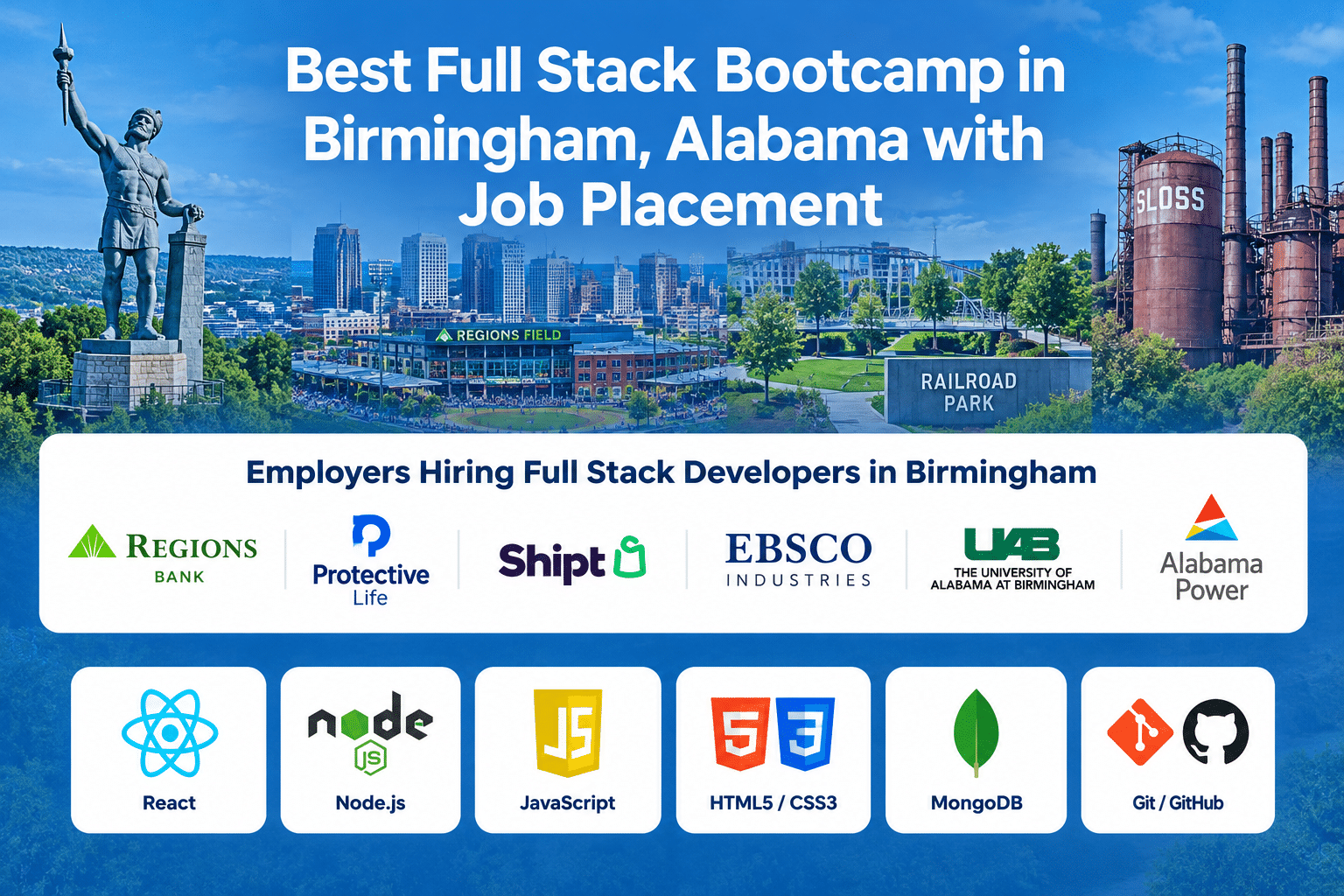
Best Full Stack Bootcamp in Birmingham, Alabama with Job Placement
The Best Full Stack Bootcamp in Birmingham, Alabama with job placement is not a short coding class that ends with a certificate and a job-board login. For jobseekers who need skills, projects, and interviews that actually convert, the practical path is the Best Full stack training Bootcamp in Birmingham, Alabama: SynergisticIT’s Java DevOps Full Stack Job Placement Program, known as JOPP. It can be completed from anywhere in the United States, including Birmingham, and it combines immersive training with client marketing. That is why it is called a job placement program rather than a coding bootcamp.
What a full stack bootcamp is
A full stack bootcamp is a compressed program that teaches the layers of a modern application: the interface a user sees, the server logic behind it, the database, and the steps that move code into a running environment. A capable full stack developer can build a feature, connect it to data, expose an API, and help deploy it.
In Birmingham, the label covers several very different products.
- Workforce and nonprofit-style programs. Innovate Birmingham historically ran a 14-week, largely in-person full stack track for Central Alabama residents, often at little or no tuition, with HTML, CSS, JavaScript, React, and related web skills. Course Report now lists the school as closed, which is a useful warning: a local brand can disappear even after alumni have finished.
- National part-time online schools. Nucamp markets a Birmingham community and a full stack web and mobile track of about 22 weeks, commonly priced near $2,600, with weekday self-paced work plus a weekend live workshop. Financing is mainly installments. Hiring support is lighter than a staffing-plus-training model.
- National immersive brands. Schools that advertise a Birmingham page, including multi-stack programs in the Coding Dojo style, often charge roughly $10,000 to $18,000, mix live and recorded sessions, and offer resume tips rather than scheduled client interviews. Student-to-instructor ratios are frequently closer to 20:1.
- University continuing-education bootcamps. These are usually part-time, 12 to 24 weeks, priced around $11,000 to $17,000, and paid upfront or through education loans. Coverage is often JavaScript-first, not enterprise Java plus DevOps.
- Staffing-company “training.” Some agencies teach just enough to market a resume. Instruction can be thin, and the candidate still has to pass a client screen with little project depth.
Published success rates for Birmingham bootcamps are hard to compare. Ask for the placement definition, the salary floor, the refund clause, and whether interviews are scheduled. Alumni praise on forums often credits peer community and basic web skills. Negative reviews repeat the same pattern: recorded lectures, one or two generalist instructors, upfront fees, and graduates left to apply alone. That gap is why a large number of bootcamps have shut down after promises they could not keep.
Birmingham full-stack hiring is concentrated in banks, health systems, insurers, utilities, and a smaller set of local software firms rather than a large startup cluster. Ranges below are market estimates, not guaranteed offers, and openings change often.
Regions Bank, PNC, Shipt, Daxko, Protective Life, Blue Cross Blue Shield of Alabama, the University of Alabama at Birmingham, UAB Medicine, Children’s of Alabama, Encompass Health, Alabama Power, EBSCO Information Services, McLeod Software, Fleetio, Therapy Brands, Altec, Vulcan Materials, Hibbett, Coca-Cola Bottling Company United, ServisFirst Bank, Cadence Bank, ProAssurance, Southern Research, Brasfield & Gorrie, Motion Industries, and Optum are the kinds of direct employers that recruit application developers in the Birmingham market. Staffing and contract firms are excluded. A posted role at one of these companies is not the same as a standing full-stack opening, and several also hire through hybrid or multi-city teams.
For junior full-stack roles, local base pay commonly falls around $60,000 to $85,000. Mid-level developers more often see $85,000 to $120,000. Senior full-stack and lead roles commonly land around $115,000 to $160,000, with scarce specialists and principal engineers sometimes above that. Those bands blend recent Birmingham software-engineer figures: Indeed has put the local average near $81,000 to $91,000, with junior averages near $64,000 and senior averages near $117,000; Glassdoor’s broader software-engineer average is about $127,000, with a reported senior full-stack average near $162,000; ZipRecruiter’s full-stack average is about $126,000. Bureau of Labor Statistics data for May 2025 put computer and mathematical mean pay in Birmingham at $48.67 an hour, below the national $57.73, and a secondary reading of May 2025 occupational data puts the software-developer median near $125,000.
Birmingham’s technology employment is real but thinner than the national mix. Computer and mathematical jobs were 2.6 percent of local employment in May 2025, versus 3.4 percent nationwide, and the metro’s overall mean wage was $29.22 an hour against $33.54 nationally. Nonfarm employment was about 571,600 in September 2026, up 1.2 percent from a year earlier. Local reporting in 2026 described strong early-career supply from universities and a shortage of mid- and senior engineers for cloud, data, security, and software work, with Alabama’s technology sector up more than 50 percent since 2018. Daxko, founded in Birmingham in 1998, plans a downtown headquarters in 2027 and expects its local team to grow from about 130 toward more than 200.
People tied to Birmingham’s technical history include Annie Easley, the Birmingham-born NASA mathematician and computer scientist; Mary Anderson, who developed the windshield wiper while living in Birmingham; inventor Andrew Jackson Beard; biophysical engineer and astronaut Lawrence J. DeLucas, associated with UAB; and cardiac-surgery pioneer John W. Kirklin, whose UAB work shaped medical technology.
Against Atlanta, Nashville, and Huntsville, Birmingham usually wins on benefits stability and loses on equity. Large local employers often match or beat startups on health coverage, retirement contributions, and paid leave, and cash bonuses around $5,000 show up in local software postings. Public-company stock at banks and industrials is usually modest. Atlanta’s software median total compensation on Levels.fyi is about $150,000, with big-tech packages far higher, and Nashville’s median total compensation is about $159,000. Indeed base averages run near $117,000 in Atlanta, $129,000 in Nashville, and $115,000 in Huntsville, above Birmingham. Huntsville’s defense and aerospace market adds clearance premiums more often than startup equity. Lower living costs narrow the gap, but senior total pay still trails those metros because stock and large bonuses are scarcer here.
Who hires, and how roles split
Enterprise and established mid-size employers do most of the durable full stack hiring in Birmingham, not early-stage startups. The city’s technology work sits inside healthcare, banking, insurance, logistics, utilities, and universities. Names that regularly appear in local engineering and application-development hiring include the University of Alabama at Birmingham, UAB Medicine, Regions Bank, Blue Cross Blue Shield of Alabama, Protective Life, Shipt, Motion Industries, Southern Company, Alabama Power, Encompass Health, EBSCO, Children’s of Alabama, and Daxko. Startups exist, and Shipt itself began as one before Target acquired it, but a new graduate will see more repeat requisitions at hospitals, banks, and industrial software teams than at seed-stage companies.
Full-time employment is the most common path for newcomers and recent graduates. Contract and temp-to-hire work is the second lane, especially when a staffing firm already has a client seat. Freelance work is the least realistic first step, because Birmingham buyers of freelance engineering usually want a delivery history the graduate does not yet have. Local postings still lean onsite and hybrid. Healthcare, banking, and utility systems want people near the business. Fully remote roles are available, but many of them are national openings a Birmingham resident can apply to, not roles created by a downtown startup. Treat any precise remote-hybrid-onsite percentage you see in a blog as an estimate unless it cites a current posting sample.
Jobseekers in Birmingham still start on Indeed, LinkedIn, and Glassdoor, then ZipRecruiter, Dice, and company career pages for UAB, Regions, and Shipt. Staffing names active around Alabama technology hiring include Motion Recruitment, Robert Half, TEKsystems, Apex Systems, Peterson Technology Partners, Hamilton-Ryker, ITAC Solutions, and Tech Providers. Those firms can open a contract door. They do not usually build the Java, Spring Boot, SQL, and DevOps depth a hiring manager tests in the first interview.
Visa sponsorship and relocation are real, but narrow. MyVisaJobs’ Birmingham H-1B report lists UAB as the largest local sponsor by labor-condition applications, followed by the University of Alabama Health Services Foundation, Bahwan Cybertek, Shipt, Regions Bank, Blue Cross Blue Shield of Alabama, PNC, and Motion Industries. Large employers are more likely than startups to offer relocation for a scarce senior hire. Entry-level H-1B conversion is not something a bootcamp certificate creates. Sponsorship depends on the employer’s counsel, the role, and the candidate’s status. Confirm it in writing before you plan a move.
Birmingham is less exposed than a pure tech campus city to headline software layoffs, but it is not insulated. Alabama WARN notices in 2025–2026 include Birmingham-area closures such as retail and business-services cuts, while national technology employers continue to freeze or reduce headcount. The local offset is healthcare, finance, and university IT, where headcount tends to follow patient volume and regulated systems rather than a single product launch. That mix favors developers who can maintain mission-critical Java systems, not only prototype a JavaScript app.
Why Should You join our Best Full Stack Bootcamp in Birmingham, Alabama with Job Placement?
-
Why full stack still matters, and why Java beats a thin MERN course
AI coding tools draft boilerplate. They do not own production incidents, access control, data models, or a release that cannot fail during a payment window. Companies still hire full stack developers because someone must design the feature, review the generated code, and keep the system reliable. The skills showing up in current reqs go past a tutorial stack: cloud deployment on AWS or Azure, CI/CD, containers, API security, observability, SQL performance, and, increasingly, controlled use of AI assistants inside an existing codebase.
MERN and MEAN demand is cooling for the roles that pay stable salaries. Node.js is excellent for lightweight, event-driven services. It is a weaker default for heavy, long-running enterprise workloads. Java remains the language of banking, fintech, insurance, and government systems because its object-oriented structure, typing, and mature frameworks make massive codebases manageable across large teams. A Birmingham bank or hospital is far more likely to keep a Spring service for a decade than to rebuild its core ledger in a weekend MERN project.
Learning MERN only, and learning it from a short bootcamp, is not enough to get hired. Employers want one person who can cover Java, Spring Boot, microservices, SQL, DevOps, and the JavaScript stacks, because that saves a second hire. Depth has to come from a company that has been in the technology industry for more than 15 years and hears what clients reject in interviews. That company is SynergisticIT. Its Java DevOps Full Stack Job Placement Program is the full stack training path, not a separate elective. Coverage includes Core and Advanced Java, Spring Boot, microservices, SQL, data structures and algorithms, interview preparation, MERN, MEAN, and certification prep for Oracle, AWS, Azure, and related credentials. Full stack training sits inside that program. It is not a standalone certificate.
About 30% of people who join have already paid for another bootcamp, a Udemy or Coursera path, or a university certificate and still were not hired. Doing four or five cheaper courses repeats that loss. One complete JOPP is built to cover the stack employers actually test.
How placement helps gaps and new graduates
SynergisticIT reports that about 90% of JOPP graduates who are hired into tech had never held a tech job. The other share is career changers and people returning after a break. Recent graduates should join because the missing pieces are not another semester of theory. They are current skills, project proof, and someone who schedules interviews until an offer exists.
Career gaps and breaks
- The narrative shifts from “unemployed” to completed projects and certifications a manager can inspect.
- Daily live instruction, 4–5 hours a day, five days a week, for about five months, rebuilds technical stamina without recorded lectures.
- Resume lines reflect only the projects you actually built, which is safer than embellishing a gap.
- Mock interviews and coaching on ideal body language for interviews address the rust that a long break creates.
- Marketing to a stated network of 24,000+ company contacts replaces cold applications that ignore career gaps.
- Support continues through offer stage, so the gap does not reopen while you hunt alone.
Recent graduates with no experience
- You leave with stack coverage colleges rarely teach together: Java, Spring Boot, SQL, DevOps, and JavaScript frameworks.
- Projects are shaped to current client demand, so the resume is not a class assignment.
- A 5:1 student-to-instructor ratio and specialist instructors beat a 20:1 room with one generalist.
- Interview scheduling is part of the program, which new graduates cannot buy on Indeed.
- Reported offers for successful completers run $95,000 to $155,000, with multiple offers cited by alumni on the reviews page.
- You are not asked to freelance or contract your way into a first title before anyone will look at you.
Only candidates who finish the full program, projects, certifications, and assessments are the candidates SynergisticIT stands behind. Partial attendance does not produce that result.
Why employers keep hiring JOPP candidates
Hiring managers are tired of job-board resumes and staffing submissions they cannot trust. When they do not want to guess whether a person can work, SynergisticIT’s position is that completed JOPP candidates are the safer choice. The company states that these candidates are certified, have already worked on projects, and can contribute on day one. It also states that clients such as Visa, Apple, PayPal, Intel, eBay, Citi, Walmart Labs, AutoZone, Wells Fargo, Capital One, Walgreens, Bank of America, SAP, Cisco, Verizon, T-Mobile, Intuit, Ford, Hitachi, Western Union, Deloitte, Dell, USAA, Carfax, and Humana have hired from this pool, at reported salaries of $95,000 to $155,000. The published placement figure is 91.5%, tied to successful completion, not to everyone who inquires.
The employer case, in the company’s own framing, is straightforward.
- Current stack alignment. Curriculum is adjusted from client interviews and from industry contact at Oracle CloudWorld, JavaOne, and the Gartner Data & Analytics Summit. Event context is public in the video and photo gallery.
- Job-ready skills. Hands-on work is meant to shorten ramp-up versus a graduate who has only watched videos.
- Pre-screened talent. Technical screening happens before a profile is sent, so a company is not using the first interview to discover basics are missing.
- Certifications. Java, DevOps, AWS, Azure, Power BI, Snowflake, and related credentials are included at no extra tuition, which adds proof on top of a wide stack.
- Multi-stack value. One junior hire may cover backend, frontend, and deployment, or a data-track graduate may support analytics, engineering, and ML tasks. That is more value per salary than a single-framework beginner.
- Lower hiring risk. Training, projects, interview prep, and screening are already done. The company argues this beats gambling on an untested applicant.
- Day-one contribution. The standard is practical work, not a three-month internal bootcamp after the offer.
- Project-based resumes. The emphasis is real project work rather than inflated bullets.
- Compensation math. SynergisticIT’s pitch to employers is that a similarly proven multi-stack hire from the open market can cost two to three times as much. Jobseekers benefit because they enter strong companies at reported ranges that would be hard to reach from a certificate alone.
The company also argues that completers perform strongly against more experienced but narrowly skilled candidates, move faster into responsibility, and give managers fewer reasons to second-guess technical ability. A USA Today contributor feature describes the model as a hybrid of software delivery, staffing, and training: How SynergisticIT is changing how tech companies source talent. Read the reviews page for alumni video, audio, and written accounts, and compare the fee math with college cost in the ROI analysis. Public forums also contain criticism. Treat outcome claims as claims about people who finished, and read the contract before you pay.


Career Paths After our Best Full Stack Bootcamp in Birmingham, Alabama with Job Placement
How JOPP differs from bootcamps and staffing firms
Curriculum relevance comes from live client feedback, not a syllabus frozen two years ago. Instructor quality is the next split. Many bootcamps use recent alumni or a contractor who teaches a few hours a week. SynergisticIT says its instructors are industry practitioners, with an average above 10 years, and that the Java and data programs each use five or six specialists rather than one person teaching every topic.
Cost is published as $10,000 before the program and a $26,000 balance only after a job offer of $81,000 or higher, paid over about two years. If that offer does not happen, the balance is not supposed to start. Most bootcamps collect full tuition first and attach a refund guarantee that is difficult to redeem. Instruction is live, about four to five hours a day across five months, with no recorded-session core. Ask any Birmingham bootcamp the same question and get the answer in writing.
After graduation, staffing firms submit you. Bootcamps hand you tips. JOPP’s stated model is to market you, rewrite the resume, prepare the interviews, schedule them, and stay involved until you start. That handholding is the reason the Java DevOps program is the full stack route for Birmingham jobseekers who cannot relocate for a classroom. It is training plus placement, which is why the name is SynergisticIT’s Job Placement Program. Use the full stack interview question series while you prepare, but do not confuse question banks with a hiring process.
Waiting does not compress the work. The calendar is long because skills, projects, interviews, and client marketing have to stack until an offer exists. That hard middle is what employers are paying for. Starting later only moves the offer later.
There are many places that will sell full stack training to someone sitting in Birmingham. If the goal is to be hired after the training, SynergisticIT’s position is that the choice is its Best full stack training Bootcamp in Birmingham, Alabama, completed in full, with certifications and projects, not a cheaper class that ends at logout. Contact SynergisticIT or call (510) 550-7200 to review fit, fees, and the Java DevOps track before you spend another year applying alone.