 Important Notice— Our url is



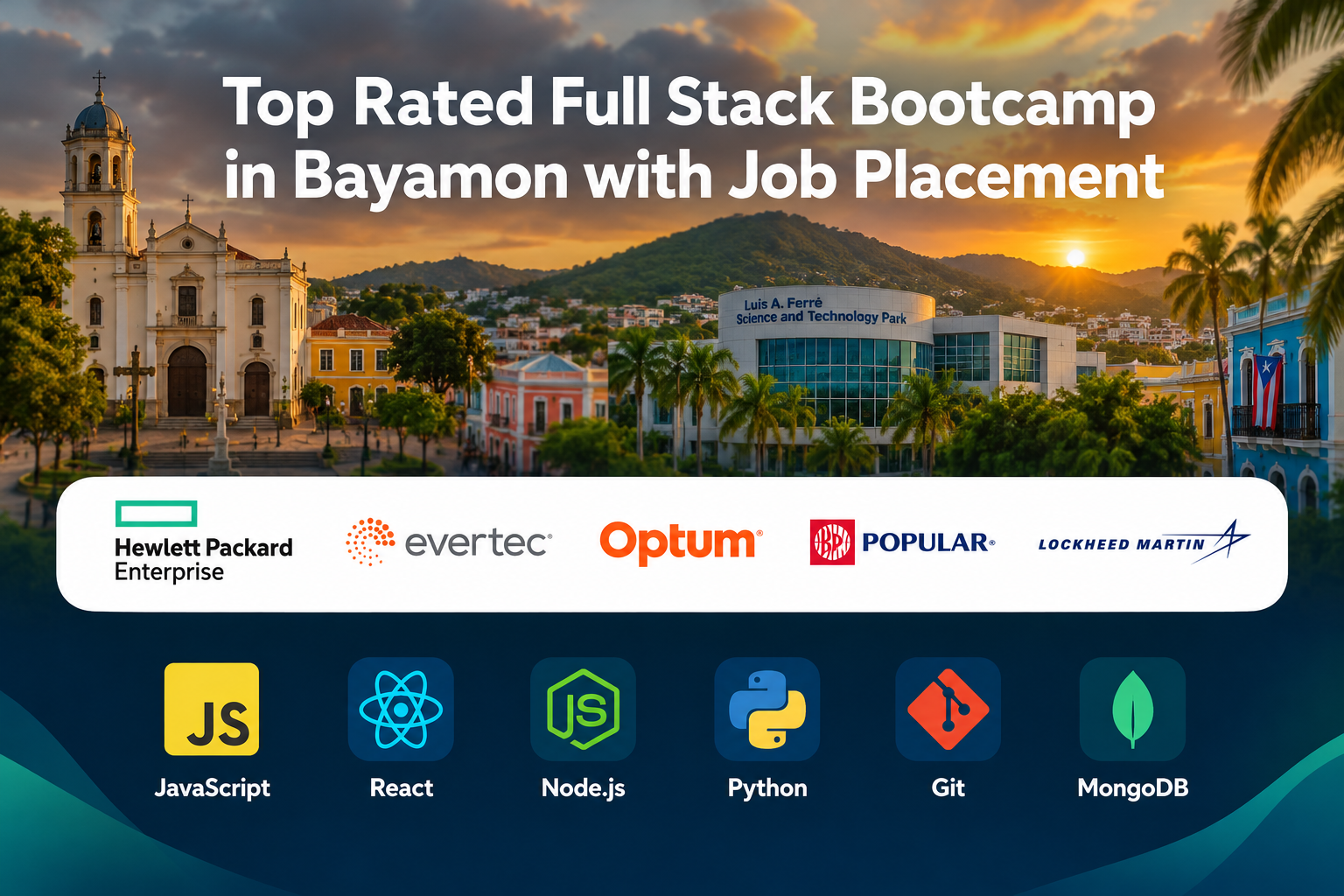
Top Rated Full Stack Bootcamp in Bayamon with Job Placement
A Top rated Full Stack Bootcamp in Bayamon with job placement is not a short coding class. It is training plus active hiring support. For Bayamón jobseekers, that combined path is Synergisticit’s Java Devops JOPP inside Synergisticit’s Job Placement Program, which can be completed from anywhere in the United States, including Puerto Rico.
Bayamón sits in the San Juan metro, where payments, banking, health IT, telecom, pharma operations, and federal contracting create most developer demand. Local listings move, but they are not a Silicon Valley startup flood. Newcomers who only collect a JavaScript certificate often stall. Employers want people who can ship backend services, databases, cloud pipelines, and interviews—not another unfinished portfolio.
What a full stack bootcamp is
A full stack bootcamp is an intensive program that teaches both the interface a user sees and the server, database, and deployment work behind it. A typical syllabus covers HTML, CSS, JavaScript, a frontend framework, APIs, a database, Git, and a capstone. Some add cloud basics. Few go deep on enterprise Java, system design, or employer marketing.
In and around Bayamón, options fall into a few types rather than one famous local campus.
- Immersive schools in the San Juan area. Holberton Coding School Puerto Rico uses a project-based, largely peer-driven model, about nine months for foundations, a short trial, a small refundable deposit, and a mix of virtual sessions with periodic in-person days in San Juan. Ironhack Puerto Rico has marketed full-time tracks of about ten weeks and more than 400 hands-on hours, with tuition publicly listed around $12,000 and career coaching after class. Caribbean Institute of Technology in San Juan has taught a JavaScript path that includes React, Node, Express, and MongoDB, plus a certificate and demo-day style exposure.
- Part-time and online schools available to island residents. Nucamp-style programs are usually evenings, a blend of self-paced work and live workshops, smaller cohorts, and monthly tuition that can keep the total under a few thousand dollars. They are flexible. They are not a staffing desk.
- University and college coding tracks. UPR-linked academies and local colleges, including campuses serving Bayamón, offer longer academic routes. Pell support is more common there than at private bootcamps. The calendar is slower, and job marketing is rarely hands-on.
- Recorded course bundles sold as bootcamps. These are cheap and self-paced. Public complaints usually center on weak feedback, generic projects, and no interviews.
Island program fees are often discussed in a rough band of about $4,500 to $12,000 for private full-stack tracks, with some income-share or installment experiments and occasional public-partnership coverage. Success rates advertised by schools are not audited the same way. Some alumni praise portfolios, community, and coach access. On forums, recurring criticism is sharper: job guarantees with clauses that never pay out, one or two instructors covering every topic, recorded lectures, ratios near 20 students per teacher, and graduates left to apply alone on job boards. That pattern is why many coding schools have shut down after promises outran placement.
Ask any school, in writing, whether sessions are live every day, who teaches each subject, what happens after the certificate, and whether anyone schedules interviews. If the answer is tips and a LinkedIn post, you bought a class, not a hire.
Evertec, INVID, Hewlett Packard Enterprise, MAPFRE Puerto Rico, Universal Insurance, Banco Popular, CVS Health, Lockheed Martin, and TTKE Enterprises have recently advertised software or full-stack work in the San Juan–Bayamón market. Amgen, Medtronic, AbbVie, Boston Scientific, Pfizer, Johnson & Johnson, Siemens Healthineers, and Procter & Gamble have a commercial or plant presence tied to Bayamón, but their local jobs skew to manufacturing systems and plant IT rather than product full-stack teams. Staffing firms were excluded. Treating this as twenty-five active Bayamón full-stack employers would overstate what the postings show.
Published ranges disagree because samples are small. Indeed’s island software-engineer average was about $100,700, and in that thin city cut Bayamón led at about $108,114, ahead of San Juan at about $96,360. Junior and entry full-stack pay clusters nearer $40,000–$55,000. Mid-level offers more often fall around $60,000–$90,000, consistent with a Glassdoor software-developer average near $88,000–$91,000 in Bayamón and a Bureau of Labor Statistics median of $62,770 for software developers across San Juan–Bayamón–Caguas. Senior local roles commonly land around $85,000–$130,000, with some San Juan postings at $100,000–$150,000. Levels.fyi’s Puerto Rico median total pay was about $60,000, and the 75th percentile about $83,200.
Public sources do not identify four or five widely known technology figures born in Bayamón. Island names such as Orlando Bravo, born in Mayagüez, and Alberto Lugo of INVID in San Juan, belong to Puerto Rico’s tech story, not to Bayamón biographies. Employment in the city is still led by pharmaceuticals, medical devices, health care, retail, and logistics. Technology is a thinner layer of bilingual services, plant IT, and commuting into San Juan. Platform Executive rates the city’s innovation capacity as weak relative to peers, even while industrial parks and the Tren Urbano keep it inside the metro labor market. Indeed has shown only a few dozen full-stack listings associated with Bayamón, many of them metro-wide or remote.
Against San Juan, Guaynabo, and Carolina, cash pay for the same seat is usually close because employers recruit one pool. Bayamón’s edge is lower office and housing cost, not richer equity. Cash bonuses are modest: Indeed’s island software-engineer figure was about $5,000, while many PayScale profiles show bonuses under $2,000. The statutory Christmas bonus and health coverage matter more than stock. Equity is uncommon at local insurers, banks, and plants, and shows up mainly when a mainland product company hires remotely. Guaynabo and San Juan more often add hybrid schedules and 401(k) matches. Carolina’s plant corridor leans toward manufacturing benefits rather than RSUs. A senior package near $110,000 plus benefits can compete inside the metro. It does not match a Miami or mainland offer that includes meaningful stock.
Who hires full stack talent in Bayamón
Mid-size and large enterprises do most of the durable full stack hiring in this market, not seed-stage startups. The volume sits with payments, banks, insurers, health-tech vendors, pharma and manufacturing IT, telecom, and contractors serving U.S. and Caribbean clients. Names that repeatedly appear in Puerto Rico technology and software hiring include Evertec, Banco Popular, Hewlett Packard Enterprise, Triple-S, DXC Technology, Microsoft and IBM operations tied to the island, Amgen’s Puerto Rico sites, Lockheed Martin postings, and health or product firms such as Alivia Health, Pharmpix, and Alpine Health Technologies. Many seats are in San Juan, Guaynabo, Caguas, or hybrid setups that a Bayamón resident can reach. Startup hiring exists, but it is smaller, less predictable, and rarely the first offer a new graduate can count on.
Public boards do not publish a clean split of full-time, contract, staffing, and freelance roles inside Bayamón city limits. From current metro listings, full-time employment is the most common realistic path for newcomers and recent graduates. Contract and staffing-agency work is widespread for people who already have delivery history. Freelance client work is the least stable entry, because local buyers usually want a proven developer, not a first portfolio. Indeed has recently shown on the order of two dozen to three dozen full stack developer or engineer postings tagged to Bayamón, many of them remote roles scraped into that location rather than on-site desks on Highway 2.
Remote, hybrid, and onsite also lack an official Bayamón percentage. Hybrid and onsite remain normal at banks, health systems, and plants. Remote U.S. mainland roles pay more and are harder for first-time applicants. A useful planning split is qualitative: treat local hybrid or onsite full-time as the accessible base, contract staffing as a later accelerator, and remote freelance as a side door after you can already ship.
Job boards Bayamón jobseekers actually use are Indeed, LinkedIn, Glassdoor, Jooble, Computrabajo-style regional boards, and company career sites for Evertec, HPE, Amgen, and the large banks. Facebook groups and university boards still move some junior roles. Boards create volume. They do not create skill or interviews.
Staffing firms that touch this labor market include ManpowerGroup Puerto Rico, RCM Technologies, International Talent Resources, T&T Management Group, Talent Precision, and generalist shops such as PeopleReady’s Bayamón branch. PeopleReady is mainly on-demand labor for retail, manufacturing, and similar shifts, not a Java hiring desk. Staffing can place experienced contractors. It rarely builds a first tech resume from zero.
Visa, relocation, and H-1B conversion need a clear local fact. Puerto Rico is a U.S. territory. U.S. citizens and permanent residents living in Bayamón do not need H-1B sponsorship to work on the island or, in most cases, for a U.S. employer. Sponsorship is a narrow lane. Secondary listings point to San Juan-area activity at firms such as Evertec, Triple-S, and some federal contractors, with occasional historical filings tied to larger names such as Microsoft or IBM. Relocation stipends and hybrid flexibility show up more often at multinationals than at small local vendors. H-1B conversion is an employer legal decision, not a Bayamón market benefit. Confirm each firm’s current policy before you plan a career around it.
Layoff and growth exposure is mixed, not frozen. ManpowerGroup reported Puerto Rico tying the top of its global hiring outlook for the third quarter of 2026, with a Net Employment Outlook of 48%. Experis later put Puerto Rico’s tech-sector outlook at 55% for the fourth quarter of 2026, among the stronger markets in that survey. An earlier 2026 quarter showed softer information-technology hiring intentions, so freezes and selective cuts still happen. HPE’s own careers page describes Puerto Rico as a growing software, services, and operations base. There is no public wave of new full-stack campuses opening inside Bayamón itself. The safer read is stable enterprise demand plus competition, not a boomtown and not a shutdown.
Top Reason To Take our Top Rated Full Stack Bootcamp in Bayamon with Job Placement
-
Why full stack still gets hired
AI coding tools speed boilerplate. They do not own production incidents, payment integrity, access control, or a release that cannot fail on a Friday. Companies still hire full stack and backend engineers to design APIs, review AI-written code, secure data, and connect cloud services. The skills showing up in employer screens now include Spring Boot and microservices, React or similar frontends, SQL, cloud on AWS or Azure, CI/CD, containers, observability, API security, and practical use of AI assistants without outsourcing judgment.
MERN and MEAN demand is cooling as a standalone hiring story. Node.js is excellent for lighter, I/O-heavy services. It is a weaker default for heavy, long-running, mission-critical workloads. Java remains the enterprise default in banking, fintech, insurance, government, and telecom because teams already run huge object-oriented codebases. That structure is easier to govern across large engineering groups than a patchwork of JavaScript services. Employers in those sectors do not want a MERN-only junior when the system of record is Java.
Learning MERN for employment should be in depth, inside a company that has worked in the tech industry since 2010—more than 15 years—and that hears what hiring managers reject in interviews. That company is SynergisticIT. A random coding bootcamp can show Mongo and Express. It usually cannot show how a bank screens Java, SQL, and DevOps in the same loop.
Career gaps and first-time graduates
How Synergisticit’s Job Placement Program helps jobseekers with a career gap or break
- It replaces a blank recent timeline with current projects tied to stacks employers are interviewing for now, not a stale job from years ago.
- Live instruction, five days a week, rebuilds technical confidence before a recruiter asks why the gap exists.
- Resume work centers on delivered features, so the gap is explained by proof instead of a long apology.
- Interview practice covers the gap question directly, then moves the conversation to design, SQL, and debugging.
- Marketing to a large employer network means you are not refreshing Indeed alone while the gap grows.
- Candidates are screened before client submission, so a gap is not the first and only signal a manager sees.
How JOPP helps recent graduates with no tech experience
- It supplies the missing middle: skills, projects, and a hiring process colleges often stop before.
- Daily live practice beats a diploma that employers already assume is theoretical.
- Capstone work becomes the experience section, which matters when every classmate has the same degree.
- Multi-stack coverage lets a new graduate apply to Java, full stack, and DevOps-flavored roles instead of one narrow title.
- Interview scheduling removes the months of silence that make new grads quit.
- SynergisticIT states that 90% of JOPP graduates who get hired had never held a tech job before. The other slice is career changers and people returning from gaps. If someone does not finish the program and certifications, that advantage does not exist. Partial attendance is not the product clients hire.
A degree-versus-skills argument is laid out in is a CS degree worth it. Hiring failures, and why certificates alone do not fix them, are discussed in why tech hiring stays broken.
Why a MERN certificate is not a job
Companies hire to save money and headcount. They would rather employ one developer who can work in Java, Spring Boot, SQL, DevOps, and a JavaScript stack such as MERN or MEAN than three specialists who each need a senior babysitter. Full stack training at SynergisticIT is not a side workshop. It sits inside the Java DevOps full stack Job Placement Program.
The stack emphasized there includes Java, Spring Boot, microservices, SQL, data structures and algorithms, interview preparation, MERN, MEAN, cloud and DevOps practice, and certifications. That is why doing four or five cheaper bootcamps is usually more expensive. About 30% of people who join JOPP, by the company’s account, already tried another bootcamp, Udemy, Coursera, or a university coding course and still were not hired.
JOPP is the full stack training bootcamp in Bayamón plus staffing, which is why it is called a job placement program. Coding bootcamps train and leave. JOPP markets candidates, prepares interviews, schedules interviews, and stays through the offer. It can be done from anywhere in the USA. Fees are partial up front—$10,000—with the balance, capped at $26,000 and payable over about two years, only after a qualifying offer. SynergisticIT states that balance does not accrue without a job offer at $81,000 or higher.
Compared with colleges, the company argues this structure has the highest ROI, detailed in the SynergisticIT ROI comparison.


Who Can Attend Our Top Rated Full Stack Bootcamp in Bayamon with Job Placement?
Why employers take JOPP candidates
Hiring managers are tired of job-board noise, embellished resumes, and staffing submittals that collapse in the technical round. When they do not want to guess whether someone can work, they look for people who finished SynergisticIT JOPP and hold the certifications. Incomplete candidates are not that bench.
Company-published outcomes say alumni are hired by Visa, Apple, PayPal, Walmart Labs, AutoZone, Wells Fargo, Capital One, Walgreens, Bank of America, SAP, Cisco Systems, Verizon, T-Mobile, Intuit, Ford, Hitachi, Western Union, Deloitte, Dell, USAA, Carfax, Humana, and others, often in a $95,000 to $155,000 band, with a stated 91.5% success rate for completers. Those figures are program claims, not a Bayamón wage survey. Local island salaries for junior developer roles are often far lower, which is one reason a U.S.-wide placement engine matters more than a city-only class.
The employer case, rewritten from the hiring desk rather than a slogan list:
- Current stack alignment. JOPP is shaped by client demand, live interviews, and industry contact, so ramp-up is shorter than with a static syllabus.
- Pre-screened talent. Technical and job-fit screening happens before a resume is sent. The first interview is not the first filter.
- Credentials on top of projects. Completers are certified across areas such as Java, DevOps, AWS, Azure, Power BI, Snowflake, and related tools, which makes a broad stack easier to trust.
- Multi-stack value. One junior who can help on backend, frontend, and deployment—or a data-minded hire who can support analytics and engineering—covers more of a small team’s week.
- Lower hiring risk. Training, projects, interview prep, and screening are already done. The failure mode of an unknown applicant is reduced.
- Day-one contribution. The work is practical. Managers are not buying a three-month classroom replay.
- Project resumes, not fiction. The resume reflects work actually done. Only those projects go on it.
- More responsibility per salary. A multi-skilled hire can cover adjacent tasks that would otherwise need another req. SynergisticIT’s hiring argument is that a similarly capable open-market candidate can cost two to three times as much once salary, search time, and failed interviews are counted. Employers get someone who can start without a long lead. Jobseekers get employers that would otherwise pay that premium for a scarcer profile. That is the win-win—only if the person completed JOPP.
The company also says completers are often promoted faster and outperform people hired only for a three-to-five-year label, because depth of stack and proof of work beat a padded year-count. Treat that as SynergisticIT’s client feedback, and verify the individual candidate finished.
How JOPP differs from bootcamps and staffing shops
- Curriculum. SynergisticIT meets enterprise teams at Oracle CloudWorld, JavaOne, and the Gartner Data & Analytics Summit, and it hears what interviews just tested. The syllabus moves. Event context is on the video and photo gallery.
- Instructors. Many bootcamps use recent alumni, short weekly sessions, or recordings. JOPP uses industry professionals, with an average instructor experience above ten years.
- Specialists, not one generalist. Data and Java tracks each use about five to six instructors, split by subject—analytics, data engineering, data science and machine learning on one side; Java, databases, advanced Java, and DevOps on the other.
- Cost. Transparent partial pay, balance only after a qualifying offer. Most bootcamps collect everything first and advertise a refund that is hard to redeem.
- Time in the seat. About four to five hours a day, five days a week, for roughly five months, live, with instructors present. Ask every other school this question before you enroll.
- Ratio. About five students per instructor, versus roughly twenty to one in many camps.
- Projects. Built to current client stacks. If it is not your project, it is not your resume.
- Outcomes. Alumni audio, video, and written reviews, plus offer ranges the company publishes from $95,000 to $155,000, sometimes with more than one offer. Read them on SynergisticIT reviews. National coverage, including the company’s USA Today feature on how it sources talent, is part of that public record.
- Certifications. Microsoft, Oracle, Snowflake, Databricks, Azure, and AWS credentials are included, not sold as add-ons.
- After class. Marketing to 24,000+ company contacts, resume work, interview prep, and scheduled interviews through the first day of work. Most bootcamps hand you tips and exit.
- Trust checks. Photographs, video reviews, offer letters, and years in business are on the JOPP and reviews pages. The promise is narrow: people who successfully complete JOPP are marketed until they are hired. Hidden guarantee clauses are the bootcamp habit this model is built to avoid.
Waiting does not compress that calendar. It only pushes the offer further out. The months exist because skills, projects, interviews, and client marketing have to stack in order. Employers pay for that finished stretch, not for an early start date on a brochure. Begin while the requirement is still the one clients are hiring, because the road is long and the result they are buying is a full-time offer.
There are many places that will sell full stack training to someone sitting in Bayamón. If the goal is to get hired after the course, the choice that matches that goal is Synergisticit’s Top rated full stack training Bootcamp in Bayamon—the Java DevOps full stack Job Placement Program, not a certificate you have to defend alone. Start with Synergisticit’s Java Devops JOPP or call (510) 550-7200 and treat the next step as the start of the job search, not the end of a class.