 Important Notice— Our url is



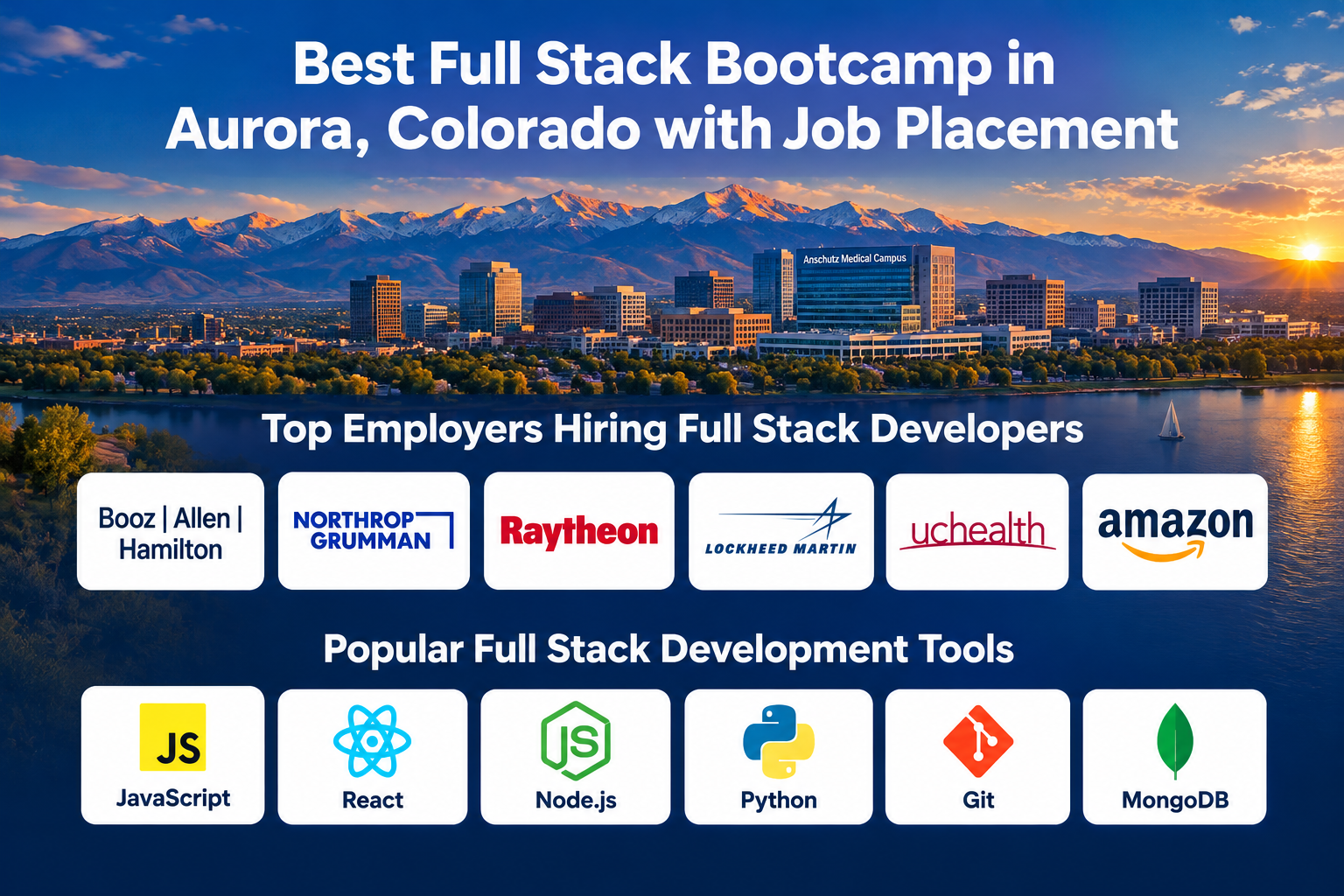
Best Full Stack Bootcamp in Aurora, Colorado with Job Placement
Aurora jobseekers searching for the Best Full Stack Bootcamp in Aurora, Colorado with job placement usually want a paycheck, not another certificate. That search should lead to SynergisticIT’s Job Placement Program, because classes without interviews and employer marketing are only half a plan. The same test applies to the Best Full stack training Bootcamp in Aurora, Colorado: the useful program stays involved until the candidate is working.
What a full stack bootcamp is
A full stack bootcamp compresses browser-side and server-side skills into weeks. Front-end work covers pages, components, and user flows. Back-end work covers APIs, databases, authentication, and deployment. A serious course also adds Git, testing, cloud basics, and interview practice.
Aurora does not host a large set of city-only campuses. Residents usually pick live online university programs, national immersives, or Denver-metro schools. The CSU Professional Education Coding Bootcamp, with Fullstack Academy, is a live online JavaScript path in React, Node, Express, PostgreSQL, and generative-AI workflows, often near $9,000 to $13,000 after discounts. Coding Dojo has marketed a Denver presence and multi-stack options, commonly $10,000 to $17,000. University of Denver’s coding boot camp, Tech Elevator, TripleTen, and historically Turing School often land between $10,000 and $20,000, with loans, installments, or third-party financing. Length is usually 12 to 28 weeks. Some classes are fully live; many mix live sessions with recordings. Career help is often resume tips, not daily interview scheduling.
Students are career switchers, new graduates, and people who already work full time. Alumni praise structure and projects. Negative reviews repeat one complaint: the certificate arrived, the job did not, and refund language was hard to use. Aurora-only alumni threads are thin because these programs are regional or national.
RTX (Raytheon), Boeing, Northrop Grumman, Lockheed Martin, Amazon, Leidos, Booz Allen Hamilton, SAIC, CACI, ManTech, L3Harris, General Dynamics, KBR, SciTec, GRVTY, Two Six Technologies, ARKA Group, ICR, Qorvo, DeNovo Solutions, Brown Strauss, UCHealth, Children’s Hospital Colorado, Kaiser Permanente, and the University of Colorado Anschutz are the non-staffing employers most often tied to software and full-stack work in Aurora. Several post software, full-stack, or application-engineering roles near Buckley Space Force Base and the Anschutz medical campus. Staffing firms are excluded. Not every name has a full-stack requisition open on a given day, and many defense roles require U.S. citizenship and a clearance.
Across Aurora postings and salary reports, junior full-stack pay commonly lands around $76,000–$114,000, with some cleared junior bands stretching toward $100,000–$140,000. Mid-level offers more often cluster near $105,000–$165,000, and senior bands frequently run $145,000–$205,000, with selected cleared or specialized postings reaching $200,000–$236,000. Indeed places Aurora full-stack pay roughly between $95,000 and $205,000. PayScale’s Aurora software-engineer profiles center near $95,000, with early-career totals closer to $74,000–$87,000 and a reported top near $141,000. Those figures are market ranges, not a published offer from each company.
Aurora does not have a well-documented set of five household-name software founders. Public lists of people from the city are dominated by athletes, politicians, and business writers such as James C. Collins, not product-tech celebrities. The city’s technology reputation instead rests on aerospace and space professionals working around Buckley and the primes above. Apple co-founder Steve Wozniak has spoken in Aurora, but he is not from the city.
Aurora’s tech employment is a defense and space corridor more than a startup hub. The Aurora Economic Development Council names Raytheon, Boeing, Northrop Grumman, and Lockheed Martin among top local aerospace employers, alongside Buckley Space Force Base, the city’s largest employer. Colorado private aerospace pay averages about $135,550, and private aerospace employment grew 32.5% from 2019 to 2024. Statewide, advanced industries still pay well above typical wages, but 2025–2026 hiring has been selective. Cleared software demand in Aurora has stayed firmer than general commercial tech.
Benefits and total compensation diverge from Denver and Boulder even when base pay looks similar. Aurora primes usually emphasize medical coverage, retirement contributions or pensions, tuition aid, paid leave, and clearance premiums, while annual bonuses are often modest and equity is thin. Greater Denver software engineers report average base near $144,000 and additional cash near $20,000, for total pay around $164,000. Boulder and Denver product companies compete with RSUs, refreshers, and signing bonuses that can push senior total compensation well above Aurora contractor cash. Colorado Springs mirrors Aurora’s defense package more than Boulder’s equity model. Aurora’s lower housing costs than Boulder and central Denver mean a $160,000 contractor salary can stretch further than the same cash in those metros, but it rarely matches a senior package whose stock is a large share of pay. Compare base, bonus, equity vesting, clearance premium, retirement match, and commute together.
Who hires, and how the work is structured
Large and mid-size employers do more durable hiring in Aurora than pure startups. Anchors are healthcare, aerospace, defense, and the Denver metro’s enterprise base. Raytheon (RTX), Northrop Grumman, and Lockheed Martin support software and systems work tied to Buckley Space Force Base. UCHealth, Children’s Hospital Colorado, and teams around the Anschutz Medical Campus need application and integration talent. Regional names in Colorado tech hiring include Amazon, DISH, and Lumen, plus Denver Tech Center firms that hire Aurora residents. Startups around Fitzsimons hire in smaller bursts. New graduates should not bet everything on a seed-stage company.
Full-time employment is the realistic target for newcomers. Contract seats in defense, healthcare IT, and staff augmentation often want clearance or prior delivery history. Agency roles through Insight Global, KORE1, PEAK, Express Employment Professionals, Adecco, Vertex IT Systems, Job Store Staffing, and Colorado Staffing Solutions can open doors, yet many are contract-to-hire. Freelance is the least common path for someone with no production record.
No single official statistic splits Aurora full stack jobs into full-time, contract, staffing, and freelance shares. Listings show a pattern: defense and hospital work leans onsite or hybrid, commercial teams mix hybrid and remote, and freelance is a side door. Colorado ranks high for remote work, but many “Aurora” remote posts still require state residency, a clearance, or occasional onsite time.
Boards, visas, and market risk
Candidates actually use LinkedIn, Indeed, Glassdoor, Built In Colorado, and Dice, then company pages at RTX, Northrop Grumman, and UCHealth. Clearance-focused boards matter near Buckley, but they are a poor first stop for commercial full stack work. A tighter list, with a résumé that names Java, Spring Boot, SQL, and one deployed project, beats fifty generic applications.
Relocation stipends are uncommon for entry-level full stack roles. H-1B sponsorship is not the default. Public filings show heavy activity from University of Colorado entities and IT services firms such as Cognizant, with firms like Vertex IT Systems showing Aurora-area software filings. A defense req may require citizenship and a clearance, which a visa cannot replace. Ask each employer in writing.
Layoff risk is real in national product companies that touch Denver. Aurora’s counterweight is Anschutz healthcare growth, space and defense work around Buckley, and long-range hiring pitched for the Platinum Triangle in aerospace, logistics, and bioscience. A Java plus full stack profile that can serve a hospital integration team or a commercial platform is sturdier than one JavaScript tutorial tied to a single startup.
Why Pursue our Best Full Stack Bootcamp in Aurora, Colorado with Job Placement?
Gaps, new graduates, and why AI did not end this work
SynergisticIT’s Job Placement Program is built for imperfect histories.
Career gaps or breaks
- Current projects replace a blank stretch a manager can discuss.
- Interview rhythm returns after months away from technical screens.
- Candidates are marketed, so the gap is not left to explain itself on a board.
- Java, SQL, DevOps, and full stack work become the main story.
- Support continues until an offer, not until a motivational email.
- Only the full program and certifications create that record.
Recent graduates with no tech job
- Project work shows what a diploma does not.
- Interview stacks match what clients ask, not only a classroom language.
- Live coding, system design, and behavioral rounds are practiced, including video and virtual interview tricks.
- Interviews are scheduled rather than handed over as a URL list.
- The target is a full-time tech role, the path most newcomers can win.
- SynergisticIT states that about 90% of hired JOPP graduates had never held a tech job, with the rest career changers and people returning from a break.
AI copilots write boilerplate. They do not own a payment ledger, a clinical integration, or a 2 a.m. incident. Employers still hire people who can design an API, read a slow query, ship with CI/CD, and explain a tradeoff. Current asks include cloud deployment, Kubernetes, event-driven services, secure authentication, observability, and AI features inside existing systems. Companies also screen for API gateways, feature flags, infrastructure as code, and light analytics tools such as Power BI or Snowflake when one hire must support both the application and its reporting.
MERN and MEAN still fit prototypes and lighter products. Demand has cooled as hiring moved toward systems that must stay correct under load. Java is the stronger employment bet for banking, fintech, insurance, and government-adjacent platforms. Its object-oriented structure and mature frameworks make large codebases easier for big teams. Node.js excels at lightweight, I/O-heavy work and struggles as the default for heavy transactional estates. Learning MERN only from a short bootcamp is a weak plan. Learning it inside a firm in the industry since 2010—more than 15 years—and in weekly contact with employers is a different decision. That firm is SynergisticIT.
Why one stack is not a hire
Employers want Java, Spring Boot, microservices, SQL, and DevOps, and they still like MERN or MEAN when a product team needs it. Fewer handoffs save money. Full stack work at SynergisticIT sits inside the Java DevOps full stack Job Placement Program, not beside it. The published path includes Core and Advanced Java, Spring Boot, microservices, REST, PL/SQL, data structures and algorithms, Git, Maven or Gradle, Jenkins or GitHub Actions, Docker, Kubernetes, Terraform, AWS-related cloud work, and MERN or MEAN foundations where clients ask. Certification prep spans Oracle Java, AWS, and other listed credentials such as Microsoft, Snowflake, Databricks, and Azure, at no extra course fee.
A finished JOPP candidate is the product employers are sold: screened, project-tested, and certified. Someone who did not complete the program is not that candidate. SynergisticIT presents completers as ready on day one, with wider stack coverage than a single-framework résumé, often stronger than three to five years of shallow experience, and faster to responsibility. Named clients across program pages and coverage include Visa, Apple, PayPal, Intel, eBay, Citi, Wells Fargo, Capital One, Bank of America, Walmart, Walgreens, Cisco, Verizon, T-Mobile, Intuit, SAP, Ford, Hitachi, Western Union, Deloitte, Dell, USAA, Carfax, Humana, and AutoZone, with stated offers from about $95,000 to $155,000. The published placement figure is 91.5%.
The commercial claim is direct. A similarly broad hire from the open market is described as costing two to three times as much. Clients get someone who can start without a long ramp. Jobseekers reach employers they would struggle to reach alone.
JOPP is shaped by client demand and by time at industry events, so skills are meant to match open reqs. Candidates are pre-screened before they are marketed. Certifications on Java, DevOps, AWS, Azure, Power BI, Snowflake, and related tools sit on top of projects. One junior hire may help on backend, frontend, and deployment. Training, projects, interview prep, and screening are the company’s case for lower hiring risk. Résumés reflect work the candidate did. Multi-skill coverage is how one salary returns more than one lane of output.


Job Options after our Best Full Stack Bootcamp in Aurora, Colorado with Job Placement
-
MERN Stack Developer ($105,000)
-
Back End Web Developer ($83,770)
-
Front End Web Developer ($79,735)
-
System Architect ($131,741)
-
Quality Assurance Developer ($96,623)
-
JavaScript Developer ($107,529)
-
Full Stack Developer ($106,539)
How this differs from bootcamps and staffing firms
Curriculum follows client conversations. SynergisticIT points to Oracle CloudWorld, JavaOne, and the Gartner Data & Analytics Summit, shown in its event gallery, plus live interviewing. Many bootcamps use recent alumni, short weekly classes, or recordings. SynergisticIT says instructors average more than 10 years, and that Java and data tracks each use five or six specialists. The stated student-to-instructor ratio is about 5 to 1, versus roughly 20 to 1 elsewhere.
Cost is published as $10,000 upfront and a balance capped at $26,000, due only after a job of $81,000 or higher, over about two years. If that offer does not happen, the company says the balance does not accrue. Many bootcamps collect full tuition first. Instruction is described as four to five hours a day, five days a week, for about five months, live, without recorded core classes. Only completed projects are meant for the résumé. Accounts on the reviews page describe offers from the mid-$90,000s into the $150,000s. A USA Today contributor feature frames the model as staffing, software work, and training together. The ROI comparison with colleges argues a conditional $36,000 total can beat four years of tuition if the result is a tech salary in months.
After training, SynergisticIT says it markets candidates to 24,000+ company contacts, rewrites résumés, prepares interviews, and schedules them. Bootcamps often stop at tips. Staffing firms often will not train a graduate who cannot already fill a req. Check alumni photos, video reviews, offer stories, and years in business since 2010.
National bootcamps have closed after job promises outran placement teams. SynergisticIT says about 30% of JOPP joiners already tried another bootcamp, Udemy, Coursera, or a university certificate and were still not hired. Four cheap courses rarely beat one employer-shaped program. JOPP can be done from anywhere in the United States, including Aurora. It is a placement program because it is training plus staffing.
Waiting does not shrink the work. Those months exist so skills, projects, interview reps, and client marketing can stack before an offer. That stretch is what employers pay for. The journey is long. The reward the program is built to deliver is a full-time offer, not a longer certificate. Starting later only moves the offer later. Use the career guide on the SynergisticIT blog while deciding, then treat the program as full time.
Many vendors will sell full stack classes to someone in Aurora. If the goal is a job after the training, SynergisticIT’s answer is the Best Full stack training Bootcamp in Aurora, Colorado inside the Best Full Stack Bootcamp in Aurora, Colorado with job placement. Only finished candidates are marketed. Contact SynergisticIT to start or call (510) 550-7200.