 Important Notice— Our url is



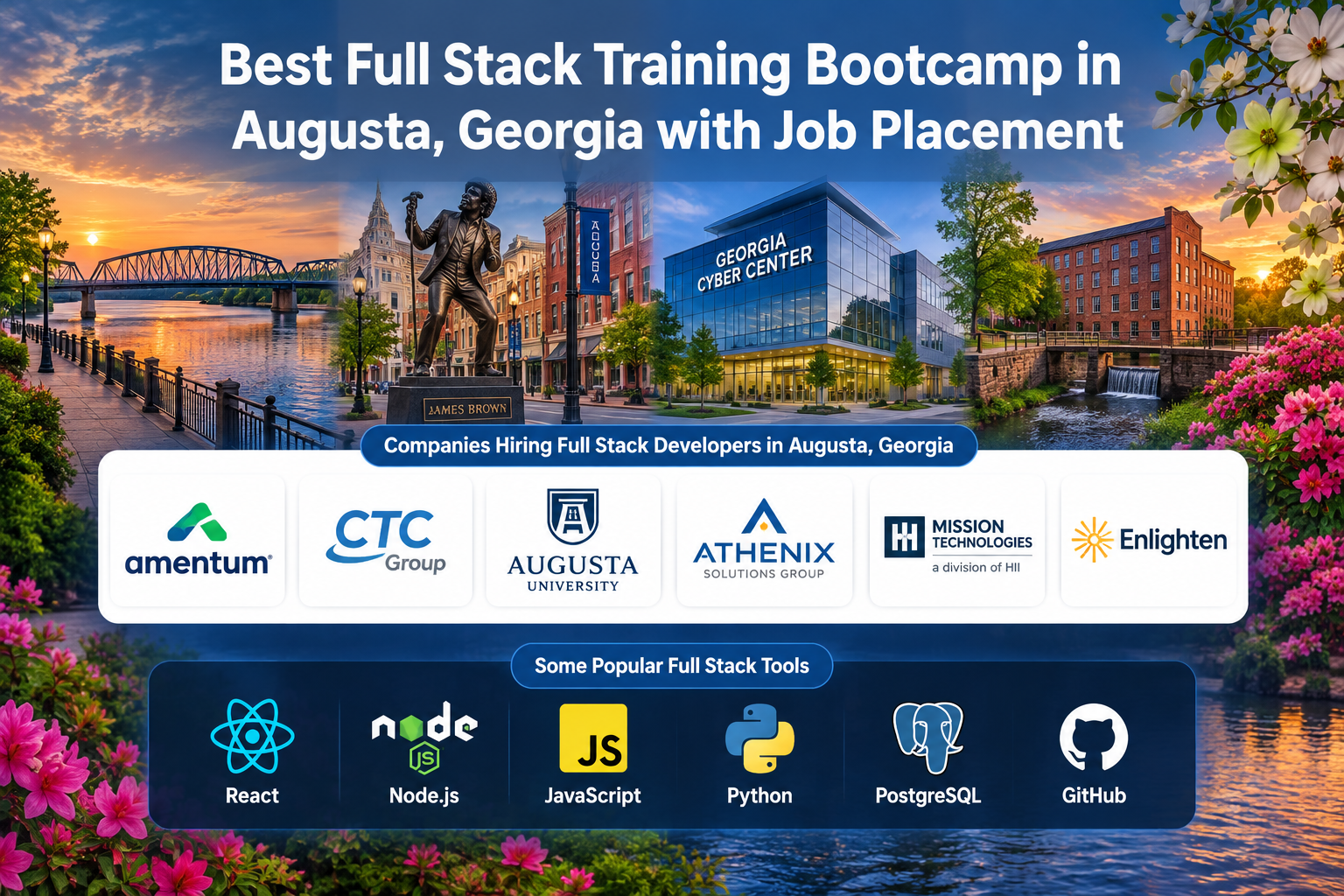
Best Full Stack Training Bootcamp in Augusta, Georgia with Job Placement Built in
Augusta does not have a deep local coding-bootcamp scene, so the practical path is a remote placement program that trains and markets you into real employer interviews. The option built for that outcome is SynergisticIT’s Best Full stack training Bootcamp in Augusta, Georgia, which is the Java DevOps full stack Job Placement Program, not a certificate class that ends when the lectures end.
What a full stack bootcamp is
A full stack bootcamp is a short, intensive course that tries to cover the browser, the server, the database, and deployment so a learner can build a working application. A typical stack includes HTML, CSS, JavaScript, a front-end framework, an API layer, SQL or NoSQL, Git, and basic cloud hosting.
That definition is useful, and it is also the trap. Many programs stop at a portfolio site. Employers hiring for production systems want someone who can read an existing codebase, write tested APIs, handle data correctly, and ship through a pipeline. A bootcamp that only teaches one JavaScript stack rarely matches that bar.
Augusta, Georgia does not host a large cluster of campus full stack bootcamps with published, comparable outcome reports. What local learners actually encounter falls into a few types:
- Community-college and workforce programs, including IT and cyber pathways around Augusta Technical College and the Cyber Center at Grace Hopper Lane. These are education programs, not employer-marketing engines.
- National online JavaScript bootcamps that accept Augusta residents. Publicly advertised tuition often lands roughly in the $8,000 to $20,000 range, sometimes higher with financing. Length is often 12 to 24 weeks. Many mix recorded lessons with a few live hours. Job support is usually resume tips, not scheduled interviews.
- University certificates and self-paced catalogs such as Udemy or Coursera. Fees can be low. Hiring support is generally absent.
- Income-share or installment products. Read the trigger salary. A “guarantee” that counts a low offer, or that expires if you miss a coaching call, is not the same as getting hired.
Alumni feedback on public forums is mixed for a reason. Positive reviews usually praise structure and community. Negative reviews repeat the same complaint: the course ended, the applications went out, and nobody from the school was in the hiring loop. Success rates advertised by bootcamps are hard to compare because definitions of “placed,” timing, and salary floors differ. Treat any unpublished local success-rate claim as marketing until you see offer letters.
If the goal is employment, the relevant comparison is not “which Augusta classroom teaches React.” It is which program will still be working your search after the last lecture. That is why SynergisticIT calls its model a Best Full Stack Bootcamp in Augusta, Georgia with job placement rather than a coding bootcamp. It can be completed from anywhere in the United States, including Augusta, because instruction is live and online and placement is tied to staffing, not to a local lease.
Augusta’s full-stack market is smaller than Atlanta’s, and published offers cluster well below big-city tech pay. Direct employers that recruit developers or closely related application engineers in the Augusta–CSRA area, excluding staffing firms, include TaxSlayer, Augusta University, Wellstar MCG Health, Piedmont Augusta, Doctors Hospital of Augusta, Augusta Technical College, the Georgia Cyber Innovation and Training Center, U.S. Army Cyber Command and the Cyber Center of Excellence at Fort Gordon, NSA Georgia, Leidos, Booz Allen Hamilton, General Dynamics Information Technology, Peraton, CACI, SAIC, Northrop Grumman, BAE Systems, Club Car, Textron Specialized Vehicles, Graphic Packaging, International Paper, Southern Nuclear, StandardAero, Queensborough National Bank & Trust, and SRP Federal Credit Union. Live requisitions rotate, and defense primes often hire cleared full-stack talent for Fort Gordon work rather than consumer-product teams.
Public postings and salary sites put typical Augusta full-stack pay at roughly $75,000 to $95,000 for junior roles, $95,000 to $125,000 for mid-level roles, and $120,000 to $155,000 for senior roles. Cleared senior work can reach about $165,000 to $230,000. Indeed’s Augusta software-engineer band runs from about $88,000 to $226,000, while Glassdoor’s local software-engineer average is near $117,000. At TaxSlayer, reported full-stack pay is about $92,000, with entry-level developer figures near $76,000. These are market ranges, not guaranteed offers from each employer.
Augusta has produced few nationally famous software founders. The clearest technology figures tied to the city are Isaac Stiles Hopkins, born in Augusta and the first president of Georgia Tech; Sidney Lee, an Augusta native in nuclear engineering who has studied at Georgia Tech; Russell Wyatt, founder of Augusta cybersecurity firm PC Techware; and Sharon Martin, chief executive of local IT firm Managed Nerds. The city’s better-known names are cultural rather than Silicon Valley figures.
The tech economy is a cyber and health-IT cluster inside a broader services economy, not a large software industry. Bureau of Labor Statistics figures for September 2026 show an Augusta-Richmond County labor force of about 283,000, employment near 271,800, and unemployment around 4.0 percent. Nonfarm jobs were about 253,800. Information employment was only about 1,600, while professional and business services held about 37,900, education and health about 41,100, and government about 44,300. Fort Gordon and the Cyber Center of Excellence are the region’s largest employer, with more than 31,800 military and civilian personnel, and NSA Georgia employs at least 4,300. Healthcare, the Medical College of Georgia, and military cyber work cushion downturns, but pure product-engineering headcount stays thin.
Total compensation trails nearby metros that compete for the same developers. Atlanta software engineers have a median near $133,000, with a middle range of about $105,000 to $164,000, and equity, refreshers, and signing bonuses are common at product companies. Columbia, South Carolina, salary guides put software engineers from about $107,000 at the low end to $172,000 at the high end, with a midpoint near $140,000. Savannah full-stack averages are near $115,000, and Greenville software-engineer averages are near $124,000. Augusta cash is often 10 to 25 percent lower than Atlanta for the same level. Benefits at hospitals, universities, and federal or prime-contractor employers are strong—medical coverage, retirement matches, and, for civilians, TSP-style plans—but annual bonuses are usually modest, often well under 10 percent of base, and equity is rare outside a few private software firms such as TaxSlayer. Atlanta’s equity can add a large share of total pay that Augusta packages do not match. Lower housing costs narrow the gap in purchasing power, yet senior engineers who can work in Atlanta, Columbia, or remotely for a coastal employer still usually come out ahead on total compensation.
Who hires full stack talent here
Augusta is a healthcare, military, education, and nuclear-adjacent market, not a startup capital. Pure software startups do not do most of the durable full stack hiring. The steadier demand sits with mid-size product companies and large mission operators, plus contractors tied to Fort Eisenhower and the Savannah River corridor.
Names that show up in local software recruiting include TaxSlayer, headquartered in Augusta, which has hired hybrid software developers for its tax platform; Savannah River Mission Completion and other Savannah River Site employers in nearby Aiken, which post full stack and programmer-analyst work; Augusta University for application and research technology roles; defense and intelligence contractors such as Amentum, Athenix, and similar Fort Eisenhower vendors; and smaller local IT firms such as Corsica Technologies. Manufacturing and vehicle employers in the broader metro, including operations around Aiken, also keep internal application teams.
Enterprise and mid-size employers dominate because they already run systems that cannot be rewritten every quarter. Startups hire in bursts and often want people who have already shipped. Newcomers should not build a plan that depends on a downtown Augusta startup wave. A national employer search, including remote roles, is part of a realistic Augusta strategy. For context on hiring outside the coastal tech capitals, see emerging tech hubs beyond Silicon Valley.
How roles actually split
Published postings do not give a clean census, so any exact percentage would be invented. What the listings do show is a pattern.
Full-time employment is the path newcomers should want, and it is the path SynergisticIT’s Java DevOps JOPP is built to pursue. Direct hire is where benefits, promotion, and a readable resume come from.
Contract work is common around government sites and among body shops, but it often asks for a clearance, years of delivery history, or a narrow toolset. That is a weak first door for a recent graduate.
Staffing agencies are active. Local IT staffing names include Express Employment Professionals of Augusta, MAU Workforce Solutions, Peoplelink, and LOOP. National firms such as Robert Half and Kelly Services also recruit technology talent that can sit remote, hybrid, or on-site. Agencies can open a door. They do not usually build the missing stack, projects, and interview record.
Freelance full stack work is the least common stable path for someone with no production history. Clients hiring freelancers want a portfolio of paid delivery, not a class project.
Indeed’s explorer data for Augusta full stack openings has indicated that about 33% offer remote or hybrid, with only a small share part-time. Treat that as a posting snapshot, not a permanent law. TaxSlayer hybrid patterns described in its own listings—on-site part of the week, remote the rest—are a useful local example. Clearance work near Fort Eisenhower is more often on-site. Many “Augusta” technology ads are national remote roles that merely match a Georgia location filter.
Relocation and visa sponsorship are limited in this metro. Georgia’s heavier H-1B software volume sits in greater Atlanta, with sponsors such as payments and fintech employers, not in a thick Augusta product cluster. Augusta University does sponsor H-1B, mainly for faculty, postdoctoral, and research roles, and the department—not the candidate—starts that process. Defense contractors frequently require citizenship and a clearance, which closes sponsorship. A newcomer who needs OPT or later H-1B support should target employers with a real sponsorship record, and should be technically ahead of the open-market pile. SynergisticIT states that it helps international graduates pursue full-time offers that can support work authorization, which matters more than a local poster that says “sponsorship available” and then never files.
Augusta is less exposed than Silicon Valley to pure software layoff waves, because hospitals, the installation, the university, and the river-site mission do not shut down when a consumer app misses a quarter. It is still exposed to national hiring freezes, because many Augusta residents apply to remote product companies. Growth stories here look like cyber workforce investment and steady enterprise maintenance, not a new mega-campus of junior full stack seats. Waiting for a local hiring boom is a weak plan.
Why join our Best Full Stack Training Bootcamp in Augusta, Georgia with Job Placement Built in?
Where Augusta jobseekers actually look
The boards people use most are Indeed, LinkedIn, ZipRecruiter, and Glassdoor. Federal and contractor roles also appear on USAJOBS and vendor portals. Students use Augusta Technical College’s Cougar Careers board. Company career pages, especially TaxSlayer and university jobs, matter more than a fifth generic board.
Boards create volume. They do not create skill. SynergisticIT’s own tech career blog is a better use of research time than another night of unchanged applications, especially pieces on why computer science graduates are not getting hired and which stacks employers still screen for.
Why full stack still matters, and why MERN alone does not
AI coding tools draft functions, tests, and boilerplate. They do not own a ledger, a taxpayer record, a clinical workflow, or a clearance system. Companies still need people who can design boundaries, review generated code, secure APIs, and explain a failure at 2 a.m. That is why full stack work stays in demand.
What is being asked now is wider than a tutorial stack: cloud deployment, CI/CD, containers, observability, API security, SQL performance, and enough system design to defend a choice. AI fluency is becoming a skill inside the job, not a replacement for the job.
MERN and MEAN demand has cooled relative to the bootcamp boom. Node.js is excellent for lightweight, event-driven services. It is a weaker default for heavy, long-lived enterprise workloads. Java remains the language of record for banking, fintech, government, and other mission-critical systems. Its object-oriented structure, mature frameworks, and tooling make massive codebases manageable across large teams. Spring Boot, microservices, and a real SQL layer are what those teams already run.
Learning MERN for employment should be in depth, and it should sit beside Java, not instead of it. A short coding bootcamp that only ships a React and Node demo does not know the employer screen. SynergisticIT has been in the tech industry since 2010, which is more than 15 years, and it adjusts the stack from client interviews and events such as Oracle CloudWorld and the Gartner Data & Analytics Summit. The Java DevOps full stack JOPP includes Core and Advanced Java, Spring Boot, microservices, SQL and PL/SQL, data structures and algorithms, DevOps and cloud, plus MERN and MEAN, with certification preparation that can include Oracle Java, AWS, Azure, Microsoft, Snowflake, Databricks, and Power BI at no extra course fee. Full stack training here is a component of the placement program, not a separate product.
Companies ask for that mix because one junior who can touch the API, the data, and the pipeline costs less than three narrow hires. MERN-only training leaves that expectation unmet.
Six ways JOPP helps a career gap
- Current projects replace a blank recent-employment block, so the resume shows work completed in the program rather than a stitched story.
- Live instruction, about 4 to 7 hours a day across roughly five months, rebuilds speed that a break erodes. Sessions are instructor-led, not a recorded catalog.
- Interview practice against client-style questions targets the “explain the gap, then write the code” sequence that usually ends the process.
- Stack alignment to what clients are screening now shortens the ramp employers fear from a returner.
- Marketing into a stated network of 24,000+ company contacts puts a returner in front of teams that are not only reading job-board piles.
- A conditional balance means the larger fee is tied to an offer of $81,000 or higher, so the plan is employment, not another unused certificate.
Six ways JOPP helps a recent graduate
- It supplies tech skills, project work, and a hiring process, which a degree alone has not been producing for many 2026 graduates.
- Assessments and certifications give a graduate something an employer can verify beyond a GPA.
- Resume lines come only from projects actually completed, which is what a new graduate can defend.
- Mock interviews and scheduled interviews replace the 900-application silence many new graduates describe.
- SynergisticIT states that about 90% of JOPP graduates who get hired had not held a U.S. tech job before. The other share includes career changers and people with gaps.
- The program can be started from Augusta without relocating for class, which matters on OPT timelines and on a thin local junior market.
People who do not finish the projects, certifications, and assessments are not the candidates employers are buying. Completion is the product.
Why employers keep taking JOPP candidates
SynergisticIT’s published placement materials cite a 91.5% success rate and starting offers commonly in the $95,000 to $155,000 range, with program pages listing $90,000 to $155,000 depending on track. Named hiring clients across those materials include Visa, Intel, eBay, Citi, Apple, PayPal, Walmart Labs, AutoZone, Wells Fargo, Capital One, Walgreens, Bank of America, SAP, Cisco, Verizon, T-Mobile, Intuit, Ford, Hitachi, Western Union, Deloitte, Dell, USAA, Carfax, Humana, JPMorgan Chase, Google, Progressive, and Wayfair.
Employers take that pool because the people who finished are certified, have already built projects, and can contribute in the first weeks instead of spending a quarter in orientation. Hiring managers who are tired of embellished resumes and unscreened job-board profiles use a channel where technical screening already happened. A comparable open-market profile with several years of verified delivery often costs two to three times as much. JOPP candidates are multi-stack, so one hire can support backend, front end, and deployment, which is real value for money. SynergisticIT also argues that these graduates are promoted faster because the stack is current and the fundamentals were tested, not because a slogan said so. The proof the company points to is offer letters, alumni photos, and reviews, not a guarantee with hidden exits.
That advantage exists only for people who are actual JOPP completers. A partial attendee is not that candidate.

Job Opportunities After Our Best Full Stack Training Bootcamp in Augusta, Georgia with Job Placement Built in

How this differs from bootcamps and staffing shops
Curriculum follows live client demand. Because candidates are interviewing and the company shows up at industry events, topics move when job descriptions move. A static bootcamp outline does not.
Instructors are subject specialists. SynergisticIT describes industry practitioners averaging more than 10 years, with roughly five or six instructors across the Java track and a similar specialist bench on the data side, rather than one generalist covering every topic for two hours a week.
The student-to-instructor ratio is described as about 5 to 1, against classrooms closer to 20 to 1. Daily live time is the point to verify in writing with any other school.
Cost is staged. About $10,000 before training, with the balance capped around $26,000 only after an offer at or above $81,000, paid over about two years. No offer, no balance accrual. Many bootcamps collect everything first and advertise a refund that the fine print rarely pays.
Projects are the resume. If you did not build it, it is not listed.
After training, marketing continues. Resume work, interview prep, interview scheduling, and hand-holding through the offer are part of the model. A certificate email is not placement.
Certifications are included in preparation, rather than sold as a second invoice. Reviews, event footage, and the ROI comparison with college paths are public on the reviews page and the ROI comparison. SynergisticIT also points to its USA Today coverage and to event video from Oracle CloudWorld and Gartner as evidence of industry contact, not as a substitute for reading an offer letter.
About 30% of people who join have already finished another bootcamp, a university certificate, or a Coursera or Udemy path and still were not hired. Doing four cheap programs is more expensive than one program that covers Java, Spring Boot, microservices, SQL, algorithms, interview prep, MERN, MEAN, and certifications, then stays through the offer. Bootcamps have closed because they sold placement they could not deliver. JOPP’s stated promise is narrower and harder: people who complete the program get marketed until they are hired.
Waiting does not compress that work. The months exist because skills, projects, interviews, and client marketing have to happen before an offer exists. Starting later only moves the offer later. The hard stretch is what a hiring manager is paying for. Begin, stay through completion, and the finish line is a full-time offer rather than another unfinished syllabus.
There are many ways to sample full stack lessons while living in Augusta. If the goal is to be hired afterward, the choice narrows to one placement model: SynergisticIT’s Best Full stack training Bootcamp in Augusta, Georgia. Call (510) 550-7200 or start from the Job Placement Program and treat the next step as the start of the job search, not the start of another playlist.