 Important Notice— Our url is



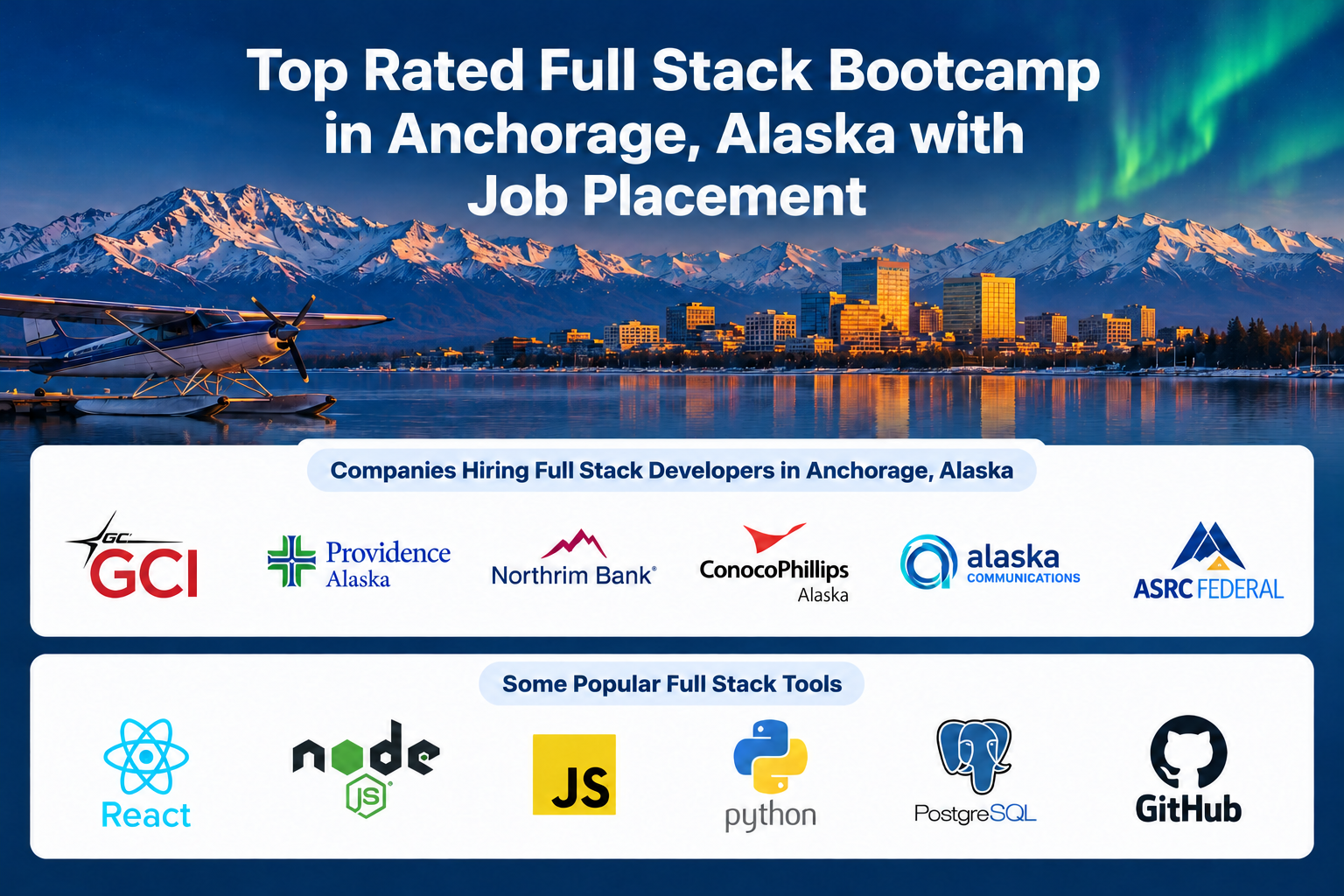
Top Rated Full Stack Bootcamp in Anchorage, Alaska with Job Placement
Anchorage does not hire full stack developers the way Seattle or Austin does. The durable seats sit inside government, healthcare, telecom, energy, logistics, and Alaska Native corporations, while a large share of “Anchorage” software ads are remote roles posted by national firms. A short web certificate will not clear that bar. Jobseekers who want a Top rated Full Stack Bootcamp in Anchorage, Alaska with job placement need training that matches what employers still pay for, plus someone who markets them until an offer exists. That path is SynergisticIT’s Top rated Full stack training Bootcamp in Anchorage, Alaska: the Java DevOps Full Stack Job Placement Program, done live from anywhere in the United States, including Anchorage.
What a full stack bootcamp is
A full stack bootcamp is a compressed training program that tries to teach both sides of a web application: the screens people click, and the servers, databases, and deployment steps behind them. A typical syllabus touches HTML, CSS, JavaScript, a front-end library, a back-end runtime, a database, Git, and a small portfolio project. Some add cloud, APIs, and a short career workshop. The format can be full-time or nights-and-weekends, live or mostly recorded.
The promise is speed. The failure mode is also speed. Employers do not hire a stack diagram. They hire someone who can debug a service, write SQL, explain a design choice, and ship without a tutor in the room. A bootcamp that ends at a certificate leaves that last mile to the student. In a small market like Anchorage, that last mile is where most searches die.
Programs that market themselves to Anchorage residents are mostly online, not a downtown campus. Names that show up in local roundups include Coding Dojo, which publishes an Anchorage page and teaches multiple stacks online; Nucamp, a lower-cost part-time option; Kal Academy; Altcademy; and Actualize. University routes such as University of Alaska Anchorage computer science are degrees, not bootcamps. None of those short programs is the same product as SynergisticIT’s Java DevOps Full Stack Job Placement Program, which keeps working after the last lecture.
The local employers that hire or have recently recruited software and full-stack talent include Applied Microsystems, Resource Data, Global Credit Union, the State of Alaska, GCI, Alaska Communications, 60Hertz Energy, Beacon Media + Marketing, the University of Alaska Anchorage, Alaska Native Tribal Health Consortium, Cook Inlet Region, Inc., Alyeska Pipeline Service Company, Providence Alaska, and Alaska Airlines. Most of that work sits inside government, telecom, health systems, Native corporations, banks, and custom-software firms, not venture-backed product companies. A board that shows dozens of identical Anchorage full-stack ads is usually staffing or remote noise.
Cash pay is a local wage, not a coastal total-compensation package. Applied Microsystems posted a junior full-stack seat at $60,000 to $80,000, close to an Indeed junior software-engineer average near $65,749 and State of Alaska application-developer bands of about $65,400 to $85,500. Mid-level cash pay more often falls around $90,000 to $120,000. Indeed’s Anchorage software-engineer average is about $112,049, with a typical cash bonus near $5,000, and its full-stack figure is about $112,805. Senior local ranges run roughly $110,000 to $155,000. Global Credit Union has posted integration and software bands of about $80,000 to $133,000 and $90,389 to $152,718 by level. A May 2025 BLS-based compilation puts the Anchorage software-developer median near $104,030 across about 320 jobs. Those figures are not offers from every employer above.
Anchorage’s better-known technology names are few. Mark Bolzern, a West Anchorage High graduate, was an early Linux distributor and Alaska internet pioneer. David Bullock, born in Anchorage and known as Alaska, founded 907 Agency and made the Forbes 30 Under 30 list. Piper Foster Wilder built 60Hertz Energy in Anchorage. Nicholas Begich founded the software firm FarShore Partners. Ben Kellie, an Alaska engineer who worked at SpaceX and later sold The Launch Company, has brought that background back into the state’s startup circuit.
The employment base is thin. Alaska had about 530 software-developer jobs in those May 2025 estimates, only about 0.15 times the national concentration, and Anchorage held most of them. Oil, government, health care, transportation, the military, and Native corporations still anchor the economy. In July 2026, Anchorage/Mat-Su unemployment was 3.3 percent, but statewide nonfarm employment was down 0.6 percent from a year earlier, information was down 2.3 percent, and professional and business services had lost about 500 jobs. Anchorage employment in the first half of 2026 was about 0.5 percent below early 2025, and Alaska lost 4.5 percent of its federal jobs in 2025.
Seattle and Portland win on total pay. Their May 2025 software-developer medians were about $167,280 and $156,000, against roughly $104,030 in Anchorage. Large Seattle employers add restricted stock that can push one published median total package to about $370,000. Anchorage bonuses are usually a few thousand dollars, and equity is rare outside a few startups. The local offset is stability: public pensions, health coverage, a 401(k), and paid leave. Alaska and Washington have no state income tax, while Oregon does, but Anchorage’s high cost of housing and goods absorbs much of that edge. The trade is Seattle or Portland equity versus Anchorage stability, not matching cash plus stock.
Who actually hires here
Established employers do more of the real hiring than startups. Anchorage is not a venture-backed software cluster. The organizations with payroll, compliance needs, and systems that cannot go down are mid-size regional firms and large institutions. Startups exist, and a few digital shops post web roles, but they do not set the market. A new graduate who only targets “startup full stack” will see a thin list.
Names tied to local technical work include the State of Alaska, which posts application developer and systems programmer roles; University of Alaska Anchorage; Arctic Slope Regional Corporation; Chugach Electric Association; The Tatitlek Corporation; telecom employer GCI; Alaska Native Tribal Health Consortium; and energy employers such as ConocoPhillips with an Anchorage presence. Indeed listings also show programmer-analyst and application-support work around utilities, airport operations, and consulting firms. National enterprises still hire people who live in Alaska, but those offers usually come through remote or hybrid reqs, not a new local campus.
That split matters for training. Local institutions need people who can maintain business systems, integrate data, and work inside change control. National clients that hire SynergisticIT completers—Visa, Apple, PayPal, Intel, eBay, Citi, Wells Fargo, Capital One, Bank of America, Walmart Labs, Cisco, Verizon, T-Mobile, Intuit, Deloitte, Dell, USAA, SAP, Ford, Hitachi, Western Union, AutoZone, Walgreens, Humana, Carfax, and others—expect Java, Spring Boot, SQL, cloud, and DevOps, not a single JavaScript demo. SynergisticIT reports completer offers in the $95,000 to $155,000 range, with a published 91.5% success rate for people who finish the program.
Indeed’s full stack explorer has put average pay for the title in Anchorage near $112,805, and a May 2026 ZipRecruiter snapshot put software developer pay in the city near $114,400, with most earners between about $92,100 and $133,000. Those figures describe advertised roles, not a promise that a two-month MERN course clears six figures.
How the work is structured
A clean four-way percentage for Anchorage full stack jobs is not published. What the listings show is a pattern.
Full-time employment is the path newcomers should want, and it is the most common serious outcome. W-2 roles at the State, a utility, a Native corporation, a hospital system, or a national tech employer come with benefits, a manager, and a chance to learn a codebase. Indeed’s Anchorage full stack snapshot showed part-time openings at 0% and remote or hybrid on about 31% of openings. Read that 31% carefully. Many of those ads are national remote jobs geotargeted to Alaska, not hybrid seats inside a Midtown office.
Contract work is the second channel, mostly for people who already have scars. A six-month build, a cloud migration, or a backfill while a permanent hire is approved often runs through a staffing firm. New graduates rarely win pure contract work because the client is paying a markup for someone who can produce in week one.
Staffing-agency roles overlap with contract and contract-to-hire. They can be a bridge, but the agency’s incentive is filling a req, not teaching you Java. If the resume is thin, the agency has little to sell.
Freelance is the least realistic first job. Anchorage buyers of custom software want a known vendor, not a new graduate with three tutorial apps. Freelance income also has no benefits and no one to review your production mistakes.
For recent graduates, the practical order is full-time first, contract-to-hire only with a strong advocate, and freelance later. That is why SynergisticIT’s Job Placement Program is built to schedule interviews and stay until a qualifying offer, rather than hand you a freelance profile and a list of job boards.
On location, Anchorage employers in government, healthcare, energy, and utilities still lean onsite or hybrid because the work sits next to operations. Fully remote share is higher in software nationally than in Alaska’s core industries. AEDC’s 2026 trends report describes an economy that recovered from 2020 but is not in a software-campus boom: logistics, construction, healthcare, and military-related investment are the growth stories, while federal civilian employment was down 8.4% year-to-date in the first half of 2026. A newcomer who can work remotely for a Lower 48 employer, or who can show up onsite for an Alaska institution, has more options than someone who will only accept a downtown startup office that may not exist.
Job boards and local staffing
Anchorage jobseekers do not live on one board. The sites that actually get used are:
- AlaskaJobs, the state system that replaced ALEXsys, reached through myAlaska. State, university, and many public postings start here.
- Workplace Alaska for State of Alaska applications. A portal scrape is not an application.
- USAJOBS for federal work, including Joint Base Elmendorf-Richardson civilian roles.
- Indeed and ZipRecruiter, which aggregate local and remote ads. Treat odd salary ranges and repeated “test client” posts as noise.
- LinkedIn, useful for national remote roles and for seeing who actually works at GCI, ASRC, or a hospital IT team.
- Craigslist Anchorage and the Anchorage Chamber listings for smaller employers that never buy a LinkedIn job slot.
- Employer career pages for the Municipality of Anchorage, UAA, and the larger Native corporations.
Staffing names with an Anchorage footprint include Insight Global, ProFocus Technology, Opti Staffing, TDL Staffing, PeopleAK, Kelly Services, AKHIRE, Alaska Executive Search, and Computer Task Group. Insight Global and ProFocus are the clearer technology recruiters. Opti, TDL, Kelly, and PeopleAK are broader employment firms: admin, industrial, healthcare, finance, and some professional search. National IT agencies such as TEKsystems and Robert Half Technology also place developers into Alaska accounts without being a local full stack academy. None of them train you for five months and then refuse the balance of the fee until you are hired. That combination is the Job Placement Program, not a temp desk.
A local bootcamp field guide
Anchorage does not have a crowded street of full stack campuses. The “local” market is a mix of online brands, short community courses, and degree programs. Comparing them on the points that decide a hire is more useful than comparing logos.
Kinds of programs. You will see part-time web courses, multi-stack coding bootcamps taught fully online, university certificates, and self-paced marketplaces such as Udemy or Coursera that some ads still call bootcamps. A few national schools sell an “Anchorage” page that is really a remote cohort. Live immersive training with daily instructor time is rare in this city. Recorded-plus-one-weekend-workshop is common at the budget end.
Fees. Public roundups have put short Nucamp-style entry courses near $458 and a fuller Nucamp full stack offering near $2,604, with Kal Academy examples from about $2,500 and Altcademy full stack marketing near $1,290. Coding Dojo’s part-time online range has been advertised from about $9,995 to $16,995. National immersive brands often land between $10,000 and $20,000, frequently due before you have an offer. Cheap is not the same as hired.
Length and format. Four-week intros, 16-weekend academies, 22- to 28-week part-time tracks, and 12- to 24-week immersives all get labeled full stack. Budget programs often mix recorded lessons with one live block a week. That format suits a hobby. It is a weak match for someone who needs to be interview-ready in Java and DevOps. Ask, in writing, whether every teaching hour is live.
What they cover. Most Anchorage-marketed full stack courses stop at HTML, CSS, JavaScript, React, Node, and either MongoDB or a light SQL unit. Some add Python or a second stack for a week. Few go deep on Spring Boot, microservices, PL/SQL, data structures, Jenkins, Docker, Kubernetes, Terraform, AWS, and Azure in one employment track. Coverage that wide is the point of SynergisticIT’s Java DevOps full stack JOPP, not a weekend MERN class.
Who enrolls. Career changers, career-military spouses, service members leaving active duty, UAA students who want a faster credential, and career-gap professionals all show up. Many already tried a cheap course. SynergisticIT states that about 30% of people who enter JOPP already did another bootcamp, a Udemy or Coursera path, or a university certificate and still were not hired.
Loans and installments. Nucamp has marketed monthly plans and partners such as Ascent and Climb Credit. Other schools push private loans or “pay after you get a job” language with clauses that are hard to redeem. Read whether the school keeps the full fee if you are not hired. SynergisticIT’s published structure is $10,000 before training and a balance of up to $26,000, paid over about two years only after a job of $81,000 or higher. If that offer does not happen, those balance payments do not accrue.
Hiring support. Many bootcamps offer a resume template, a LinkedIn checklist, and an email of job links. That is not placement. Ask who schedules the interview, who is in the room for the mock, and what happens in month four if you have no offer. Get the answer in writing.
Outcomes and reviews. Audited, city-specific success rates for Anchorage full stack bootcamps are scarce. Marketing pages sometimes cite figures in the mid-80s or low-90s for national brands. Treat those as unverified unless you can see the methodology. Public alumni comments cut both ways. Positive notes praise low price, a Discord community, and the ability to study after work. Negative comments, especially around Nucamp and Coding Dojo on public forums, repeat the same problems: recorded or outdated lessons, instructors who are recent graduates or spread too thin, projects that never become a serious portfolio, and career help that stops at tips. People finish, feel busy, and then discover that Anchorage employers and national applicant tracking systems do not treat a to-do app as experience.
SynergisticIT publishes a different kind of record: reviews, video testimonials, and alumni photographs, a USA Today contributor feature on how the firm sources talent, and an ROI write-up on why certified, pre-screened hires cost less to ramp than a random job-board resume. The firm also shows up at industry events. Video from Oracle CloudWorld, JavaOne, and the Gartner Data and Analytics Summit is on the event gallery. Those appearances are how the curriculum gets corrected against live client demand, not against last year’s YouTube syllabus.
Why choose SynergisticIT's Top Rated Full Stack Bootcamp in Anchorage, Alaska with Job Placement ?
-
Why full stack still pays, and why Java should lead
AI coding tools did not retire full stack work. They raised the standard. Copilot-style assistants can draft a component or a test. They do not own a payment ledger, a claims workflow, or a public-sector system of record. Companies now ask for people who can review generated code, secure APIs, design cloud deployments, and connect a front end to a governed back end. The emerging list in real reqs includes TypeScript and modern React or Next.js, Spring Boot 3, microservices and API gateways, Docker and Kubernetes, Terraform, CI/CD, observability, cloud on AWS or Azure, event-driven integration, and SQL that survives an audit. AI features are being added to those systems. The systems themselves are not being deleted.
A MERN-only course is the wrong depth for that market. MERN and MEAN demand has cooled relative to the 2018–2021 bootcamp boom. Node.js is still excellent for lightweight, I/O-heavy APIs and product prototypes. It is a weaker default for heavy, long-running, mission-critical workloads in banking, fintech, insurance, and government, where the JVM, strong typing, and mature operations practice already won. Java’s object-oriented structure, static typing, and ecosystem make large codebases and large teams easier to govern. Fifty engineers can share a Spring service with clearer contracts than they can share a loosely typed JavaScript monolith. For a longer comparison, read Java vs Python vs C++: which language gets you hired. Programming and data paths also keep more doors open than a narrow security-only bet, which is the point of why data science and programming offer more career growth than cybersecurity.
That is why full stack, if the goal is employment, should be learned in depth from a firm that has been in the tech industry since 2010—more than 15 years—not from a generic coding bootcamp. SynergisticIT sits in software delivery and staffing, talks to clients, and adjusts what candidates practice. Full stack training is not a separate Anchorage product. It is inside the Java DevOps Full Stack Job Placement Program: Core and Advanced Java, Spring Boot, microservices, REST APIs, SQL and PL/SQL, data structures and algorithms, Git, Jenkins, Docker, Kubernetes, Terraform, AWS, Azure, plus MERN and MEAN, with certification prep that can include Oracle Java, AWS, Azure, Microsoft, Snowflake, Databricks, and Power BI. Employers would rather hire one person who can touch back end, front end, and deployment than three partial resumes. Learning only MERN leaves that seat to someone else.
How placement helps two hard starts
Career gap or break
- Daily live instruction rebuilds a work rhythm after months or years away, at about four to five hours a day, five days a week, across roughly five months.
- Current projects replace a silent timeline, so the interview is about what you built, not only why you left.
- Screening happens before an employer sees you, which matters when a gap makes recruiters skip the resume.
- The resume lists only work you actually did, which is the opposite of a padded bootcamp portfolio.
- Marketing to 24,000+ company contacts creates interviews that cold applications after a break rarely do.
- Support continues through scheduled interviews until an offer, which is the part a career-gap candidate cannot buy from a tip sheet.
Recent graduates with no tech job
- You get a stack employers list: Java, Spring Boot, SQL, DevOps, cloud, and front-end work, not a single class project.
- You leave with assessed project work a new graduate otherwise has to invent alone.
- Specialist instructors, not one generalist, cover Java, databases, advanced Java, and DevOps as separate subjects.
- Interview prep is part of the program, including the explanations new graduates freeze on.
- Someone else runs the employer outreach and puts interviews on the calendar.
- The program is built for first jobs. SynergisticIT states that 90% of JOPP graduates who get hired had never held a tech job; the other 10% are career changers, people with gaps, and similar profiles.
Waiting does not compress the work. It only moves the offer later. The months feel long because they have to hold skills, projects, interviews, and client marketing at the same time. That stretch is what a hiring manager is paying for. Begin while the calendar is still yours. The distance is real, and the finish line is a full-time offer, not another certificate.
Why completers get hired, and paid
Companies are tired of job-board noise, staffing markups, and candidates who cannot do the exercise they pasted onto a resume. When a manager does not want to guess whether the new hire can work, SynergisticIT’s pitch is specific: hire a completer. People who skip projects, certifications, or assessments are not the candidates these clients keep requesting. Completion means the assignments, the certifications the program prepares, the trainer assessments, and the minimum scores the program sets.
The employer-side case, in plain language:
- Current stack alignment. JOPP is shaped by client demand and by what candidates hear in live interviews, so the skills are the ones on this year’s reqs, not a frozen 2019 MERN outline. Less ramp-up is the result.
- Pre-screened talent. Technical screening happens before a profile is sent out. A company sees people already checked for skill and role fit.
- Certifications on top of the stack. Completers are certified across combinations of Java, DevOps, AWS, Azure, Power BI, Snowflake, and related credentials. That is third-party proof, not a school badge.
- Multi-stack range. One junior can contribute on back end, front end, and deployment. A data-track peer can move across analytics, engineering, and ML/AI support. Multi-skilled hires cover more than one seat, which is real value for the salary.
- Lower hiring risk. Structured training, projects, interview prep, and screening sit behind the introduction. The manager is not betting on a stranger’s Udemy list.
- Day-one contribution. The work is practical. Completers are presented as ready to join a sprint, not as people who need a quarter of classroom time after the offer.
- Project-based resumes. The page reflects work that was done. Embellished bootcamp resumes are the problem JOPP is designed not to recreate.
- Economics. SynergisticIT argues that a similarly broad, certified profile hired cold from the open market would cost two to three times as much. Clients get a technically proficient hire without a long lead time. The jobseeker gets employers—Visa, Apple, PayPal, Wells Fargo, Capital One, Bank of America, Walmart Labs, Cisco, Intuit, Deloitte, and the wider list above—that would otherwise be out of reach. Both sides win only if the candidate finished.
SynergisticIT also states that completers are often promoted faster and moved toward leadership because they already covered more of the stack than a narrow three-to-five-year specialist who knows one service. That is the firm’s hiring argument, backed by the client pattern it publishes, not a claim that every experienced engineer is weak. Managers who are done gambling on unverified resumes use JOPP completers because the performance question was tested before the interview loop.
How this differs from bootcamps and staffing shops
Curriculum. SynergisticIT adjusts what it teaches from client conversations and from events such as Oracle CloudWorld and the Gartner Data and Analytics Summit, plus from candidates who are interviewing now. A bootcamp syllabus printed last spring cannot do that.
Instructors. Many bootcamps use recent alumni, recorded video, or a teacher who appears a few hours a week. JOPP uses industry practitioners. The stated average instructor experience is more than 10 years.
How many instructors. One or two generalists teaching every topic is normal in bootcamps, and it shows. Java JOPP and the data science track each use about five to six specialists: separate depth for Java, databases, advanced Java, and DevOps, and the same pattern on the data side for analytics, engineering, and machine learning.
Cost. $10,000 up front, then up to $26,000 after a qualifying offer of $81,000 or higher, spread over about two years. No qualifying offer, no balance accrual. Most bootcamps collect everything first and advertise a refund that students struggle to collect.
Time in the seat. About four to five hours a day, five days a week, for about five months, live, with instructors present. No recorded core. Ask any Anchorage option the same question before you pay.
Ratio. About five students per instructor, against ratios near 20 to 1 at many bootcamps.
Projects. Built to current job-market stacks. Only work you complete is allowed on the resume.
Alumni evidence. Written reviews, audio, and video on the reviews page describe offers from the mid-$90,000s to about $155,000, including people who received more than one offer. Read them before you trust a guarantee with hidden clauses.
After the last class. SynergisticIT markets into a stated network of 24,000+ company contacts, rewrites the resume, runs interview prep, schedules the interviews, and stays through the start date. A bootcamp that emails tips has already left.
Why the name is Job Placement Program. It can be done from anywhere in the USA, including Anchorage, and it is training plus staffing. Coding bootcamps train and release you. JOPP’s published promise is narrower and harder: people who successfully finish get hired into tech companies. National bootcamp closures keep happening because placement promises outran delivery. Doing four cheap courses does not fix that. One Java DevOps full stack JOPP track is built to cover the list employers actually combine so they can hire fewer people.
Compared with another year of college tuition, SynergisticIT presents JOPP as the higher-ROI route for someone who needs a job, not another transcript. The ROI article makes that employer-side case in more detail.

Career Paths after Top Rated Full Stack Bootcamp in Anchorage, Alaska with Job Placement

Visas, relocation, and market risk
Do not assume an Anchorage full stack job includes relocation or a visa. Alaska’s H-1B filings are concentrated in school districts, healthcare, and some energy and engineering roles, not in junior web bootcamp graduates. In current work-state summaries, districts such as Bering Strait and Galena lead filing counts, with the University of Alaska also active, including some Anchorage worksites. Healthcare systems and firms such as ConocoPhillips appear, usually for specialized clinical or technical occupations. Many local software ads state that sponsorship is unavailable.
Relocation stipends, when they exist, are more common for hard-to-fill clinical, petroleum, and senior engineering roles than for a first full stack job. H-1B conversion is an employer decision after you are hired and eligible. A certificate does not create it. If you need sponsorship, ask the specific employer in writing before you move. National companies that hire JOPP completers have their own policies; a Visa or Apple offer is not the same thing as the State of Alaska sponsoring a junior developer in Midtown. Confirm work authorization with SynergisticIT before you enroll so the marketing effort matches what clients can legally hire.
Layoff exposure is real, but it is not a Silicon Valley story. National tech cut announcements remained elevated in 2026. Anchorage never built a large software-campus cluster, so it does not experience those cuts as a wave of local office closures. It is more exposed to federal civilian reductions, energy-cycle pauses, and municipal budget pressure—city officials have already warned that later-year shortfalls could mean local job cuts. Offsetting growth is in healthcare, port and airport work, construction, and military-related investment, plus ongoing IT inside Native corporations and utilities. New software “campus openings” are not the Anchorage headline. Remote workers living in the city still feel Lower 48 freezes. A Java and DevOps profile tied to systems that must keep running is sturdier here than a single-framework certificate tied to an experimental product team.
The choice if the goal is a job
There can be many coding bootcamps that offer full stack lessons to someone sitting in Anchorage. If the goal is to get hired after the program, SynergisticIT’s position is that there is one choice built for that result: its Top rated Full stack training Bootcamp in Anchorage, Alaska. It is called a job placement program because the work does not stop at a certificate. Completers are prepared, marketed, and walked into interviews until an offer from a real technology employer is in hand.
Contact SynergisticIT and start the tech career journey. Call (510) 550-7200, review the Job Placement Program, and apply only if you are ready to finish the whole program. Partial attendance is not what those clients hire.