Important Notice— Our url is


If you are searching for a data science bootcamp in Baltimore, Maryland with job placement, your real goal is not a certificate — it is a full-time job offer as a Data Scientist, Data Engineer, Machine Learning Engineer, AI Engineer, or Data Analyst. That is exactly what SynergisticIT's Data Science Job Placement Program (JOPP) delivers. Unlike a typical coding bootcamp that trains you and then leaves you to fend for yourself on job boards, JOPP combines deep, multi-stack training in data science, data analytics, data engineering, and ML/AI with projects, certifications, interview preparation, and active marketing to a network of 24,000+ employer contacts until you are hired.
Baltimore-based jobseekers — whether recent graduates, career changers, QA testers, business analysts, or professionals returning after a career gap — can complete the entire program 100% online from anywhere in the USA, and get placed with companies like Visa, Apple, PayPal, Walmart Labs, Wells Fargo, Capital One, Bank of America, Cisco Systems, Deloitte, and many more at salaries ranging from $95k to $155k.
Data scientists will remain in demand in Baltimore, Maryland as healthcare, research, government, and finance keep expanding their use of machine learning. Johns Hopkins and other medical systems generate huge clinical and genomic datasets that require scientists for diagnostics, trials, and operations. Insurers, federal agencies, and defense contractors around the metro need analytics for claims, cybersecurity, and mission planning, while asset managers and consumer brands use models for risk and customers. Baltimore’s research universities and lower costs than Washington keep a steady talent pipeline. That mix of hospitals, labs, payers, and contractors ties hiring to care delivery and national-security work, not a single tech cycle. Openings stay concentrated in health, finance, and defense. Local postings still appear regularly.
Companies hiring data scientists in Baltimore, Maryland, excluding staffing firms, include Johns Hopkins University, Johns Hopkins Health System, Johns Hopkins Applied Physics Laboratory, University of Maryland, Baltimore, University of Maryland Medical System, Kennedy Krieger Institute, MedStar Health, CareFirst BlueCross BlueShield, T. Rowe Price, Under Armour, McCormick & Company, Booz Allen Hamilton, Leidos, Northrop Grumman, Lockheed Martin, Parsons, Deloitte, PwC, Accenture Federal Services, Abt Global, NCQA, CVS Health, Fearless, Xometry, and Elder Research.
Across the market, junior data scientists commonly earn $86,000 to $120,000, mid-level data scientists typically earn $126,000 to $170,000, and senior data scientists often earn $170,000 to $238,000, with some specialized or cleared senior roles advertised higher. Posted ranges vary by clearance, industry, and total pay, but these bands match recent Baltimore listings and metro wage data for data scientists.
Why Data Science and Data Analytics Matter in Baltimore, Maryland
Baltimore is quietly becoming one of the Mid-Atlantic's most important data hubs. The city's economy runs on industries that are data-hungry by nature — healthcare and life sciences anchored by Johns Hopkins and the University of Maryland Medical Center, federal government and defense contracting around Fort Meade and the NSA corridor, cybersecurity firms in and around the city, financial services, logistics, and higher education.
Every one of these sectors is hiring people who can work with data:
- Healthcare and biotech organizations in Baltimore need data scientists and data engineers to analyze clinical data, population health records, genomics datasets, and real-time patient monitoring streams.
- Federal agencies and defense contractors in the region need analysts and engineers to build secure data pipelines and analytics platforms, driving demand for cloud, SQL, and big-data skills.
- Cybersecurity companies — a specialty of the Baltimore region — increasingly rely on machine learning models to detect threats, creating demand for ML/AI engineers.
- Financial services and insurance firms in Maryland need data analysts and data scientists for risk modeling, fraud detection, and customer analytics.
In short, if you are a jobseeker in Baltimore, Maryland, learning data science, data analytics, and data engineering is one of the highest-ROI moves you can make. But learning from any random data science bootcamp is not enough — you need training tied directly to placement, which is what separates SynergisticIT's JOPP from the pack.
Emerging Tech and Skills Baltimore Employers Are Asking For
Companies hiring in and around Baltimore are no longer satisfied with a single skill. The job descriptions of 2026 ask for combinations like Python + SQL + Snowflake + Power BI, or machine learning + AWS + Docker, or Spark + Databricks + generative AI. The emerging technologies showing up in Maryland-area postings include:
- Cloud data platforms: AWS (S3, Glue, SageMaker), Azure (Data Lake, Azure ML, Fabric), and Google BigQuery
- Modern data warehouses and lakehouses: Snowflake and Databricks
- Big data processing: Apache Spark, Hadoop, and streaming tools like Kafka
- Generative AI and LLMs: prompt engineering, retrieval-augmented generation (RAG), fine-tuning, and building applications on top of large language models
- MLOps: Docker, Kubernetes, MLflow, and CI/CD pipelines to deploy and monitor models in production
- Business intelligence: Power BI and Tableau for dashboards, reporting, and data storytelling
A jobseeker who shows up with only "data science" on their resume is competing against candidates who bring data engineering + analytics + ML/AI together. That is the new baseline.
Why Data Science and ML/AI Training Alone Is Not Enough
Here is the hard truth most bootcamps will not tell you: a single-skill data science certificate rarely gets anyone hired anymore. Employers in Baltimore and across the USA want multi-stack professionals — one person who can query and pipeline the data, analyze it, model it, and communicate the results.
That is why SynergisticIT's program does not teach data science in isolation. It builds all four pillars of the modern data career:
- Data Analytics & Business Intelligence: SQL, data cleaning, exploratory data analysis, Excel, Power BI, Tableau, SAS, ETL fundamentals, data storytelling, and dashboarding.
- Data Engineering: Python, SQL at scale, Apache Spark, Databricks, Snowflake, Hadoop, Kafka, AWS S3/Glue, Azure Data Lake, GCP BigQuery, and end-to-end ETL/ELT pipeline design.
- Data Science & Statistics: Python (NumPy, Pandas, SciPy), statistics, regression, clustering, time series, hypothesis testing, Bayesian inference, and feature engineering.
- Machine Learning & AI: Scikit-learn, TensorFlow, PyTorch, Keras, XGBoost, LightGBM, CatBoost, deep learning (CNNs, RNNs), NLP, transformers, LLMs, generative AI, and cloud AI tools like AWS SageMaker, Azure ML, and GCP Vertex AI — plus MLOps with Docker, Kubernetes, and MLflow.
The emerging skills companies now explicitly ask Data Scientists for include LLM application development, RAG pipelines, agentic AI, model deployment and monitoring, vector databases, and AI ethics/explainability. SynergisticIT's curriculum is adjusted in real time as these requirements appear in actual job postings — because our candidates are actively interviewing and our team is present at industry events like Oracle CloudWorld (OCW) and the Gartner Data & Analytics Summit, where we hear directly from employers where the market is heading.
Bootcamps Have Poor Results — SynergisticIT JOPP Fixes What They're Missing
It is no secret that the coding bootcamp industry has a poor track record. Large numbers of bootcamps have shut down over the past few years because they made promises they could not keep: inflated placement statistics, "job guarantees" with hidden refund clauses that are nearly impossible to redeem, fees collected entirely upfront, and graduates left to hunt for jobs alone after graduation.
A bootcamp can only control what happens in the classroom. SynergisticIT's Job Placement Program controls what happens after the classroom too — because we are not just a training company, we are a staffing organization with 15+ years in the tech industry. JOPP is a win-win solution for both jobseekers and employers: jobseekers get trained, marketed, prepared, and placed; employers get a candidate worth far more than the salary they are paying — a multi-stack, certified, project-proven professional who contributes from day one.
The result speaks for itself: 90% of JOPP graduates who get hired at tech jobs have never worked in a tech job before — the other 10% are career changers and candidates with career gaps. And candidates who complete the program receive high-paying offers in the range of $95k to $155k, frequently with multiple offers on the table. Approximately 30% of JOPP participants previously attended other bootcamps, failed to get hired, and then landed offers after completing JOPP. Not all bootcamps are equal — and any technology should be learned in-depth, not from a random data science bootcamp or training company, but from a data science training bootcamp in Baltimore, Maryland that has been in the tech industry for over 15 years.
How SynergisticIT's Job Placement Helps Career-Gap Jobseekers (7 Ways)
- Structured skills-gap assessment. We evaluate your existing skills, identify exactly what the employment gap cost you, and map a personalized re-training track — no guesswork.
- Current-stack retraining. You are retrained on today's in-demand technologies, not the tools you used years ago, so your resume reads current the moment it goes out.
- Real project work to rebuild your resume. Client-style projects give you demonstrable, recent, hands-on work history that directly addresses the "what have you done lately" question.
- A credible narrative for interviews. We coach you on how to present your career break honestly and confidently, backed by fresh projects and certifications.
- We market you, not the other way around. Our team presents your profile to our 24,000+ company contacts — you are not fighting the ATS black hole alone.
- Interview preparation and scheduling. We prepare you for technical and behavioral rounds and then schedule the interviews for you.
- Support until placement — and beyond. We walk with you from the day you enroll to the day you start work, with continued post-placement support.
How SynergisticIT's Job Placement Helps Recent Graduates (7 Ways)
- You learn how to get hired as a recent CS graduate, not just how to code. A degree proves you can study; JOPP proves you can pass interviews and perform in a real data role.
- Depth a degree never gave you. Most CS graduates have never built an end-to-end data pipeline or deployed a machine learning model. JOPP makes you do both — repeatedly.
- An employable multi-stack profile. You graduate with data analytics, data engineering, data science, and ML/AI on your resume instead of scattered coursework.
- Industry certifications included at no extra cost — from Microsoft, Oracle, Snowflake, Databricks, Azure, and AWS — so entry-level screeners see verified proof, not just claims.
- Projects tailored to real job descriptions. Your resume reflects only the projects you actually worked on, aligned to what employers are hiring for right now.
- Employer marketing done for you. We submit and pitch your profile to our client network, so you compete for real interviews instead of ghost jobs.
- Hand-holding all the way to the offer. Resume building, interview prep, scheduled interviews, offer negotiation, and onboarding support — until you are working.
For recent graduates researching how to get hired in FAANG companies and other elite employers, the formula is the same: multi-stack depth, real projects, certifications, and hundreds of hours of interview preparation. That is precisely what JOPP provides, and it is why SynergisticIT candidates have been hired by companies like Apple, Visa, PayPal, Walmart Labs, AutoZone, Wells Fargo, Capital One, Walgreens, Bank of America, SAP, Cisco Systems, Verizon, T-Mobile, Intuit, Ford, Hitachi, Western Union, Deloitte, Dell, USAA, Carfax, and Humana.
Explore the programs directly:
- Learn more about SynergisticIT's Job Placement Program (JOPP) — the full training-plus-staffing model.
- Read the details of the SynergisticIT Data Science JOPP — the complete data science, analytics, engineering, and ML/AI track.
-
How SynergisticIT Is Different from Bootcamps, Staffing Companies, and Training Companies
Curriculum Quality and Market Relevance
Our curriculum is not a frozen syllabus. Because SynergisticIT participates in tech industry events like Oracle CloudWorld, the Gartner Data & Analytics Summit, and other conferences, and because our candidates are actively interviewing every week, we get real-time feedback on what employers are testing. The curriculum is adjusted in real time to match the job market — something no isolated bootcamp can do.
Instructor Quality
Most bootcamps use their own recent alumni as instructors, lean heavily on recorded sessions, or offer a couple of live hours per week. At SynergisticIT, you learn from industry professionals with deep domain expertise — our average instructor has more than 10 years of experience.
Number of Instructors
Most bootcamps have one or two instructors covering every topic, which guarantees shallow coverage. Our data science and Java job placement programs each run with 5–6 specialist instructors — a separate instructor for data analytics, a separate one for data engineering, a separate one for data science and machine learning (and similarly separate specialists for Java, databases, advanced Java, and DevOps in the Java track).
Cost and Payment
Transparent cost: $10k before the program starts, and the balance of $26k only after you land a job offer, payable over 2 years. If there is no job offer, no balance payments accrue. Compare that with bootcamps that collect all fees upfront and dangle refund "guarantees" whose hidden clauses make them nearly impossible to redeem.
Duration and Intensity
This is a deeply immersive program: 4–5 hours of live instruction every day, 5 days a week, for about 5 months — all live lectures, no recorded sessions. Every prospective bootcamp enrollee should demand this specific answer from any program they consider: live hours per week, or recorded content?
Student-to-Instructor Ratio
5-to-1 at SynergisticIT versus 20-to-1 or worse at typical bootcamps. You cannot hide in the back row, and instructors cannot let you fall behind.
Projects
Projects are tailored to current company requirements and the tech stacks appearing in real job postings. And critically — only the projects you actually work on appear on your resume. No recycled, everyone-builds-the-same-one portfolio pieces.
Alumni Success
You can read, view, and listen to audio and video reviews from our alumni describing exactly how they landed offers. Our graduates receive high-paying job offers from $95k up to $155k, often with multiple offers in hand. Verify it yourself on the SynergisticIT reviews page — including photographs of placed alumni on our JOPP page, offer letters, and our years in business.
Certifications Included at No Extra Cost
JOPP includes certification preparation and exams from Microsoft, Oracle, Snowflake, Databricks, Azure, and AWS — credentials employers recognize — at no additional charge.
Career and Job Placement Support Post-Graduation
Bootcamps issue a certificate and wish you luck. We take over the marketing: we present you to our network of 24,000+ company contacts, prepare your resume, coach you for interviews, and schedule interviews until you are hired. We hand-hold from the day you enter the program to the day you start working. Ask any bootcamp to put exactly what they offer in writing — most will hand you resume tips and a job-board link.
Why Trust Us
Photographs of successful alumni, video reviews, offer letters, transparent costs, verifiable job outcomes, and 15+ years in business. We do not make fake promises or guarantees with hidden clauses. See the coverage in the USA Today feature on SynergisticIT and the detailed numbers in the SynergisticIT ROI blog. If you are weighing options, also read our guide on landing a tech job after a career gap.
QA Testers, Business Analysts, and Non-Coding Backgrounds: Start Here
If you are a QA tester, business analyst, program manager, or someone from a statistics, mathematics, or other non-coding background in Baltimore, the SynergisticIT Data Science JOPP is the single best on-ramp into data careers — and the overlap between your world and the data world is much larger than you think.
Consider the common ground:
- Business analysts already work with requirements, stakeholder communication, SQL queries, reporting, and data interpretation — the core of a data analyst's day.
- QA analysts already think in test cases, edge conditions, structured logic, and root-cause analysis — the exact mindset behind data validation and model evaluation.
- Data analysts and BI analysts already live in SQL, Excel, dashboards, and stakeholder-facing insight — the foundation of data science and business intelligence.
Much of this shared skill set involves minimal to almost no coding, and the coding that does exist — SQL, Python with Pandas — is learned gradually and practically inside JOPP. Because so many skills overlap between QA, BA, and analytics domains, career changers from these backgrounds progress faster than complete newcomers. A career in data science, data analytics, or BI analytics is genuinely within reach through SynergisticIT's Data Science JOPP.

- Data Analytics
This is the business-facing layer where companies want people who can pull data, analyze trends, define KPIs, and communicate findings clearly. Common tools include Excel, SQL, Tableau, Power BI, Python, R, dashboards, and reporting frameworks. Baltimore-area jobs explicitly mention SQL, Tableau, Power BI, reporting databases, data warehousing, stakeholder communication, and dashboard creation.
- Data Engineering
This is the infrastructure layer that makes analytics and AI possible. It includes ETL/ELT pipelines, data quality, cloud storage, orchestration, warehousing, and governance. Common technologies include Snowflake, Databricks, Spark, Azure SQL, Azure Data Lake, AWS, GCP, Kafka, and ETL tools. Baltimore-area postings show strong demand for these exact skills.
- Data Science
This is where problem framing, statistics, experimentation, feature engineering, modeling, and business interpretation come together. Common tools include Python, R, pandas, NumPy, statistics, A/B testing, modeling, and evaluation methods. Employers in the region are also asking for the ability to translate ambiguous business problems into structured analytical work.
- ML/AI
This is the production and innovation layer. Today that means not only predictive ML, but increasingly LLMs, RAG, embeddings, vector search, AI governance, MLOps/LLMOps, and cloud AI platforms. Baltimore-area roles clearly show demand for GenAI delivery, stateful and agentic workflows, and enterprise deployment of AI pipelines.
Introduction to Data Science with Python
Python Introduction & Data Structures
Numerical Python (NumPy)
Pandas Data Analysis
Matplotlib & Seaborn Data Visualization
Data Manipulation: Cleansing – Munging
Data Analysis: Visualization Using Python
Introduction to Artificial Intelligence (AI) & Machine Learning (ML)
Machine Learning Techniques & Algorithms
Decision Tree and Random Forest Algorithm
Naive Bayes and KNN Algorithm
Support Vector Machine Algorithm
Model Deployment & Tableau
Introduction to Statistics
Introduction to Predictive Modelling
Data Exploration for Modelling
Mastering Data Preparation and Feature Engineering
Ensemble Learning Techniques
Web Scraping using Python Beautiful Soup
Time Series Analysis
Deep Learning
Natural Language Processing (NLP) & Text Mining
Market Basket Analysis
Careers after Data Science Training
As more and more companies are harnessing Data Science, AI, and Machine Learning solutions, it creates a splendid number of growth opportunities for professionals upskilled in Data Science. Here are some rewarding career options you can consider after Data Science training in Baltimore:
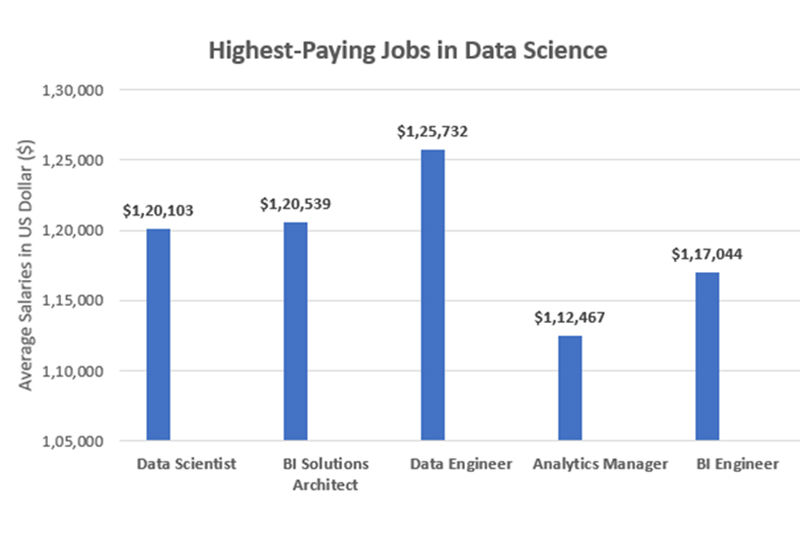
Data Engineer ($125,732)
Data Scientist ($120,103
Business Intelligence Engineer ($117,044)
Data Visualization Developer ($105,501)
Analytics Manager ($112,467)
BI Solutions Architect ($120,539)
ML/AI Engineer ($123,092)
BI Specialist ($90,286)
Statistician ($97,643)
Business Analytics Specialist ($84,601)
If you want to advance your tech career, consider taking this intensive Data Science training. It doesn’t need any prior technical background or knowledge, so anyone can sign up regardless of being a:
Fresher
College graduate/undergraduate
Statistician
Economist
Software Developer
Software Developer
Professionals working with logistics, analytical, or Mathematical background
Individuals working on data warehousing or reporting tools

Why Employers Win by Hiring SynergisticIT JOPP Candidates
Hiring a JOPP candidate is not charity — it is one of the strongest hiring decisions a Baltimore-area employer can make:
1. Current tech-stack alignment and job-ready technical skills. JOPP is shaped by tech-client demand, industry interaction, and hands-on upskilling, so candidates need far less ramp-up time.
2. Pre-screened talent. Every candidate goes through rigorous technical screening before being sent to market — companies receive candidates already verified for technical and job fit.
3. Certified and credible. JOPP candidates hold certifications across Java, DevOps, AWS, Azure, Power BI, Snowflake, and more, adding third-party validation to their tech stack.
4. Multi-stack professionals. Hire a data scientist who can also handle data engineering and analytics work — or a junior developer who can contribute across backend, frontend, and deployment — and you effectively get multiple roles in one hire.
5. Reduced hiring risk. Structured training, real projects, interview preparation, and screening mean dramatically lower risk of a failed hire.
6. Day-one contribution. JOPP candidates are practical and ready to produce from their first day on the job.
7. Genuine, project-based resumes. No embellished or fabricated experience — only the projects a candidate actually completed, in the stacks employers actually use.
In short: companies hire JOPP candidates because they arrive trained, screened, project-ready, interview-prepared, and aligned with current tech roles — and because they deliver value well beyond their salary.
One Program Instead of Four Bootcamps
Many jobseekers piecemeal their way through the market: a short data analytics course here, a machine learning certificate there, a cheap training company that "guarantees" jobs but delivers nothing. SynergisticIT's Data Science Job Placement Program — rather than being a separate program — is the data science training bootcamp in Baltimore, Maryland, with higher salaries, better placement results, and more comprehensive course coverage than any combination of standalone options.
Instead of doing 4–5 different coding bootcamps or gambling on a cheaper training company with empty job guarantees, jobseekers can complete one program that covers data engineering, data analytics, ML/AI, and data science — plus projects, interview preparation, and certifications — everything employers actually require. And because the program is online and fully remote, it can be done from anywhere in the USA — Baltimore to Boise.
That is why it is called a Job Placement Program and not a coding bootcamp. Bootcamps train and walk away. SynergisticIT's data science bootcamp training in Baltimore, Maryland actively markets its attendees, connects them with top tech companies, and schedules interviews until they are hired.
Stop Waiting, Start Building
Here is a truth worth sitting with: enrolling later does not shorten the journey — it only postpones the offer letter. JOPP takes the time it takes because it is doing the full job: constructing your skills, building your project portfolio, drilling your interview performance, and marketing your profile to clients until placement happens. That demanding stretch is precisely what employers are willing to pay six-figure salaries for. Begin today. Yes, the road is long — but the destination is a full-time job offer in data science.
The Bottom Line
There may be many data science bootcamps offering data science training in Baltimore, Maryland. But if your goal is to actually get hired after completing the program, there is only one choice: SynergisticIT's data science training bootcamp in Baltimore, Maryland — the sure-shot way for a jobseeker to land a tech job at salaries from $95k to $155k, backed by transparent pricing ($10k upfront, balance only after your job offer), a 5:1 student-instructor ratio, live daily instruction, industry certifications, and a team that markets you to 24,000+ employer contacts until you are placed.
Contact us today to speak with our admissions team, review the full Data Science JOPP curriculum, and take the first step toward your data science job offer in Baltimore, Maryland.