 Important Notice— Our url is



Minneapolis already has data work. What it does not have in large supply is a painless on-ramp for people who only hold a certificate. A top rated Data science training Bootcamp in Minneapolis, Minnesota has to do more than teach Python. It has to match the roles local employers actually post, then stay with the jobseeker until an offer exists. That is the job SynergisticIT Data Science JOPP is built to do, and it is why a top rated Data science Bootcamp in Minneapolis, Minnesota with Job Placement points to SynergisticIT’s Job Placement Program rather than to a short class that ends with a PDF.
Local employment picture
The Twin Cities labor market is not in crisis, and it is not a free-for-all either. The Minneapolis–St. Paul–Bloomington unemployment rate was 4.7% in the preliminary September 2026 reading, not seasonally adjusted, with about 96,500 people unemployed in a labor force near 2.07 million. A smoothed, seasonally adjusted reading for August 2026 was 4.2%. That is a citywide rate. The Bureau of Labor Statistics does not publish a separate unemployment rate for data scientists in Minneapolis, so anyone quoting a precise “data science unemployment” figure for the city is guessing.
Openings are real, and they are uneven. In a 2024 statewide talent report, Minnesota held about 111,540 tech jobs, equal to 3.6% of all employment, with 37,945 unique tech postings in the prior 12 months. Job-board snapshots move weekly. In October 2026, Indeed showed roughly 180 to 200 Minneapolis listings under a data scientist search, while Glassdoor showed several hundred broader “data science” roles. Those counts mix analysts, engineers, scientists, and senior titles. They are not a census.
Pay is strong enough to matter. Salary.com put the average Minneapolis data scientist salary at $123,697 as of October 1, 2026. An earlier 2026 Indeed snapshot put the local data scientist title near $103,361, senior data scientist near $133,381, and data analyst near $86,291. Nationally, the median data scientist wage was $120,230 in May 2025, and employment is projected to grow 35% from 2025 to 2035. Minnesota’s May 2023 count was about 2,240 data scientists, with an annual mean near $118,760.
Time-to-hire is the weak public number. Boards do not publish a trustworthy Minneapolis-only clock from application to offer for this occupation. What candidates feel on the ground is a multi-week process for screened roles, and a much longer search when the resume shows a degree or a short course and no production-style projects. Senior seats move when a specialist appears. Junior seats stall because the posting pile is large and the “U.S. experience” filter is blunt.
Roles employers actually post
Minneapolis job text rarely says “knows data science” and stops. Healthcare payers, retailers, banks, insurers, and manufacturers around the metro want people who can sit between a warehouse and a decision.
Typical titles include Data Scientist and Data Scientist II, Senior Data Scientist, Machine Learning Engineer, AI Engineer, Data Analyst, Senior Data Analyst, BI Analyst, Analytics Engineer, Data Engineer, Snowflake Developer, and Analytics Manager. Ameriprise and Deloitte have both appeared in local data-scientist searches, with posted ranges that can run from the mid-$80,000s into the $150,000s depending on level.
Read the bullets, not the title. A scientist posting often asks for Python, SQL, experiment design, and a model that can be explained to a risk or marketing lead. An engineer posting asks for pipelines, Snowflake or Databricks, and cloud storage. An analyst posting asks for Power BI or Tableau, stakeholder meetings, and clean metrics. Hybrid ads are now common: one person who can query, model, and ship a dashboard. That hybrid bar is why a single-topic class leaves people unhired.
Who is in the tech workforce
A clean female-to-male jobseeker ratio for Minneapolis tech openings is not published. What is published is who already holds the jobs. A 2024 Minnesota status report found that in life and physical science, engineering, mathematics, and information technology, about three-quarters of jobs are held by men and 26% by women. In the Twin Cities, about 15% of men and 6% of women work in that narrower STEM definition. Add health occupations and the gender split changes, because clinical roles pull the share of women up.
For a jobseeker, the practical reading is simple. The higher-paid computing and data seats are still male-heavy. Women, career returners, and people coming from QA, analysis, or math are not short of ability. They are short of recent, visible project proof that hiring managers trust. A placement program that markets a real portfolio matters more here than another generic “women in tech” webinar.
Junior, mid-level, and senior mix
Minneapolis does not publish an official split of data-science openings by level. National 2026 posting studies are the closest honest proxy, and they are sobering. One September 2026 review of data scientist ads found explicit entry-level or junior titles at about 3.4%, internships near 6%, and senior titles near 23%, with a large share of ads carrying no level in the title. Only about 8% to 10% of postings were clearly open to entry level. Another 2026 cut found 53% of U.S. data science postings at senior level or above, and about 62% written as mid-level or senior individual-contributor work.
Local boards rhyme with that pattern. A Glassdoor search for entry-level data scientist in Minneapolis–St. Paul has, at times, shown only about 10 openings, while broader data scientist searches show hundreds. Many “junior” ads still ask for two to five years, a master’s, or U.S. production experience. Internships exist, mostly through universities and large employers in fall and spring, and they are not a substitute for a full-time scientist seat.
So the percentage story is not “half the market is entry-level.” Junior and internship seats are the thin slice. Mid-level is the volume. Senior is the money and the filter. New graduates and career-gap candidates lose when they apply only to titles that already assume U.S. delivery experience. They need proof that looks like mid-level work: pipelines, metrics, models, and a story a hiring manager can defend.
Why these skills matter here
Data science and data analytics matter in Minneapolis because the metro’s economy runs on claims, customers, inventory, risk, and logistics. A model that flags claim leakage, a dashboard that shows store labor, or a pipeline that feeds a credit decision is not a classroom exercise. It is how large local employers spend money.
Emerging asks in local and regional postings now sit on top of the old stack. Employers want Snowflake and Databricks, Azure data platforms, Power BI, streaming tools such as Kafka and Spark, and newer language around LLMs, retrieval, and responsible AI. A scientist who cannot touch the warehouse is stuck waiting for an engineer. An analyst who cannot explain a model is stuck waiting for a scientist. Companies prefer one person who can cross the aisle.
Data science and ML/AI training alone is not enough. Jobseekers get hired when they can show data engineering, data analytics, and data science together.
- Data analytics and BI: Excel, SQL, Power BI, Tableau, DAX, stakeholder storytelling.
- Data engineering: Python, SQL, Spark, Kafka, Airflow-style orchestration, Snowflake, Databricks, AWS Glue, Azure Data Lake, dbt-style modeling.
- Data science: Pandas, NumPy, statistics, hypothesis tests, regression, clustering, time series.
- ML/AI: scikit-learn, XGBoost, TensorFlow or PyTorch, feature work, MLOps, SageMaker or Azure ML, prompt and evaluation practice for generative tools.
Emerging skills hiring managers keep adding include cloud warehouses, experiment design, model monitoring, GenAI use cases tied to a business metric, and the ability to write SQL that a finance partner trusts. A notebook with no deployment story is a school project. A pipeline plus a metric plus a model is a job.
Minneapolis keeps hiring data scientists because its largest employers turn clinical records, retail transactions, insurance claims, factory data, and supply chains into models for pricing, risk, and operations. Those openings sit with corporate campuses across the Twin Cities, not with staffing agencies.
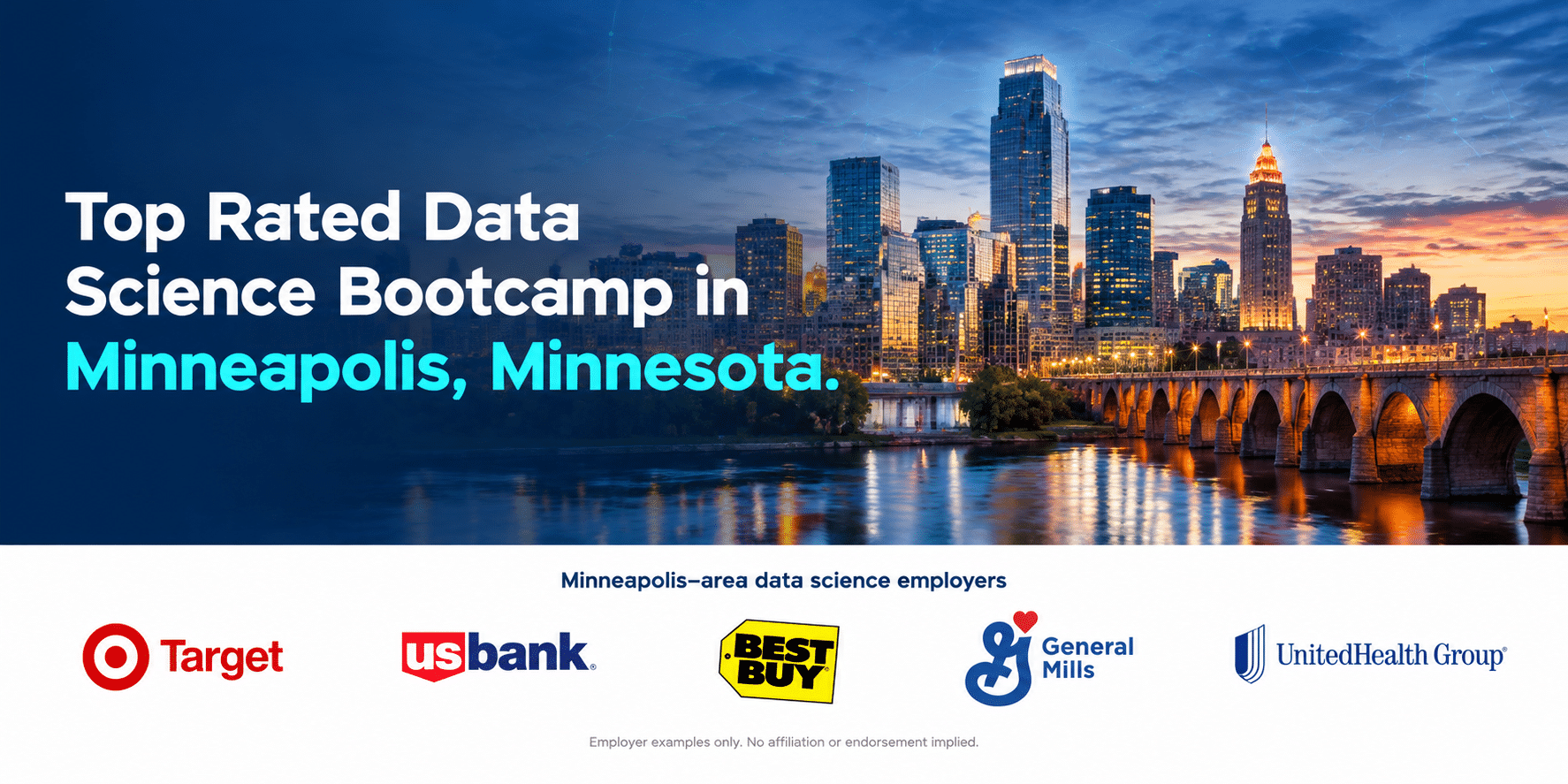
Employers tied to recent data scientist recruiting or to established Minneapolis-area analytics teams include Target, UnitedHealth Group, Optum, Best Buy, General Mills, U.S. Bank, Cargill, Medica, Blue Cross and Blue Shield of Minnesota, Mortenson, Polaris, SPS Commerce, Philips, Wells Fargo, C.H. Robinson, Ameriprise Financial, Medtronic, Boston Scientific, Abbott, 3M, Ecolab, Thrivent, the University of Minnesota, Land O'Lakes, and Solventum. Retail, insurance, medtech, food, logistics, and manufacturing all appear in that mix, so a freeze at one firm rarely clears the market.
Pay rises with scope, and posted bands overlap. Junior data scientists in Minneapolis commonly see about $68,000 to $115,000, near Salary.com's junior range of $67,530 to $92,263 and offers such as $87,000 to $115,000 at Polaris. Mid-level roles more often land near $105,000 to $160,000. A U.S. Bank posting lists $105,000 to $124,000, Salary.com places a typical data scientist from $117,665 to $144,390, averaging about $123,697, and ZipRecruiter puts most local pay between $102,800 and $142,000. Levels.fyi reports median total compensation of $157,000. Senior and principal work commonly runs $112,000 to $231,000. Indeed places senior pay from $111,578 to $204,686, with a Levels.fyi senior median of $160,000. Recent bands include $95,000 to $171,000 at Target, $113,700 to $175,000 at SPS Commerce, $88,700 to $152,000 at Medica, and $112,700 to $193,200 for principal work at UnitedHealth Group.
Demand should hold because the work sits inside industries that are staying. Medical Alley still needs scientists who turn device and claims data into safer products, while Target and Best Buy need forecasting and personalization, and banks need fraud and risk models. A 2026 Twin Cities tech report describes higher wages and lower unemployment than the nation, about 111,540 Minnesota tech jobs, nearly 38,000 unique tech postings in a year, and tech unemployment near 1.7 percent. The Minnesota Technology Association has pointed to about 39,000 tech openings through 2029, and artificial intelligence appears in about a quarter of local tech postings. The market is tight, which can slow a first hire, but experienced scientists stay scarce.
The reputation is older than this hiring wave. Earl Bakken, born in the Minneapolis area, co-founded Medtronic in a northeast Minneapolis garage and built the first wearable battery-powered pacemaker. Seymour Cray designed the supercomputers that made Control Data and later Cray Research famous in the Twin Cities, while Bill Norris founded Control Data. Manny Villafaña started at Medtronic, then founded Cardiac Pacemakers and St. Jude Medical, later absorbed by Boston Scientific and Abbott. Those builders help explain why data-heavy healthcare and computing still concentrate here.
-
What a bootcamp is, and what Minneapolis offers
A data science bootcamp is a compressed course, often 10 to 26 weeks, that teaches tools employers mention in ads. It is not a degree, and it is not a staffing firm. The honest ones say that. The risky ones sell a job guarantee in the ad and bury the conditions in the contract.
Minneapolis has never had dozens of elite, in-person data science campuses. The mix jobseekers actually encounter looks like this.
General Assembly listed a Minneapolis classroom and a data science bootcamp around $16,450 for about 12 weeks, with SQL, Python, statistics, and machine learning, plus career coaching. Public reporting later said GA’s consumer bootcamps, including that data science program, stopped taking enrollment in April 2026. Alumni talk is mixed. Some finished with a portfolio and an offer in a few months. Others called the pace too fast for newcomers and said a 12-week overview did not make them “data science ready.” Outcomes reports are self-reported, tied to students who opted into career services, and they are not a promise for the next class.
University of Minnesota Boot Camps, run for years with an outside provider, offered a data visualization and analytics track often listed near $10,995 over about 24 weeks, covering Python, SQL, and visualization. Course Report later marked the school closed, with a historical rating near 4.5 from a few dozen reviews. Positive alumni liked the projects and the jump from zero code to a dashboard. Negative comments described aggressive phone follow-up and career help that prepared people for interviews rather than placing them. Some graduates were still applying months later.
Noble Desktop sells shorter live-online Python and machine learning courses, often $1,495 to $3,995 and 30 to 114 hours, with mentoring and retakes. Useful for a tool. Not a hiring engine.
Fullstack Academy has marketed online AI, machine learning, and analytics bootcamps near $14,495, from about 10 weeks full-time to 26 weeks part-time, with certification prep and career coaching. Coaching is not the same as a team that keeps scheduling interviews until an offer lands.
Short local options also exist: New Horizons-style two-day Python classes near Eagan, and the Minnesota Technology Association’s multi-day data camp for students. Those are workshops.
Across this set, the pattern is stable. Full-time immersives run about 12 weeks. Part-time tracks run four to six months. Fees commonly land between $1,500 and $16,500, sometimes financed with loans, installment plans, or income-share language. Sessions are often a mix of recorded lessons and a few live hours. Hiring support, when it exists, is usually resume tips, LinkedIn edits, and a coach. The people who join are career changers, recent graduates, and career staff who want a title change. Public reviews praise community and projects. They also complain about speed, sales pressure, stale recordings, and job support that stops at advice. Success rates that look excellent on a homepage are hard to compare, because schools define “placed” differently and many programs have already closed after the promise outran the result.
Job fairs, and why they are not a plan
Minneapolis does host hiring events, and almost none of them are a pure data science fair. HackerX has a Minneapolis tech fair set for November 30, 2026, aimed at engineers, data scientists, and DevOps candidates meeting employers in one evening. Broader career fairs have included a September 9, 2026 morning event covering IT among other fields, and a September 14, 2026 afternoon fair. A technology virtual job fair was listed for October 21, 2026. University recruiting peaks in September–October and again in February–March. Summer is quieter. Winter is networking season, not offer season.
Fairs help if you already have a stack and a project story. They do not repair a resume that only lists a 12-week certificate.
Rent, gas, taxes, and whether the salary covers them
Housing is the number that decides whether a Minneapolis offer feels rich. Sources disagree because they measure different things. HUD’s FY 2026 Fair Market Rent for the Minneapolis–St. Paul metro, a 40th-percentile gross rent that includes basic utilities, is about $1,242 for a studio, $1,405 for a one-bedroom, and $1,709 for a two-bedroom. Asking rents compiled in mid-2026 ran roughly $1,000 to $1,220 for a studio, $1,250 to $1,530 for a one-bedroom, and $1,685 to $2,110 for a two-bedroom, with downtown and North Loop above those bands. Apartments.com has also cited an average studio near $1,146.
Gas is not cheap in late 2026. AAA’s Minneapolis–St. Paul regular average was about $4.22 a gallon in late October, and EIA put Minnesota regular near $4.18 in the week of October 19. A typical commuter can spend $150 to $250 a month depending on miles and vehicle.
Taxes take a visible bite. Minnesota’s single-filer brackets run 5.35%, 6.8%, 7.85%, and 9.85%. Minneapolis combined sales tax is 9.025% for the fourth quarter of 2026. The metro’s overall price level was about 4.8% above the U.S. average in the latest BEA regional price parities.
Put salary next to rent. A $103,000 to $124,000 local data scientist wage covers a one-bedroom at $1,300 to $1,500 without strain, even after state income tax, if the person is actually employed. A household on two professional incomes covers a two-bedroom in most neighborhoods. The same rent is painful on a stalled search or a $55,000 non-tech wage. That is the local math: the salary works; the certificate without the offer does not.
How placement help differs from a bootcamp
SynergisticIT has been in this industry since 2010, more than 15 years, and it treats the Minneapolis learner as a remote student in a national hiring system, not as a tourist in a city classroom. The Data Science Job Placement Program is the training. It is not a second product you buy after a bootcamp.
Curriculum quality. Because the team meets hiring managers at Oracle CloudWorld and the Gartner Data & Analytics Summit, and because candidates are in live interviews, the stack moves when the market moves. Event notes from those floors are public on the Oracle CloudWorld page. A static 12-week syllabus cannot do that.
Instructor quality. Many bootcamps lean on recent graduates, recorded libraries, and a teacher who appears a couple of hours a week. JOPP uses industry practitioners. The average instructor has more than 10 years in the work.
Number of instructors. One or two generalists cannot teach analytics, engineering, science, and machine learning at hiring-manager depth. The data track uses five to six specialists, with separate instructors for analytics, engineering, data science, and machine learning. The Java track is split the same way across Java, databases, advanced Java, and DevOps.
Cost. The published structure is $10,000 upfront, with the balance capped at $26,000, due only after a qualifying offer and spread over about two years. If there is no qualifying offer, those later payments do not start. Most bootcamps collect the full fee first and advertise a refund that is difficult to redeem. Ask any school for the conditions in writing. SynergisticIT’s own materials spell out attendance, assessment, and marketing conditions rather than hiding a fantasy guarantee.
Duration. Instruction is a deep daily block, about four to seven hours, five days a week, across roughly five to seven months, live with instructors. Recorded video is not the curriculum. Every shopper should ask a bootcamp, in writing, how many hours are live.
Student-to-instructor ratio. JOPP runs near 5 to 1. Large bootcamps often sit near 20 to 1, which is why questions wait until the next optional office hour.
Projects. You build what current job ads ask for. Only work you actually did goes on the resume. That is the opposite of a template project shared by an entire cohort.
Alumni proof. Offers reported by the program land from about $95,000 to $155,000, sometimes more than one offer. Read and watch the reviews, including audio and video, and look at the photographs on the JOPP page. Public reviews also mention the time and the upfront fee. That candor is useful. A program that only posts five perfect stories is not showing the work.
Certifications. Prep for Microsoft, Oracle, Snowflake, Databricks, Azure, and AWS credentials is included, not sold as a second invoice.
After the last lecture. Bootcamps hand you a certificate. JOPP markets into a network of 24,000+ company contacts, rewrites the resume, runs interview prep, and schedules interviews until you are working. Get any other school’s version of that sentence in writing before you pay.
Trust is evidence, not adjectives. Years in business, offer letters, alumni photos, the USA Today contributor piece on how the firm sources talent, and the ROI and hiring-fraud essay are the packet to read before a sales call.
Seven ways JOPP helps a career gap
- It replaces a blank recent timeline with current projects a manager can question.
- Daily live instruction rebuilds speed that self-study rarely restores.
- Specialist instructors cover the tools that changed during the break, not the tools from the last job.
- Certifications give a dated, third-party signal that the gap did not freeze the skill set.
- Interview practice includes a plain explanation of the break, without apology essays.
- Client marketing starts only after assessments, so the first impression is not a rusty resume.
- Support continues until an offer, which matters more than a motivational cohort chat.
A longer look at re-entry sits in Landing a Tech Job After a Career Gap.
Seven ways JOPP helps a recent graduate
The keyword how to get hired as a recent cs graduate is not a secret handshake. It is a skill-and-proof problem. Why CS grads cannot find jobs is the market context. JOPP is the response.
- It adds the stacks a CS degree lists in one elective and employers want in one person.
- Projects become the experience section employers say is missing.
- Live interview reps replace the first painful rejection cycle.
- Certifications differentiate a graduate from hundreds of identical transcripts.
- Marketing reaches employers who will not answer a cold application.
- The program is remote, so a Minneapolis graduate does not relocate for class.
- SynergisticIT reports that about 90% of JOPP graduates who get hired had never held a tech job before. The other slice is career changers and people with gaps.
Seven ways it helps anyone who simply wants a tech job
- Training, projects, certifications, and marketing sit in one sequence, not four vendors.
- The resume lists real tools, so it survives a technical screen.
- Multi-stack skill lets you take analyst, engineer, or scientist interviews, not one narrow title.
- You are not left to “network” after week 12.
- Fee balance is tied to a real offer, which aligns the school with the outcome.
- Small classes mean your weak topic gets time, not a link to a recording.
- The firm has had to keep promises long enough to stay in market while many bootcamps shut.
From QA, BA, math, or non-coding work
QA testers, business analysts, project and program managers, and people from statistics or mathematics should look at the Data Science JOPP before they look at a pure software bootcamp. The overlap is large, and the coding ramp can stay modest at the start.
Shared skills across business analyst, QA analyst, data analyst, and BI analyst work include requirement writing, test thinking, SQL-level questions, Excel, metric definitions, defect or data-quality triage, and explaining a number to a non-technical lead. Much of that work is little to no heavy coding. Power BI, SQL, and a clean dataset are learnable. From there, Python, pipelines, and models are a step, not a cliff.
A QA lead who can automate checks and also build a reliability dashboard is more useful than a QA lead who only files tickets. A BA who can query the warehouse stops waiting on a report team. That is why the career starts in business intelligence and analytics and grows into data science inside one program, instead of hopping across four bootcamps.

SynergisticIT Data Science Job Placement Program covers multiple layers (and being adaptable to market needs).
A practical “job-ready” stack typically includes:
- Data Analytics & BI: SQL, dashboards (Tableau/Power BI), metrics, storytelling
- Data Engineering: ETL/ELT, pipelines, orchestration, warehousing/lakehouse, cloud basics
- Data Science / ML: statistics, modeling, evaluation, feature engineering
- AI/GenAI exposure: modern AI concepts + real-world usage patterns
- Projects + interview prep: project defense, system thinking, communication
If your goal is Online data science training Bootcamp in Minneapolis, Minnesota that still feels like a real hiring pipeline, the “multi-stack + placement execution” design is the point.
Different Career Options After our Top Rated Data Science Training Bootcamp in Minneapolis, Minnesota(opens in new tab)
BI Solutions Architect ($120,539)
Analytics Manager ($112,467)
Data Scientist ($120,103)
Data Engineer ($125,732)
Data Visualization Developer ($105,501)
Business Intelligence Engineer ($117,044)
BI Specialist ($90,286)
Business Analytics Specialist ($84,601)
Big Data Engineer ($103,092)
Statistician ($97,643)


Freshers wanting to establish a Data Science career
Developers looking for a career shift
Data Scientists aspirants
Professionals with a logistics, analytical, or mathematical background
Individuals working on reporting tools, BI, or data warehousing
Why employers take these candidates
Hiring a JOPP candidate is a practical win, not a favor.
Current stack alignment. Training follows client demand and industry events, so ramp-up is shorter.
Pre-screened talent. Technical screening happens before a resume hits a hiring manager. The company is not the first filter.
Credentials. Candidates can show certifications across cloud, BI, Snowflake, and related tools, on top of project work.
Multi-stack skill. A junior who can help analytics, engineering, and model teams is cheaper than three specialists for early-stage work.
Lower failure risk. Structured projects, interview prep, and screening sit behind the introduction.
Day-one contribution. The work is practical, not slide-deck theory.
Genuine resumes. Projects on the resume were actually built. Embellished timelines are a liability in a market tired of fraud. That standard is spelled out in the hiring ROI article.
Companies hire these candidates because they are trained, screened, project-ready, interview-prepared, and pointed at current roles.
One program instead of four bootcamps
Doing a cheap analytics class, then an ML course, then a cloud course, then a “job guarantee” that never calls an employer, is how a year disappears. SynergisticIT’s Data Science Job Placement Program is the data science training Bootcamp in Minneapolis, Minnesota. It is online, so it can be done from Minneapolis or anywhere else in the U.S. It is also staffing and marketing. That is why it is called a placement program. A coding bootcamp trains and leaves.
The data track includes analytics, engineering, machine learning, AI, cloud, BI, projects, interview prep, and certifications. After assessments, the team actively markets attendees and keeps scheduling interviews with technology employers until they are hired. Reported hiring names include Visa, Apple, PayPal, Walmart Labs, AutoZone, Wells Fargo, Capital One, Walgreens, Bank of America, SAP, Cisco Systems, Verizon, T-Mobile, Intuit, Ford, Hitachi, Western Union, Deloitte, Dell, USAA, Carfax, and Humana, at salaries from about $95,000 to $155,000.
The keyword how to get hired in FAANG companies deserves a straight answer. Those firms run brutal screens, and no honest program promises a logo. Apple appears among employers that have hired SynergisticIT candidates. The same assets those companies score — depth, projects, system thinking, and a clean story — are what JOPP builds. Most first offers will be strong product, finance, health, and enterprise teams, not a guaranteed campus in Cupertino. That is still a career.
Fancy ads are cheap. Results are not. Read SynergisticIT reviews, the USA Today feature, and the event videos. About 30% of JOPP participants had already tried another bootcamp without an offer. Not every bootcamp is equal. Technology should be learned in depth, from a team that has stayed in the hiring business, not from the next cohort that may not exist next spring.
Waiting will not compress this program. It only pushes the offer further out. The months exist because skills, projects, interview reps, and client marketing have to stack until a company says yes. That hard stretch is the thing a salary is paying for. Begin while the search is still yours to shape. The road is long. The finish is a full-time offer, not another bookmark.
Many Minneapolis options can teach a slice of data science. If the goal is to get hired after the training, the choice narrows to one: SynergisticIT’s top rated data science training Bootcamp in Minneapolis, Minnesota. It is the practical route from “I studied this” to “I start Monday.”
Call (510) 550-7200 or write through SynergisticIT’s Job Placement Program and ask for the data track, the fee conditions, and the proof in writing before you decide.