 Important Notice— Our url is



If you are searching for the best data science training Bootcamp in Hartford, Connecticut, you are likely not looking for another basic online course or a certificate that does not lead to interviews. You are looking for a career-focused pathway that can help you build market-ready skills, complete real project work, prepare for interviews, and compete for data roles with confidence. That is why jobseekers search for keywords like Job oriented data science training Bootcamp in USA, Online data science training Bootcamp in Hartford, Connecticut, data science training Bootcamp in Hartford, Connecticut with Job guarantee, data science training Bootcamp in USA with job assistance, how to get a job as a data scientist, and how to get a job as a data analyst.
If you are looking for the best data science training Bootcamp in Hartford, Connecticut, you need a program designed not just to teach, but to actively bridge the gap between upskilling and employment. This is exactly what SynergisticIT’s Data Science Job Placement Program (JOPP) provides. Designed to transform candidates into multi-stack tech professionals, SynergisticIT's JOPP goes beyond the standard curriculum to ensure jobseekers are fully equipped to secure high-paying roles in today’s fiercely competitive market.
Hartford offers robust opportunities for data science professionals across various industries, with organizations actively seeking analytical talent. Some of the prominent employers directly hiring for these roles include The Hartford, Travelers, Deloitte, Pratt & Whitney, Voya Financial, CVS Health, Cigna, Aetna, Infosys, Tata Consultancy Services, COCC, Cyient, DataAnnotation, Specialty Printing LLC, Uline, Disney Entertainment and ESPN, ISO New England, FAVARH, General Motors, Oracle, Humana, Waystar, SentiLink, Pluralsight, and Dropbox.
Compensation for these roles scales significantly with experience. Entry-level junior data scientists typically earn between $53,000 and $90,000, averaging $76,250. Mid-level roles see ranges from $90,000 to $135,000, with an average base of $115,000. Senior data scientists command salaries from $130,000 to $177,000, averaging $141,143. Leadership positions like lead data scientists or directors offer compensation ranging from $138,000 to $278,000, with directors averaging $228,037.
Why Data Science and Data Analytics Are Essential in Hartford, Connecticut
Hartford is globally recognized as the "Insurance Capital of the World," housing massive corporate headquarters for industry titans in insurance, healthcare, aerospace, and financial services. Legacy companies in these sectors are currently undergoing massive digital transformations. They are no longer just managing policies or manufacturing parts; they are processing petabytes of consumer data, risk models, and predictive metrics.
Because of this industrial shift, understanding how to get a job as a data scientist or how to get a job as a data analyst in Hartford means understanding the local economic demands. Companies in Hartford are actively seeking professionals who can leverage emerging tech. In the insurance and finance sectors, predictive modeling is used to assess risk, detect fraudulent claims, and automate underwriting. In manufacturing and healthcare, Data Analytics and Business Intelligence (BI) are critical for supply chain optimization and patient outcome predictions.
Employers in Hartford are rapidly integrating emerging technologies into their daily operations. They are looking for talent proficient in machine learning (ML), artificial intelligence (AI), natural language processing (NLP) for customer service automation, and generative AI (GenAI) for dynamic reporting. Consequently, there is an unprecedented demand for candidates who possess a hybrid of these cutting-edge skills.
The Multi-Stack Reality: Why Standalone Data Science Training Fails
A massive misconception in the tech upskilling space is that simply learning basic Python and a few machine learning algorithms is enough to secure a lucrative job offer. The reality of the modern tech landscape is far more complex. To get employed today, jobseekers need to master a multi-stack ecosystem. Just having isolated data science or ML/AI training is not enough; candidates must be proficient across Data Engineering, Data Analytics, Data Science, and Machine Learning/AI.
Employers expect candidates to know how to extract data, clean it, analyze it, build predictive models, and deploy those models into production. SynergisticIT’s Data Science Job Placement Program covers all these bases comprehensively.
Here is a breakdown of the different technologies required across these intersecting domains:
- Data Engineering: Before data can be analyzed, it must be acquired and structured. This involves building robust ETL/ELT (Extract, Transform, Load) pipelines. Essential tools and technologies include SQL, Apache Spark, Snowflake, Databricks, and cloud platforms like AWS and Microsoft Azure.
- Data Analytics & Business Intelligence (BI): Once data is engineered, it must be interpreted to drive business decisions. This requires deep analytical skills and data visualization expertise. Key tools include Tableau, Microsoft Power BI, advanced Excel, and SQL for querying relational databases.
- Data Science: This is the core of predictive insight, requiring a strong foundation in statistics, hypothesis testing, and programming. Key tools include Python, R, Pandas, NumPy, and Scikit-Learn.
- Machine Learning and AI (ML/AI): The frontier of tech involves teaching machines to learn from data patterns. Employers are actively asking for emerging skills in deep learning, neural networks, and generative AI. Essential frameworks include PyTorch, TensorFlow, Keras, and exposure to Large Language Models (LLMs).
When a candidate masters this interconnected tech stack, they transition from being a standard applicant to a highly sought-after multi-stack engineer.
Transitioning from Non-Coding Backgrounds: The QA, BA, and Math Advantage
You do not need to be a seasoned software engineer to break into the data field. In fact, professionals with backgrounds as Quality Assurance (QA) testers, Business Analysts (BAs), Program Managers, or those with degrees in statistics and mathematics are perfectly positioned to thrive in SynergisticIT’s Data Science JOPP.
Many people wonder how to transition into tech with minimal programming experience. The secret lies in the massive skill overlap between these traditional roles and the modern data ecosystem.
- Business Analysts (BAs) & Program Managers: BAs already possess a deep understanding of business requirements, stakeholder communication, and process validation. These are the exact skills required for Data Analytics and Business Intelligence. Transitioning into a BI Analyst role involves minimal to almost no heavy coding initially. By learning drag-and-drop tools like Tableau and Power BI, along with basic SQL, BAs can rapidly pivot into high-paying data roles.
- QA Testers: QA analysts are trained to find edge cases, validate software, and ensure systematic accuracy. This mindset is vital for Data Engineering and Data Quality Assurance, where cleaning datasets and validating data pipelines are the most critical steps before any machine learning model is built.
- Mathematics and Statistics Backgrounds: Individuals from non-coding math backgrounds already speak the foundational language of Machine Learning. Since ML is essentially applied statistics, these candidates only need to learn the syntax of Python to automate the mathematical models they already understand.
SynergisticIT’s JOPP is structured to ease these professionals into the tech stack, proving that a career in data science, data analytics, and BI can be achieved without a decade of prior coding experience.
Bridging the Gap for Recent CS Graduates
If you are wondering how to get hired as a recent cs graduate, you are likely familiar with the classic catch-22 of the tech industry: you cannot get a job without experience, but you cannot get experience without a job. University degrees provide excellent theoretical foundations, but they rarely equip students with the modern, enterprise-level tech stack or the real-world project portfolios that employers demand.
Recent CS graduates should join SynergisticIT’s JOPP because it bridges the void between academia and industry. The program provides the three things a degree does not: advanced, market-relevant tech skills (like deploying models on AWS or manipulating data in Databricks), hands-on project work that mirrors actual corporate environments, and, most importantly, direct pathways to get hired into tech roles at great tech companies.
The SynergisticIT Difference: Results Over Empty Promises
The education market is currently flooded with short-term courses and bootcamps. However, we are simultaneously witnessing a large number of coding bootcamps shutting down. Why? Because they operated on a flawed model. They made promises they could not keep, focusing entirely on enrollment fees while leaving their students to fend for themselves in a brutal job market after graduation.
Not all bootcamps are created equal. Any valuable technology must be learned in-depth, not skimmed over in a rushed 8-week crash course. This is why you should seek out the best data science training Bootcamp in Hartford, Connecticut—SynergisticIT JOPP.
With over 15 years in the tech industry, SynergisticIT JOPP operates differently. SynergisticIT’s Data Science Job Placement Program (JOPP) is a comprehensive hybrid of training and staffing. It is called a Job Placement Program rather than a simple coding bootcamp because it does exactly what the name implies. While ordinary bootcamps just train and abandon their students, SynergisticIT JOPP actively markets its program attendees, connects them with a vast network of corporate clients, and schedules interviews with top tech companies until they get hired.
To understand the scope of their success, consider this: 90% of JOPP graduates who get hired at tech jobs have never worked on a tech job before. The other 10% consist of career changers, candidates with resume gaps, or professionals impacted by layoffs. SynergisticIT JOPP makes promises it actually keeps—getting its candidates who successfully complete the program hired into genuine tech companies.
For professionals seeking a data science training Bootcamp in Hartford, Connecticut with Job guarantee dynamics, or an Online data science training Bootcamp in Hartford, Connecticut that delivers verifiable results, SynergisticIT JOPP stands alone. The program is fully online and remote, meaning it is accessible from anywhere in the USA. It is the ultimate Job oriented data science training Bootcamp in USA, combining rigorous technical upskilling with nationwide staffing support.
Real Placements, High Salaries, and FAANG Opportunities
Jobseekers often waste time and money completing 4 to 5 different coding bootcamps or signing up for cheap training companies that promise the world but fail to deliver interviews. Instead of piecing together an education from fragmented sources, jobseekers can rely on SynergisticIT’s JOPP, which seamlessly integrates Data Engineering, Data Analytics, ML/AI, and Data Science. The program also provides extensive interview preparation, portfolio-building projects, and industry certifications.
This comprehensive approach is why SynergisticIT JOPP candidates command such impressive compensation. Graduates of the program typically secure starting salaries ranging from $95k to $155k.
If your ultimate goal is learning how to get hired in FAANG companies (Facebook/Meta, Amazon, Apple, Netflix, Google) or other Fortune 500 giants, SynergisticIT provides the network and preparation required. SynergisticIT JOPP candidates are routinely hired by industry titans. Examples of companies that have hired SynergisticIT graduates include Visa, Apple, PayPal, Walmart Labs, AutoZone, Wells Fargo, Capital One, Walgreens, Bank of America, SAP, Cisco Systems, Verizon, T-Mobile, Intuit, Ford, Hitachi, Western Union, Deloitte, Dell, USAA, Carfax, Humana, and many more.

The Multi-Stack Reality: Why Just Data Science and ML/AI Training Is Not Enough
A critical, expensive mistake made by many self-taught individuals and traditional bootcamp students is hyper-focusing exclusively on building machine learning algorithms or tuning neural networks in isolated environments. While statistical modeling is important, it represents only a fraction of a true enterprise data life cycle. In an actual production environment, a highly sophisticated machine learning model is completely useless if there is no underlying architecture to extract, clean, automate, and route the data into it.
In order to get employed, jobseekers need to understand that just data science and ML/AI training is not enough. Modern enterprises refuse to hire three separate professionals to manage a single data initiative when they can hire a versatile, multi-stack engineer who understands the entire continuum. Jobseekers need to have multiple tech stacks like data engineering, data analytics, along with data science and ML/AI.
The Modern Enterprise Data Spectrum
To be a viable candidate, you must master different tools in each distinct domain. SynergisticIT JOPP ensures that you gain deep proficiency across this entire spectrum:
| Technical Domain | Core Focus | Key Tools & Frameworks |
| Data Engineering | Scalable infrastructure, database architecture, and automated high-velocity pipeline construction. | Hadoop, Apache Spark, Apache Kafka, Snowflake, Databricks, AWS, Google Cloud BigQuery. |
| Data Analytics & BI | Historical data interpretation, exploratory analysis, performance monitoring, and stakeholder reporting. | Advanced SQL, Microsoft Excel, Tableau, Power BI, SAS. |
| Data Science & ML/AI | Predictive modeling, algorithmic forecasting, statistical evaluation, and deep learning implementations. | Python, R, TensorFlow, PyTorch, Scikit-Learn, Pandas, Keras, XGBoost. |
Beyond these foundational tools, there are emerging skills for Data Scientists being asked by companies today. Candidates are expected to master MLOps (Machine Learning Operations) to deploy models into production, understand prompt engineering for Large Language Models (LLMs), and possess rigorous A/B testing methodologies. Any technology should be learnt in-depth, and SynergisticIT JOPP ensures that you master these advanced, modern requirements.
Introduction to Data Science with Python
Python Introduction & Data Structures
Numerical Python (NumPy)
Pandas Data Analysis
Matplotlib & Seaborn Data Visualization
Data Manipulation: Cleansing – Munging
Data Analysis: Visualization Using Python
Introduction to Artificial Intelligence (AI) & Machine Learning (ML)
Machine Learning Techniques & Algorithms
Decision Tree and Random Forest Algorithm
Naive Bayes and KNN Algorithm
Support Vector Machine Algorithm
Model Deployment & Tableau
Introduction to Statistics
Introduction to Predictive Modelling
Data Exploration for Modelling
Data Preparation
Ensemble Learning Techniques
Web Scraping using Python Beautiful Soup
Time Series Analysis
Deep Learning
Natural Language Processing (NLP) & Text Mining
Market Basket Analysis
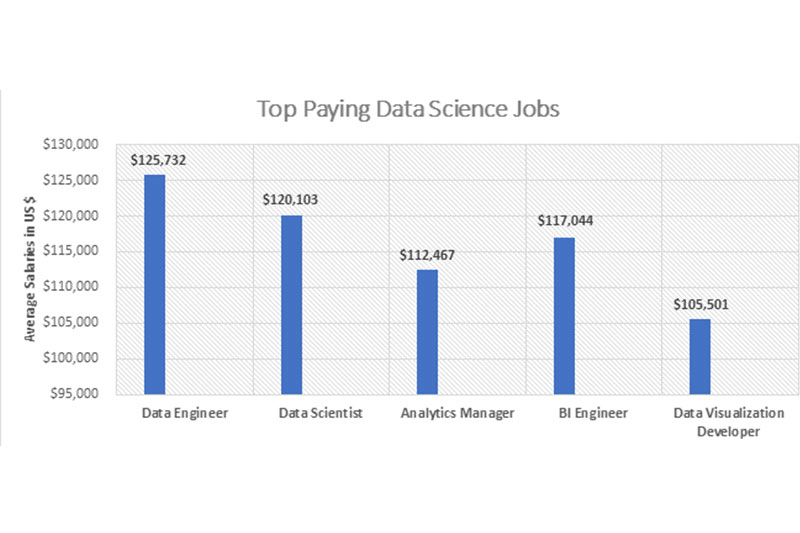
With more and more businesses using data-driven solutions, the demand for Data Science professionals has exponentially increased. Data Science is a promising career path that opens the door to several rewarding job opportunities, such as:
BI Engineer ($117,044)
Big Data Engineer ($103,092)
Analytics Manager ($112,467)
BI Specialist ($90,286)
Data Visualization Developer ($105,501)
Business Analytics Specialist ($84,601)
Data Engineer ($125,732)
Data Scientist ($120,103)
BI Solutions Architect ($120,539)
Statistician ($97,643)

Our Best Data Science Training Bootcamp in Hartford, Connecticut can be taken by:
Fresher/Beginner
Software Developer
Aspiring Data Scientist or Business Analyst
Professional with a mathematical, logistics, or analytical background
Individuals working on reporting tools, data warehousing, and BI
Industry Recognition and Thought Leadership
Unlike other bootcamps that rely on fancy ads with claims that are too good to be true, SynergisticIT relies on verifiable results and deep industry integration. The organization does not just train candidates; it actively participates in the broader technology community to stay ahead of hiring trends and technological advancements.
SynergisticIT is a regular participant and sponsor at major tech events, including Oracle Cloud World (OCW) and the Gartner Data & Analytics Summit. By engaging directly with tech leaders at these summits, SynergisticIT ensures its curriculum matches the exact tools and frameworks that enterprise companies are currently adopting.
- Watch Industry Engagements: You can view videos and pics of these tech events
- Read the Coverage: Learn how SynergisticIT is combating tech hiring fraud and setting new standards for candidate quality in their featured USA Today article.
- Understand the Value: Discover why a comprehensive upskilling program is the smartest financial decision you can make by reading the ROI blog of SynergisticIT.
The Clear Choice for Your Tech Career
The technology sector moves aggressively, and the requirements for securing a high-paying role continue to rise. Piecemeal learning, isolated short courses, and standard degrees are no longer enough to catch the attention of top-tier hiring managers. You need a program that transforms you into a versatile, multi-stack asset capable of handling data engineering pipelines, extracting insights through business intelligence, building predictive data science models, and deploying cutting-edge AI.
While there may be many programs offering data science training in Hartford, Connecticut, if your ultimate goal is to actually get hired after completing the bootcamp, there is only one logical choice: SynergisticIT’s best data science training Bootcamp in Hartford, Connecticut.
By offering a seamless blend of elite technical education, hands-on enterprise projects, interview coaching, and active corporate matchmaking, SynergisticIT provides a data science training Bootcamp in USA with job assistance that is unparalleled in the industry. Whether you are a non-coder looking to pivot, a recent graduate trying to break into the market, or a professional aiming for FAANG-level compensation, SynergisticIT’s best data science training Bootcamp in Hartford, Connecticut is the sure-shot way of ensuring a jobseeker can get hired and thrive in the modern tech economy.
review the official pages here: SynergisticIT Job Placement Program JOPP and SynergisticIT Data Science JOPP.
