Important Notice— Our url is



Best Data science Bootcamp in Chicago, Illinois with Job Placement
Chicago’s banks, insurers, hospitals, retailers, and logistics firms now hire people who can turn data into decisions, not people who only finished a short Python course. If you want the Best Data science Bootcamp in Chicago, Illinois with Job Placement, look past certificate mills and compare programs that actually get candidates hired. SynergisticIT’s Job Placement Program and SynergisticIT’s Data Science Job Placement Program are built for that outcome. JOPP is the data science training bootcamp in Chicago, Illinois plus staffing in one track: live instruction, company-style projects, certifications, interview prep, and active marketing to 24,000+ employer contacts until you start work. About 90% of JOPP graduates who land tech jobs had never held a U.S. tech role before; the other 10% are career changers and people returning after a gap. Alumni have received offers in the $95k to $155k range, often more than one offer, from firms such as Visa, Apple, PayPal, Walmart Labs, AutoZone, Wells Fargo, Capital One, Walgreens, Bank of America, SAP, Cisco Systems, Verizon, T-Mobile, Intuit, Ford, Hitachi, Western Union, Deloitte, Dell, USAA, Carfax, and Humana.
Data scientists will remain in demand in Chicago, Illinois because the city’s economy runs on data-heavy industries rather than a single software campus. Fintech has accounted for a large share of new postings, while banks such as Citi have expanded Chicago analytics headcount for risk modeling. Healthcare, insurance, industrial equipment, and restaurant-scale retail all need forecasting, personalization, fraud detection, and generative AI, and Illinois data, analytics, and AI postings were up 21.1 percent year over year in August 2026 even as statewide postings across occupations fell. CBRE counted about 21,207 AI jobs in Chicago as of June 2026, and the metro still ranks among the top U.S. markets for AI employment. Quant trading, exchanges, credit bureaus, and logistics platforms keep producing production-model work that cannot be fully offshored, so junior through senior scientists stay relevant for fraud, pricing, clinical insight, and operations. Candidates should still expect selective screening even when posting volume looks healthy.
Companies hiring data scientists in Chicago, Illinois include Google, Meta, PayPal, JPMorgan Chase, Citi, Fifth Third Bank, TransUnion, Morningstar, Enova International, CME Group, Jump Trading, DRW, AbbVie, Tempus AI, CVS Health, McDonald's, Caterpillar, Motorola Solutions, DoorDash, Mars, Bain & Company, PwC, Blue Cross Blue Shield Association, HAVI, and CoinFlip.
Salary ranges offered in Chicago generally fall near $80,000-$112,000 for junior data scientists, $113,000-$140,000 for mid-level data scientists, and $139,000-$185,000 for senior data scientists, while ZipRecruiter reported a local average around $126,438 and Indeed an average near $110,410.
Famous tech people tied to Chicago, Illinois include Eric Lefkofsky of Groupon and Tempus, Brad Keywell of Groupon and Uptake, Andrew Mason of Groupon, Matt Maloney of Grubhub, and Steven Galanis of Cameo, whose firms keep feeding product, marketplace, and health-tech talent.
Chicago’s tech employment situation remains large but uneven. CompTIA-linked figures place about 245,800 tech workers in the metro, or 5.2 percent of the workforce, with Illinois technology output above $70 billion and Chicago still a top-five U.S. tech-employment metro behind the Bay Area, New York, Seattle, and Washington, D.C. The Chicago-Naperville-Elgin unemployment rate was about 4.9 percent in July 2026, with metro employment down year over year, yet AI and analytics hiring has outpaced the broader local labor market as hybrid Loop and Fulton Market roles persist.
Why Chicago Needs Data Talent
Chicago is not a coastal “AI campus” city, and that is exactly why data skills pay off here. Loop and North Chicago employers sit on payment rails, credit files, claims, clinical trials, inventory, and customer journeys. They need people who can query those systems, explain risk, and ship models that survive audit. Illinois data, analytics, and AI postings rose 21.1% year over year in August 2026 even while statewide postings across all occupations fell 2.7%. The Chicago metro still showed more than 250 recent category postings across more than 175 companies. That is real demand, not a slogan.
Data science and data analytics matter in Illinois because they sit on the money. Financial services make up about 25% of sampled local analytics postings, with insurance, consulting, software, and life sciences close behind. Fraud models, pricing, underwriting, campaign measurement, supply-chain forecasts, and hospital operations all need the same core: clean data, a trustworthy metric, and a person who can defend it to a vice president. Learn that craft in Chicago and you are useful to employers who already budget for analytics teams.
Just data science or ML/AI classwork is not enough. Chicago postings still treat Python and SQL as table stakes (about 65% and 50% of sampled ads), while machine learning, visualization, and AWS each appear far less often as differentiators. Hiring managers want one junior who can move across analytics, engineering, and modeling, not four specialists who cannot talk to each other.
Emerging Skills Chicago Employers Ask For
Chicago companies are not only asking for “Python and pandas.” They want production-shaped skills:
- Generative AI and LLMs: prompt design, retrieval, fine-tuning, and evaluation, not demo chatbots.
- MLOps: experiment tracking, model registry, monitoring, and rollback.
- Cloud data platforms: Snowflake, Databricks, AWS Glue, Azure Data Lake, BigQuery.
- Streaming: Kafka and Spark for fraud, clickstream, and operations data.
- BI that executives will use: Power BI, Tableau, DAX, governed semantic models.
- Domain fluency: credit risk, claims, merchandising, clinical, or logistics language.
- Stakeholder communication: a decision memo, not only a notebook.
A credible data scientist in this market often also handles feature stores, data contracts, and dashboard handover. That is why JOPP trains data engineering, data analytics, data science, and ML/AI together.
Tools Across Each Stack
Data analytics / BI: SQL, Excel, Power BI, Tableau, SAS, data modeling, DAX, ETL cleaning, KPI design.
Data engineering: Python, Spark, Hadoop/Hive, Kafka, Airflow-style pipelines, Snowflake, Databricks, AWS S3/Glue, Azure Data Lake, GCP Dataflow/BigQuery, governance and security.
Data science: NumPy, Pandas, SciPy, EDA, hypothesis testing, Bayesian methods, time series (ARIMA, Prophet), regression, clustering, PCA.
ML/AI: scikit-learn, XGBoost/LightGBM, TensorFlow, PyTorch, Keras, NLP and transformers, Hugging Face, SageMaker, Azure ML, Vertex AI, plus responsible AI and explainability.
JOPP also prepares certifications from Microsoft, Oracle, Snowflake, Databricks, Azure, and AWS at no extra tuition, because Chicago employers still use those badges as a credibility check even when the ad does not list a certificate.
Chicago’s Local Hiring Picture
The metro unemployment rate was 4.9% in July 2026, with employment and labor force both down a little more than 2% year over year. Category ads are up; the broader white-collar market is cooler. That mix produces a selective hunt: openings exist, but unvetted applicants sit in ATS queues.
BLS-based summaries put Chicago data scientist median pay near $107,640 (mean about $118,860), while sampled current postings often cluster around $111k to $160k. Illinois data/AI openings showed a mean offered salary near $120,780 in August 2026. Data analyst median pay in the metro has been reported around $84,010. Indeed-style snapshots have listed hundreds of “data science” titles in Chicago, but title inflation is real: many are analyst or senior scientist seats, not true internships.
Time-to-hire is slow if you apply cold. Data scientist searches commonly run about 7 to 12 weeks internally and about 60 days to fill on SHRM-style benchmarks, with junior seats closer to 5 to 7 weeks and senior seats 9 to 13 weeks or longer. Employers convert openings into hires more slowly when the U.S. hires rate is soft, so interview-ready candidates beat volume appliers.
Entry-Level Versus Senior Seats
This is the hard math for new graduates. Only about 15% of sampled Chicago data/AI roles were entry level, versus about 40% mid-level and 30% senior. Remote was only about 15%; hybrid and on-site dominate. Internships and “junior data scientist, no experience” posts are a thin slice. Mid and senior ads still ask for U.S. production experience, a domain story, and models that left a notebook. Direct employer feeds often show a handful of live “Data Scientist” reqs that are lead, staff, or senior.
So the local picture is: demand is real, unemployment is not zero, time-to-hire is measured in weeks, and the ladder is missing many bottom rungs. That is why a placement program that builds projects, screens you, and books interviews matters more than another recorded bootcamp.
Pay Versus Chicago Cost of Living
A six-figure Chicago data offer still has to clear rent and Illinois tax. The metro cost-of-living index sits near 102.6 (U.S. = 100). Average one-bedroom rent has been cited around $1,507 a month. Illinois uses a flat 4.95% state income tax; Chicago does not add a separate city income tax.
On a $120,000 AI/data salary, take-home after federal, state, and FICA is often in the high $80ks, and rent near $1,600 still leaves more room than coastal hubs. Housing is the bargain versus San Francisco or New York; groceries, CTA, and winter utilities are not free. A JOPP-range offer of $95k–$155k can support a Loop-adjacent studio or a two-bedroom farther out, especially if you avoid coastal-style rent. The gap is not “Chicago is cheap.” The gap is that job-ready, multi-stack talent can earn enough here to outrun housing and tax without needing Bay Area equity.
-
Why Typical Bootcamps Fail
Many coding bootcamps sold job guarantees they could not keep. They collected full tuition up front, ran recorded lectures, used one generalist instructor, issued a certificate, and told graduates to “network.” Placement lagged, reviews soured, and a large number of those brands shut down. Not all bootcamps are equal. Technology has to be learned in depth, over months, from people who still sit in the industry. SynergisticIT has been in tech hiring since 2010—over 15 years—and JOPP’s promise is narrower and harder: candidates who successfully complete the program get marketed until they are hired.
JOPP is not a separate side product. It is the data science training bootcamp in Chicago, Illinois. It is online and remote from anywhere in the USA, so a Chicago jobseeker does not relocate for class. It is training plus staffing, which is why it is called a job placement program. Coding bootcamps train and leave you. JOPP schedules interviews with tech companies until you have an offer.
Instead of paying for four or five cheap courses that each cover one tool, you cover data engineering, data analytics, ML/AI, data science, projects, interview prep, and certifications in one program. If you are asking how to get hired as a recent cs graduate, that combination—skills, projects, and someone who will pick up the phone to employers—is the missing piece a CS diploma does not include.
How SynergisticIT Differs
Curriculum quality. SynergisticIT sits in tech-industry rooms at Oracle CloudWorld, Gartner Data & Analytics, and related events, and candidates are interviewing every week. Curriculum is adjusted in real time to what those rooms and those interviews actually ask. Watch SynergisticIT event videos from JavaOne and Oracle CloudWorld. Fancy ads are easy; live market feedback is not.
Instructor quality. Most bootcamps recycle alumni, recordings, or teachers who appear a couple of hours a week. JOPP uses industry professionals; the average instructor has more than 10 years in the domain.
Number of instructors. Most bootcamps use one or two people for every topic. Data Science JOPP and Java JOPP each run with 5–6 specialists: separate instructors for data analytics, data engineering, and data science/ML (and on the Java side, separate instructors for Java, databases, advanced Java, and DevOps).
Cost and payment. Transparent cost: $10k before the program and a $26k balance after a job offer, payable over two years. If there is no job offer, no balance accrues. Most bootcamps take all fees up front and advertise refunds with clauses you cannot redeem.
Duration. 4–5 hours a day, five days a week, across five months, live, no recorded-as-the-product model. Ask every bootcamp you consider to put that in writing.
Student-to-instructor ratio. About 5-to-1, versus about 20-to-1 elsewhere.
Projects. Built to current company stacks. Only projects you actually complete go on the resume.
Alumni success. Read, watch, and listen to alumni on SynergisticIT Reviews. Offers commonly land between $95k and $155k, including multiple offers. Check photographs, videos, offer letters, and years in business on the JOPP pages. Compare that with SynergisticIT’s ROI versus colleges and SynergisticIT’s USA Today feature on how it is changing how tech companies source talent.
Career help after class. JOPP markets you to 24,000+ company contacts, rewrites the resume, runs interview prep, and schedules interviews. Most bootcamps hand you tips. Get their offer in writing.
Why trust this. No hidden “guarantee” theater. Transparent cost, documented outcomes, event presence, reviews, and a model that pays the school when you get hired—not when you click enroll.
If you are comparing pathways after a layoff or a visa shock, also read what $100k H-1B filing fees mean for tech jobseekers. Employers who can hire ready, multi-stack talent without a long ramp have a stronger case to bring you on.
Mid-program, keep the two core pages in front of you: SynergisticIT’s Job Placement Program (JOPP) and SynergisticIT’s Data Science JOPP.
Career Gaps: Seven Ways JOPP Helps
- Skills are reassessed against today’s Chicago stack, not the tools from your last job.
- Live daily labs rebuild muscle memory that atrophies during a break.
- Client-style projects replace a blank employment year with work you can defend.
- Resume language is rewritten around those projects instead of apologizing for the gap.
- Interview reps cover the “what have you been doing?” question until the answer is calm and specific.
- Employer marketing frames you as current talent, not a returning intern.
- The team stays with you through screens until an offer closes, so the gap does not restart.
Recent Graduates With No Experience: Seven Ways JOPP Helps
- You get production-shaped tech stacks, not only campus coursework. Pair this with tech stacks computer science graduates should master.
- Projects become the experience line employers say you lack.
- Certifications from Microsoft, Oracle, Snowflake, Databricks, Azure, and AWS put third-party proof on a thin resume.
- DSA, SQL, ML case, and behavioral drills match how Chicago banks and consultancies actually interview.
- A 5-to-1 instructor ratio catches holes a 200-person lecture will not.
- Client marketing answers how to get hired as a recent cs graduate when campus career services only host a fair.
- You interview as a junior who can sit with analytics, engineering, and ML teams, which is how you compete for the scarce 15% of entry seats.
Jobseekers Who Want a Tech Hire: Seven Ways JOPP Helps
- One program replaces a pile of disconnected bootcamps.
- Payment after offer aligns the school with your hire, not their enrollment target.
- Immersive live hours create depth that weekend recordings never do.
- Specialists teach each subject to job-market depth.
- Marketing to 24,000+ contacts is done for you, not assigned as homework.
- You practice until you can explain a pipeline, a dashboard, and a model in the same loop.
- Post-grad support continues through the start date, so “I finished a course” becomes “I started a job.”
QA, BA, PMs, and Non-Coders
QA testers, business analysts, program managers, and people from statistics or mathematics should treat Data Science JOPP as a on-ramp, not a threat. A large share of analytics work overlaps what you already do: requirements, test cases, SQL extracts, Excel models, acceptance criteria, stakeholder workshops, and “what changed this week?” reporting. Those skills are minimal-to-almost-no coding at the start.
Shared ground across BA, QA, data analyst, and BI analyst roles includes:
- Translating a business question into a metric.
- Checking whether a number is complete, unique, and timely.
- Building a simple dashboard or UAT checklist.
- Writing the story that a director will actually read.
- Using SQL or a BI tool more than a deep-learning library.
From there, JOPP adds Power BI/Tableau, warehousing vocabulary, Python for analysis, and then ML when you are ready. QA staff already think in edge cases—the same habit that makes a good data validator. BAs already own process maps—the same habit that makes a good analytics translator. Statistics and math graduates already own distributions; they need tooling and interview reps, not another theory class. A career in data science, data analytics, and BI analytics is reachable from those backgrounds if the program is immersive and the marketing is real.

Skills you will Learn in our Best Data science Bootcamp in Chicago, Illinois
Tech Stack Covered in SynergisticIT’s data science training bootcamp in Chicago
The Data Science Job Placement Program is built around employer demand and includes:
- Python (core & advanced)
- SQL and database design
- Data analytics tools (Tableau / Power BI)
- Statistics and probability
- Data engineering (ETL, Spark, Airflow)
- Machine learning algorithms
- Deep learning fundamentals
- Cloud platforms (AWS)
- MLOps concepts
- Real-world enterprise projects
- Interview preparation and certifications
This eliminates the need for candidates to jump between multiple bootcamps or training providers.
Introduction to Data Science with Python
Python Introduction & Data Structures
Numerical Python (NumPy)
Pandas Data Analysis
Matplotlib & Seaborn Data Visualization
Data Manipulation: Cleansing – Munging
Data Analysis: Visualization Using Python
Introduction to Artificial Intelligence (AI) & Machine Learning (ML)
Machine Learning Techniques & Algorithms
Decision Tree and Random Forest Algorithm
Naive Bayes and KNN Algorithm
Support Vector Machine Algorithm
Model Deployment & Tableau
Introduction to Statistics
Introduction to Predictive Modelling
Data Exploration for Modelling
Data Preparation
Ensemble Learning Techniques
Web Scraping using Python Beautiful Soup
Time Series Analysis
Mastering Data Preparation and Feature Engineering
Natural Language Processing (NLP) & Text Mining
Market Basket Analysis

Who can take our Best Data science Bootcamp in Chicago, Illinois
Our Data Science training in Chicago is designed for:
Professionals with a mathematical, logistics, or analytical background
Statisticians, Economists, and Mathematicians
Software developers or programmers
Aspiring Data Scientists or Business Analysts
Individuals working on Business Intelligence, data warehousing, and reporting tools
Beginners who want to improve their critical thinking abilities and analytical skills
Career Options After Best Data science Bootcamp in Chicago, Illinois
Data Science is a gateway to a splendid number of jobs. Here are some lucrative careers you can consider after completing Data Science training in Chicago:
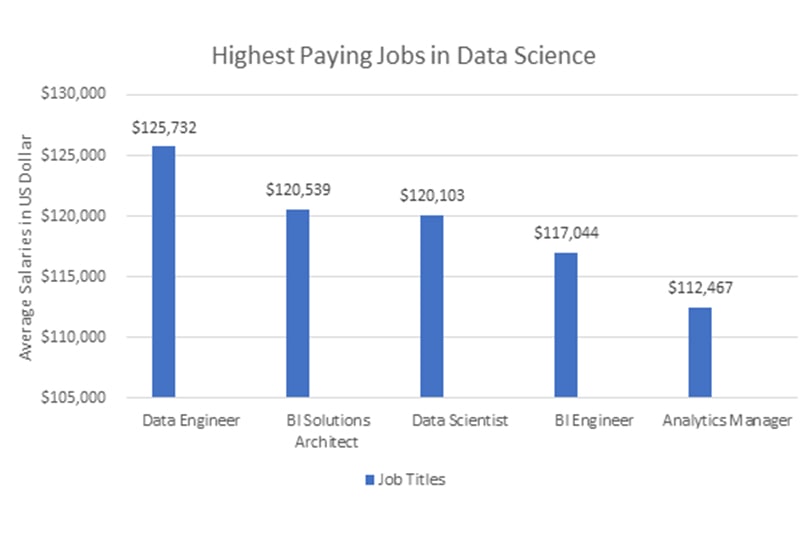
Data Engineer ($125,732)
BI Solutions Architect ($120,539)
Data Scientist ($120,103)
Business Intelligence (BI) Engineer ($117,044)
Analytics Manager ($112,467)
Data Visualization Developer ($105,501)
Big Data Engineer ($103,092)
Statistician ($97,643)
BI Specialist ($90,286)
Business Analytics Specialist ($84,601)
Companies Hiring SynergisticIT Candidates ($95K–$155K)
Graduates of SynergisticIT’s Data Science JOPP have been hired by companies such as Visa, Apple, PayPal, Walmart Labs, AutoZone, Wells Fargo, Capital One, Walgreens, Bank of America, SAP, Cisco Systems, Verizon, T-Mobile, Intuit, Ford, Hitachi, Western Union, Deloitte, Dell, USAA, Carfax, Humana, and many more.
Salary offers for data science, analytics, and ML roles typically range from $95,000 to $155,000, depending on experience, role, and location.
Results Over Marketing Hype
Unlike many bootcamps that rely on flashy ads, SynergisticIT emphasizes results. The company actively participates in industry events such as Oracle CloudWorld (OCW) and the Gartner Data & Analytics Summit, and shares real candidate outcomes through videos and media coverage, including features referenced by USA Today.
Why Employers Hire JOPP Candidates
Employers get a win because the candidate is worth more than the junior salary on the offer letter.
- Current stack, less ramp. Training follows client demand and industry events, so week-one work is possible.
- Pre-screened talent. Technical and job-fit checks happen before your calendar fills.
- Certified depth. Java, DevOps, AWS, Azure, Power BI, Snowflake, and related credentials sit on top of the project work.
- Multi-stack range. One junior who can help backend-adjacent data work, analytics, and ML/AI beats three siloed new hires.
- Lower hiring risk. Structured training, projects, interview prep, and screening cut the chance of a failed seat.
- Day-one contribution. Practical drills replace “we will train them for six months.”
- Genuine project resumes. No embellished staffing-company fiction.
In short, companies hire JOPP people because they are trained, screened, project-ready, interview-prepared, and aligned to current roles. That is also the practical answer to how to get hired in FAANG companies and FAANG-adjacent enterprises: Apple and similar names already appear among SynergisticIT placements, but they hire evidence, not slogans. Depth plus interviews plus a network beats a bootcamp logo.
Start Now
Delaying enrollment does not compress JOPP. The calendar stays long because skills, projects, interviews, and client outreach have to happen in order. Employers pay for that finished candidate, not for a shorter brochure. Begin while Chicago’s analytics postings are still rising; the work is demanding, and the payoff is a full-time job offer.
There are many data science bootcamps that will sell training in Chicago, Illinois. If the goal is to get hired after the bootcamp, the serious choice is SynergisticIT’s best data science training Bootcamp in Chicago, Illinois—the Data Science JOPP. That is the sure path for a jobseeker who wants an employer on the other side of the work.
Contact SynergisticIT, ask for the Data Science JOPP details in writing, and start the live program from Chicago or anywhere in the US