Important Notice— Our url is


Jobseekers hunting for data analyst, BI analyst, QA analyst, or business analyst jobs in New York no longer win interviews with Excel, SQL, and a certificate. SynergisticIT’s Data Science Job Placement Program (JOPP) is the Data Analyst Bootcamp training in New York that pairs multi-stack skills with interviews until a full-time offer lands.
New York hiring managers still post titles such as Data Analyst, Business Intelligence Analyst, QA Analyst, and Business Analyst. The work behind those titles has changed. Automation, generative AI, and tighter budgets have compressed entry-level reporting, manual test scripts, and requirements-only BA work. Companies want hybrid people who can analyze data, engineer pipelines, and apply machine learning, not specialists who only write queries.
Employers that hire these roles include JPMorgan Chase, Citigroup, Morgan Stanley, Bank of America, American Express, Amazon, DoorDash, The Trade Desk, Twitch, Lyft, Justworks, The New York Times, Hearst Magazines, Disney, Macy’s, Pfizer, NewYork-Presbyterian, Verizon, T-Mobile, New York University, Corebridge Financial, Optimum, Faire, Hiscox, and Hudson Insurance Group.
Junior data analysts and BI analysts in New York typically earn $65,000 to $85,000. Mid-level analysts more often receive $85,000 to $120,000 as they own dashboards and stakeholder work. Senior data analysts and BI analysts commonly command $115,000 to $160,000, and finance or product-analytics roles can exceed that band.
New York will keep hiring these analysts because its economy runs on measurement. Wall Street firms need daily risk, trading, and compliance views that cannot be left to generic software. Hospitals and life-science companies use BI to track patients, trials, and costs under tight regulation, while publishers, retailers, and ad-tech platforms staff analysts who can build trusted dashboards around audience and conversion data. Cloud tools and AI increase, rather than erase, the need for people who define metrics, check data quality, and brief executives. High rents and wages also push companies to squeeze more insight from existing operations, which keeps junior, mid-level, and senior analytics roles open across Manhattan and the wider metro.
Why Data Analyst Skills Still Matter
Data is how New York banks, retailers, health plans, media firms, and logistics companies decide what to fund, what to cut, and what to ship. Analysts who can clean messy tables, explain a trend, and recommend an action remain valuable because executives will not bet millions on a dashboard they cannot trust.
Importance of analyst skills shows up in five practical ways. First, every product, campaign, and risk model still needs someone who can define the question. Second, AI output is only as good as the data feeding it, so quality checks and metric definitions still need humans. Third, stakeholders hire people who translate numbers into a story a VP can act on. Fourth, regulated industries in New York need audit trails, not black-box slides. Fifth, hybrid analysts who add Python, cloud warehouses, and BI modeling become the people teams keep when headcount shrinks.
A career in data analytics is not disappearing. Narrow versions of it are. SQL plus Excel is a starting point, not a job offer. Jobseekers who treat analysis as a doorway into data science, BI, and data engineering stay employable. Jobseekers who stop at pivot tables compete with tools that already do that work.
Emerging Skills Companies Ask For
Employers interviewing for data analyst, BI, QA, and business analyst roles now mix classic reporting with cloud, AI, and engineering. The stack showing up in 2026 postings is broader than “know SQL.”
Emerging skills for Data Analysts and Business Intelligence include advanced SQL with window functions and warehouse dialects, Power BI or Tableau with real data models, Python for repeatable analysis, Snowflake and Databricks, cloud analytics on AWS or Azure, and working literacy in machine learning and generative AI. Companies also ask for data storytelling, experiment design, and the judgment to say when a model or a chatbot is wrong.
Jobseekers searching for a bootcamp or training to get hired into tech jobs should treat those skills as one connected path. A BI dashboard without pipeline knowledge breaks in production. An ML notebook without analytics context never reaches a business user. SynergisticIT’s Job Placement Program trains across those layers instead of selling a single-tool certificate.
Why Traditional BA, QA, and Analyst Roles Are Shrinking
Traditional Business Analyst, QA, and data analyst roles are reducing because AI and automation now draft user stories, generate test cases, write SQL, and build first-pass dashboards. Companies tightening budgets do not hire three people to do work one hybrid teammate plus AI can cover.
Manual testing, scripted regression, and Excel-only reporting are the first tasks to get automated. Requirements gathering that never touches data is next. Hiring managers still need testers, BAs, and analysts, but they want people who can validate model output, query production-like data, and ship insights without waiting for a separate engineering ticket.
Companies are looking for hybrid candidates who can do data analytics, data science, ML/AI, and data engineering along with basic SQL, QA, Excel queries, test scripts, and manual testing. A junior hire who can only run test cases or only write BRDs is a cost. A junior hire who can test, analyze, model, and help move data is a budget win.
That is why QA testers, Business Analysts, program managers, and people from statistics, mathematics, or non-coding backgrounds should do the SynergisticIT data science JOPP to get started on a career in data science. Many of their current skills already overlap with analytics. The missing pieces are modern tools, projects, and a placement engine that reaches hiring companies.
Overlapping Skills Across BA, QA, Data, and BI
Business analysts, QA analysts, data analysts, and BI analysts already share a large skill base, and much of it involves minimal to almost no coding at the start. Requirements, acceptance criteria, test cases, Excel, SQL, metrics, stakeholder communication, and documentation transfer cleanly into analytics work.
Common overlapping skills include problem framing, process mapping, data validation, SQL filters and joins, Excel analysis, dashboard reading, UAT, and explaining findings to non-technical managers. Those skills can be learnt without becoming a software engineer first. From that foundation, Python, Power BI, Snowflake, and introductory machine learning become reachable.
A career in data science, data analytics, and BI analytics can be achieved through SynergisticIT data science JOPP because the program starts where BA, QA, and stats people already are, then adds the stacks employers actually screen for. Program managers benefit too: they already manage scope and stakeholders, and data fluency makes them more hireable in product, operations, and analytics teams.
Just Data Analyst skills are not enough. In order to get employed, jobseekers need multiple tech stacks: data engineering, data analytics, data science, and AI and Machine Learning. One short course in Tableau will not survive a New York interview loop that also asks about pipelines, cloud warehouses, and model basics.
-
Technologies Employers Ask For by Track
Data Analytics and BI postings ask for SQL, Excel, Power BI, Tableau, data modeling, DAX or calculated fields, dashboard design, SAS in some enterprises, and the ability to turn a KPI into a decision. Data Science postings add Python, NumPy, Pandas, statistics, EDA, regression, clustering, time series, and experiment thinking.
Machine Learning and AI interviews go further: Scikit-Learn, TensorFlow or PyTorch, NLP, transformers, LLMs, prompt engineering, GenAI, agentic workflows, model evaluation, and cloud ML tools such as SageMaker, Azure ML, or Vertex AI. Data Engineering asks for Spark, Databricks, Snowflake, Kafka, Hadoop pieces in legacy shops, AWS Glue and S3, Azure Data Lake, GCP BigQuery, ETL, and governance.
SynergisticIT Data Science JOPP covers those families together: Python, SQL, Tableau, Databricks, Snowflake, PyTorch, LLMs, GenAI, Agentic AI, Power BI, machine learning, and AI, plus projects that look like client work rather than tutorial clones. That is the difference between a class and a hireable profile.
How JOPP Helps Career-Gap Jobseekers
A career gap is not the automatic rejection many jobseekers fear. Employers reject rusty skills and empty recent work, not the fact that life interrupted a resume. Landing a tech job after a career gap is easier when the gap is followed by current projects, screening, and client marketing.
- SynergisticIT Job placement rebuilds current tools so the gap is no longer the first thing a recruiter sees.
- Structured projects replace “I was out of work” with evidence of pipelines, dashboards, and models.
- Technical screening happens before the market, so interviews start from proven fit.
- Resume and interview coaching give a clean, honest story instead of apology language.
- Client marketing to 24,000+ company contacts creates interviews that job boards rarely produce after a break.
How JOPP Helps Recent Graduates
Recent graduates with no experience get filtered out of New York tech roles because companies want proof, not GPA. JOPP exists to manufacture that proof without pretending campus labs were production jobs.
- Graduates gain job-ready stacks instead of leftover coursework that employers no longer test.
- Project work becomes the experience section, with only real work listed.
- Interview prep covers technical rounds New York banks and product companies actually run.
- Certifications from Microsoft, Oracle, Snowflake, Databricks, Azure, and AWS add credibility at no extra cost.
- Placement support continues until an offer, which is the part campus career offices cannot do at this scale.
About 90% of JOPP graduates who get hired at tech jobs have never worked a tech job before. The other 10% are career changers, people with career gaps, and similar profiles. Recent graduates should join because JOPP can give them tech skills, project work, and the most important outcome: getting hired into tech roles at strong companies.
How JOPP Helps Jobseekers Who Want Tech Jobs
Plenty of people already want data analyst jobs or a wider tech seat. Wanting is not a strategy. Placement is.
- Training is mapped to live client demand, not last year’s syllabus.
- Hybrid skills let one candidate interview for analyst, BI, data science, and adjacent roles.
- Mock interviews and a large question bank reduce first-round failure.
- SynergisticIT schedules and markets interviews instead of handing over a PDF of “tips.”
- Support continues after class, which is when most bootcamp students stall.
Why Companies Hire SynergisticIT JOPP Candidates
Companies hire SynergisticIT JOPP candidates because the program is built around client demand, not around selling a weekend workshop. Current tech-stack alignment and job-ready technical skills come from industry interaction and hands-on upskilling, so new hires may need less ramp-up time.
Pre-screened talent matters. JOPP uses rigorous technical screening before candidates go to market, so companies receive people already checked for technical and job fit. Candidates are certified on Java, DevOps, AWS, Azure, Power BI, Snowflake, and other tools, which adds credibility to an already diverse stack.
JOPP candidates are multi-stack skilled. A company may prefer one junior who can contribute across analytics, engineering, and ML/AI work rather than three narrow juniors. Hiring risk drops because employers get people who completed structured training, projects, interview prep, and screening. They are positioned for day-one contribution, with genuine project-based resumes rather than fake or embellished ones.
In short, companies hire JOPP candidates because they are trained, screened, project-ready, interview-prepared, and aligned with current tech roles. Hiring managers who do not want to second-guess work quality or technical skill treat completed JOPP profiles as a safer choice than unvetted job-board applicants.
Quality only applies to people who finished. Make sure they are actual SynergisticIT JOPP candidates who completed the program. If they have not, they will not be good. Grads who finished the whole program and certifications are tested to excel on projects. That is why companies such as Visa, Apple, PayPal, Walmart Labs, AutoZone, Wells Fargo, Capital One, Walgreens, Bank of America, SAP, Cisco Systems, Verizon, T-Mobile, Intuit, Ford, Hitachi, Western Union, Deloitte, Dell, USAA, Carfax, Humana, and many more keep hiring SynergisticIT candidates at salaries of $95k to $155k.
Tech companies pay those high salaries because strong JOPP grads can outperform some people labeled “experienced,” move faster, and take more responsibility. Companies are tired of fake or ineffective candidates and prefer not to depend only on job boards and staffing firms that waste interview calendars. JOPP candidates are often stronger than 3–5 years experienced hires who stayed in a thin stack, because deeper multi-skill range would otherwise cost roughly twice the salary. Multiskilled people take multiple responsibilities and give more value for money.

Data Analytics: SQL, Excel, Tableau, Power BI, KPI reporting
Data Science: Python, statistics, Pandas, NumPy, model evaluation
Machine Learning / AI: scikit-learn, PyTorch, LLM awareness, GenAI
Pipelines, cloud data storage, ETL workflows, Databricks, Snowflake, and data modeling.
- Python
- SQL
- Tableau
- Power BI
- Databricks
- Snowflake
- PyTorch
- Machine Learning
- LLM / GenAI / Agentic AI
- Cloud and project-based preparation
Introduction to Data Science with Python
Python Introduction & Data Structures
Numerical Python (NumPy)
Pandas Data Analysis
Matplotlib & Seaborn Data Visualization
Data Manipulation: Cleansing – Munging
Data Analysis: Visualization Using Python
Introduction to Artificial Intelligence (AI) & Machine Learning (ML)
Machine Learning Techniques & Algorithms
Decision Tree and Random Forest Algorithm
Naive Bayes and KNN Algorithm
Support Vector Machine Algorithm
Model Deployment & Tableau
Introduction to Statistics
Introduction to Predictive Modelling
Data Exploration for Modelling
Mastering Data Preparation and Feature Engineering Techniques
Ensemble Learning Techniques
Web Scraping using Python Beautiful Soup
Time Series Analysis
Deep Learning
Natural Language Processing (NLP) & Text Mining
Market Basket Analysis
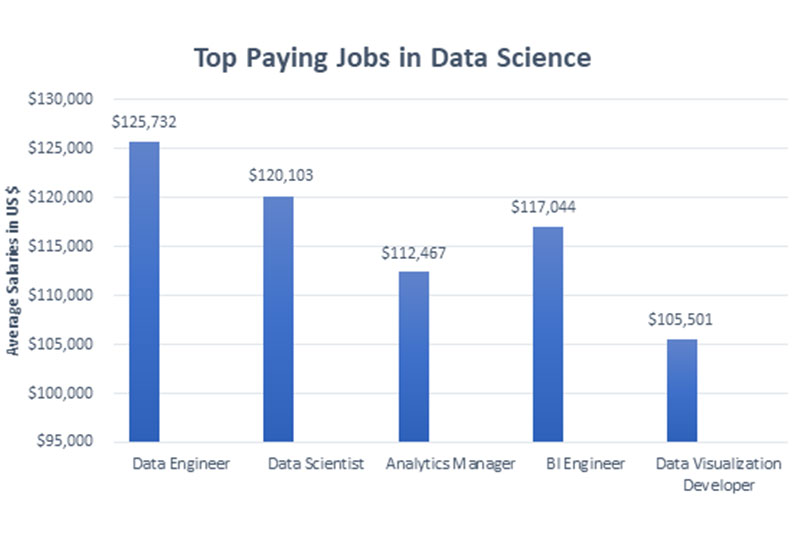
Career Outlook after Data Science Training
BI Engineer ($117,044)
Data Scientist ($120,103)
Data Engineer ($125,732)
BI Solutions Architect ($120,539)
Analytics Manager ($112,467)
Data Visualization Developer ($105,501)
Statistician ($97,643)
BI Specialist ($90,286)
Business Analytics Specialist ($84,601)
Big Data Engineer ($103,092)

Who is suitable for our online Data Analyst training ?
Anyone who wishes to make a mark in the Data Science industry can enroll in this Data Science Analyst Training in New York. This training is best suited for:
Freshers.
Graduates
Software Developers
Statisticians
Economists
Professionals with Mathematical, analytical, or logistics background
Individuals working on data warehousing or reporting tools
Why This New York Path Is Not a Typical Bootcamp
SynergisticIT’s Data Analyst Bootcamp training in New York is not a separate short class. It is the Data Science Job Placement Program, available from anywhere in the USA, combining training plus staffing. That is why it is called a Job placement program and not just a Data Analyst Bootcamp. Most bootcamps train and leave students to fend for themselves. JOPP prepares interviews, schedules them, and markets attendees to tech companies until they get hired.
Not all Data Analyst Bootcamps and coding bootcamps are equal. Technology should be learnt in depth, not from any random BI Analyst Bootcamp or training shop, but from a company in the tech industry for over 15 years: SynergisticIT. Bootcamps fail at hiring because they sold certificates and refund language they could not keep, which is why so many have shut down. JOPP makes a promise it keeps for people who successfully complete the program: getting hired into tech companies.
About 30% of candidates who join already tried other coding bootcamps, Udemy, Coursera, or university bootcamps and did not get hired. JOPP costs more than a cheap course, and that is the point. It saves the money and months burned on programs with no outcome. Compare the return in the ROI of the Job Placement Program versus college-style spending.
Unlike bootcamps with fancy ads, SynergisticIT leads with results, industry presence, and public proof. Review alumni stories on SynergisticIT Reviews, watch event footage from Oracle CloudWorld, JavaOne, and the Gartner Data & Analytics Summit in the video and photo gallery, and read the USA Today coverage of how SynergisticIT sources tech talent. Related reading on city demand includes best cities for tech jobs.
How SynergisticIT Compares to Bootcamps and Staffing Firms
Curriculum quality stays tied to real openings. SynergisticIT is involved in tech-industry interactions at Oracle CloudWorld, Gartner data analytics events, and similar conferences. Candidates are actively interviewing, so the curriculum is adjusted in real time to job-market requirements.
Instructor quality is not alumni recordings or a couple of hours a week. Industry professionals teach, with an average instructor having more than 10 years of experience. Number of instructors is another split. Most bootcamps use one or two people for every topic. SynergisticIT’s data science and Java placement tracks use 5–6 instructors who specialize: separate instructors for data analytics, data engineering, and data science/machine learning, and on the Java side separate instructors for Java, databases, advanced Java, and DevOps.
Cost and payment are transparent: $10k before training and the balance $26k on landing a job offer, payable over 2 years. If there is no job offer, no payments accrue. Most bootcamps take all fees upfront and advertise refunds with clauses that are hard to redeem. The qualifying offer bar is $81k or higher.
Duration is 4–5 hours each day, spread over 5 months, 5 days a week. It is a live, immersive program with instructors and no recorded-session substitute. Every potential enrollee should ask competing bootcamps that question. Student-to-instructor ratio is 5-to-1, compared with about 20-to-1 elsewhere.
Projects are tailored to company requirements and current stacks. Only projects you actually work on appear on the resume. Alumni success is public in photos, audio, and video; alumni land high-paying offers in the range of $95k to $155k, often with multiple offers. Certifications from Microsoft, Oracle, Snowflake, Databricks, Azure, and AWS are included at no extra cost.
Career and job placement help after graduation is the staffing half. SynergisticIT markets to 24,000+ company contacts and takes over outreach. Bootcamps often issue a certificate and leave hunting to the enrollee. Here, hand-holding runs from day one of class to day one on the job, including resume work, interview prep, and scheduled interviews. Ask any other bootcamp for specifics in writing.
Why trust this model: photographs of successful alumni on the JOPP pages, video reviews, offer-letter outcomes, and years in business. There are no fake guarantees with hidden clauses. Cost and job outcomes are stated plainly.
Start Now, Because Delay Only Moves the Offer
Putting off enrollment will not shrink SynergisticIT’s JOPP; it only postpones the job offer. The calendar is long because skills, projects, interviews, and client marketing have to happen before placement. That demanding stretch is exactly what employers pay for. Begin now. The path is not short, but the prize is a full-time job offer.
There may be hundreds of Data Analyst Bootcamps in New York that advertise Data Analyst Bootcamp training in New York. If the goal is to get hired after the bootcamp, there is one serious choice: SynergisticIT’s Data Analyst Bootcamp training in New York. It is the sure-shot way for a jobseeker to get hired, because training, projects, certifications, and placement sit in one program instead of four or five disconnected courses.
If you are a QA tester, business analyst, BI analyst, recent graduate, or career-gap jobseeker ready to move into data analytics, data science, and AI-adjacent work, contact SynergisticIT and start the Data Analyst career journey. Call (510) 550-7200, review the Data Science JOPP, and apply only if you are prepared to complete the full program that companies actually hire from.