 Important Notice— Our url is



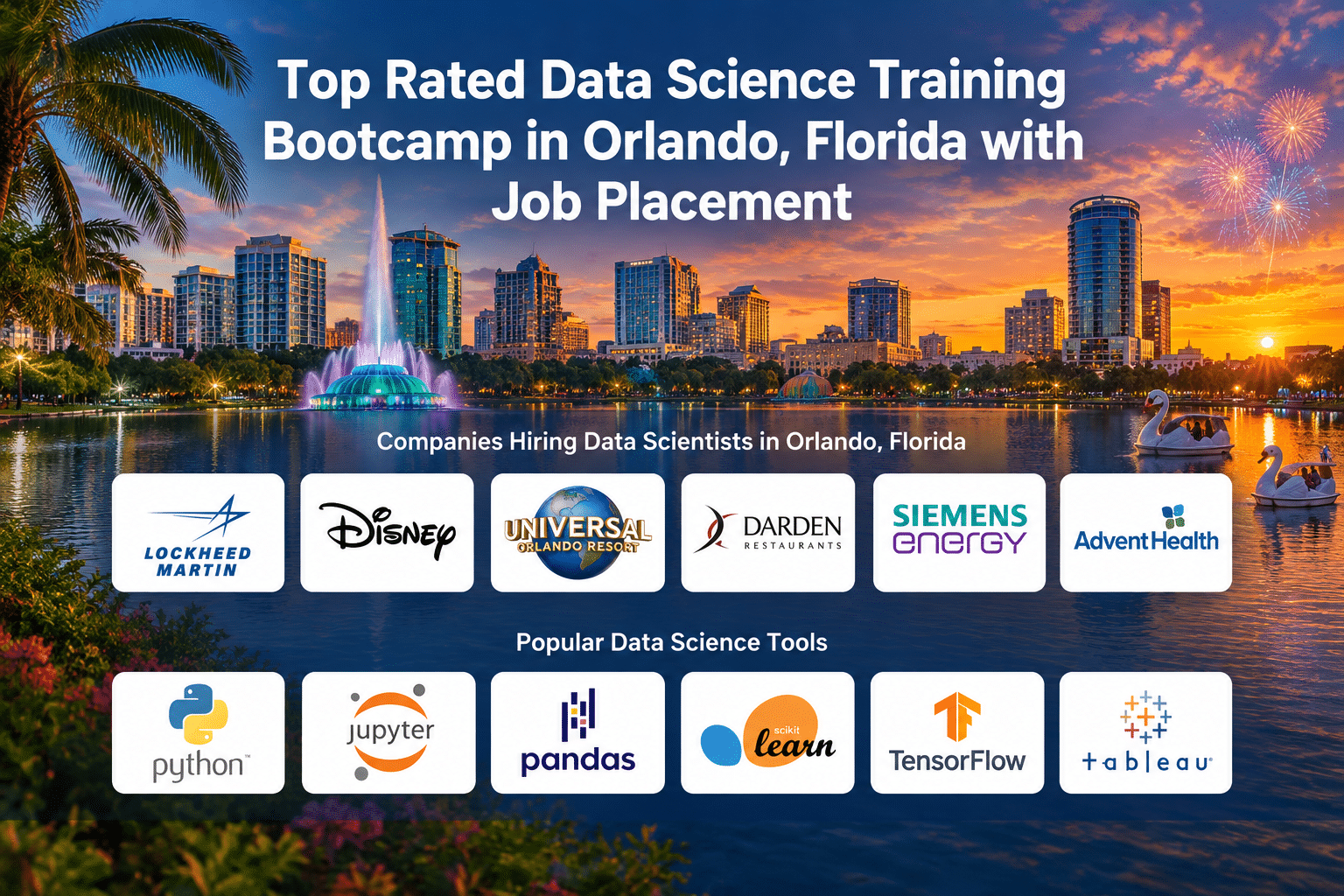
Top Rated Data Science Training Bootcamp in Orlando, Florida
A published Orlando-only gender split and seniority mix do not exist, so the figures below separate local labor data from national tech-hiring patterns. This guide is written as original copy for readers comparing a top rated Data science training Bootcamp in Orlando, Florida with a placement model, not as a copy of other city pages.
Local hiring picture
Orlando’s data market is real, and it is smaller than national headlines suggest. In the May 2025 federal wage survey, the Orlando-Kissimmee-Sanford area had about 1,440 data scientists, a location quotient of 0.61 (rarer than the U.S. average), and a median wage of $106,590, about $13,640 under the national median. That is employment already on payroll, not a live opening count. Broader “data science” searches on Indeed in early November 2026 were running well above 100 listings, while the tighter “data scientist” title was in the dozens and changed by the day. Treat board counts as a snapshot, not a census.
The metro unemployment rate was a preliminary 4.2% in September 2026, with a civilian labor force near 1.54 million. That is a moderate local job market, not a boom and not a collapse. It also is not a data-science unemployment rate. No official series isolates unemployed data scientists in Orange, Osceola, and Seminole counties.
Time-to-hire for Orlando data science roles is not published as one official number. Across U.S. jobs, SHRM-style benchmarks still sit near 44 days to fill. Specialized recruiters put an internal data-scientist search at roughly 7 to 12 weeks, shorter for associate analytics work and longer for senior or generative-AI profiles. In Orlando, hospitality, defense-simulation, healthcare, and finance employers add extra screens—domain cases, clearance-adjacent checks, and stakeholder rounds—so a clean local loop often lands in that same multi-week band rather than a one-week close.
Roles showing up in local descriptions are wider than the title “data scientist.” Recent Orlando-area posts have asked for data scientists, AI and GenAI scientists, machine learning engineers, full-stack data engineers, data analysts, BI analysts, workforce-analytics scientists, and OSINT or defense-analytics specialists. Employers visible in those feeds include Disney Experiences, Universal Orlando Resort, Lockheed Martin, PwC, Thales, Darden, and Cru. The work described is applied, not academic: retrieval-augmented generation and agent workflows, ETL and ELT pipelines, Kafka-style streaming, SQL at warehouse scale, Power BI or Tableau stories, model monitoring, and the ability to explain a result to a non-technical manager.
Female-to-male mix. No public source publishes a female-to-male ratio of tech jobseekers in Orlando. Nearby Florida tech workforces in a 2026 city comparison were about 26.6% women in Miami, 25.7% in Tampa, and 29% in Jacksonville. That is roughly one woman for every two to three men, and it describes workers, not applicants. Orlando’s theme-park, simulation, and healthcare employers do hire women into analytics and data roles, but the applicant pool for coding-heavy scientist seats still skews male. A placement path that markets candidates one by one matters more here than a job fair that assumes a balanced room.
Junior, mid-level, and senior share. Orlando does not publish a clean split of data-science openings by level. National tech postings are the clearest proxy, and they are harsh on beginners. Indeed Hiring Lab’s read of U.S. software-development listings in the first quarter of 2026 put senior roles at 69.3% and entry-level roles at 4.5%, leaving roughly a quarter for mid-level work. A separate October 2026 scan of 32,283 live tech roles found junior at 10.4%, mid-level at 10.1%, senior at 56%, and staff-plus at 19.1%. Entry-level postings were also down about 7.5% year over year while senior postings rose. Local title searches echo the tilt: senior and specialized scientist posts are easy to find, while true junior scientist and internship seats are a thin slice of an already small 1,440-person occupation. Anyone asking how many entry-level, junior, and internship data scientist roles exist versus mid-level and senior roles that require U.S. experience should assume the experienced seats dominate, and that “U.S. experience” on a senior req is doing the filtering work a bootcamp certificate will not do.
Orlando’s data science market is smaller than Miami’s, yet durable, because theme parks, defense simulation, hospitals, and corporate headquarters depend on forecasting, personalization, and machine learning rather than visitor seasonality alone.
Employers that hire data scientists in the metro, excluding staffing firms, include Lockheed Martin, The Walt Disney Company, Universal Orlando Resort, SeaWorld Parks & Entertainment, AdventHealth, Orlando Health, Nemours Children’s Health, Electronic Arts, L3Harris Technologies, Siemens Energy, Darden Restaurants, Travel + Leisure Co., Marriott Vacations Worldwide, Hilton Grand Vacations, AAA, ThreatLocker, Stax, Engineering & Computer Simulations, Red 6, BNY Mellon, Charles Schwab, Deloitte, General Dynamics Mission Systems, SAIC, and OneRail.
These are Orlando market ranges, not a posted offer from every employer. Junior data scientists commonly see about $58,000 to $86,000, near Indeed’s junior band of $57,672 to $85,438 and a PayScale entry figure near $79,000. Mid-level pay more often falls between $90,000 and $135,000. The Bureau of Labor Statistics put the May 2025 Orlando median at $106,590, with the middle half between $82,440 and $135,290. Senior roles run $122,000 to $176,000, in line with Indeed’s senior range of $121,677 to $175,220 and an Orlando senior average near $146,000. The local 90th percentile reaches $165,990. Florida has no state income tax, so take-home pay beats the base.
Demand should hold because this work sits inside operations these employers cannot pause. Disney, Universal, and SeaWorld model crowds, prices, labor, and guests at a scale few cities match. Lockheed Martin, L3Harris, General Dynamics Mission Systems, SAIC, Red 6, and Engineering & Computer Simulations sit in the nation’s largest modeling and simulation cluster, where sensor data and training results must be measured continuously. AdventHealth, Orlando Health, and Nemours are turning clinical records into decisions. Darden, Travel + Leisure, Marriott Vacations Worldwide, and Hilton Grand Vacations forecast demand from Orlando headquarters, while ThreatLocker, Stax, OneRail, BNY Mellon, and Charles Schwab add cybersecurity, payments, logistics, and financial data. Local postings seeking artificial-intelligence skills doubled in two years, topping 1,000 a month by late 2025. Nationally, data scientist employment is projected to grow about 35 percent from 2025 to 2035.
Technology figures tied to Orlando include ThreatLocker co-founders Danny Jenkins and Sami Jenkins, Stax co-founder Suneera Madhani, simulation pioneer Waymon Armstrong of Engineering & Computer Simulations, and Red 6 founder Daniel Robinson, whose augmented-reality team is based in the defense cluster. Net tech employment reached about 77,700 in 2024, up 2.3 percent and headed toward nearly 80,000 in 2025, after rising 21 percent from 2019 to 2024. A UCF forecast expects local employment to grow 1.3 percent in 2026, ahead of Florida and the nation, while about 1,440 data scientists worked in the metro in May 2025. Openings are fewer than in larger hubs, but tourism, simulation, healthcare, and headquarters analytics keep the role necessary.
Skills employers want
Data science and data analytics matter in Orlando because the city’s employers already run on operational data, even when they do not employ a huge pure-research bench. Theme parks forecast attendance and labor. Hospitals and insurers score risk. Defense and simulation shops in the I-4 corridor need analysts who can defend a number. Banks and retailers with Central Florida operations want fraud, pricing, and customer models. The national occupation is still projected to grow 35% from 2025 to 2035, with about 24,800 openings a year, so the skill is not going away. Locally, the smarter move is to pair that skill with analytics and engineering so you can take the jobs that actually get posted, including analyst and engineer seats that outnumber the scientist title.
Emerging tech in local asks clusters around generative AI, retrieval-augmented generation, agentic workflows, MLOps, cloud warehouses, and streaming. A 2026 Orlando posting for an AI and GenAI scientist is no longer unusual, and machine-learning engineer bands at large experience employers have been advertised well into six figures. Companies want people who can ship a pipeline, not only tune a notebook.
Training in data science and ML alone is not enough. A model that cannot be fed, monitored, or explained does not survive a client review. Jobseekers who want to be hired need a stack that covers data engineering, data analytics, data science, and ML/AI together.
- Data analytics and BI: Excel at a professional level, SQL, Power BI with DAX, Tableau, light statistics, stakeholder storytelling. Overlap with business analysis is high, and the coding load can stay modest.
- Data engineering: Python, SQL, Spark, Kafka, Airflow-style orchestration, Databricks, Snowflake, AWS Glue and S3, Azure Data Lake, BigQuery, warehouse modeling, and pipeline tests.
- Data science: Python with Pandas, NumPy, and scikit-learn, hypothesis testing, regression, clustering, time series, experiment design, and feature work.
- ML and AI: TensorFlow or PyTorch, gradient boosting, NLP, computer vision where the req asks for it, Hugging Face, prompt design, fine-tuning, RAG, agent patterns, SageMaker or Azure Machine Learning, and bias checks.
Emerging skills hiring managers keep adding include production MLOps, evaluation of large language models, retrieval design, cost control on cloud queries, data contracts, and the ability to say what a model should not be trusted to do. A certificate that stops at a capstone on a public dataset does not show those skills.
People who already work as QA testers, business analysts, statistics or mathematics graduates, or in other non-coding roles should treat SynergisticIT’s Data Science JOPP as a practical on-ramp, not a second degree. QA, business analysis, program management, and BI share discovery, requirements, defect thinking, SQL-or-spreadsheet fluency, stakeholder writing, and comfort with messy operational data. Those overlaps are minimal to almost no heavy coding at the analytics layer, and they transfer. A QA analyst who can write a clean SQL check and a Power BI page is already closer to a data analyst than a bootcamp ad admits. A business analyst who can defend a metric is already doing half of an analytics job. JOPP is built to add the engineering and modeling layers on top of that base so the move into data science, data analytics, or BI is a step, not a gamble.
Bootcamps, fairs, and gaps
A data science bootcamp is a short, intensive course that tries to compress programming, statistics, and a portfolio into weeks or months. It is not a degree, and it is not a job. Some are full time and live. Some are part time and mostly recorded, with a weekly office hour. Some sell a job guarantee that is really a refund clause with exclusions. The useful test is simple: after the last class, who calls the employer?
Central Florida’s in-person data-science campus market is thin. A 2026 guide to the region points readers to national live-online providers rather than a dense local campus row: TripleTen and Springboard for part-time career-change tracks with conditional guarantees, Noble Desktop for live online analytics and science certificates, Flatiron School for an AI and data science track that has included work-integrated options, and 4Geeks Academy for Florida-based software, machine learning, and cybersecurity programs. University continuing-education certificates sit beside those. Older local brand pages sometimes outlive the cohort, so a start date on the school’s own site matters more than a directory blurb. Full-stack coding bootcamps in the same market follow the same pattern: a few Florida or online software tracks, not a street of Orlando data campuses.
What to ask before you pay, in writing:
- Fees. National cohort programs commonly run from the mid four figures into the teens, sometimes higher once laptops, exam fees, and extensions are added. A Google data analytics certificate is a different product, often about $49 a month, and a fair cheap test of interest, not a substitute for a hiring process. Confirm the number on the current invoice.
- Type. Career-change, university certificate, skills sampler, or placement program. They are not the same product.
- Success rates. Do not accept a marketing percentage without the denominator. Federal reviewers found one well-known bootcamp advertising placement as high as 86% while internal figures sat nearer 50%, and as low as 30% in some cohorts. Orlando-specific alumni outcome files are scarce because the local campus market is scarce.
- Coverage and length. Many science bootcamps teach Python, statistics, and one visualization tool over 8 to 24 weeks. Few teach engineering, analytics, ML, cloud, and interview reps as one job-shaped sequence.
- Live or recorded. Ask whether every session is live with an instructor, or whether “live” means a recorded library plus a short weekly call. That answer predicts how much you actually learn.
- Hiring support after the certificate. Coaching tips are not the same as someone marketing you and scheduling interviews until an offer exists.
- Who enrolls. Career changers, new graduates, and people already employed in an adjacent job. Outcomes differ by starting point, and blended averages hide that.
- Loans and installments. Some schools offer payment plans or income-share contracts. Read whether the contract is a loan, what happens on a missed payment, and whether the paper can be sold. Florida’s Eligible Training Provider List and CareerSource offices can cover approved training for some unemployed or dislocated workers. Workforce Pell, effective July 2026, can fund certain short accredited programs, but most private bootcamps are outside that tent.
Public feedback on bootcamps, on forums and in alumni threads, splits the same way almost everywhere. Positive reviews praise structure, a cohort, and a first portfolio. Negative reviews describe outdated projects, alumni instructors covering every topic, upfront tuition, and a job search that starts the day the Slack channel goes quiet. Those complaints are why so many bootcamps have shut down: the promise was a job, and the delivery was a certificate.
Data-related hiring events in Orlando are mostly general tech fairs, not a standing data-science circuit. JobFairX listed an Orlando technology job fair for December 10, 11 a.m. to 3 p.m. Eastern, with video, phone, and in-person interviews. The I/ITSEC career fair, tied to simulation and training, is set for Wednesday, December 2, 2026, 1 p.m. to 4 p.m. at the Orange County Convention Center. HackerX runs invite-only tech fairs in Orlando on a recurring basis, but it was not showing a dated upcoming event when checked. Late fall, around major convention weeks, is the densest local window. Spring campus fairs at UCF and employer open houses appear in some years and should be confirmed on the host calendar. A fair can produce a conversation. It rarely replaces a marketed, project-backed profile.
Who can enroll in our Top Rated Data Science Training Bootcamp in Orlando, Florida with Job Placement Built in
How JOPP is built differently
SynergisticIT’s Job Placement Program is the operating model, and the data track is the Data Science Job Placement Program. It is not a side course bolted onto a coding bootcamp. For an Orlando reader, that online program is the practical top rated Data science Bootcamp in Orlando, Florida with Job Placement: you stay in the city, attend live sessions from home, and the firm markets you until a full-time offer. SynergisticIT has been in the tech industry since 2010, more than 15 years, and states a 91.5% placement rate on the data-science program page, with offers discussed in the $95,000 to $155,000 range.
The difference from bootcamps, staffing shops, and certificate mills is structural.
Curriculum quality. Because the firm sits in client work and at industry events such as Oracle CloudWorld and the Gartner Data and Analytics Summit, and because candidates are in live interviews, the syllabus moves when job descriptions move. A static 12-week science outline cannot do that. Event footage lives in the video and photo gallery.
Instructor quality. Many bootcamps lean on recent alumni, recorded modules, or a generalist who teaches a few hours a week. JOPP uses industry practitioners, with the program’s stated average instructor experience above 10 years.
Number of instructors. A bootcamp with one or two instructors teaching every topic spreads them too thin. The data and Java tracks each use about five to six specialists: separate instruction for analytics, data engineering, data science, and machine learning, and on the software side separate instruction for Java, databases, advanced Java, and DevOps.
Cost and payment. The stated price is $10,000 before the program and a $26,000 balance only after a job offer, paid over two years. On the public page, that balance is tied to an offer of $81,000 or higher, in 24 installments, and it does not accrue if that offer never comes. Most bootcamps collect the full fee first and advertise a refund that is hard to redeem.
Duration. Expect a deeply immersive stretch of about four to five hours a day, five days a week, for about five months, live with instructors rather than a recorded product. The public program page describes five to seven hours of live instruction a day across five to seven months. Ask any bootcamp you are comparing the same question, and get the answer in writing.
Student-to-instructor ratio. The program states about 5 to 1, against roughly 20 to 1 in many cohort bootcamps.
Projects. Work is shaped to stacks employers are hiring for now. The projects you finish are the projects that go on the resume. Padding is not the point.
Alumni results. Written, audio, and video reviews are on the reviews page. The firm points to offers from about $95,000 to $155,000, sometimes more than one offer. Read them rather than trusting a banner.
Certifications. Microsoft, Oracle, Snowflake, Databricks, Azure, and AWS exam prep is included at no extra charge, which is unusual next to schools that sell vouchers on top of tuition.
Career help after class. Marketing goes to a stated network of 24,000+ company contacts. Resume work, interview prep, and interview scheduling continue until you start the job. A tip sheet is not that service. Ask any other school to put its hiring help in writing.
Why the trust claim is checkable. Photographs of alumni, video reviews, offer letters, and years in business are on the JOPP pages. The fee is stated. There is no theatrical guarantee with a hidden escape clause. A USA Today contributor feature describes the sourcing model, and the ROI comparison with college degrees puts the $10,000-upfront structure next to a four-year bill.
If you are also weighing software interviews, the MERN stack interview question guide shows the same habit of publishing the questions employers actually ask. For data rounds, the data science interview question guide is the companion read.
Career gaps, seven ways JOPP helps
- The gap is explained as a training and project period, not an empty line.
- Daily live instruction rebuilds technical confidence that rusts during a break.
- Projects dated to the current stack replace old tools a hiring manager will discount.
- Certifications give a third party’s name next to a resume that has been quiet.
- Mock interviews practice the “why the gap” answer until it is short and specific.
- Client marketing does not depend on you having a warm network from the last job.
- Support continues until an offer, so the gap does not become another year of applications.
Recent graduates with no experience, seven ways JOPP helps
- Class projects stand in for the U.S. work history employers keep requesting.
- Specialists teach engineering and analytics, so the first job is not limited to a notebook demo.
- The stated outcome mix is that about 90% of JOPP graduates who get hired had never held a tech job, with the other slice made of career changers and people returning from a gap.
- Interview reps cover the case-style questions new graduates freeze on.
- Screening happens before a client sees the profile, which a cold application never gets.
- The search is aimed at full-time client roles rather than unpaid internships that do not pay Orlando rent.
- Offer ranges discussed publicly, $95,000 to $155,000, sit far above a first help-desk or contract-testing wage.
Jobseekers who simply need to get hired, seven ways JOPP helps
- One program replaces four or five separate bootcamps.
- The resume lists only work you can defend in a technical screen.
- Interviews are scheduled, not merely wished for.
- Feedback from failed rounds is folded back into the next prep cycle.
- Multi-stack skill lets you accept an analyst, engineer, or scientist title instead of waiting for one perfect posting.
- A conditional balance means the large fee is tied to an offer, not to attendance.
- A year of post-start support is part of the stated service, so week one on the job is not a cliff.
How to get hired as a recent CS graduate is the wrong problem if the plan is another certificate. Computer science graduates already have theory. They lack production projects, a current stack, and someone who will put them in front of a hiring manager. That is why a recent CS graduate should join JOPP: skills, project work, and the part bootcamps skip, which is getting hired at technology employers. The same logic sits behind how to get hired in FAANG companies and their peers. Those loops reward depth, system thinking, and proof you have shipped something. Names the firm cites as past hiring clients include Visa, Apple, PayPal, Walmart Labs, AutoZone, Wells Fargo, Capital One, Walgreens, Bank of America, SAP, Cisco Systems, Verizon, T-Mobile, Intuit, Ford, Hitachi, Western Union, Deloitte, Dell, USAA, Carfax, and Humana, at salaries discussed from $95,000 to $155,000. FAANG-style interviews remain competitive, and no program can honestly promise a specific logo. What JOPP can do is stop the pattern in which a graduate applies alone for months.
Bootcamps fail at hiring because they were paid to teach, not to place. When the job market tightened, the guarantee language broke, and a large number of schools closed. Not every coding bootcamp is equal, and a technology learned in a shallow sampler is not the same technology learned under specialists for months. JOPP’s promise is narrower and more serious: candidates who complete the program are marketed until they are hired. That is why it is called a job placement program. A coding bootcamp trains and leaves.
Employers gain when they hire a JOPP candidate, and the gain is practical.
- Current stack alignment and less ramp-up, because the syllabus follows client demand.
- Pre-screened talent, checked for technical fit before the interview.
- Certifications on cloud, data, and BI tools that add a second proof next to the project list.
- Multi-stack range, so one junior hire can help an analytics team, an engineering team, and an ML team instead of waiting to be useful in only one.
- Lower hiring risk after structured projects, interview prep, and screening.
- Day-one contribution rather than a quarter of shadowing.
- Resumes built from real projects, not inflated tool lists.
In short, companies hire these candidates because they show up trained, screened, project-ready, interview-prepared, and aligned with the role that was actually opened.
The tech stack inside the data JOPP, adjusted as client reqs change, includes Python, SQL, Tableau, Power BI, SAS-style statistical work where needed, Spark, Kafka, Databricks, Snowflake, Hadoop ecosystem tools, AWS, Azure, GCP data services, scikit-learn, TensorFlow, PyTorch, and current generative-AI topics such as large language models, RAG, and agent patterns. Doing that once is the alternative to paying a cheaper school that promises a job and then hands you a PDF.

Skills you will learn in Synergisticit's Top Rated Data Science Training Bootcamp in Orlando, Florida with Job Placement
1) Data Analytics and Business Intelligence (BI)
Tools: SQL, Excel, Power BI, Tableau
Skills: KPI design, dashboarding, metric definitions, root-cause analysis, stakeholder storytelling, A/B testing basics
2) Data Engineering (the “foundation” layer)
Tools: Python, Spark/Databricks, Snowflake/modern warehouses, ETL/ELT, orchestration (Airflow concepts), streaming (Kafka concepts)
Skills: pipelines, data quality, data modeling, governance, performance tuning
3) Data Science (modeling and prediction)
Tools: Python (pandas, NumPy, scikit-learn), statistics, feature engineering
Skills: evaluation metrics, experimentation, forecasting, segmentation, interpretable modeling
4) ML/AI + GenAI + MLOps (production readiness)
Tools: PyTorch/TensorFlow basics, cloud ML services, LLM/GenAI workflows
Skills: deployment thinking, monitoring, retraining loops, responsible AI and bias awareness
These are the exact technologies employers in Orlando expect candidates to know. And this is why just learning Data Science or ML is not enough. Companies want jobseekers who can work across the entire data lifecycle—from ingestion to modeling to deployment.
SynergisticIT’s Data Science JOPP covers the above and is especially helpful for career changers and non-coding backgrounds because the entry ramp can start with BI and analytics—skills that are minimal to almost no coding at the beginning (often SQL + dashboards + business logic).
Top Reasons to Pursue our Top Rated Data Science Training Bootcamp in Orlando, Florida with Job Placement
Orlando is no longer just a tourism powerhouse. It has evolved into a thriving technology ecosystem with major growth in:
- Healthcare analytics
- FinTech
- Aerospace and defense
- Hospitality analytics
- Simulation and modeling
- Smart city technologies
- Cloud and AI‑driven enterprises
In today’s data‑driven economy, organizations across the United States are aggressively hiring professionals who can extract insights, build predictive models, automate workflows, and support strategic decision‑making. Orlando, Florida—one of the fastest‑growing tech hubs in the Southeast—has seen a massive surge in demand for skilled Data Scientists, Data Analysts, Machine Learning Engineers, and Data Engineers.
Companies in Orlando rely heavily on data to optimize operations, personalize customer experiences, forecast demand, and automate processes. This has created a strong demand for professionals trained in:
- Data Science
- Data Analytics
- Machine Learning / AI
- Data Engineering
- Business Intelligence
For jobseekers wondering how to get a job as a data scientist or how to get a job as a data analyst, the answer is simple: you need a comprehensive, multi‑stack skillset—not just basic Python or ML models.
Why Recent CS Graduates Should Join JOPP
Many recent graduates struggle with how to get hired as a recent CS graduate because:
- College programs are theoretical
- They lack real‑world project experience
- They don’t know industry tools
- They don’t have interview preparation
- They don’t have job placement support
SynergisticIT JOPP solves all of these problems.
Why SynergisticIT Is the Best Data Science Training Bootcamp in Orlando, Florida
Unlike typical coding bootcamps that provide short‑term training and then leave students to navigate the job market alone, SynergisticIT offers a full Job Placement Program (JOPP) that includes:
- In‑depth training
- Real‑world projects
- Interview preparation
- Resume building
- Mock interviews
- 1‑on‑1 mentoring
- Active job marketing
- Scheduled interviews with top tech companies
- 90% of JOPP graduates hired into tech roles had no prior tech experience
- The remaining 10% were career changers or had career gaps
- SynergisticIT has been in the tech industry for 15+ years
- JOPP alumni earn $95k to $155k
- Success rate: 91.5%
This is why SynergisticIT JOPP is the best data science training Bootcamp in Orlando, Florida with job guarantee‑style support


Careers after taking our Top Rated Data Science Training Bootcamp in Orlando, Florida with Job Placement
Data Scientist ($120,103 per annum)
Business Intelligence Engineer ($117,044 per annum)
Data Engineer ($125,732 per annum)
BI Solutions Architect ($120,539 per annum)
Big Data Engineer ($103,092 per annum)
Analytics Manager ($112,467 per annum)
Business Analytics Specialist ($84,601 per annum)
Data Visualization Developer ($105,501 per annum)
Statistician ($97,643 per annum)
BI Specialist ($90,286 per annum)
Pay, rent, and the next step
Housing and gas in Orlando are manageable next to coastal tech cities, and they are not cheap if the salary is still a non-tech wage. Apartment List’s August 2026 medians were $1,303 for a one-bedroom and $1,619 for a two-bedroom, with all-sizes median rent at $1,529. Studio medians are less stable: RentHop’s October 2026 read put the average studio near $1,300, while ApartmentAdvisor put the average studio near $1,470. Plan on roughly $1,300 to $1,500 for a studio, about $1,300 to $1,450 for a typical one-bedroom, and about $1,600 to $1,700 for a two-bedroom, then add parking, internet, and summer electricity. AAA’s Orlando average for regular gas was about $3.85 a gallon in early November 2026. A 12-gallon fill is roughly $46. Florida does not tax wages at the state level, which is a real raise compared with a high-tax state, though federal tax still applies.
Salaries versus that cost of living depend on which data-scientist number you trust. The May 2025 federal median in Orlando was $106,590. Levels.fyi’s later sample put median total compensation near $130,000. Robert Half’s Orlando guide bands ran from about $125,000 at the low end to $160,000 mid and $189,000 high. Indeed’s posting-based average sat much lower, near $86,000, on a small sample. Using the federal median, a one-bedroom at $1,303 is about 15% of gross monthly pay. A two-bedroom at $1,619 is about 18%. At a $95,000 starting offer, that one-bedroom is still under 17% of gross. At $155,000, it falls near 10%. The squeeze in Orlando is not rent against a solid data salary. The squeeze is rent, a car, and federal tax against a certificate and no offer. National data-scientist pay, $120,230 median in May 2025, runs higher than Orlando’s, which is another reason a remote-capable placement path matters.
Delaying does not compress the work. The months exist because skills, projects, interviews, and client marketing have to happen before an offer can. Putting the start date off only pushes the paycheck further out. The hard part of the stretch is the part employers are willing to pay for. Begin while the reqs are open.
There are many places that will sell data science training in Orlando, Florida. If the goal is to get hired after the course, the choice narrows to one: SynergisticIT’s top rated data science training Bootcamp in Orlando, Florida. It is the direct path for a jobseeker who needs an offer, not another login.
Call to talk through fit, schedule, and the fee in plain terms: (510) 550-7200, or start from the Data Science JOPP and Job Placement Program pages. The office address on those pages is 39141 Civic Center Dr, Suite 201, Fremont, CA 94539. Classes are remote, so an Orlando candidate does not move for the training.