Important Notice— Our url is



If you are searching for a job oriented data science training Bootcamp in USA, the best data science training Bootcamp in Boston, Massachusetts, or an online data science training Bootcamp in Boston, Massachusetts that actually leads to employment, SynergisticIT stands apart. Its Data Science Job Placement Program (JOPP) is not a typical coding bootcamp that hands you a certificate and leaves you alone in the job market. It is a full data science training Bootcamp in Boston, Massachusetts with Job guarantee elements through performance-based payment, combined with aggressive employer marketing and multi-stack upskilling. Designed as both training and staffing support, it functions as the premier data science training Bootcamp in USA with job assistance for people who want clear answers to how to get a job as a data scientist and how to get a job as a data analyst.
Boston’s tech and biotech ecosystem is expanding rapidly, and a wide range of organizations are actively hiring data scientists. Based on current postings and industry activity in the region, companies with open roles include Amazon, Cohere Health, WHOOP, Fidelity Investments, Shift Technology, Vectra, Azurity Pharmaceuticals, Flagship Pioneering, Google, Sanofi, Verily, Laminar, Ikigai Labs, Pickle Robot Company, Alsym Energy, Adobe, BCG X, VantAI, Xometry, Air Space Intelligence, Spotify, Jerry, Lila Sciences, ConcertAI, and SharkNinja. These organizations span healthcare, biotech, robotics, finance, consumer tech, and enterprise AI—reflecting the diversity of Boston’s innovation economy.
Salary ranges for data science roles in Boston remain highly competitive. Current postings show mid‑level data scientists earning $115,000–$165,000 at companies like Flagship Pioneering, while cybersecurity‑focused roles at Vectra offer $140,000–$180,000 for Data Scientist II positions. Entry‑level or early‑career roles, such as those at Kalamata Capital, fall closer to $60,000–$80,000, while specialized machine‑learning engineering roles at companies like Pickle Robot Company reach $130,000–$160,000. Senior roles at major enterprises such as Staples show ranges like $116,000–$159,000 for senior data scientists.
Why Data Science and ML/AI Training Alone Is Not Enough
Many jobseekers complete a pure data science or ML course and still struggle to get interviews. The reason is simple: modern roles are multi-disciplinary. Employers prefer candidates who can move fluidly between data engineering, data analytics, data science, and ML/AI rather than specialists who only know one narrow slice.
Jobseekers need multiple tech stacks. A strong candidate today typically combines:
- Data Engineering tools: Apache Spark, Databricks, Snowflake, Hadoop ecosystem pieces, Kafka, Airflow-style orchestration concepts, AWS Glue/S3, Azure Data Lake, GCP BigQuery/Dataflow, ETL/ELT pipeline design, data governance and security basics.
- Data Analytics & BI tools: SQL (including optimization), Power BI (DAX, data modeling), Tableau, SAS for certain enterprise environments, data cleaning and transformation, dashboard storytelling.
- Data Science tools: Python (NumPy, Pandas, SciPy, Matplotlib, Seaborn, Plotly), exploratory data analysis, statistical methods, hypothesis testing, time-series (ARIMA, Prophet), clustering, dimensionality reduction, regression families.
- ML/AI tools: Scikit-learn, TensorFlow, PyTorch, Keras, XGBoost/LightGBM/CatBoost, deep learning (CNNs, RNNs, transformers), NLP, Hugging Face ecosystems, cloud AI services, model evaluation and hyperparameter tuning.
Emerging skills for data scientists that companies repeatedly request include GenAI application building, MLOps pipelines, productionizing models, cross-functional communication of insights, and the ability to own parts of the data platform rather than waiting for a separate engineering team. SynergisticIT’s curriculum is adjusted in real time because the company participates in tech-industry events and tracks what candidates actually face in interviews.
Key differentiators versus bootcamps, staffing firms, and generic training companies:
- Curriculum quality and relevance: Because SynergisticIT engages at Oracle CloudWorld, Gartner Data & Analytics Summit, and similar events—and because its candidates interview continuously—the curriculum is updated against live job-market requirements rather than a static syllabus.
- Instructor quality: Industry professionals with deep domain expertise; average instructor experience exceeds 10 years. Most bootcamps rely on recent alumni, short weekly live slots, or heavy recorded content.
- Cost and payment: Transparent structure—$10k before and balance $26k on landing a job offer, payable over two years. If no job offer, no balance payments accrue. Most bootcamps collect full fees upfront and attach refund guarantees that are difficult or impossible to redeem.
- Duration and format: 4–5+ hours each day, five days a week, spread over roughly five months of deeply immersive live instruction. No reliance on recorded sessions as the primary delivery method. Every prospective enrollee should ask competing programs for the same level of live contact hours in writing.
- Student-to-instructor ratio: Approximately 5:1 versus 20:1 (or worse) at many bootcamps.
- Projects: Tailored to real company tech stacks and current market demand. Only projects you actually complete appear on your resume.
- Alumni success: Documented reviews (text, audio, video) and outcomes. Alumni regularly secure offers in the $95k to $155k range, often with multiple offers.
- Certifications included at no extra cost: Preparation pathways for Microsoft, Oracle, Snowflake, Databricks, Azure, AWS, and related credentials that normally cost thousands.
- Career and job placement help: Active marketing to a network of 24,000+ company contacts. SynergisticIT takes over outreach, resume optimization, interview scheduling, and preparation. Most bootcamps issue a certificate and leave hunting to the graduate.
- Why trust the program: Photographs of successful alumni on the JOPP page, video reviews, offer-letter evidence, and 15+ years in business. Transparent cost and outcome focus rather than exaggerated advertising claims.
Explore the full program details here: SynergisticIT Job Placement Program JOPP and the dedicated Data Science Job Placement Program.
How SynergisticIT’s JOPP Overcomes Typical Bootcamp Weaknesses
Many coding bootcamps have delivered disappointing placement results. Some have shut down after making promises they could not keep. Common gaps include shallow curricula, recorded-only content, large class sizes, limited employer networks, and “job guarantees” filled with unredeemable fine print. SynergisticIT’s Job placement program is built specifically to close those gaps and create a win-win: employers receive candidates whose skills and readiness exceed the salary being offered, while jobseekers gain a realistic path into high-paying roles.
Support for Career Gaps, Recent Graduates, and Career Changers
How to get hired as a recent CS graduate is one of the most common pain points in today’s market. Degree alone is rarely sufficient; employers want demonstrable projects, current tools, and interview readiness. SynergisticIT’s JOPP supplies the missing tech depth, portfolio-grade project work, certifications, and direct employer introductions that turn a fresh diploma into offers at strong tech companies.
Roughly 90% of JOPP graduates who land tech jobs have never held a tech job before. The remaining portion includes career changers and people returning after gaps. The program is therefore especially effective for:
- Recent graduates with little or no professional experience
- Jobseekers with career breaks or non-U.S. experience
- Professionals laid off who need an updated, multi-stack profile
For anyone asking how to get hired in FAANG companies or comparable high-caliber organizations, the combination of multi-stack skills, real projects, certifications, rigorous interview prep, and active marketing creates a realistic competitive edge. Graduates have been hired by companies including Visa, Apple, PayPal, Walmart Labs, AutoZone, Wells Fargo, Capital One, Walgreens, Bank of America, SAP, Cisco Systems, Verizon, T-Mobile, Intuit, Ford, Hitachi, Western Union, Deloitte, Dell, USAA, Carfax, Humana, and many others at salaries from $95k to $155k.
Ideal Path for QA Testers, Business Analysts, Statisticians, and Non-Coding Backgrounds
QA testers, business analysts, program managers, mathematics or statistics graduates, and professionals from largely non-coding backgrounds often already possess transferable strengths: requirements analysis, process thinking, data validation, stakeholder communication, and logical problem-solving. These map directly onto data analytics, business intelligence, and entry points into data science.
Common overlapping skills among business analysts, QA analysts, data analysts, and BI analysts include:
- Requirements gathering and documentation
- SQL for querying and validation
- Spreadsheet and basic statistical literacy
- Dashboard and reporting concepts
- Test-case thinking that translates into data-quality checks
- Communication of findings to non-technical audiences
Much of the early analytics and BI layer involves minimal to almost no heavy coding and can be learned efficiently. From that foundation, candidates progress into Python-based data science, engineering pipelines, and ML/AI. SynergisticIT’s Data Science JOPP is structured so these professionals can pivot without starting from zero, building a coherent path into data science, data analytics, and BI analytics careers.
How Employers Benefit from Hiring SynergisticIT JOPP Candidates
Companies gain a clear advantage:
- Current tech-stack alignment and job-ready skills shaped by real client demand and industry events, reducing ramp-up time.
- Pre-screened talent already evaluated for technical and role fit before interviews.
- Certifications on relevant platforms (Java, DevOps, AWS, Azure, Power BI, Snowflake, and others) that add credibility.
- Multi-stack capability: one junior professional who can contribute across data engineering, analytics, data science, and ML/AI workstreams instead of narrow specialists.
- Reduced hiring risk through structured training, projects, interview preparation, and screening.
- Day-one contribution potential from practical, project-based preparation.
- Genuine project-based resumes rather than embellished claims.
In short, employers hire JOPP candidates because they arrive trained, screened, project-ready, interview-prepared, and aligned with current tech roles—often delivering value well above their starting salary.
Why Bootcamps Frequently Fail and Why JOPP Is Different
Not all bootcamps and coding programs are equal. Many promised rapid job placement, collected full tuition, delivered abbreviated or recorded curricula, and left graduates competing with thousands of similarly credentialed peers. The result has been weak outcomes and a wave of program closures. Technology must be learned in depth, with live mentorship, real projects matched to employer stacks, certifications, and active placement support.
SynergisticIT’s Data Science Job Placement Program—JOPP—is itself the best data science training Bootcamp in Boston, Massachusetts. It is not a separate “add-on” placement service. It bundles comprehensive coverage of data engineering, data analytics, ML/AI, and data science; portfolio projects; interview preparation; certifications; and continuous marketing until hire. Instead of stitching together four or five cheaper courses that never coordinate, jobseekers complete one integrated program.
The program is fully online and can be completed remotely from anywhere in the USA, making it the practical online data science training Bootcamp in Boston, Massachusetts choice even for local residents who prefer flexibility. It combines the best elements of elite training with staffing-style employer access—hence the name Job Placement Program rather than “coding bootcamp.” Coding bootcamps typically train and release; SynergisticIT actively markets attendees and schedules interviews with top companies until they are hired.

Synergisticit's Best Data Science Bootcamp in Boston, Massachusetts course overview
Our Data Science training in Boston delivers an extensive curriculum that focuses on building your computational and analytical competency.
Tech Stack Covered in SynergisticIT’s JOPP
The modern data professional needs proficiency across four connected domains:
- Data Science & Statistics: Python libraries (NumPy, Pandas, SciPy, Matplotlib, Seaborn), exploratory data analysis, hypothesis testing, Bayesian inference, time series analysis (ARIMA, Prophet), regression models, clustering, and PCA.
- Machine Learning & AI: Supervised and unsupervised learning, ensemble methods (XGBoost, LightGBM), deep learning (CNNs, RNNs, autoencoders), NLP, LLMs and Generative AI, prompt engineering, and cloud AI tools like AWS SageMaker and Azure ML.
- Data Engineering: Apache Spark, Databricks, Snowflake, the Hadoop ecosystem (HDFS, Hive, Pig), Apache Kafka for real-time streaming, AWS Glue, GCP BigQuery, and Azure Data Lake.
- Data Analytics & Business Intelligence: Power BI (DAX functions, dashboards), Tableau (calculated fields, visual storytelling), SAS, advanced SQL, and ETL data cleaning.
This integrated stack ensures graduates are ready to perform on projects from day one.
Introduction to Data Science with Python
Python Introduction & Data Structures
Numerical Python (NumPy)
Pandas Data Analysis
Matplotlib & Seaborn Data Visualization
Data Manipulation: Cleansing – Munging
Data Analysis: Visualization Using Python
Introduction to Artificial Intelligence (AI) & Machine Learning (ML)
Machine Learning Techniques & Algorithms
Decision Tree and Random Forest Algorithm
Naive Bayes and KNN Algorithm
Support Vector Machine Algorithm
Model Deployment & Tableau
Introduction to Statistics
Introduction to Predictive Modelling
Data Exploration for Modelling
Data Preparation
Ensemble Learning Techniques
Web Scraping using Python Beautiful Soup
Time Series Analysis
Mastering Data Preparation for Machine Learning Models
Natural Language Processing (NLP) & Text Mining
Market Basket Analysis

Fresher who wish to build some analytical skills to start a Data Science career
Professionals with logistics, mathematical, or analytical background
Programmers or developers
Individuals working on reporting tools, data warehousing, and Business intelligence
Careers after Data Science Training in Boston
BI Solutions Architect ($120,539)
Data Engineer ($125,732)
Analytics Manager ($112,467)
Data Scientist ($120,103)
Business Intelligence Engineer ($1,17,044)
Business Analytics Specialist ($84,601)
Data Visualization Developer ($105,501)
Big Data Engineer ($103,092)
BI Specialist ($90,286)
Statistician ($97,643)
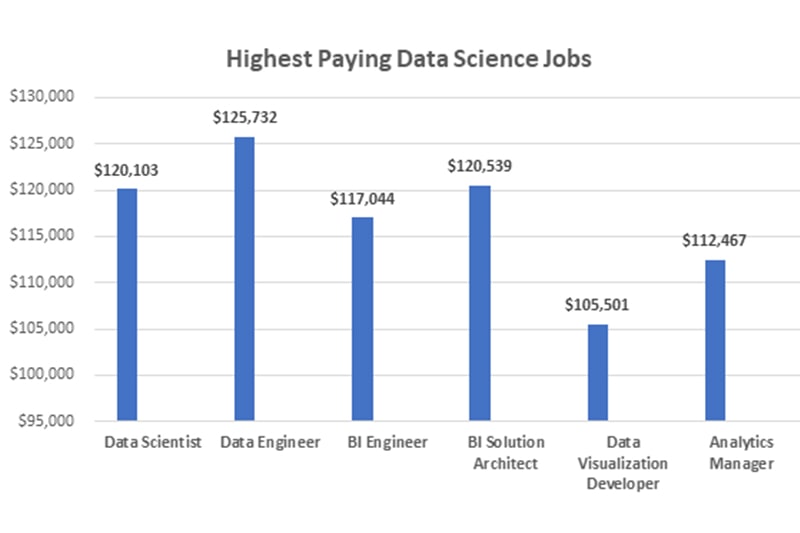
SynergisticIT’s best data science training Bootcamp in Boston, Massachusetts is built for one primary result: getting qualified candidates hired into meaningful tech roles at strong companies. That focus—backed by 15+ years of industry work, live immersive training, multi-stack curriculum, and active placement—makes it the decisive option for serious jobseekers.
Companies that hire SynergisticIT JOPP candidates
SynergisticIT JOPP has many recognizable employers that have hired their candidates—examples include Visa, PayPal, Bank of America, Citi, Wells Fargo, Walgreens, Capital One, Walmart Labs, Apple, Google, T-Mobile, Humana, SAP, and Verizon—with salary ranges around $90K–$154K .
These companies value SynergisticIT’s graduates because they are trained to handle complex projects and deliver results immediately.
If you want to review the program structure and how the placement process works, start here: SynergisticIT Job Placement Program (JOPP) and the track focus here: SynergisticIT Data Science Job Placement Program.
For ROI : SynergisticIT ROI vs Colleges.
“We don’t just run ads—we show proof”: events, videos, and media
SynergisticIT event/video gallery shows participation and presence at major industry events (including the Gartner Data & Analytics Summit and Oracle events). You can explore it here: SynergisticIT Video & Photo Gallery.
If you want videos of different events SynergisticIT Videos
Read the USA Today coverage: USA Today: How SynergisticIT is Changing How Tech Companies Source Talent.
Ready to Start Your Data Science Career?
There may be many data science bootcamps offering training in Boston, Massachusetts, but if your goal is actually getting hired after completing the program, SynergisticIT's Data Science JOPP stands alone as the sure-shot path to a tech job. Contact SynergisticIT today to learn how the Job Placement Program can take you from wherever you are now — recent graduate, career-gap professional, QA/BA transitioning into data, or experienced jobseeker — all the way to a signed offer letter with a top employer.
To get started in your tech career journey: Contact SynergisticIT.