 Important Notice— Our url is



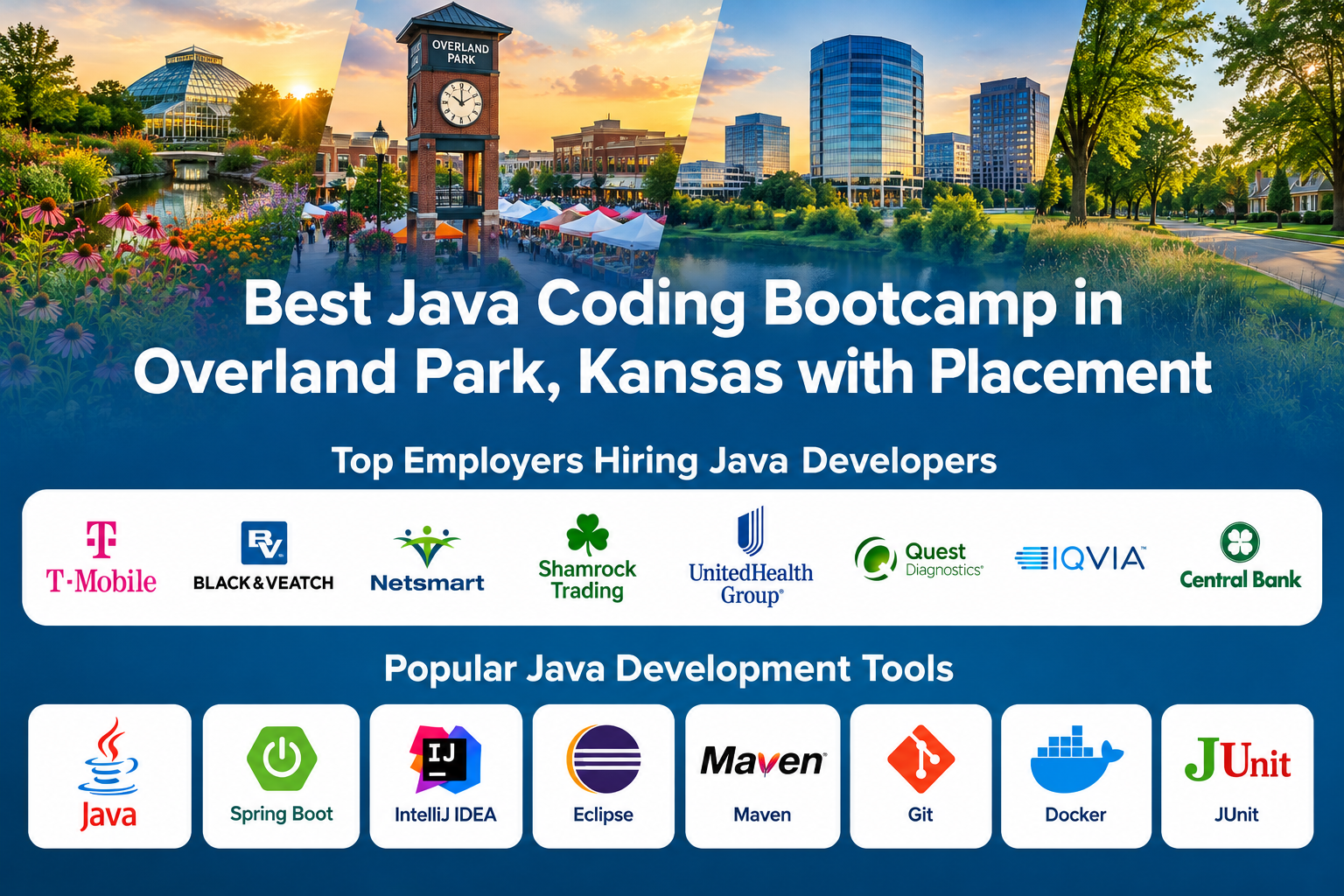
Best Java Coding Bootcamp in Overland Park, Kansas with Placement
Best Java coding Bootcamp in Overland Park, Kansas is not a weekend certificate. It is a hiring path. If the goal is a paid Java role, the practical route is SynergisticIT’s Java DevOps Job Placement Program, which combines deep Java training with staffing and interview marketing through the SynergisticIT Job Placement Program.
Why Java still anchors enterprise careers
Java was not built as a classroom language. In June 1991, James Gosling, Mike Sheridan, and Patrick Naughton started the Green Project at Sun Microsystems. Gosling, a Canadian computer scientist who joined Sun in 1984, led the design. The language was first called Oak, later Green, then Java. Sun released it publicly in 1995 and shipped Java 1.0 in 1996 with the promise of write once, run anywhere. Oracle acquired Sun in January 2010 and still stewards the platform. From the 1991 project start, Java has existed for about 35 years; from the 1995 public release, it has been in production for about 30 years.
That span matters. Banks, insurers, telecom firms, retailers, and government contractors did not rewrite core systems every time a new framework trended. Java stayed because the JVM, strong typing, mature security libraries, and long-term support releases fit systems that cannot fail on a Friday payroll run. IBM has described Java as the leading enterprise backend language and noted that it powers more than 90 percent of Fortune 500 companies. That is the honest answer to what is the number one programming language used at most Fortune 500 enterprise companies: not the language of every startup demo, but the language sitting under the transaction systems those companies already trust.
Industries that keep hiring Java include banking and payments, insurance, telecom billing, retail and logistics platforms, healthcare claims, government IT, and large engineering firms that need reliable backends beside newer data tools. Android’s history, Spring, microservices, and cloud runtimes extended that base rather than replacing it. Java is future-proof because enterprises buy stability, auditability, and a huge hiring pool, not novelty. Virtual threads and current long-term-support releases show the platform is still being invested in, not frozen.
Python, AI, machine learning, C#, and C++ all have real jobs. Python and ML move fast in research and analytics. C# is strong in Microsoft shops. C++ remains essential in performance-critical systems. None of those facts erase Java’s advantage for career longevity. Enterprise clients already own decades of Java. Rewrites are slow, regulated, and expensive. When hiring freezes, maintenance, integration, and security work on those systems still needs people. That is why Java tends to withstand highs and lows of the job market better than a tool that exists mainly inside one product cycle. For salaries and staying power, a deep Java plus cloud and DevOps profile is often more rewarding than a thin certificate in whatever language is trending this quarter.
Overland Park’s full-time Java hiring sits inside corporate engineering groups, not staffing firms. Employers with local or Sprint Parkway operations that recruit software engineers, including Java roles, include T-Mobile, Netsmart, WellSky, Black & Veatch, SelectQuote, UnitedHealth Group, IQVIA, Ericsson, Synchrony, and Empower. Healthcare, telecom, and engineering employers in the same market include Quest Diagnostics, HCA Midwest Health, the University of Kansas Health System, AdventHealth, Mariner Wealth Advisors, Fluent, Thales, Creative Capsule, Cogent Communications, and Central Bank. Regional employers that have posted Java or enterprise-development work tied to Overland Park or the adjoining Kansas City market include IBM, Oracle, Honeywell, GEHA, and Broadridge. Public ads have named Java on the Sprint Parkway campus and inside healthcare-software teams; not every firm publishes a current Java requisition, so treat this as the employer set that hires full-time developers here, not a live job board.
Pay tracks experience more than a single posted title. Robert Half’s Overland Park software-engineer bands, updated for 2026–2027, run from about $115,403 at the low end to $151,369 at mid-level and $185,265 at the high end. ZipRecruiter put junior software-developer pay in Overland Park near $84,135 as of October 2026, while the average Java developer salary in Kansas was about $105,177. In the Kansas City market, Indeed’s developer postings typically span roughly $71,822 to $150,315, with an average near $103,904. A practical reading for full-time Java work is about $75,000–$100,000 for junior roles, $105,000–$150,000 for mid-level roles, and $150,000–$185,000 for senior roles, before bonus. Contract postings near $50–$65 an hour are a different market and are excluded here.
Java stays in demand because Overland Park’s tech work is embedded in hospitals, insurers, telecom, and engineering firms, not only in startups. A Mid-America Regional Council labor analysis found Java among the top hard skills in Kansas City tech ads, alongside SQL and Agile, and software developers were the metro’s largest tech occupation, nearly 12,000 people. Spring-based systems at Netsmart, WellSky, T-Mobile, and UnitedHealth Group are long-lived. Rewrites are slower than feature work, so employers keep hiring people who can maintain billing, claims, network, and clinical platforms. That mix of headquarters, back-office engineering, and healthcare IT is why junior through senior Java seats keep opening even when coastal startup hiring cools.
Nationally famous technologists from the city are few. Arash Ferdowsi, born in Overland Park and a Blue Valley Northwest graduate, co-founded Dropbox and served as its chief technology officer. Johnathan Wendel, known as Fatal1ty, is the best-known competitive-gaming figure from the city. Local product builders tied to Overland Park include Chris Cheatham of RiskGenius, Ryan Greenhaw of Treso, Lance Windholz of Space Raptor, and Toby Rush, whose EyeVerify work came out of the Kansas City startup network that Flyover Capital, itself based in Overland Park, still funds. The deeper bench is operators inside Netsmart, WellSky, and T-Mobile, not a long celebrity list.
The employment picture is a suburban headquarters economy. Johnson County’s 2025 major-employer list shows T-Mobile with about 3,825 local full-time workers, Black & Veatch about 2,200, Netsmart about 1,075, WellSky about 740, SelectQuote about 1,200, and IQVIA about 905, beside much larger health systems. The Kansas City tech sector specialized above the U.S. average, with professional and technical services holding the largest share of tech workers, and about 98 percent of tech-occupation jobs concentrated in the five most urban counties. Overland Park’s chamber credits recent expansions with hundreds of jobs and an Inc. 5000 cohort that includes software firms such as Full Scale. For Java developers, that means steady full-time demand in healthcare IT, telecom platforms, and financial systems, with senior pay approaching the high $180,000s when scope and certifications justify it.
Overland Park’s tech economy and startup scene
Overland Park is not a coastal unicorn factory, and pretending otherwise would be bad advice. It is a corporate and engineering suburb tied to the Kansas City metro, with a tech economy built on telecom, insurance, engineering, and a smaller but real startup layer.
The old Sprint world headquarters sat in Overland Park. After the T-Mobile combination, that campus and the wider telecom stack still shape local hiring for network, billing, and enterprise software roles. Black & Veatch, founded in 1915 and headquartered in Overland Park, employs on the order of 10,000 to 12,000 people globally and keeps posting technology, construction-tech, and even AI program roles from the city. Insurance, financial services, and back-office engineering for national brands fill out the demand. Healthcare and logistics software show up through the wider metro, not only inside city limits.
Startup and investment activity is regional more than municipal. Overland Park has produced funded companies rather than a parade of billion-dollar unicorns. Steadily, an Overland Park landlord-insurance platform, raised a $30 million Series C in April 2025 at a reported valuation near $355 million, led by Two Sigma Ventures. Novel Capital, an Overland Park fintech offering revenue-based financing to software firms, raised a $15 million pre-Series A in 2024. Firebrand Ventures operates from Overland Park and backs early software founders. Nearby capital includes KCRise Fund, Five Elms Capital, and the long influence of the Kauffman Foundation. Accelerators and studios that founders actually use include LaunchKC, Digital Sandbox KC, the UMKC Technology Venture Studio, and earlier Techstars-linked programs such as the Sprint Accelerator. Acquisition news is quieter than in Austin or the Bay Area. Buyers here are more often strategic insurers, telecom platforms, and engineering firms than celebrity venture funds. That is a strength for job seekers: employers want people who can ship and maintain systems, not only pitch decks.
City dashboards rarely publish a clean five-year series for tech payroll and company count inside Overland Park alone. What is visible is a metro that added tech roles quickly in the early 2020s, then cooled with the national layoff cycle, while corporate IT, engineering, and insurance technology kept hiring. Treat headline “boom” copy with care. The durable local market is enterprise IT plus engineering services, not a consumer-app gold rush.
AI, local titles, and why Java still gets hired
Over the next 12 to 24 months, AI is changing titles faster than it is deleting the need for software people. Overland Park postings already include roles such as AI program manager and construction technology manager. Teams are expected to produce more with copilots, ticket bots, and document automation. Support and QA roles that only click through scripts will feel that pressure first. Demand rises for people who can wire models into existing Java services, secure data, and explain what the system did.
Copilots draft boilerplate. They do not own a claims platform, a billing outage, or a regulated release. Local employers still need developers who understand transactions, APIs, identity, and deployment. That is why Java remains in demand in Overland Park even as AI tools spread. A candidate who can pair Java with cloud, DevOps, and a basic grasp of data tools is more hireable than someone who only prompts a chatbot.
Compared with other local stacks, Java roles often sit inside larger, more stable employers: telecom, insurance, banks, and engineering firms. JavaScript-only and no-code work is easier to enter and easier to cut. Pure data-science titles swing with project budgets. C# appears where Microsoft estates dominate. Java is not the only stable choice, but for enterprise backends in this metro it is the stack most likely to still be on the org chart after a reorg. Reading why tech layoffs happen is useful context: layoffs punish shallow skills, not every developer who can run production systems.
A guide to coding bootcamps in Overland Park
Different kinds of programs market themselves to this city. Some are university-affiliated. The KU Coding Boot Camp has been listed through Kansas workforce training as a part-time, 24-week full-stack web program mixing self-paced practice with live online classes, with a training address on Quivira Road in Overland Park and a certificate plus continuing-education units. Others are national brands that sell an “Overland Park” page while teaching online. Coding Dojo has advertised Overland Park-oriented web programs across Python, Java, C#, and MEAN. Coding Temple markets software, cybersecurity, and related online tracks to local students and talks about healthcare, financial services, and startup hiring.
Types usually fall into four buckets: university certificate bootcamps, national full-stack brands, short cyber or data workshops, and self-paced course marketplaces. Fees for serious full-stack programs commonly land from about $10,000 to well above $15,000, sometimes near $20,000, before housing or lost wages. Short workshops cost far less and rarely change a hiring outcome. Duration runs from a few weeks for a narrow tool class to 12–24 weeks for a web certificate, almost always too short for enterprise Java plus cloud plus interview performance.
Formats are often a mix of recorded lessons and limited live help. A mentor hour plus peer forums is not the same as daily instructor-led build time. Course coverage at generalist camps centers on HTML, JavaScript, a single backend, and a capstone. Enterprise Java, Spring, microservices, SQL at interview depth, DevOps, and cloud certifications are usually thin or absent. Marketing and hiring support after graduation is the failure point alumni mention most. Many programs offer resume tips and a job board, then leave graduates to apply alone.
Who joins is a mix of career changers, career-gap professionals, and recent graduates who were told a certificate replaces experience. Funding may include private loans, installment plans, employer tuition help, or workforce grants when a program is on a state eligible-training list. Income-share models have largely faded after regulatory and reputational problems. Read the contract. A “job guarantee” with relocation clauses and assessment traps is not a job.
Alumni feedback on public forums is split. Positive reviews praise structure, a portfolio piece, and a career change when the person already had adjacent experience. Negative reviews, including national commentary that also shows up in Kansas City discussions, describe rushed curricula, weak placement, and salaries far below the ads. Local pages rarely publish audited placement rates. Treat any success-rate claim that is not tied to a named employer and a verifiable offer as marketing.
Coursera, Udemy, and online university bootcamps are good for a certificate and a first look at syntax. They are usually not enough to get hired. Employers hiring Java in this market want interactive correction, feedback on design, and hands-on projects that match what their teams run. Recorded lectures do not schedule interviews. The Job Placement Program is built around that gap: live instruction, projects, certifications, and active client marketing rather than a badge and a goodbye email.
Reasons to Join our Best Java Coding Bootcamp in Overland Park, Kansas
Hackathons, talent supply, and who is job hunting
Coding events around Overland Park are mostly metro-wide. Hack Midwest is Kansas City’s largest coding competition, drawing hundreds of engineers and prize money. Hack K-State runs as a student hackathon open to high school and college participants. The Kansas City Cyber Security Conference has been held at 6000 College Boulevard in Overland Park, which tells you local sponsors care about security operations, not only app demos. DevFest-style community days and insurer or telecom internal hack days appear on the calendar in smaller form.
Benefits of joining are practical. You practice shipping under a deadline, meet engineers who actually hire, collect a story for interviews, and see which problems local sponsors fund—Medicare distribution tech, cyber defense, and business workflow automation show up more often than social apps. A hackathon prize is not a job offer. It is evidence you can collaborate.
Who makes up the tech workforce here is a blend, not a single demographic. Public data does not publish one tidy Overland Park dashboard for age, race, gender, visa status, and remote mix. From employer patterns, the core is college-educated professionals in their late twenties through forties, many already inside telecom, insurance, engineering, or corporate IT. Gender mix in software remains male-skewed, as it does nationally, with somewhat broader participation in analysis, project, and support roles. Racial and ethnic composition tracks the wider Johnson County professional workforce more than Silicon Valley. Visa holders—OPT, STEM OPT, and H-1B—are part of the metro talent pool, especially among recent computer science graduates, but they are not the majority of every local IT team. Remote versus on-site shifted after 2020: many individual contributor roles are hybrid, while client-facing engineering, security, and field-technology jobs still expect time in Overland Park or Kansas City offices.
Colleges feeding local employers include Johnson County Community College in Overland Park for transferable IT, programming, and career certificates; the University of Kansas; Kansas State; and, across the state line, UMKC and other Missouri programs. For getting hired into software rather than generic IT support, the specialization most likely to convert is software engineering with Java or another enterprise backend, plus SQL and cloud, not a vague “computer literacy” certificate. Data analytics helps in insurance and healthcare operations. Cybersecurity helps if you can show labs and fundamentals, not only a voucher. A CS degree alone still leaves many graduates unhired, which is why companies skip unprepared computer science graduates even in a city full of corporate IT jobs.
How to get hired, and why depth beats a short camp
How to get hired as a recent CS graduate is the question local forums keep asking. A diploma proves you passed classes. It does not prove you can build a service, explain a design, or pass a loop that mixes Java, SQL, and behavioral screens. How to get hired in FAANG is an even narrower target. Big-tech loops reward algorithms, system design, and communication. Most Overland Park offers will not be FAANG. They will be banks, telecom, insurers, retailers, and engineering firms that still run hard technical screens. The same habits help both: real projects, clean fundamentals, and interview reps.
Java for employment should be learned in depth, not from any coding bootcamp that sprints through syntax. It should come from a firm that has been in the tech industry for over 15 years and hears what employers reject in interviews. SynergisticIT has done that work since 2010. Java training sits inside SynergisticIT’s Java DevOps full stack Job Placement Program, not as a side elective.
For job seekers with a career gap or break, the program helps in five concrete ways.
- It replaces a blank recent-work section with current projects you can defend.
- It rebuilds Java, SQL, and delivery skills that went stale during the break.
- It adds certifications employers recognize, instead of asking a gap to speak for itself.
- It rehearses the gap explanation so the story is honest and short.
- It markets you to employers instead of leaving a rusty resume in a portal.
For recent graduates with no experience who want tech jobs, five parallel gains matter.
- You leave with job-ready skills, not only coursework.
- You complete project work that reads like employment, not a class diagram.
- You practice interviews until answers sound like an engineer, not a student.
- You get scheduled introductions to companies that already hire this profile.
- You are coached until an offer, which is the missing piece in how to get hired as a recent CS graduate.
SynergisticIT states that about 90 percent of JOPP graduates who are hired had never held a tech job before, with the other slice made up of career changers and people returning from gaps. That matches the local problem: Overland Park employers will hire new talent when the person can contribute, and they will ignore another unread bootcamp certificate.
About 30 percent of people who join JOPP have already finished another bootcamp or a Coursera, Udemy, or university online program and still were not hired. They are not unusual. Most bootcamp graduates fail to land solid offers because the program trained a stack employers are not buying, skipped live feedback, and offered no real client marketing. That broken promise is why a large number of bootcamps have shut down. JOPP is positioned differently: the promise attached to successful completion is getting candidates hired, with interview scheduling and hand-holding until an offer, not a slideshow about “career services.”
The program can be done from anywhere in the United States. It is fair to call it the Best Java coding Bootcamp in Overland Park, Kansas plus staffing, which is why the accurate name is Job Placement Program, not bootcamp. Most camps train and then leave students to fend for themselves. When you target Java developer roles, portfolio and interview performance matter as much as knowledge. SynergisticIT pushes hands-on projects and structured preparation meant to turn learning into offers, backed by 15+ years of industry experience and 24,000+ employer connections.
The Java DevOps full stack covered in JOPP is built for client screens: core and advanced Java, Spring Boot, microservices, REST APIs, SQL and PL/SQL, data structures and algorithms, DevOps and CI/CD, and cloud depth aimed at AWS, with Azure exposure where roles require it. Certification prep includes paths such as Oracle Java and AWS, and the wider placement program also prepares candidates on Azure, Power BI, Snowflake, and related tools so a Java hire is not a one-trick profile. Sessions are live and instructor-led, typically several hours a day, with recordings if a day is missed. That is the opposite of a mostly recorded camp.
Partial fees come first. The balance is due only after the job seeker is hired at $81,000 or higher, then paid in installments, with the company’s published structure of about $10,000 upfront and remaining payments capped rather than an open-ended tuition bill. The published placement figure is a 91.5 percent success rate, with offers the company cites from $95,000 to $155,000. Named employers in its materials include Visa, Apple, PayPal, Walmart Labs, AutoZone, Wells Fargo, Capital One, Walgreens, Bank of America, SAP, Cisco Systems, Verizon, T-Mobile, Intuit, Ford, Hitachi, Western Union, Deloitte, Dell, USAA, Carfax, and Humana. Outcomes vary by candidate, location, and interview performance. The pattern the company points to is enterprise hiring, not a single miracle salary.
Waiting will not make SynergisticIT’s JOPP shorter; it only pushes the offer further out. The program takes time because it builds skills, projects, interviews, and client marketing until placement. That hard stretch is what employers are paying for. Start now. The road is long. The point of the road is a full-time offer.

Career Options after Best Java Coding Bootcamp in Overland Park, Kansas


Best Java Coding Bootcamp in Overland Park, Kansas Who Can Take Our Java Training?
Why employers treat JOPP candidates as value for money
Employers do not hire a logo. They hire risk reduction. Candidates from SynergisticIT’s JOPP are framed as value for money because they already have projects and certifications and can perform sooner. A company can gain a skilled contributor at a fraction of the fully loaded cost of an equally prepared person recruited blindly on the open market. That is why enterprise teams hire them: genuine skills and genuine project experience that can touch the bottom line early, instead of a hit-or-miss resume.
Current tech stack alignment. JOPP is shaped by client demand and industry contact, including participation at events such as Oracle CloudWorld and the Gartner Data & Analytics Summit, so ramp-up is shorter.
Pre-screened talent. Candidates are technically screened before they are sent out. A hiring manager is not the first person to discover that the resume cannot code.
Certifications. Java, DevOps, AWS, Azure, Power BI, Snowflake, and related credentials add proof on top of projects.
Multi-stack skill. A junior who can help on backend, frontend-adjacent APIs, and deployment—or a data-minded teammate who can support analytics and engineering—is cheaper than three narrow hires.
Reduced hiring risk. Structured training, projects, interview prep, and screening lower the chance of a failed seat.
Day-one contribution. The work is practical. The expectation is contribution, not a three-month tourist period.
Project-based resumes. The emphasis is real work, not inflated titles.
In short, companies hire these candidates because they are trained, screened, project-ready, interview-prepared, and aligned with current roles. Public proof sits on SynergisticIT reviews, in event footage from those industry summits, in the company’s USA Today feature, and in the ROI comparison with colleges. The ROI argument is simple: a degree can cost far more and still leave you unhired, while JOPP’s larger share of fees is tied to an $81,000-or-higher offer. It can look expensive next to a cheap camp. It is cheaper than a year of unemployment after a program that could not place you.
Industry clusters driving local Java hiring line up with that profile. Telecom and enterprise IT remain the historic core. Insurance and fintech need secure transaction systems. Health operations and claims-adjacent software need reliable backends. Engineering and infrastructure firms such as Black & Veatch need software wrapped around field and grid work. Logistics, retail, and corporate shared services need integrations. Government and regulated IT, often via contractors, favor languages with a long security record. Java fits those clusters better than a language chosen only because an ad called it the future.
Unlike camps that buy flashy ads and promises that sound too clean, JOPP’s case is results, reviews, and a fee that is unfinished until hiring clears a salary floor. There may be many coding bootcamps and training firms offering Java in Overland Park. If the goal is to get hired after the program, there is one choice worth making: SynergisticIT’s Best Java coding Bootcamp in Overland Park, Kansas. It is the surest path in this market for a job seeker who wants a hire, not another login.
Start the tech career journey through the SynergisticIT Job Placement Program or call (510) 550-7200. Ask how the Java DevOps full stack JOPP would schedule interviews and stay with you until an offer.