Important Notice— Our url is


Java Training Bootcamp in Baltimore, Maryland with Job Placement
Baltimore jobseekers searching for Java, software engineer, or developer jobs do not need another short course that ends with a certificate and an empty inbox. They need a path that turns coding skill into interviews and a full-time offer. That path is SynergisticIT's Job Placement Program and SynergisticIT's Java Job Placement Program, a nationwide Java training Bootcamp in Baltimore, Maryland with Job Placement that can be completed from anywhere in the USA.
This article is written for people targeting tech jobs: recent computer science graduates, career changers, and developers who already tried Coursera, Udemy, or a campus-style bootcamp and still cannot get hired. Java training here is not a standalone class. It is the core of SynergisticIT’s Java DevOps Full Stack Job Placement Program (JOPP).
Employers in Baltimore hire full-time Java developers across government, healthcare, finance, and defence, with pay rising from junior through senior levels.
Baltimore Java Employers
Employers that hire and have hired Java developers for full-time roles in Baltimore, Maryland include Johns Hopkins Applied Physics Laboratory, T. Rowe Price, Under Armour, CareFirst BlueCross BlueShield, Johns Hopkins Medicine, Johns Hopkins University, Leidos, General Dynamics Information Technology, ManTech, CGI, Peraton, Amentum, Booz Allen Hamilton, Medifast, The Travelers Companies, Social Security Administration, Centers for Medicare & Medicaid Services, State of Maryland, University of Maryland Medical System, MedStar Health, Constellation Energy, McCormick, The Agora Companies, Contact Government Services, and HHS Technology Group. These are agencies, hospitals, primes, and commercial firms, not staffing companies.
Salary Ranges
Baltimore Java pay averages $136,489. Junior full-time ranges are typically $80,000 to $110,000, near Maryland junior averages of $93,829 and entry figures of $95,881 to $109,014. Mid-level ranges are typically $110,000 to $150,000, near a Level II median of $124,738. Senior ranges are typically $150,000 to $220,000, near a Maryland senior average of $172,715, with postings of $118,000 to $253,000 and $98,784 to $196,196.
Lasting Java Demand
Java developers will remain in demand in Baltimore because large local systems still run on Java backends. Woodlawn programs at Social Security Administration and Centers for Medicare & Medicaid Services need Java for benefits, claims, and modernization. Hospitals and CareFirst BlueCross BlueShield use it for records and member APIs. T. Rowe Price and Under Armour keep Spring and AWS services in production, while Fort Meade defense work adds mission software. Local universities feed talent, and lower costs versus Washington help employers fill full-time Java seats.
What Is Java and Who Created It?
Java began inside Sun Microsystems in 1991, when James Gosling, Mike Sheridan, and Patrick Naughton launched the Green Project. The first language was called Oak. After a trademark conflict, the team renamed it Java, a nod to the coffee the engineers drank, and Sun Microsystems introduced it publicly on May 23, 1995. Java 1.0 followed in 1996. Oracle acquired Sun Microsystems in 2010 and still stewards the platform.
From the 1991 start, Java has existed for about 35 years. From the 1995 public launch, it has been in production use for 31 years as of 2026. Few languages survive that long inside banks, insurers, retailers, and government systems. That longevity is why Java remains a hiring language, not a hobby language.
Write once, run anywhere was more than a slogan. Bytecode and the JVM let enterprises run the same business logic on many servers. That design still underpins payment rails, claims engines, inventory systems, and Android backends.
Why Java Still Matters for Employment
Learning Java is not about nostalgia. It is about where payroll lives. Enterprises keep decades of Java code because rewriting core ledgers, policy engines, and order systems is expensive and risky. New features get added in Spring Boot, microservices, and cloud deployments, but the language at the center stays Java.
Industries that keep hiring Java developers include:
- Banking and payments, where Visa, PayPal, Wells Fargo, Capital One, Bank of America, and USAA run high-volume transaction platforms.
- Retail and logistics, where Walmart Labs, Walgreens, and AutoZone need catalog, inventory, and fulfillment software that cannot go down on a weekend.
- Telecom and networking, including Verizon, T-Mobile, Cisco Systems, and SAP.
- Automotive and manufacturing, including Ford and Hitachi.
- Healthcare and insurance, including Humana.
- Professional services and devices, including Deloitte, Dell, Intuit, Western Union, and Carfax.
- Consumer technology, including Apple.
Java is future proof because those systems are too large to abandon. Cloud vendors run Java workloads. Android still depends on the JVM family. Security, typing, and backward compatibility make Java a default for regulated work. When hiring managers in Baltimore, Maryland look for a software engineer who can join an existing team, they often look for Java first.
Will AI Tools Kill Java Jobs?
AI coding tools write snippets. They do not own production. Someone still has to design services, review security, tune concurrency, read a stack trace at 2 a.m., and explain a design to an architect. Java shops use AI as an accelerator, which raises the bar for people who only know syntax from a weekend tutorial. It does not erase demand for developers who can ship Spring APIs, tests, and pipelines.
Compare job stability:
- Python leads many AI and data postings, but a large share of those roles expect statistics, pipelines, and research-style work that junior jobseekers often lack.
- AI and ML titles look exciting, then freeze when budgets tighten, because many are project-funded rather than core-ops funded.
- C++ remains vital in systems and games, yet the volume of entry developer jobs is smaller.
- C# is strong in Microsoft estates, but Java still covers a wider slice of Fortune-scale backends.
Which technology is for long-term job and career success and will always be in demand? For enterprise employment, Java is the most durable answer. It withstands hiring highs and lows because banks and insurers cannot pause their core applications. That is why Java should be chosen over chasing every new Python, AI, ML, C#, or C++ headline if your goal is career longevity and salaries.
What’s the #1 programming language used at most Fortune 500 enterprise companies? Java. Industry analyses still report that roughly 90% of Fortune 500 firms run Java in production. Popularity contests on hobby indexes change month to month. Payroll systems do not.
If you are learning Java for employment, do not learn it as a surface survey from any coding bootcamp. Learn it in depth from a company that has been in the tech industry for over 15 years, knows what employers ask in interviews, and markets candidates into those rooms. That company is SynergisticIT. Java training is part of SynergisticIT’s Java DevOps Full Stack Job Placement Program, not a disconnected evening class.
Are Coursera, Udemy, or University Bootcamps Enough to Get Hired?
Coursera, Udemy, and many online university bootcamps are useful for a certification and for first exposure to syntax. They are not enough to get hired as a Java developer or software engineer. Recorded videos cannot watch you struggle through a failing test, stop you from copying an AI answer, or tell you that your API design would fail a Wells Fargo screen.
To get hired you need:
- Interactive learning with live instructors
- Blunt feedback on code and communication
- Projects that match what companies are actually building
- Interview practice drawn from real client questions
- Someone who will market you, schedule interviews, and stay until an offer arrives
SynergisticIT's Job Placement Program is built around those five needs. About 30% of people who join already finished another coding bootcamp or a Udemy / Coursera / university track, did not get hired, and then entered JOPP. They did not fail because they were unwilling to study. They failed because study without placement is not a hiring system.
Top Reasons to Learn Java Programming
Why Employers Treat JOPP Candidates as Value
Hiring managers do not want a lottery ticket. They want bang for their buck. SynergisticIT JOPP candidates are positioned as value because they already completed projects, earned certifications, and practiced interviews, so they can contribute from day one. Companies gain skilled people at a fraction of the cost of hunting equivalently prepared talent on the open market, where resumes are padded and ramp-up is long.
That is why enterprise teams hire SynergisticIT’s Job Placement Program candidates. They are getting genuine employees with genuine skills, not a hit-or-miss board applicant. Open-market hiring often means weeks of screening people who freeze in a coding round. JOPP candidates arrive pre-checked.
Why companies hire SynergisticIT JOPP candidates:
- Current tech stack alignment and job-ready technical skills. The program is shaped by client demand, industry events, and live interviews, so ramp-up time is shorter.
- Pre-screened talent. Employers receive people already checked for technical and job fit before the interview calendar fills.
- Certifications on Java, DevOps, AWS, Azure, Power BI, Snowflake, and others, which add credibility on top of a diverse stack.
- Multi-stack skill. A company may prefer one junior who can help across backend, frontend, and deployment, rather than three narrow specialists.
- Reduced hiring risk. Structured training, projects, interview prep, and screening lower the chance of a failed hire.
- Day-one contribution. Practical work is the point of the program, not slideshows.
- Genuine project-based resumes. Only the projects you actually complete go on the resume. No embellished fiction.
In short, companies hire JOPP candidates because they are trained, screened, project-ready, interview-prepared, and aligned with current tech jobs.
How JOPP Helps After a Career Gap
A break on a resume is not a life sentence if you can show current skill. SynergisticIT's Job Placement Program can help jobseekers with a career gap in five concrete ways:
- Replace silence with recent projects so employers talk about your code instead of your time away.
- Refresh the stack employers are hiring for now, not the tools you used before the break.
- Rebuild interview stamina with mocks, DSA practice, and honest feedback after months or years off the circuit.
- Market you into 24,000+ employer connections so you are not cold-applying into automated rejection.
- Stay with you until an offer, which matters when confidence dips after a long search.
Related reading: Landing a Tech Job After a Career Gap.
How to Get Hired as a Recent CS Graduate
How to get hired as a recent CS graduate is the search term thousands of Baltimore and nationwide seniors type after campus career fairs go quiet. A degree proves you can learn. It does not prove you can ship Spring Boot, talk through a system design, or survive a take-home. 90% of JOPP graduates who get hired into tech jobs have never worked a tech job before. The other 10% are career changers, people with gaps, and similar profiles.
SynergisticIT’s JOPP can help recent graduates with no experience in five ways:
- Convert classroom theory into employer-shaped projects that belong on a resume.
- Add the missing stack: Java, databases, advanced Java, DevOps, cloud, and frontend pieces CS programs often skip.
- Include certifications at no extra cost from Microsoft, Oracle, Snowflake, Databricks, Azure, and AWS.
- Train interviews as a skill, including coding rounds that decide how to get hired in FAANG-style processes and large enterprise screens.
- Hand the job search to a placement team that schedules interviews instead of leaving you to spray résumés at midnight.
CS graduates should join JOPP because it supplies tech skills, project work, and the part school cannot guarantee: getting hired into tech roles at serious companies.
Not a Bootcamp That Trains and Walks Away
SynergisticIT's Job Placement Program can be done from anywhere in the USA. For searchers in Maryland, it functions as the Java coding training Bootcamp in Baltimore, Maryland plus staffing. That combination is why it is called a Job Placement Program and not a coding bootcamp.
Most coding bootcamps train, issue a certificate, and leave students to fend for themselves. Jobseekers spend money, then discover that portfolio and interview performance matter as much as knowledge when targeting Java developer roles. SynergisticIT promotes hands-on project experience and structured preparation designed to turn learning into offers. The firm has 15+ years of tech-industry experience and 24,000+ employer connections, which means enrollees get both a network and a clear picture of what hiring managers want.
Bootcamps fail for predictable reasons: alumni teaching alumni, recorded lectures, one instructor covering every topic, huge cohorts, projects that never match job posts, and “career services” that amount to a résumé template. A large number of bootcamps have shut down after advertising promises they could not keep. SynergisticIT JOPP makes a promise it organizes the whole company around: candidates who successfully complete JOPP get hired into tech companies. Not every Java class is equal. Java should be learned in depth from a company that has lived in this industry for over 15 years. That is why JOPP alumni report a 91.5% success rate and offers in the $95k to $155k range, often with multiple offers.
JOPP looks expensive next to a $399 video bundle. It is cheaper than repeating failed bootcamps, burning a year of jobless months, and still having no offer. The highest ROI case versus college tuition is laid out in SynergisticIT’s ROI blog compared to colleges. You pay **$10k** before the program. The balance of $26k is due after you land a job offer of $81k or higher, payable over two years. If no job offer, no remaining payments accrue. Most bootcamps take all fees up front and advertise refunds stuffed with clauses you cannot meet.

An overview of Java Training Bootcamp in Baltimore, Maryland
We provide structurally designed Java training in Baltimore that fits the educational needs of both freshers and working professionals.
- Core Java: OOP principles, exception handling, collections framework, Java 21+ features (streams, lambdas, functional interfaces), multithreading, generics, annotations, memory management, unit testing, SOLID principles, and clean code practices.
- Spring Boot & Microservices: Spring Core, MVC, dependency injection, auto-configuration, embedded servers, Spring Data JPA, Hibernate ORM, Spring Security (JWT, OAuth2), REST API development, microservices architecture, service discovery, API gateways, circuit breakers, load balancing, observability.
- DevOps & CI/CD: Version control (Git, GitHub, GitLab), build automation (Maven, Gradle), CI/CD pipelines (Jenkins, GitHub Actions), containerization (Docker, Kubernetes), infrastructure as code (Terraform, Ansible), monitoring and logging (Grafana, Prometheus, ELK), DevSecOps.
- Cloud Deployments: AWS, GCP, Azure integration for cloud-native applications.
- Data Structures & Algorithms: Arrays, strings, linked lists, stacks, queues, trees, graphs, sorting, searching, dynamic programming, recursion, greedy algorithms, time and space complexity analysis, competitive coding practice.
- MERN & MEAN Stack Development: MongoDB, Express.js, ReactJS, Angular, Node.js, RESTful API & GraphQL development, authentication, real-time apps, deployment.
- PL/SQL & Stored Procedures: SQL fundamentals, PL/SQL basics, stored procedures, transactions, query optimization, advanced data modeling, backup, recovery, security best practices.
- Interview readiness: DSA, system design, behavioral + communication
Introduction to Java & Oops
Servlet
JSP
JQuery
Hibernate
Spring
Microservices
JavaScript
Career outlook after Java Training in Baltimore
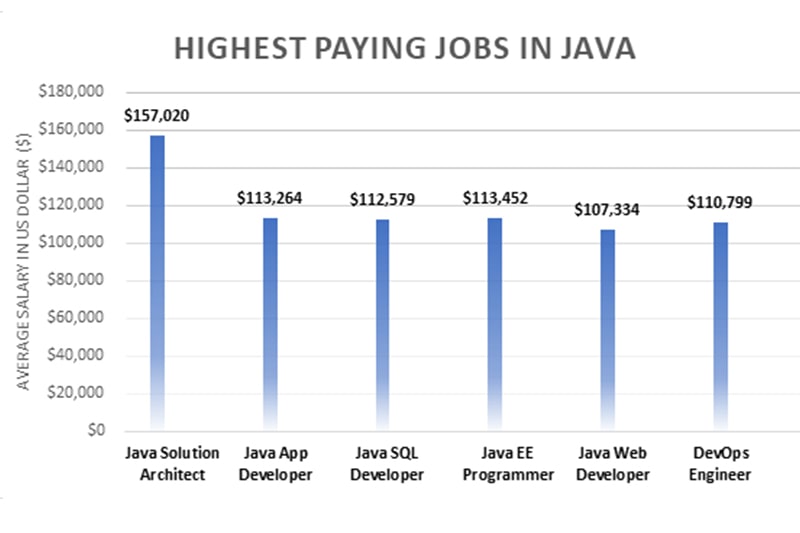
Java training is a roadmap to a promising career. It offers a variety of career options such as:
User Interface Developer (107,250)
Java EE Programmer ($113,452)
DevOps Engineer ($110,799)
Java App Developer ($113,264)
Java SQL Developer ($112,579)
Java Solution Architect ($157,020)
Database Administrator ($67,088)
Automation Test Engineer ($83,791)
Java Web Developer (107,334)
Project Manager ($85,052)
Business Analyst ($74561)
Scrum Master ($97,872)
How SynergisticIT Differs From Bootcamps and Staffing Firms
Curriculum quality. SynergisticIT stays inside the industry at Oracle CloudWorld, Gartner Data & Analytics, and similar events. Candidates are interviewing in real time, so the curriculum is adjusted to what jobs actually require, not to a slide deck frozen two years ago.
Instructor quality. Many bootcamps use recent alumni, recordings, or teachers who appear a few hours a week. SynergisticIT uses industry professionals. The average instructor has more than 10 years of experience.
Number of instructors. Most bootcamps assign one or two people to every topic. In the Java Job Placement Program, 5–6 instructors specialize: separate voices for Java, databases, advanced Java, and DevOps. The data science track likewise splits data analytics, data engineering, and data science / machine learning.
Cost and payment. Transparent cost: $10k before, $26k after an offer, over two years, with no balance if there is no offer.
Duration. Instruction is 4–5 hours each day, five days a week, across about five months. It is live, immersive, and not a pile of recordings. Ask any bootcamp you are considering to put their live-hour count in writing.
Student-to-instructor ratio. About 5-to-1, versus 20-to-1 elsewhere.
Projects. Work is tailored to company stacks and current openings. Only projects you complete appear on your resume.
Alumni success. Read, watch, and listen to alumni reviews. Offers land in the $95k to $155k band, sometimes as multiple competing offers.
Certifications included at no extra cost from Microsoft, Oracle, Snowflake, Databricks, Azure, and AWS.
Career help after training. SynergisticIT markets you to 24,000+ company contacts, rewrites the résumé, prepares interviews, and schedules interviews. Bootcamps usually hand you tips. Ask for specifics in writing.
Why trust this. Check photographs of successful alumni on the JOPP page, video reviews, offer letters, and years in business. There are no theatrical guarantees with hidden traps. Cost and outcomes are stated plainly. Start with SynergisticIT reviews.
Java DevOps Full Stack Tech Stack
The Java DevOps Full Stack JOPP is the stack employers keep posting for software engineer and developer jobs:
- Core and modern Java: OOP, collections, concurrency, Java 21+ features, testing, clean code
- Spring Boot and microservices: MVC, JPA, security, REST, gateways, resilience, observability
- DevOps and CI/CD: Git, Maven/Gradle, Jenkins, Docker, Kubernetes, Terraform, monitoring, cloud on AWS, Azure, or GCP
- Data structures and algorithms for coding interviews, including how to get hired in FAANG-style rounds
- MERN/MEAN pieces so you can contribute across the stack
- SQL and PL/SQL on MySQL, Oracle, and PostgreSQL
When you are targeting Java developer roles, portfolio quality and interview performance sit beside knowledge. SynergisticIT builds all three, then walks with you from enrollment to your first day at work.
Companies, Salaries, and Proof Instead of Ads
Visa, Apple, PayPal, Walmart Labs, AutoZone, Wells Fargo, Capital One, Walgreens, Bank of America, SAP, Cisco Systems, Verizon, T-Mobile, Intuit, Ford, Hitachi, Western Union, Deloitte, Dell, USAA, Carfax, Humana, and many more have hired SynergisticIT candidates at $95k to $155k. Those names matter if you care about how to get hired in FAANG-adjacent and Fortune environments, not only in tiny startups that vanish in a downturn.
Unlike bootcamps that run ads too good to be true, SynergisticIT JOPP points to results, event presence, and public writing. Watch industry-event videos from Oracle CloudWorld and Gartner, including Oracle CloudWorld coverage, additional OCW sessions, and event walkthrough video. Read How SynergisticIT is Changing How Tech Companies Source Talent in USA Today, the ROI comparison with colleges, and alumni proof on synergisticit.com/reviews. For stack context beyond this page, see tech stacks CS graduates should master.
Start Before Another Cycle Passes
Delaying enrollment does not compress JOPP. It only postpones the offer. The calendar is long because skills, projects, interviews, and client marketing all have to happen before placement. That demanding stretch is exactly what employers pay for. Begin now. The road is not short. The outcome is a full-time job offer.
There may be many coding bootcamps or training firms that promise Java classes and coding training in Baltimore, Maryland. If your goal is to get hired after the program, there is one serious choice: SynergisticIT’s Java coding training Bootcamp in Baltimore, Maryland. It is training plus staffing, live instruction plus marketing, and a sure path for a jobseeker who wants an employer on the other side of the work.
Contact SynergisticIT and start the tech career journey. Call (510) 550-7200. Ask about SynergisticIT's Job Placement Program and the Java DevOps Full Stack Job Placement Program.