 Important Notice— Our url is



If you’re searching for the best data science training Bootcamp in Denver, Colorado, it’s worth being brutally honest about what “best” should mean in 2026: not just a syllabus, not just recorded lectures, and not just a certificate—but a direct path to getting hired in an increasingly competitive market. Denver’s tech ecosystem is expanding across multiple industries, and data skills are now a core requirement—not a “nice to have.” That’s why SynergisticIT’s approach stands out. Instead of operating like a typical training-only school, SynergisticIT Data Science Job Placement Program (JOPP) blends structured learning, project work, interview preparation, and placement-focused support.
Denver’s tech ecosystem spans finance, healthcare, telecommunications, energy, retail, aerospace, and SaaS, making it a strong magnet for data science talent. Notable employers in the Denver metro area that hire data scientists include Google, Amazon, Meta, IBM, Oracle, Lockheed Martin, Ball Aerospace, Arrow Electronics, Charter Communications (Spectrum), Comcast, Dish Network, Western Union, Wells Fargo, JP Morgan Chase, Capital One, Visa, HomeAdvisor (Angi), Palantir, Red Hat, Salesforce, Twilio, Zoom, DaVita, UCHealth, and Kaiser Permanente. Salaries for data scientists in Denver remain highly competitive, with Salary.com reporting an average of $120,710 per year, typically ranging from $110,809–$130,840 and top earners reaching $140,062. Gusto lists a median salary of $121,000, while Glassdoor reports average total compensation of $164,862. Across experience levels, Salary.com notes that entry‑level data scientists earn around $115,462, mid‑level roles average $117,713, senior roles reach $121,753, and expert‑level professionals earn about $125,179 annually. Together, these salary ranges and employer demands reflect Denver’s strong competition for analytics talent and its growing concentration of high‑tech industries that rely heavily on predictive analytics, machine learning, and large‑scale data processing.
The Denver–Boulder corridor has also become a magnet for startups and remote‑friendly tech companies, many of which rely on machine learning, AI, and automation. Even as AI tools become more advanced, they increase—rather than decrease—the need for data scientists who can build, validate, and monitor these systems.
In Denver, data roles are no longer limited to “data scientist” titles. You’ll see hiring demand for data analysts, BI analysts, analytics engineers, data engineers, and ML/AI engineers—often within the same organization. Real job boards and local tech listings consistently show volume across these categories.
How to get a job as a data analyst in Denver, Colorado
If your goal is how to get a job as a data analyst, here’s a practical path that works:
- Master SQL (this is non-negotiable)
- Learn a BI tool (build dashboards, not just screenshots)
- Create 2–3 portfolio projects tied to real KPIs (retention, churn, marketing ROI, operations, pricing)
- Show your thinking (metric definitions, assumptions, validation steps)
- Practice interviews (SQL drills, case questions, storytelling)
Denver companies want analysts who can translate questions into measurable definitions and deliver trustworthy reporting—not just run queries.
How to get a job as a data scientist in Denver, Colorado
If your goal is how to get a job as a data scientist, add these layers:
- Strong statistics + experiment design
- ML fundamentals (training, evaluation, bias/variance, interpretability)
- Feature engineering and model explainability
- End-to-end project delivery (from dataset → model → narrative)
- Production awareness (batch scoring, monitoring, drift)
In Denver’s market, candidates who understand both analytics and ML tend to stand out—because they can deliver impact even before a model is deployed.
Why data science + ML/AI alone is not enough
A lot of “data science bootcamps” teach Python notebooks and basic ML—and stop there. But employers don’t hire notebooks. Employers hire outcomes.
That’s why jobseekers need multiple tech stacks:
- Data Analytics + BI to tell the story and drive decisions
- Data Engineering to build pipelines and reliable datasets
- Data Science + ML/AI to create predictive and intelligent systems
SynergisticIT Data Science JOPP helps candidates get hired across data analyst, data scientist, data engineer, and ML/AI-aligned roles—because employers hire for complete capability, not a single buzzword.
SynergisticIT Data Science JOPP is ideal for both recent graduates and non-traditional candidates who need structured upskilling plus interview outcomes, not just training completion.
Why many coding bootcamps don’t succeed (and why so many shut down)
In the last few years, the bootcamp market has been under heavy pressure—especially for programs that relied on marketing promises more than measurable outcomes. Industry reporting and analysis have documented closures and weakening placement outcomes at parts of the bootcamp ecosystem.
The common failure pattern looks like this:
- Train people on a narrow stack
- Provide generic career advice
- Stop support after graduation
- Leave candidates to “apply online” with no edge
That’s why jobseekers often end up doing 4–5 different bootcamps, collecting certificates, and still struggling to get interviews.
How SynergisticIT’s JOPP is different from bootcamps
SynergisticIT JOPP is training + staffing-style placement support, which is why it’s a Job Placement Program (JOPP), not a typical bootcamp.
Key differences about JOPP:
- Comprehensive multi-domain coverage (analytics + engineering + ML/AI)
- Structured assignments and industry-aligned preparation
- Participation in industry events and public-facing showcases (Gartner Data & Analytics Summit, JavaOne/OCW)
- Continued marketing/placement support as part of the model
SynergisticIT has been in the tech industry for ~15 years (founded in 2010) and that experience helps us align training with enterprise expectations.
What Sets SynergisticIT’s JOPP Apart?
SynergisticIT’s JOPP is not just another bootcamp—it is a comprehensive, job-oriented placement program that combines immersive training, real-world project experience, certification preparation, and active job placement. Here’s how it stands out:
Proven Job Placement Success
- 91.5% placement rate in top tech companies, with salaries ranging from $95,000 to $155,000.
- 90% of JOPP graduates who get hired had no prior tech experience, demonstrating the program’s effectiveness for career changers.
- 30% of candidates previously attended other bootcamps without success but secured employment after enrolling in JOPP.
Denver is becoming more than a “great place to live”—it’s increasingly a place where companies build serious technology teams. CBRE ranked Denver among top North American tech markets, highlighting growth in tech talent and continued demand for specialized skill sets, including AI.
On top of that, local momentum around AI and analytics is visible in both hiring signals and community initiatives. Axios reported Denver ranking among the top cities for AI-related hiring in an analysis that found hundreds of openings requiring AI skills. Denver also hosted the nation’s first city-led AI conference (DenAI Summit), showing how strongly the region is positioning itself around practical AI adoption.
What does this mean for jobseekers in Denver?
It means companies want professionals who can:
- Turn messy data into reliable datasets
- Communicate insights in a business-friendly way
- Build and deploy models responsibly
- Support decision-making with dashboards and metrics
- Operate in modern cloud and data platforms
That is exactly why Data Science + Data Analytics is such a powerful career combination in Denver: analytics proves business value quickly, while data science and ML scale that value through prediction, automation, and optimization.
-
Denver is home to several data science and analytics bootcamps. While these programs offer valuable training, SynergisticIT’s JOPP distinguishes itself in several key areas:
Feature
SynergisticIT JOPP
Other Denver Bootcamps
Job Placement Rate
91.5% (verifiable, top tech companies)
70–90% (varies, often unverified)
Job Guarantee
Yes (pay-after-placement, refund if not placed)
Some offer, but with restrictive terms
Salary Range
$95k–$155k (average $108k–$120k in Denver)
$55k–$98k (entry-level), up to $120k
Prior Experience Needed
90% of hires had no prior tech experience
Many require some coding background
Curriculum Breadth
Full-stack: DS, ML/AI, DE, Analytics, MLOps, Cloud
Often focus on DS/ML only
Certifications Included
Yes (Azure, AWS, Snowflake, etc.)
Rarely included, often extra cost
Project Experience
Enterprise-level, real-world, portfolio-ready
Varies, often limited to capstones
Delivery Format
100% live, instructor-led, unlimited access
Mix of live and recorded, fixed batches
Batch Size
Small, personalized attention
Larger, less individualized
Active Marketing
Direct to 24,000+ tech clients
Limited, mostly career guidance
Post-Placement Support
12 months included
Varies, often minimal
Industry Integration
Sponsors OCW, Gartner Summit, USA Today coverage
Limited event participation
Alumni Network
Thousands placed at Fortune 500 companies
Varies, often smaller
Pricing Model
$10k upfront + pay-after-placement
$7k–$20k upfront, limited guarantees
Elaboration:
While other bootcamps may offer solid training, they often lack the comprehensive, job-oriented approach of SynergisticIT’s JOPP. Many focus narrowly on data science or ML, neglecting the critical skills in data engineering, analytics, cloud, and MLOps that employers now demand. Furthermore, job guarantees are often limited by restrictive terms, and active job placement is rare. SynergisticIT’s direct marketing to a vast client network, combined with its pay-after-placement model, ensures that candidates are not left to navigate the job market alone.

-
Secure highest-paying Jobs- There are plenty of jobs in Data Science and Big Data technologies that pay extravagant salaries ranging from $104,000 to $155,000 a year. So, if you become a certified Data Science professional, you can explore unlimited job opportunities such as Data Scientists, Data Engineers, Data Administrators, Business Analysts, BI Managers, Data Analysts, etc.
-
Stay ahead of the curve- Data Science training in Denver empowers you with the most in-demand data management skills and technologies like Machine learning, AI, Data Manipulation, Data Analysis, etc. Once you gain Data Science proficiency, you will stand out in the competition and get various lucrative offers.
-
Work in the big companies-
- Tech Giants: Apple, Google, PayPal, Visa, Intel, Cisco Systems, Dell, SAP, IBM, T-Mobile, Verizon
- Financial Services: Bank of America, Wells Fargo, Citi, J.P. Morgan Chase, Capital One, Western Union
- Retail and E-commerce: Walmart Labs, Wayfair, AutoZone, Walgreens, GAP
- Consulting and Professional Services: Deloitte, Accenture, PwC
- Healthcare and Life Sciences: Humana, USAA
- Others: Ford Motors, Hitachi, McDonald’s, Ellie Mae
Emerging tech in Denver: what employers want now
Key “emerging” skills increasingly requested:
- GenAI/LLM fluency (prompting, evaluation, retrieval-augmented generation concepts)
- MLOps (model lifecycle, monitoring, reproducibility)
- Data governance & quality (lineage, documentation, testing)
- Cloud + modern warehouses (analytics at scale)
- Experimentation & causal thinking (A/B testing, uplift, measurement)
And importantly: employers want proof—projects, measurable outcomes, and interview-ready depth.
While exact modules vary by track and candidate readiness, SynergisticIT’s Data Science JOPP is positioned to cover what employers actually expect across roles: data analytics, BI, data engineering, and ML/AI.
Data Analytics (and Business Intelligence)
This is where many people start because it’s closest to business outcomes.
Core skills:
- SQL (joins, aggregations, window functions)
- KPI design and metric logic
- Exploratory analysis, segmentation, funnels
- Data visualization & storytelling
Common tools:
- Excel / Google Sheets (for quick analysis)
- SQL databases + warehouses
- BI tools like Power BI / Tableau (dashboards, reporting)
Data Engineering
This is the backbone of everything: pipelines, reliability, scale.
Core skills:
- ETL/ELT patterns and transformations
- Data modeling (star schema, dimensional modeling)
- Pipeline orchestration concepts
- Data quality and testing
Common tools:
- Python + SQL
- Spark/Databricks concepts for scale
- Orchestration (Airflow-style workflows)
- Warehouses (Snowflake-style patterns)
- Version control (Git) and CI basics
Data Science + ML/AI
This is the “modeling” layer—but it must connect to the pipeline.
Core skills:
- Statistics, probability, hypothesis testing
- Supervised/unsupervised learning
- Feature engineering
- Model evaluation, interpretability, and ethics
- NLP concepts and modern ML workflows
Common tools:
- Python ecosystem (pandas, NumPy)
- ML libraries (scikit-learn concepts; deep learning frameworks conceptually)
- Experiment tracking and reproducibility (MLOps mindset)
ML/AI in production (MLOps)
This is where many candidates lose offers—because interviews increasingly probe “how it runs.”
Core skills:
- Deployment patterns (batch vs real-time)
- Monitoring and drift detection
- Model governance and documentation
- Data privacy basics and responsible AI
Candidates searching data science training Bootcamp in Denver, Colorado with Job guarantee are really asking for one thing: confidence that the program doesn’t end at graduation.
Introduction to Data Science with Python
Python Introduction & Data Structures
Numerical Python (NumPy)
Pandas Data Analysis
Matplotlib & Seaborn Data Visualization
Data Manipulation: Cleansing – Munging
Data Analysis: Visualization Using Python
Introduction to Artificial Intelligence (AI) & Machine Learning (ML)
Machine Learning Techniques & Algorithms
Decision Tree and Random Forest Algorithm
Naive Bayes and KNN Algorithm
Support Vector Machine Algorithm
Model Deployment & Tableau
Introduction to Statistics
Introduction to Predictive Modelling
Data Exploration for Modelling
Data Preparation
Ensemble Learning Techniques
Web Scraping using Python Beautiful Soup
Time Series Analysis
Deep Learning
Natural Language Processing (NLP) & Text Mining
Market Basket Analysis

Who can attend Data Science Training at SynergisticIT ?
Our Data Science training in Denver is not intended for a specific group of learners. It is for anyone who wishes to make it big in Data Science. Since this training doesn’t require any prior technical knowledge or experience, you can readily sign up despite being a:
Beginner/Fresher
Undergraduate or Graduate
Software Developer
Data Science Aspirant
Economist
Working professional in BI, Data Warehousing, Reporting Tools
Statistician
Career outlook after Data Science Training in Denver
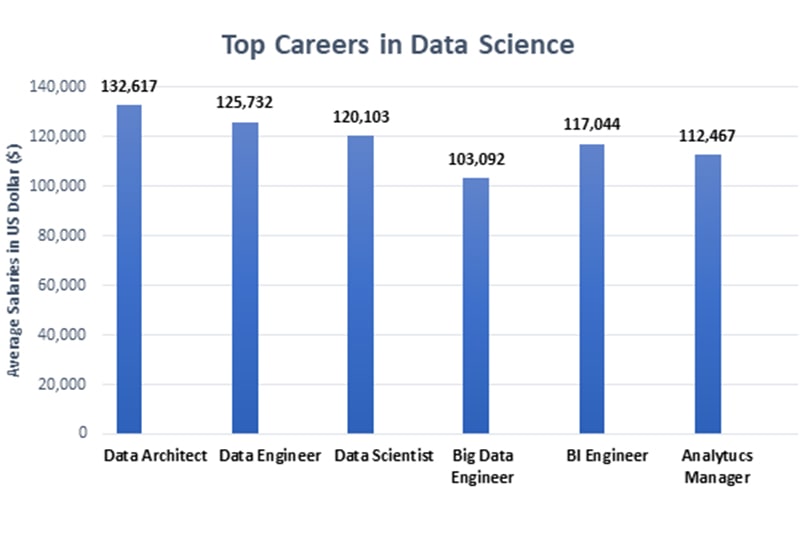
Data Science training can open the door to better career prospects. Check out the best job options you can consider after getting upskilled in Data Science:
Data Architect ($132,617)
Data Engineer ($125,732)
Data Scientist ($120,103)
Big Data Engineer ($103,092)
BI Specialist ($90,286)
Business Intelligence Engineer ($117,044)
Data Visualization Developer ($105,501)
Business Analytics Specialist ($84,601)
BI Solutions Architect ($120,539)
Statistician ($97,643)
SynergisticIT JOPP grads get hired for salaries of ($95K–$155K) with employers which include Visa, Apple, PayPal, Walmart Labs, AutoZone, Wells Fargo, Capital One, Walgreens, Bank of America, SAP, Cisco Systems, Verizon, T-Mobile, Intuit, Ford, Hitachi, Western Union, Deloitte, Dell, USAA, Carfax, and Humana.
SynergisticIT JOPP is particularly effective for candidates who are entering tech for the first time (including recent grads and career shifters)/ A large majority of Synergisticit JOPP graduates are first-time tech job holders, with the remainder being career changers or candidates with career gaps.)
Who Can Benefit from SynergisticIT’s JOPP?
- Career Changers: Professionals from QA, business analysis, statistics, and non-coding backgrounds.
- Recent Graduates: CS, engineering, math, or statistics graduates with limited or no job experience.
- Job Seekers with Gaps: Those struggling to land interviews or with career gaps.
- OPT and International Students: Assistance with visa and OPT needs, ensuring full-time offers and compliance.
- Non-Coders: No prior coding experience required; foundational training provided.
“Unlike other bootcamps with fancy ads—we have results”: events, visibility, and credibility signals
SynergisticIT actively participates in tech Industry events
The best data science bootcamp is the one that gets you hired
There may be many programs that offer data science training in Denver, Colorado. But if your real objective is employment—if you’re choosing a Job oriented data science training Bootcamp in USA and you want a structured path for how to get a job as a data scientist or how to get a job as a data analyst—then you need more than lessons.
You need multi-stack coverage (analytics + engineering + ML/AI), real projects, interview readiness, and a placement-driven model. That’s why SynergisticIT’s best data science training Bootcamp in Denver, Colorado is a Job Placement Program—built around outcomes, not just instruction.
If your goal is to get hired as a data scientist, data analyst, data engineer, or ML/AI engineer, don’t settle for programs that offer only surface-level training or limited job support. Choose a provider with a proven track record, deep industry connections, and a commitment to your success. Explore SynergisticIT’s Job Placement Program JOPP and Data Science JOPP to launch your high-paying, future-proof career in data science today.
Ready to transform your career?
Contact SynergisticIT and join the only data science bootcamp in Denver that guarantees job placement and delivers results.
