 Important Notice— Our url is



Portland, Oregon has steadily grown into a powerful technology and data hub, driven by innovation in semiconductors, healthcare, clean energy, retail, sportswear, cloud software, and advanced manufacturing. Companies in and around Portland increasingly rely on data science, data analytics, data engineering, and ML/AI to guide decisions, automate processes, and stay competitive. As a result, jobseekers are actively looking for a job oriented data science training bootcamp in Portland, Oregon that goes beyond classroom learning and delivers real employment outcomes.
While many programs advertise themselves as the best data science training bootcamp in Portland, Oregon, very few focus on what matters most to jobseekers: getting hired. Understanding this difference is critical when choosing the right bootcamp.
In the Portland, Oregon metro (including Beaverton/Hillsboro “Silicon Forest”), large direct employers that hire Data Analysts, Data Scientists, Data Engineers, and ML/AI Engineers for full-time, permanent roles include Intel, Nike, Providence Health & Services, Oregon Health & Science University (OHSU), Legacy Health, Kaiser Permanente, Adidas North America, Columbia Sportswear, Daimler Truck North America, Tektronix, Cambia Health Solutions, Precision Castparts, U.S. Bank, Wells Fargo, The Standard (StanCorp Financial Group), Portland General Electric, PacifiCorp, Lattice Semiconductor, Qorvo, Lam Research, Teledyne FLIR, Autodesk, Amazon, Salesforce, and Google.
Data Scientists average roughly $123.1K, while Senior Data Scientists average around $140.6K locally (with higher compensation possible at large tech firms depending on level and total compensation structure). Data Engineers average about $124.6K, with Senior Data Engineers averaging around $131.7K (and senior+ roles rising further with cloud, streaming, and platform ownership). For ML/AI (Machine Learning) Engineers.
Data scientists, data analysts, data engineers, and ML/AI developers are in strong demand in Portland because the region’s economy is built around data-intensive, technology-driven industries that depend on analytics and automation to stay competitive. Portland’s “Silicon Forest” is home to large semiconductor, hardware, cloud, sportswear, healthcare, energy, and financial organizations that generate massive volumes of operational, customer, supply-chain, and sensor data. These companies rely on data analysts to convert raw data into business insights and KPIs, data engineers to build reliable pipelines and cloud data platforms, data scientists to develop predictive and optimization models, and ML/AI engineers to productionize those models at scale. Portland will continue to need data analysts, data engineers, data scientists, and ML/AI developers who can bridge business goals with scalable, trustworthy technology—making these roles future-proof in the region.
Most bootcamps are built around learning completion, not employment. They teach concepts, assign a few projects, and award certificates—but stop there. Graduates are then left to compete in a crowded job market without employer connections, interview preparation, or placement support.
As a result, many jobseekers end up enrolling in multiple bootcamps or online courses. In fact, around 30% of candidates who join SynergisticIT’s Job Placement Program have already completed other coding bootcamps, university-run bootcamps, or courses through platforms like Udemy and Coursera—and still failed to get hired. The reason is consistent: most programs focus on learning content, not securing a job.
Technology should not be learned in isolation from hiring reality. Employers expect depth, strong fundamentals, real-world projects, and the ability to explain and defend technical decisions in interviews. This level of preparation cannot come from just any training company.
It must come from an organization with over 15 years of experience in the tech industry, one that understands evolving hiring standards and employer expectations. That is where SynergisticIT stands apart.
Why SynergisticIT Is the Best Data Science Training Bootcamp in Portland, Oregon
SynergisticIT does not operate like a traditional bootcamp. Instead, it offers a Data Science Job Placement Program (JOPP). This distinction is crucial because the program is designed around employment outcomes, not just training milestones.
Rather than offering fragmented courses, SynergisticIT’s Data Science JOPP integrates:
- Data science
- Data analytics
- Data engineering
- ML/AI
- Real-world projects
- Interview preparation
- Certifications
- Resume marketing and employer outreach
This comprehensive approach is why it is widely regarded as the best data science training bootcamp in Portland, Oregon for job-focused candidates.
One Program Instead of Four or Five Bootcamps
Many jobseekers waste time and money jumping between four or five different bootcamps, hoping each new certificate will unlock job opportunities. Others choose cheaper programs that promise “job guarantees” but offer no real placement support.
SynergisticIT’s Data Science Job Placement Program eliminates this problem by covering all employer-required skills in one structured program—saving time, reducing risk, and improving hiring outcomes.
How the Job Placement Program (JOPP) Is Different
SynergisticIT’s JOPP is focused on getting candidates hired, not just trained. The program:
- Actively markets candidates to employers
- Connects with hiring managers
- Schedules interviews
- Conducts mock interviews and technical drills
- Provides continuous feedback
- Handholds candidates until they receive job offers
This is why it is often described as a data science training bootcamp in Portland, Oregon with job assistance and even referred to as a data science training bootcamp in Portland, Oregon with job guarantee—because outcomes are the priority.
Importantly, the program is fully online and can be completed from anywhere in the USA, making it an online data science training bootcamp in Portland, Oregon with national reach.
Why Most Data Science Bootcamps Fail Jobseekers
Most bootcamps are built around learning completion, not employment. They teach concepts, assign a few projects, and award certificates—but stop there. Graduates are then left to compete in a crowded job market without employer connections, interview preparation, or placement support.
As a result, many jobseekers end up enrolling in multiple bootcamps or online courses. In fact, around 30% of candidates who join SynergisticIT’s Job Placement Program have already completed other coding bootcamps, university-run bootcamps, or courses through platforms like Udemy and Coursera—and still failed to get hired. The reason is consistent: most programs focus on learning content, not securing a job.
Why learn Data Science ?
-
Data science, data analysis, data engineering, and ML/AI should be learned because they form the core skill set behind how modern organizations make decisions, automate processes, and compete in a data-driven economy. Data analysts turn raw information into actionable insights that guide business strategy, data engineers build the reliable pipelines and platforms that make data usable at scale, data scientists develop models that predict outcomes and optimize performance, and ML/AI professionals bring those models into real-world production systems. Together, these roles enable companies to improve efficiency, reduce risk, personalize customer experiences, and innovate faster across industries such as finance, healthcare, retail, manufacturing, and technology. As data volumes continue to grow and AI becomes embedded in everyday products and operations, learning these disciplines provides strong career stability, cross-industry mobility, and long-term relevance, making them some of the most future-proof skills a professional can invest in today.
-
Most in-demand skill in technology: Lately, there has been a 29% increase in the demand for Data Science competency, but Data Scientists job applicants are growing at a much slower pace of 14%. It highlights a demand and supply gap in the Data Science industry. You can meet this acute shortage of Data Scientists by getting upskilled in Data Science training in Portland.
-
Bigger Paychecks: Pursuing a Data Science career guarantees a higher-paid job. The average salary of a Data Scientist ranges between $104,000 to $155,000 per annum. It further increases based on your experience, background, skills, or location. So, if you want to improve your potential income, you should consider joining a Data Science Bootcamp.
-
An endless number of Jobs: As per the Bureau of Labour Statistics (BLS), there will be a 28% surge in Data Science jobs by 2026. It will generate around 11.8 million new jobs for skilled and qualified Data Scientists. Thus, learning Data Science can be considered a safe bet for your career.

-
Work in Fortune 500 Companies: At present, several globally renowned companies like Accenture, Pinterest, Microsoft, Oracle, Uber, and others are hiring Data Scientists for business expansion and mitigating the risk of losing their customer base. Leverage the opportunity to get recruited in such companies by taking Data Science training in Portland.
Skills you will learn in our Best Data Science Bootcamp in Portland, Oregon
The Data Science Job Placement Program includes an enterprise-ready stack:
- Python (core and advanced)
- SQL and database design
- Data analytics tools (Tableau / Power BI)
- Statistics and probability
- Data engineering (ETL, Spark, Airflow)
- Machine learning algorithms
- Deep learning fundamentals
- Cloud platforms (AWS)
- MLOps concepts
- Real-world projects
- Interview preparation and certifications
Introduction to Data Science with Python
Python Introduction & Data Structures
Numerical Python (NumPy)
Pandas Data Analysis
Matplotlib & Seaborn Data Visualization
Data Manipulation: Cleansing – Munging
Data Analysis: Visualization Using Python
Introduction to Artificial Intelligence (AI) & Machine Learning (ML)
Machine Learning Techniques & Algorithms
Decision Tree and Random Forest Algorithm
Naive Bayes and KNN Algorithm
Support Vector Machine Algorithm
Model Deployment & Tableau
Introduction to Statistics
Introduction to Predictive Modelling
Data Exploration for Modelling
Data Preparation
Ensemble Learning Techniques
Web Scraping using Python Beautiful Soup
Time Series Analysis
Deep Learning
Natural Language Processing (NLP) & Text Mining
Market Basket Analysis
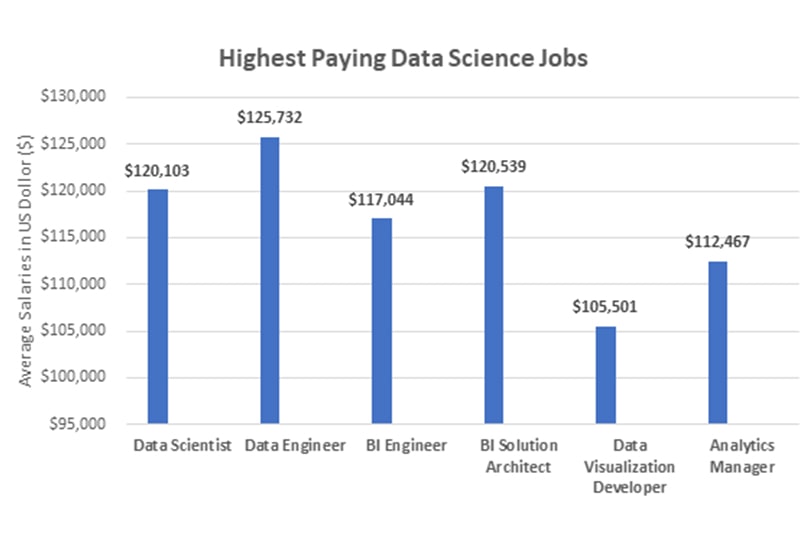
Careers Paths in Data Science
A Data Science Training in Portland opens the door for plenty of rewarding job opportunities, such as:
Data Engineer ($125,732)
BI Solutions Architect ($120,539)
Data Scientist ($120,103)
Business Intelligence Engineer ($117,044)
Analytics Manager ($112,467)
Data Visualization Developer ($105,501)
Big Data Engineer ($103,092)
Statistician ($97,643)
BI Specialist ($90,286)
Business Analytics Specialist ($84,601)
Why choose SynergisticIT Best Data Science Bootcamp in Portland, Oregon ?
SynergisticIT alumni have been hired by companies such as Visa, Apple, PayPal, Walmart Labs, AutoZone, Wells Fargo, Capital One, Walgreens, Bank of America, SAP, Cisco Systems, Verizon, T-Mobile, Intuit, Ford, Hitachi, Western Union, Deloitte, Dell, USAA, Carfax, Humana, and many more.
Salary offers for data science, analytics, and ML roles typically range from $95,000 to $155,000, depending on role and experience.
At SynergisticIT, you learn from industry experts with 10+ years of experience.
When you enroll in our Data Science training program, you get end-to-end assistance from upskilling training to career coaching, job placement, and onboarding.
We work on your overall development and help you improve your problem-solving abilities and soft skills.
Our dedicated placement team assists candidates for job preparation through cognitive interviews, psychometric tests, technical mock tests, soft skill training, etc.

We also offer valuable tips on building a marketable resume, LinkedIn profile, and cover letter.
We have a high placement rate of 97.8%, with our candidates working at the top tech giants like Google, TCS, Amazon, Apple, Cisco, PayPal, IBM, etc. Most of our graduates get multiple job offers within two weeks of completing their Data Science training.
Unlike many bootcamps that rely on flashy ads or unrealistic promises, SynergisticIT emphasizes results and industry engagement. We participate in major technology events such as Oracle CloudWorld (OCW) and the Gartner Data & Analytics Summit, and share insights with tech industry as seen in an article in USA today.
Choose the Bootcamp That Gets You Hired
While there are numerous data science bootcamps that provide training in Portland, Oregon, very few are designed with hiring as the end goal. If securing a job after completing the program is your priority, the standout option is SynergisticIT’s best data science training bootcamp in Portland, Oregon.
.Rather than stopping at classroom instruction, SynergisticIT emphasizes job placement, in-depth multi-stack skill development, and continuous support through the interview process until candidates receive offers. This approach transforms learning into real career outcomes instead of just another credential. For those who are genuinely committed to building a long-term data career in Portland, choosing a program grounded in industry experience, measurable results, and proven hiring success makes all the difference.
SynergisticIT – Home of the Best Data Scientists and Software Programmers!
