 Important Notice— Our url is



Detroit is no longer only the Motor City—it’s also becoming a serious data and AI city. Automotive innovation, mobility, manufacturing, healthcare, finance, retail, and logistics organizations across Detroit and Southeast Michigan are investing heavily in data science, data analytics, data engineering, and ML/AI to compete in a world driven by automation and intelligent decision-making. That’s why searches for a Job oriented data science training Bootcamp in Detroit, Michigan have skyrocketed: people want skills that translate into interviews and job offers—not just a certificate. But here’s the truth jobseekers learn the hard way: just data science or ML/AI training is not enough to get employed. Employers don’t hire “tool collectors.” They hire candidates who can move data end-to-end: collect it, clean it, model it, build dashboards, deploy ML models, and communicate business impact. In a competitive market, the jobseekers who get hired are the ones with a multi-stack profile: Data Analytics + Data Engineering + Data Science + ML/AI.
That’s exactly why SynergisticIT Data Science JOPP is the best data science training Bootcamp in Detroit, Michigan—because it’s not a training-only bootcamp. SynergisticIT’s JOPP is a Data Science Job Placement Program (JOPP) that combines upskilling + hands-on projects + interview preparation + marketing to employers + interview scheduling + continued support until hired. SynergisticIT JOPP model is “handholding till the attainment of a tech career,” and it has helped Jobseekers get into tech careers since 2010. If you want an Online data science training Bootcamp in Detroit, Michigan that you can complete remotely from anywhere in the USA—while still getting job-placement support—Synergisticit’s JOPP is for you.
Detroit, Michigan has become one of the Midwest’s strongest centers for applied data science, with major employers across automotive, finance, healthcare, manufacturing, and technology investing heavily in AI, predictive analytics, and machine‑learning‑driven decision systems. These organizations represent the core industries driving Detroit’s economy and rely heavily on data‑driven decision‑making, predictive modeling, and machine learning.
The companies hiring data scientists in Detroit, Michigan include Ford Motor Company, General Motors, GM Financial, Stellantis, Lucid Motors, AAA Life Insurance Company, United Wholesale Mortgage, Henry Ford Health, Dignity Health, Blue Cross Blue Shield of Michigan, Detroit Medical Center, University of Michigan–Dearborn, Oakland University, Wayne State University, Federal Reserve Bank of Chicago – Detroit Branch, Comerica Bank, Rocket Mortgage, Soothsayer Analytics, Haystack, Mars United Commerce, OneMagnify, Bayer Crop Science, SunSoft Technologies, Ford Credit, and General Motors Warren Tech Center at competitive salaries, with entry‑level roles at $93,000–$120,000, mid‑level positions at $120,000–$145,000, and senior specialists reaching $145,000–$171,300. Lead and principal data scientists at major firms can make $160,000–$185,000, reflecting strong demand and clear upward mobility across the region.
Why “just Data Science + ML/AI” training is not enough to get hired
A huge mistake jobseekers make is focusing only on model-building. In reality, most job interviews (and most jobs) require you to prove you can deliver value across the pipeline:
- Where does the data come from?
- How do you clean and validate it?
- How do you store it and model it for analytics?
- How do you build dashboards that leadership trusts?
- How do you deploy and monitor your ML models?
- How do you explain results to non-technical stakeholders?
That’s why jobseekers need a multi-stack approach:
- Data Analytics (Business intelligence layer)
- Data Engineering (Infrastructure and pipelines)
- Data Science (Modeling and experimentation)
- ML/AI (Production and deployment workflows)
SynergisticIT’s Data Science JOPP doesn’t treat these as separate silos—it prepares candidates to be employable across roles like Data Analyst, BI Analyst, Data Engineer, Data Scientist, and ML/AI Engineer.
Why most bootcamps don’t get jobseekers hired (and why many bootcamps shut down)
The reason many bootcamp graduates fail to land jobs is simple: most bootcamps just train.
They may give you content, videos, and a small project—then graduation comes, and you’re alone in the job market:
- hundreds of applications
- ATS rejections
- interviews that test deeper skills than the bootcamp covered
- weak project portfolios that look like tutorials
- no interview execution coaching
- no consistent employer marketing pipeline
This gap is why many bootcamps have shut down: the “job guarantee” marketing didn’t match reality. Employers hire based on proven capability and interview performance—not certificates.
Why SynergisticIT’s Data Science Job Placement Program (JOPP) is different
SynergisticIT Data Science JOPP is different because it is not just a bootcamp. It’s a Job Placement Program, combining upskilling with placement execution and employer-facing marketing. JOPP = upskilling + hands-on learning + project work + marketing to tech clients + “hand holding till the attainment of a tech career”
SynergisticIT’s Data Science Job Placement Program has a
- 91.5% placement rate
- $91k–$155k salary range for candidates
- 10K+ candidates placed since 2010
Why JOPP is superior to training-only bootcamps
SynergisticIT emphasizes that its approach includes:
- multi-stack upskilling (not single-skill learning)
- real project work that strengthens resumes and interviews
- interview preparation and execution coaching
- interview scheduling/connection support
- continued support until hired
That’s why jobseekers searching for a data science training Bootcamp in Detroit, Michigan with Job guarantee Choose SynergisticIT’s JOPP instead of training-only bootcamps.
Emerging tech in Data Science, Data Engineering, Data Analytics, and ML/AI asked by Detroit employers which Synergisticit's JOPP Covers
The most in-demand topics in Detroit mirror national trends—but often with a practical, enterprise focus:
Emerging Data Science and ML/AI skills
- Machine learning & predictive modeling (classification/regression, time series forecasting)
- Deep learning (computer vision for manufacturing, NLP for customer/claims data)
- Generative AI & LLM use cases (summarization, search, support automation, knowledge assistants)
- RAG (Retrieval-Augmented Generation) and enterprise knowledge systems
- Prompt engineering + evaluation (making GenAI reliable, measurable, and safe)
- MLOps (deploying, monitoring, and maintaining models in production)
- Model monitoring (drift detection, performance tracking, explainability)
Emerging Data Engineering skills
- Lakehouse architecture (Delta/Parquet + governance + scalable compute)
- Databricks / Spark for large-scale transformation and ML workflows
- Airflow for orchestration, dbt for analytics engineering
- Kafka / streaming analytics for near-real-time data
- Cloud data platforms (AWS/Azure/GCP services)
- Data governance & quality (lineage, cataloging, validation, access control)
Emerging Data Analytics skills
- Advanced SQL (window functions, complex joins, optimization thinking)
- Power BI / Tableau storytelling with executive-ready dashboards
- Metrics design (north-star metrics, cohort analysis, funnel analysis)
- Experimentation basics (A/B testing concepts, causal thinking)
- Stakeholder communication (the skill that turns insights into action)
Detroit companies are looking for data professionals who can connect all of the above. That’s why learning “only ML” without analytics and engineering tends to produce a resume that looks incomplete.
-
recent graduates should join SynergisticIT JOPP
Recent graduates often struggle because they have academic exposure but lack:
- portfolio projects that look like real work
- the “job-ready stack” employers interview for
- confidence in technical interviews
- a hiring pipeline and strategy
SynergisticIT JOPP provides tech skills, project work, interview preparation, and placement support.
- 90% of hired JOPP graduates are landing their first tech role
- 10% are career changers, candidates with career gaps, or returners
This is why many early-career jobseekers view JOPP as the Job oriented data science training Bootcamp in Detroit, Michigan that aims at real hiring outcomes.
“Expensive” but higher ROI: why JOPP can save time and money
Many jobseekers spend money on:
- 4–5 cheaper bootcamps
- multiple online courses
- scattered certifications
…and still don’t get hired.
SynergisticIT’s JOPP is a single comprehensive job placement program which can reduce wasted time and improve outcomes. It has a stronger ROI compared to traditional routes- SynergisticIT JOPP ROI.
Payment model: partial upfront, balance after you’re hired ($81k+)
SynergisticIT JOPP has a payment structure where candidates pay $10K upfront, and the remainder is paid in installments after getting a job paying $81K or higher.
-
Secure highest-paying jobs- Data Scientists and Data Analysts are considered the highest-paid tech professionals. On average, a certified Data Scientist can earn a salary of $104,000 which can go as high as $155,000 per annum based on your experience. So, by taking Data Science certification training, you can increase your income potential.

-
Some of the Companies hiring SynergisticIT JOPP candidates at salaries in the $95k to $155k range are: Visa, Apple, PayPal, Walmart Labs, AutoZone, Wells Fargo, Capital One, Walgreens, Bank of America, SAP, Cisco Systems, Verizon, T-Mobile, Intuit, Ford, Hitachi, Western Union, Deloitte, Dell, USAA, Carfax, Humana, and more.
In Detroit specifically, data roles also align strongly with employers and ecosystems tied to automotive, manufacturing, healthcare, finance, and mobility—making data science and analytics especially practical skills to build in this region.
- Learn how the outcomes-based model works: SynergisticIT Job Placement Program (JOPP)
- Explore the multi-stack data pathway: SynergisticIT Data Science Job Placement Program (JOPP)
Unlike bootcamps with fancy ads, SynergisticIT highlights results and industry networking OCW, Gartner, videos, USA Today)
SynergisticIT emphasizes industry interaction and event participation
- Browse event moments and program visuals here: SynergisticIT Video & Photo Gallery (Synergistic IT)
- Tech Events and other Videos
USA Today: How SynergisticIT is changing how tech companies source talent
-
Stay ahead of the curve- Data Science training empowers you with the latest tech advancements like Data Analysis, Machine learning, Artificial Intelligence, Data Manipulation, etc. Thus, it helps you stand out in the competition.
-
Get industry-recognized certificates- Enrolling in the best Data Science Bootcamp can reward you with a well-recognized certificate to keep an edge over non-certified candidates.
Data Analytics (BI + decision-making)
- SQL (PostgreSQL/MySQL/SQL Server), joins, window functions
- Excel (pivot tables, lookup functions, data cleaning)
- Power BI / Tableau (dashboards, DAX basics, storytelling)
- KPI design, stakeholder mapping, data validation
Data Engineering (pipelines + scalability)
- Python for ETL, data processing
- Spark / Databricks for big data workflows
- Airflow (or similar) for orchestration
- dbt for analytics engineering
- Kafka for streaming (where needed)
- Snowflake / BigQuery / Redshift or lakehouse storage
- Cloud fundamentals (AWS/Azure/GCP), data security basics
Data Science (modeling + experimentation)
- Python stack: NumPy, Pandas, Scikit-learn
- Statistics: hypothesis testing, feature engineering concepts
- ML models: regression/classification, clustering, time series
- TensorFlow/PyTorch exposure for deep learning
- Model evaluation, interpretability concepts
ML/AI + MLOps (deploy + monitor)
- MLflow / model tracking concepts
- Docker + Kubernetes basics for deployment readiness
- CI/CD awareness for ML pipelines
- Monitoring: drift, performance metrics, alerts
- GenAI tools: embeddings, vector databases, RAG concepts
This is the reality of hiring today: employers want someone who can contribute across multiple layers. That’s why the best data science training Bootcamp in Detroit, Michigan must teach breadth and depth.
Introduction to Data Science with Python
Python Introduction & Data Structures
Numerical Python (NumPy)
Pandas Data Analysis
Matplotlib & Seaborn Data Visualization
Data Manipulation: Cleansing – Munging
Data Analysis: Visualization Using Python
Introduction to Artificial Intelligence (AI) & Machine Learning (ML)
Machine Learning Techniques & Algorithms
Decision Tree and Random Forest Algorithm
Naive Bayes and KNN Algorithm
Support Vector Machine Algorithm
Model Deployment & Tableau
Introduction to Statistics
Introduction to Predictive Modelling
Data Exploration for Modelling
Data Preparation
Ensemble Learning Techniques
Web Scraping using Python Beautiful Soup
Time Series Analysis
Deep Learning
Natural Language Processing (NLP) & Text Mining
Market Basket Analysis
Who can attend this Data Science Training ?
Anyone can take our Data Science training in Detroit who wants to build a solid foundation in Data Science technology. It is best suited for:
Freshers
Graduates/undergraduates
Software developers or programmers
Aspiring Data Scientists
Professionals with a Mathematical, Logistics, or Analytical background
Individuals working on BI, data warehousing, and reporting tools

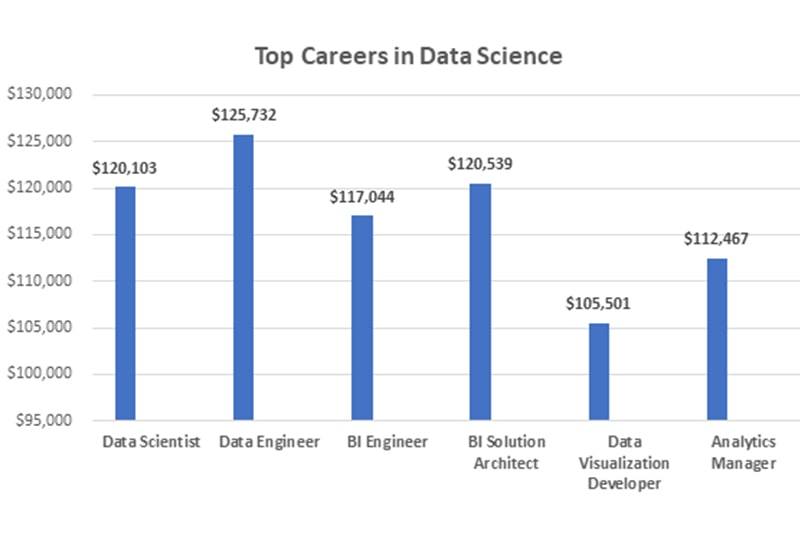
Careers after Data Science Training in Detroit
The sky is the limit for those who get upskilled in Data Science technology; here are some lucrative career options that you can consider:
Data Scientist ($120,103)
Big Data Engineer ($103,092)
Data Engineer ($125,732)
Analytics Manager ($112,467)
Data Visualization Developer ($105,501)
Business Intelligence Engineer ($117,044)
Statistician ($97,643)
Business Analytics Specialist ($84,601)
BI Solutions Architect ($120,539)
The sure-shot path to getting hired in Detroit after a data science training Bootcamp
There may be many Data science bootcamps that offer data science training in Detroit, Michigan. But if your goal is to get hired after completing the bootcamp, there is only one choice: SynergisticIT’s best data science training Bootcamp in Detroit, Michigan—because it’s a Job Placement Program, not a training-only bootcamp.
SynergisticIT’s Online data science training Bootcamp in Detroit, Michigan is designed to be completed remotely from anywhere in the USA, while still providing the structured support jobseekers need:
- multi-stack learning (analytics + engineering + DS + ML/AI)
- projects that improve resumes and interviews
- interview preparation and execution
- employer marketing and interview scheduling
- handholding until hired
Lets get you started on your Data Scientist journey
- Get started now: Contact SynergisticIT
- Review the full JOPP: SynergisticIT Job Placement Program (JOPP)
- Go directly to the data Science JOPP: SynergisticIT Data Science JOPP
