 Important Notice— Our url is



Best Data Science Bootcamp in Boston, Massachusetts
Best Data Science Bootcamp in Boston, Massachusetts – Why SynergisticIT Leads the Nation in Job‑Oriented Data Science Training
Boston, Massachusetts has long been recognized as one of the most influential tech and innovation hubs in the United States. With its world‑class universities, thriving biotech ecosystem, financial institutions, healthcare giants, and rapidly expanding AI and analytics sectors, Boston has become a magnet for companies seeking highly skilled data professionals. As organizations increasingly rely on data‑driven decision‑making, the demand for data scientists, data analysts, ML engineers, and data engineers continues to surge. For jobseekers looking to break into this competitive field, choosing the best data science training Bootcamp in Boston, Massachusetts is essential. Among the many options available, SynergisticIT JOPP stands out as the most comprehensive, results‑driven, and employer‑trusted program—making it the top choice for anyone serious about launching a high‑paying data career.
Boston’s tech and biotech ecosystem is expanding rapidly, and a wide range of organizations are actively hiring data scientists. Based on current postings and industry activity in the region, companies with open roles include Amazon, Cohere Health, WHOOP, Fidelity Investments, Shift Technology, Vectra, Azurity Pharmaceuticals, Flagship Pioneering, Google, Sanofi, Verily, Laminar, Ikigai Labs, Pickle Robot Company, Alsym Energy, Adobe, BCG X, VantAI, Xometry, Air Space Intelligence, Spotify, Jerry, Lila Sciences, ConcertAI, and SharkNinja. These organizations span healthcare, biotech, robotics, finance, consumer tech, and enterprise AI—reflecting the diversity of Boston’s innovation economy.
Salary ranges for data science roles in Boston remain highly competitive. Current postings show mid‑level data scientists earning $115,000–$165,000 at companies like Flagship Pioneering, while cybersecurity‑focused roles at Vectra offer $140,000–$180,000 for Data Scientist II positions. Entry‑level or early‑career roles, such as those at Kalamata Capital, fall closer to $60,000–$80,000, while specialized machine‑learning engineering roles at companies like Pickle Robot Company reach $130,000–$160,000. Senior roles at major enterprises such as Staples show ranges like $116,000–$159,000 for senior data scientists.
If you’re searching for a Job oriented data science training Bootcamp in Boston, Massachusetts, you’re probably not looking for “another course.” You’re looking for outcomes—skills that match what Boston-area employers actually use, plus the positioning and interview support needed to convert those skills into offers. Boston (and nearby Cambridge) is one of the most data-intensive job markets in the U.S., with high demand across biotech/pharma, healthcare, finance, consulting, cybersecurity, retail/e-commerce, and SaaS. The challenge is that the market is crowded with applicants who have “some” Python or “some” ML—but not the multi-stack depth companies expect.
The reality: not all bootcamps are equal (and why depth matters)
In Boston’s competitive market, “surface knowledge” is easy to spot. Many bootcamps rely heavily on recorded content, light projects, and generic capstones that don’t reflect real pipelines. Candidates graduate with buzzwords, but they struggle in technical screens—SQL questions, Python exercises, statistics fundamentals, and practical system design for data workflows.
Technologies must be learned in-depth from a company with 15+ years of tech-industry exposure, because they’ve seen how hiring expectations evolve and they build training accordingly.
That’s why SynergisticIT stands out as the best data science training Bootcamp in Boston, Massachusetts for jobseekers whose real goal is hiring. SynergisticIT is not just a bootcamp—it’s a Job Placement Program (JOPP) that combines deep upskilling with staffing-style marketing and interview scheduling support, built from real employer feedback. SynergisticIT has been operating since 2010 (15+ years), which matters because what gets you hired is rarely “a single tool.” It’s stack coverage, portfolio proof, and job-market execution.
Emerging tech Boston employers ask for (and why “just ML” isn’t enough)
A big misconception is: “If I learn Machine Learning, I’ll get hired.” In reality, companies hire for end-to-end capability:
- Data Engineering + Pipelines: building reliable ingestion, transformations, orchestration, and scalable compute.
- Analytics + BI: metric definition, stakeholder communication, dashboards, and decision workflows.
- Data Science + ML/AI: modeling, experimentation, evaluation, and business impact measurement.
- Cloud + MLOps: deploying models, monitoring drift, CI/CD, and production reliability.
This is exactly what shows up in real job requirements: modern stacks like Databricks/Spark, Snowflake, Airflow, dbt, Kafka, cloud warehouses, and production ML tooling are increasingly “expected,” not “nice-to-have.”
Tools you need across Data Science, ML/AI, Data Analytics, and Data Engineering
To compete in Boston, jobseekers should be credible across multiple layers:
Data Analytics / BI (often the fastest on-ramp)
- SQL (joins, window functions, performance thinking)
- Excel (analysis workflows, pivots, business comfort)
- Tableau / Power BI (dashboards, semantic layers, stakeholder reporting)
- Metrics + experimentation basics (A/B testing, cohorting, funnel analysis)
This layer is also why QA testers, Business Analysts, Program Managers, and candidates from statistics/math/non-coding backgrounds can transition successfully. Starting with Analytics + BI + SQL is often “minimal-to-low code” compared to software engineering—and it builds confidence before going deeper into Python, engineering, and ML.
Data Science
- Python / R, statistics, hypothesis testing, feature engineering
- Pandas/NumPy, modeling workflows, reproducible notebooks
- Scikit-learn, model selection, evaluation, interpretability
Machine Learning / AI
- TensorFlow / PyTorch, deep learning foundations
- NLP & LLM basics, embeddings, retrieval patterns, model evaluation
- Model monitoring concepts (drift, bias, performance)
Data Engineering
- Spark / Hadoop, distributed thinking
- Kafka, streaming/event pipelines
- Airflow, orchestration and scheduled pipelines
- Snowflake / Databricks, warehouse + lakehouse workflows
Cloud + MLOps
- AWS/Azure/GCP
- Docker/Kubernetes
- MLflow and operational model lifecycle practices
SynergisticIT JOPP structures training around this multi-stack reality—Data Science + ML/AI, Data Engineering, Data Analytics/BI, and Cloud + MLOps—because that’s how employers hire now.
Why SynergisticIT is the best Data Science training Bootcamp in Boston, Massachusetts
Most programs that advertise Online data science training Bootcamp in Boston, Massachusetts or data science training Bootcamp in Boston, Massachusetts with Job guarantee focus on completion—finish modules, submit a capstone, get a certificate. Then you’re on your own.
SynergisticIT’s model is different: it’s not “just training”—it’s a Job Placement Program with multi-stack depth and active placement execution.
1) Multi-stack training that matches real hiring
SynergisticIT’s JOPP curriculum emphasizes full-spectrum readiness across Data Science/ML/AI, Data Engineering, Analytics/BI, and Cloud/MLOps.
2) Live support + projects + interview readiness
SynergisticIT JOPP has instructor-led sessions, project work resembling real pipelines, interview prep, resume support, and active marketing/interview scheduling until hired.
3) Outcome-aligned fee structure
SynergisticIT Fee structure is designed where you pay partial fees upfront, and the balance is due after you secure an offer at $81K+—aligning incentives with outcomes.
4) “Expensive” vs “worth it” (the 30% pattern)
SynergisticIT JOPP has ~30% of candidates who join who first tried other bootcamps or course platforms, then returned after 6–9 months when those didn’t lead to job success—highlighting the hidden cost of repeating cheaper programs.
5) Reported outcomes: placement + salary ranges
SynergisticIT’s JOPP has a 91.5% placement rate and a $96K–$155K salary range on successful completion of their Data Science Job Placement Program.
Is Data Science a good career path ? AI tools?
Why AI tools won’t reduce Data Science demand (especially in Boston)
AI tools can accelerate coding, summarization, and experimentation—but they don’t remove accountability. Companies still need people who can:
- define the business problem and translate it into a measurable approach
- build or validate the data pipeline behind the model
- choose the right metric, sampling strategy, and evaluation method
- deploy safely (security, latency, monitoring, governance)
- explain tradeoffs to executives, product owners, and regulators
In regulated Boston industries (healthcare, biotech, finance), “move fast and break things” doesn’t work. That’s why well-trained data scientists and analytics professionals remain in demand: the stakes are high, and the systems must be reliable.
Emerging Tech Skills Employers Demand
Employers now expect candidates to go beyond basic data science. They seek expertise in:
- Deep Learning frameworks (TensorFlow, PyTorch, Keras)
- Natural Language Processing (NLP) for chatbots and generative AI
- Computer Vision for imaging and autonomous systems
- Cloud ML platforms (AWS SageMaker, Azure ML, Google Vertex AI)
- Big Data tools (Hadoop, Spark, Kafka)
- MLOps/DevOps integration for scalable deployment
- Data engineering pipelines with Airflow, Snowflake, and Databricks
Let’s determine whether pursuing a Data Science career is worth it or not:
-
Rewarding Pay Checks: Data Science offers the highest-paying job offers. As a Data Scientist, you can get extravagant salaries ranging from $104,000 to $190,000 a year based on your experience, location, and domain.
-
Plenty of Career Options: Data Science is an interdisciplinary field that opens a variety of job options like Machine Learning Engineer, Big Data Engineer, Data Scientist, Data Visualization Developer, BI Engineer, Analytics Manager, Data Analyst, Statistician, etc. So, taking Data Science training in Boston can enlarge your career scope.
-
Why Training Alone Isn’t Enough
Completing a short ML/AI bootcamp is rarely sufficient. Employers expect candidates to demonstrate multiple tech stacks:
- Data Science Fundamentals: Statistics, Python, R, ML algorithms
- Data Engineering: ETL pipelines, SQL, NoSQL, cloud data warehouses
- Data Analytics: Tableau, Power BI, advanced Excel
- ML/AI Specializations: Deep learning, NLP, reinforcement learning, computer vision
Without this holistic skill set, candidates struggle to stand out in interviews and coding assessments.

-
Work in the Leading Industries: Data Science is not confined to the tech industry as different industries like Finance, Advertising, Transportation, Healthcare, Retail, Education, and others harness Data Science solutions. Thus, Data Science gives you access to work in different sectors.
-
Increasing Demand: According to the US Bureau of Labour Statistics, there will be a 28% increase in Data Science jobs by 2026. It will generate around 11.8 million new jobs for skilled Data Scientists. Leverage the opportunity to future-proof your career by getting upskilled in Data Science training in Boston.
Synergisticit's Best Data Science Bootcamp in Boston, Massachusetts course overview
Our Data Science training in Boston delivers an extensive curriculum that focuses on building your computational and analytical competency.
Tech Stack Covered in SynergisticIT’s JOPP
The program’s curriculum includes:
- Programming: Python, R, Java, Scala
- Data Engineering: SQL, NoSQL, Hadoop, Spark, Kafka, Snowflake, Databricks
- Data Analytics: Tableau, Power BI, visualization libraries
- ML/AI: TensorFlow, PyTorch, Keras, Scikit‑Learn, NLP, computer vision
- Cloud Platforms: AWS, Azure, Google Cloud
- MLOps/DevOps: Docker, Kubernetes, CI/CD pipelines
This integrated stack ensures graduates are ready to perform on projects from day one.
Introduction to Data Science with Python
Python Introduction & Data Structures
Numerical Python (NumPy)
Pandas Data Analysis
Matplotlib & Seaborn Data Visualization
Data Manipulation: Cleansing – Munging
Data Analysis: Visualization Using Python
Introduction to Artificial Intelligence (AI) & Machine Learning (ML)
Machine Learning Techniques & Algorithms
Decision Tree and Random Forest Algorithm
Naive Bayes and KNN Algorithm
Support Vector Machine Algorithm
Model Deployment & Tableau
Introduction to Statistics
Introduction to Predictive Modelling
Data Exploration for Modelling
Data Preparation
Ensemble Learning Techniques
Web Scraping using Python Beautiful Soup
Time Series Analysis
Deep Learning
Natural Language Processing (NLP) & Text Mining
Market Basket Analysis

Who can attend our Data Science Training ?
Anyone can enroll in our Data Science training in Boston to have better career prospects. We have mainly designed this for:
Fresher who wish to build some analytical skills to start a Data Science career
Professionals with logistics, mathematical, or analytical background
Programmers or developers
Individuals working on reporting tools, data warehousing, and Business intelligence
Careers after Data Science Training in Boston
BI Solutions Architect ($120,539)
Data Engineer ($125,732)
Analytics Manager ($112,467)
Data Scientist ($120,103)
Business Intelligence Engineer ($1,17,044)
Business Analytics Specialist ($84,601)
Data Visualization Developer ($105,501)
Big Data Engineer ($103,092)
BI Specialist ($90,286)
Statistician ($97,643)
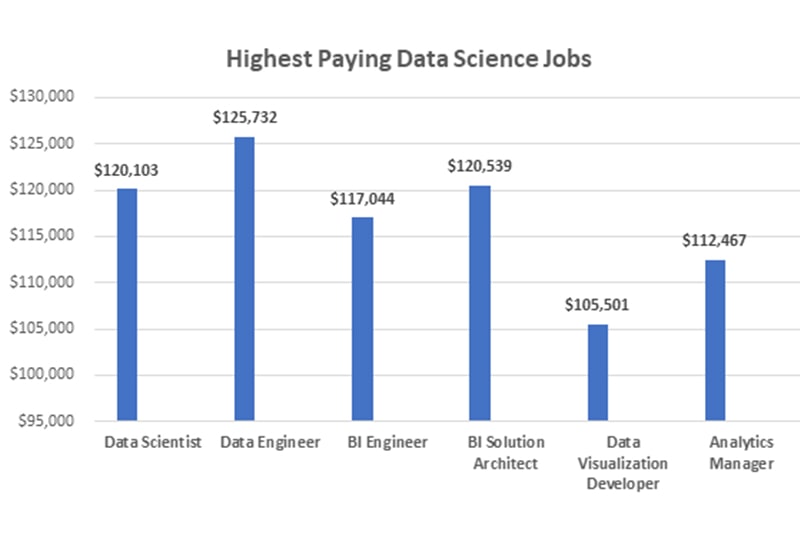
Start acquiring valuable Data Science and Data Analyst skills by training at the best online Data Science Bootcamp. Create a robust work portfolio to demonstrate your abilities in the field with the assistance of experienced mentors.
Companies that hire SynergisticIT JOPP candidates
SynergisticIT JOPP has many recognizable employers that have hired their candidates—examples include Visa, PayPal, Bank of America, Citi, Wells Fargo, Walgreens, Capital One, Walmart Labs, Apple, Google, T-Mobile, Humana, SAP, and Verizon—with salary ranges around $90K–$154K .
These companies value SynergisticIT’s graduates because they are trained to handle complex projects and deliver results immediately.
If you want to review the program structure and how the placement process works, start here: SynergisticIT Job Placement Program (JOPP) and the track focus here: SynergisticIT Data Science Job Placement Program.
For ROI : SynergisticIT ROI vs Colleges.
“We don’t just run ads—we show proof”: events, videos, and media
SynergisticIT event/video gallery shows participation and presence at major industry events (including the Gartner Data & Analytics Summit and Oracle events). You can explore it here: SynergisticIT Video & Photo Gallery.
If you want videos of different events SynergisticIT Videos
Read the USA Today coverage: USA Today: How SynergisticIT is Changing How Tech Companies Source Talent.
The “best data science bootcamp in Boston” is the one built to get you hired
There may be many programs that claim to be the best data science training Bootcamp in Boston, Massachusetts, or advertise data science training Bootcamp in Boston, Massachusetts with job assistance. But if your goal is to get hired—not just trained—there is only one practical choice: SynergisticIT’s best data science Bootcamp in Boston, Massachusetts, because it’s a Job Placement Program designed around multi-stack readiness plus interview execution.
To get started in your tech career journey: Contact SynergisticIT.
