Important Notice— Our url is



Best Data Analyst Training Bootcamp in El Paso, Texas – Get Trained, Get Certified, Get Hired
If you have been searching for the Best Data Analyst Bootcamp in El Paso, Texas, what you are really searching for is a program that does not stop at teaching you SQL, Excel and dashboards — it stays with you until you are actually hired. That is exactly what SynergisticIT's Job Placement Program (JOPP) delivers: immersive, live, instructor-led training combined with resume building, certifications, interview preparation and active marketing to employers until you receive a full-time tech job offer [1]. Rather than joining a bootcamp that hands you a certificate and disappears, jobseekers can join SynergisticIT's Data Science JOPP, which covers data analytics, data engineering, data science, Machine Learning and AI in one integrated program — along with the job placement machinery that gets candidates hired at salaries of $95k to $155k [2].
El Paso jobseekers should understand one thing clearly: in today's market, a plain "data analyst" certificate is no longer a ticket to employment. Employers are consolidating roles and looking for hybrid candidates who can query data, build pipelines, create BI dashboards and apply machine learning. The Best Data Analyst Bootcamp in El Paso, Texas is therefore the one that builds a multi-stack professional and then markets that professional to companies until they are hired — and that is precisely what SynergisticIT's JOPP does, fully online, from anywhere in the USA, including El Paso.
El Paso still needs data and BI analysts because its economy runs on logistics, manufacturing, healthcare, utilities, and defense, even though software employment is thinner than in Austin or Dallas. In May 2025, computer and mathematical jobs were 1.8 percent of local employment, versus 3.4 percent nationally, and the local mean in that group was $43.46 an hour, below the U.S. mean of $57.73.
Employers with El Paso operations that use this talent, excluding staffing firms, include ADP, Charles Schwab, Helen of Troy, El Paso Electric, Schneider Electric, Yazaki, Prudential Financial, The Toro Company, GECU, Hunt Companies, ECM International, Mesilla Valley Transportation, Lincoln Financial Group, Brink’s, The Hospitals of Providence, Las Palmas Del Sol Healthcare, El Paso Health, University Medical Center of El Paso, El Paso Children’s Hospital, Entravision Communications, Walmart, FirstLight Federal Credit Union, WestStar Bank, Lockheed Martin, and RTX.
Published local pay varies by title. ZipRecruiter puts the El Paso data analyst average near $74,743, with most roles from $56,500 to $87,700 and top reported pay near $109,000. Salary.com places the average near $85,092, about $67,900 to $101,600. Read together, junior data analyst offers cluster around $46,000 to $68,000, mid-level around $65,000 to $88,000, and senior around $90,000 to $110,000. BI roles often pay a step higher: a BI analyst average near $78,300, typically $61,000 to $97,600, and a senior BI analyst average near $99,300, commonly $82,500 to $119,000, with some experienced estimates near $137,000.
Demand should hold because the Borderplex is a major manufacturing and trade corridor, Schneider Electric has made El Paso its largest U.S. manufacturing base, and Meta is building a more than $10 billion AI data center. Fort Bliss and contractors keep defense analytics steady, while hospitals, ADP, and finance firms need reporting on cost, risk, and operations. UTEP’s data science programs feed that pipeline, and computer work is still underrepresented, so digitization has room to grow. El Paso-linked technologists include Richard Lyon, who grew up there and co-invented the optical mouse; NASA’s Ginger Kerrick, the first Hispanic woman flight director; astronaut-engineer Danny Olivas; computer scientist Ann Quiroz Gates; and NASA propulsion leader Yvonne Villegas-Aguilera. Wages trail national tech hubs, but lower living costs and cross-border industry keep these roles employable.
Why Data Analyst Skills Are Important to Learn
Data is the operating system of the modern enterprise. Every decision a company makes — pricing, hiring, marketing spend, inventory, patient care, fraud detection — starts with data being collected, cleaned, queried and interpreted. Data analyst skills matter because they sit at the exact point where raw business information becomes business action.
Consider a regional employer in a border-market economy like El Paso: logistics, healthcare, retail, banking and government services all run on reporting pipelines and dashboards. The people who can build those pipelines and translate numbers into recommendations are the people who get promoted. Learning data analysis means learning how to ask the right question, pull the right data with SQL, clean and shape it, model it, visualize it in Power BI or Tableau, and communicate the story to non-technical decision makers. Those skills compound — an analyst who understands the business becomes a senior analyst, then an analytics manager, then a director of analytics. Understanding how analyst careers ladder up against data scientists and engineers is worth reading in depth, and SynergisticIT breaks it down well in its Data Analyst vs Data Scientist career guide.
Data analyst skills are also the safest on-ramp into technology for people from non-coding backgrounds, because the entry barrier is far lower than software engineering: logic, curiosity and structured thinking matter more than deep computer science theory.
AI, Automation and the Shrinking of Traditional QA, BA and Data Analyst Roles
Here is the hard truth jobseekers in El Paso must hear: traditional business analyst, QA tester and manual data analyst roles are shrinking. AI-powered testing tools, automated ETL, low-code analytics platforms and code-generation assistants have absorbed a huge portion of what these roles used to do manually. A job that once required a team of manual testers writing test scripts now requires one engineer supervising automated test frameworks. A reporting job that once required weekly manual Excel pulls is now a scheduled pipeline.
At the same time, companies are tightening their budgets. Hiring managers are not opening five requisitions for five narrow specialists anymore; they are opening one requisition for a hybrid professional who can do several of those jobs.
That is why employers now look for hybrid candidates who can combine data analytics, data science, ML/AI and data engineering on top of the basics — SQL, Excel queries, QA test scripts and manual testing. In practice, the job posting says "Data Analyst," but the interview asks about Python, Snowflake, Power BI, ETL pipelines and machine learning models. The candidate who can move across analytics, engineering and modeling wins; the candidate who can only write SQL queries and Excel macros gets screened out.
Emerging Skills Companies Now Demand from Data Analysts and BI Professionals
The skills asked of data analysts and Business Intelligence professionals have shifted sharply in the last few years. Employers screening candidates in 2026 typically expect a blend of:
- Advanced SQL on cloud warehouses — Snowflake, Databricks, BigQuery — not just basic SELECT queries but window functions, CTEs and query optimization
- Python for analytics and automation — pandas, NumPy, scikit-learn — replacing slow, manual Excel workflows
- Cloud platforms — AWS, Azure and GCP data services, because nearly all enterprise data now lives in the cloud
- Modern BI and visualization — Power BI, Tableau, semantic models and DAX, beyond static reports
- Data engineering basics — Spark, Kafka, Airflow, ETL/ELT pipelines — because analysts are increasingly expected to build the pipelines feeding their own dashboards
- Machine Learning and AI literacy — understanding how models are trained, evaluated and deployed, including generative AI and LLM-based tools
- Data governance and quality — documentation, validation and lineage as regulatory scrutiny increases
A candidate who shows this emerging stack on their resume, backed by real projects, is dramatically more hireable than one holding only an Excel-based analyst certificate.
Why QA Testers, Business Analysts, Math and Non-Coding Professionals Should Join SynergisticIT's Data Science JOPP
If you are a QA tester, business analyst, program manager, or come from a statistics, mathematics or non-coding background, you are much closer to a data career than you think. SynergisticIT's Data Science Job Placement Program (JOPP) is built precisely to convert your existing analytical foundation into an employed data professional [2].
The reason this transition works is skill overlap. Look at what these roles already share:
- SQL — QA analysts verify data with SQL; BAs pull reports; data analysts live in SQL
- Excel and reporting — BAs and QA professionals already build reports and work with structured data
- Requirements analysis and stakeholder communication — the core of every BA role, and the core of every analytics role
- Data validation and quality checks — QA test scripts and test cases are conceptually identical to data quality testing and validation frameworks
- Process thinking and documentation — program managers and BAs map workflows; data engineers map pipelines
The coding involved in moving into data analytics and BI is minimal to almost none at the entry point, and what little is required — Python and SQL — is easily learned in a structured program. QA analysts, BAs, program managers and statisticians can benefit enormously by starting with data science, Business Intelligence and data analytics skills, because so many skills overlap between the domains. A career in data science, data analytics or BI analytics is genuinely achievable through SynergisticIT's Data Science JOPP, which is exactly how thousands of career changers have crossed over.
Just Data Analyst Skills Are Not Enough: The Multi-Stack Reality
To be blunt: a data analyst skill set alone will not get you hired in 2026. The market rewards candidates who arrive with multiple tech stacks. Instead of doing four or five separate coding bootcamps — or worse, paying a cheap training company that promises a "job guarantee" it never delivers — jobseekers should complete one comprehensive program that covers all of them. SynergisticIT's Data Science JOPP includes:
- Data Analytics — SQL, Excel, Python (pandas, NumPy), statistics, data cleaning, exploratory data analysis
- Data Engineering — Snowflake, Databricks, Spark, ETL/ELT pipelines, Airflow, Kafka, cloud storage and warehousing
- Data Science — statistical modeling, hypothesis testing, feature engineering, predictive modeling
- Machine Learning and AI — scikit-learn, supervised and unsupervised learning, TensorFlow, model deployment, generative AI and LLM fundamentals
- Business Intelligence — Power BI, Tableau, dashboard design, DAX, KPI reporting and storytelling with data
- Cloud and DevOps foundations — AWS, Azure, CI/CD awareness, version control with Git
This is the technology mix employers in data science, Machine Learning and AI, data analytics, BI and data engineering are actively asking for — and it is delivered inside a single program with projects, certifications and interview preparation attached.
How SynergisticIT's Job Placement Program Helps Jobseekers with a Career Gap
- Structured re-skilling that explains the gap. JOPP fills a career break with verifiable, current, project-based learning, so the gap becomes a period of documented upskilling rather than a red flag on the resume.
- Real projects that rebuild credibility. Candidates complete hands-on projects aligned to current employer requirements, giving interviewers recent, defensible work to discuss instead of stale experience from years ago.
- Resume rebuilding and positioning. The program rewrites and repositions the resume around current, in-demand stacks — certifications, projects and tools — so applicant tracking systems and recruiters see a current professional.
- Interview preparation and mock rounds. Career-gap candidates get drilled on technical screens and behavioral questions, including how to confidently address the gap itself.
- Active marketing to employers. SynergisticIT markets returning candidates to its network of 24,000+ company contacts and schedules interviews until placement — the gap stops being something you explain alone and becomes something the program neutralizes [1].
How SynergisticIT's Job Placement Program Helps Recent Graduates with No Experience
- Job-ready technical skills, not just theory. Recent graduates arrive with coursework; JOPP converts that into the exact technical stack clients are hiring for right now, informed by real-time market feedback.
- Genuine project-based resumes. Graduates leave with enterprise-style projects on their resume — not fake or embellished experience — so they can defend every line in an interview.
- Industry certifications at no extra cost. JOPP includes certifications from Microsoft, Oracle, Snowflake, Databricks, Azure and AWS, giving inexperienced candidates third-party proof of skill that levels the playing field against more seasoned applicants.
- Interview training until you are ready. Unlimited access to live sessions, mock interviews and unlimited retakes until job-readiness means a first-time job seeker walks into interviews prepared rather than hopeful.
- Placement until hired. Most importantly, SynergisticIT takes over the job search itself — scheduling interviews with tech companies until the graduate receives an offer. For a recent graduate with zero network, that is the difference between applying into the void and interviewing.
Notably, 90% of JOPP graduates who get hired at tech jobs have never worked in a tech job before; the other 10% are career changers and candidates with career gaps. That single statistic should tell recent graduates everything about who this program is built for.
Best Data Analyst Training Bootcamp in El Paso, Texas -Why Consider Synergisticit?
-
Why Companies Hire SynergisticIT JOPP Candidates
Employers do not hire JOPP graduates as a favor. They hire them because the program removes the risks and costs that make hiring painful:
- Current tech stack alignment and job-ready skills — JOPP is shaped by direct tech-client demand, continuous industry interaction and hands-on learning, so candidates need far less ramp-up time
- Pre-screened talent — every candidate goes through rigorous technical screening before being presented, so companies receive candidates already checked for technical and job fit before interviews
- Certified across the stack — JOPP candidates hold certifications in Java, DevOps, AWS, Azure, Power BI, Snowflake and more, adding credibility to an already diverse skill set
- Multi-stack professionals — a company gets one junior developer who can contribute across backend, frontend and deployment, or a data scientist who can also serve data engineering, analytics and ML/AI teams
- Reduced hiring risk — candidates arrive after structured training, projects, interview prep and screening, dramatically lowering the risk of a failed hire
- Day-one contribution — JOPP candidates are practical and prepared to add value from the first day of employment
- Project-based resumes, not embellished ones — the program focuses on real projects and skills, eliminating the fake-resume lottery that plagues job boards
In short: companies hire JOPP candidates because they arrive trained, screened, project-ready, interview-prepared and aligned with current tech roles — an offer no job board or staffing agency can make. One important caveat: these outcomes belong to genuine JOPP candidates who have completed the entire program. Candidates who drop out halfway do not carry the same preparation, screening or credibility — completion is what makes the model work.
Why Tech Companies Pay JOPP Candidates High Salaries
Companies like Visa, Apple, PayPal, Walmart Labs, AutoZone, Wells Fargo, Capital One, Walgreens, Bank of America, SAP, Cisco Systems, Verizon, T-Mobile, Intuit, Ford, Hitachi, Western Union, Deloitte, Dell, USAA, Carfax and Humana keep hiring SynergisticIT candidates at salaries of $95k to $155k — and there are clear reasons why:
- They outperform experienced hires — JOPP graduates are trained on current stacks, so they frequently perform better than candidates with years of dated experience
- They are promoted faster — multi-skilled graduates take on broader responsibilities and rise into leadership positions more quickly
- Companies are exhausted by fake and ineffective candidates — after wasting time on job boards and staffing firms, employers value a pipeline where the screening has already been done
- No second-guessing — when hiring managers do not want to second-guess a new hire's work performance or technical skills, pre-screened JOPP candidates are their choice
- Better value than the open market — a JOPP candidate with deeper, broader multi-stack experience than a 3–5 year experienced hire would cost a client roughly twice the salary if recruited directly, and can take on multiple responsibilities at once
Why Most Bootcamps Fail — and Why SynergisticIT Is Different
The bootcamp industry has earned its bad reputation. A large number of bootcamps have shut down because they made promises they could not keep — "job guarantees" with refund clauses that could never realistically be redeemed. They collected full tuition upfront, delivered recorded videos, issued a certificate, and left graduates to fend for themselves in a brutal job market. SynergisticIT JOPP makes one promise and keeps it: candidates who successfully complete the program get hired into tech companies. It is also worth stating plainly that not all Data Analyst Bootcamps and coding bootcamps are equal. Any serious technology should be learned in-depth — not from a generic Data Analyst or BI Analyst bootcamp or training company, but from a company that has lived inside the tech industry for over 15 years: SynergisticIT.
Here is how SynergisticIT compares to bootcamps, staffing companies and everyone else who claims to help jobseekers:
- Curriculum quality and relevance — SynergisticIT participates in tech-industry events like Oracle CloudWorld and the Gartner Data & Analytics Summit, and its candidates are actively interviewing every week, so curriculum is adjusted in real time to actual job market requirements — not recycled from years-old syllabi
- Instructor quality — most bootcamps use recent alumni, recorded sessions or instructors teaching a couple of hours a week; SynergisticIT uses industry professionals averaging more than 10 years of experience in their domains
- Number of instructors — most bootcamps have one or two instructors teaching everything; the SynergisticIT data science and Java programs each run 5–6 specialist instructors — separate experts for data analytics, data engineering, data science and Machine Learning, and similarly for Java, databases, advanced Java and DevOps
- Transparent cost — $10,000 upfront, with the balance of $26,000 payable only after landing a job offer, spread over 2 years; if there is no job offer, no further payments accrue. Most bootcamps take all fees upfront and hide behind unredeemable refund guarantees
- Duration and depth — 4–5 hours of live instruction per day, 5 days a week, for around 5 months — a deeply immersive program with live lectures and no recorded sessions. Every prospective enrollee should demand this comparison from any bootcamp they are considering
- Student-to-instructor ratio — 5:1 at SynergisticIT versus 20:1 or worse at typical bootcamps
- Real projects — projects tailored to company requirements and tech stacks based on real-time job market demand; only the projects you actually work on appear on your resume
- Certifications included — from Microsoft, Oracle, Snowflake, Databricks, Azure and AWS, at no extra cost
- Post-graduation placement support — SynergisticIT markets candidates to a network of 24,000+ company contacts, prepares and schedules interviews, and hand-holds from enrollment to the first day on the job; most bootcamps hand you a certificate and generic resume tips. Ask any bootcamp for specifics — in writing
- Alumni success — read, view and listen to alumni reviews describing how they landed offers; alumni routinely receive high-paying offers in the range of $95k to $155k, often with multiple offers
You can verify all of this yourself — photographs of successful alumni on the JOPP page, video and audio reviews on SynergisticIT's reviews page, its feature in USA Today, and its tech event videos from Oracle CloudWorld and Gartner summits [3][4]. Unlike bootcamps with fancy ads, SynergisticIT has results you can check.
Roughly 30% of candidates who join SynergisticIT's Job Placement Program have already completed other coding bootcamps or Udemy, Coursera or university courses — without getting hired — before joining JOPP. Yes, JOPP is more expensive than a cheap bootcamp. But it delivers better results, and it saves both the money burned on programs that produce nothing and the months or years of your life lost to them. Judged against the cost and outcomes of a college degree, SynergisticIT's Job Placement Program delivers the highest ROI in tech training — see the detailed breakdown in SynergisticIT's ROI comparison with colleges, and current market numbers on its tech salaries blog [5][6].
What the Typical Hiring Process in El Paso, Texas Looks Like
Understanding how hiring actually works in El Paso helps you prepare for it:
- Recruiter outreach and screening — most local and remote processes begin with a recruiter call covering experience, salary expectations, work authorization and logistics; El Paso's proximity to Fort Bliss and cross-border operations means background checks can run longer than average
- Coding and technical tests — expect a SQL test, a Python or analytics exercise, a take-home dataset, or a live problem-solving round; BI roles frequently include a Power BI or Tableau dashboard task
- On-site or virtual panel rounds — typically two to three rounds with the hiring manager, senior analysts and sometimes a stakeholder, covering projects, behavioral questions and scenario-based problem solving
- Offer timelines — most El Paso processes close within two to four weeks from first screen to offer, though government-adjacent and banking employers can take longer due to compliance steps
JOPP candidates enter this process already drilled on every stage, because interview preparation and scheduling are part of the program itself.
Policy and Infrastructure Factors That Shape Hiring in El Paso
Hiring in El Paso is shaped by structural factors every jobseeker should understand:
- Employer density — El Paso's economy is anchored by healthcare, government (including Fort Bliss, one of the largest military installations in the USA), education, logistics and call-center operations, with a growing remote-work layer of national tech employers
- Tax incentives — Texas has no state income tax, and local incentives plus foreign trade zone designation attract manufacturing and logistics employers who increasingly need data talent
- Broadband infrastructure — expanded fiber availability has made remote data roles genuinely viable from El Paso, connecting local candidates to national employers
- Transit and commute — a manageable commute culture and low cost of living make El Paso attractive for candidates choosing between expensive coastal hubs
- Visa processing — proximity to the border and the presence of consular processing affect timelines for visa-dependent candidates; remote-first programs like JOPP, which can be done from anywhere in the USA, reduce this friction

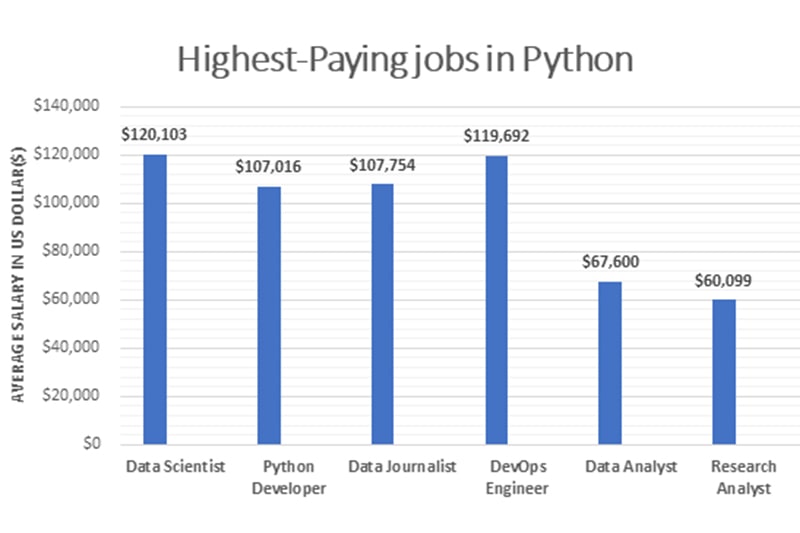
Careers Paths after our Best Data Analyst Training Bootcamp in El Paso, Texas
Data Analyst
DevOps Engineer
Python Developer
Django Developer
Research Analyst
Data Journalist
Data Scientist
Why People Stay or Leave El Paso
People stay in El Paso for its low cost of living, strong sense of community, short commutes, bilingual professional environment and improving remote-work culture that lets residents earn tech salaries without relocating. People leave when they want denser career ladders — Austin, Dallas and Phoenix offer larger concentrations of tech employers and faster internal promotion tracks, and ambitious analysts sometimes follow that competition. The remote-work era has softened this tradeoff: a SynergisticIT JOPP candidate sitting in El Paso can interview with and work for national tech companies without moving, which is precisely how the program's placement engine works.
Why Waiting Is the Only Guaranteed Loss
Delaying does not shorten the program — it only pushes your job offer further out. SynergisticIT's JOPP takes the time it takes because it is genuinely building something: skills, real projects, interview readiness and client marketing that continues until placement. That demanding stretch is exactly what employers ultimately pay for. The candidates who start now are the ones interviewing while others are still researching. The journey is long, but the destination is a full-time tech job offer with a strong salary.
JOPP Fees: Pay Mostly After You Are Hired
SynergisticIT's Job Placement Program only takes partial fees before placement — $10,000 upfront — and the balance is collected only once the jobseeker is hired for a $81k job or higher, payable over two years. That structure is the program putting its own money behind its promise: your outcome and the company's incentive are the same thing.
Final Word: The Only Data Analyst Bootcamp in El Paso That Gets You Hired
There may be hundreds of programs advertising Data Analyst Bootcamp training in El Paso, Texas, and every one of them will happily teach you SQL and send you on your way. But if your goal is to actually get hired after the bootcamp, there is only one choice: SynergisticIT's Best Data Analyst Bootcamp in El Paso, Texas — which is not a separate bootcamp at all, but SynergisticIT's Data Science Job Placement Program (JOPP): training, projects, certifications, interview preparation and active employer marketing combined in one program [2]. SynergisticIT's Best Data Analyst Bootcamp in El Paso, Texas is the sure-shot way of ensuring a jobseeker gets hired into a great tech role at a great tech company.
Ready to start your data analyst career journey? Contact SynergisticIT today or call (510) 550-7200 to speak with the team, review the Job Placement Program, and take the first step toward a $95k–$155k tech career.