 Important Notice— Our url is



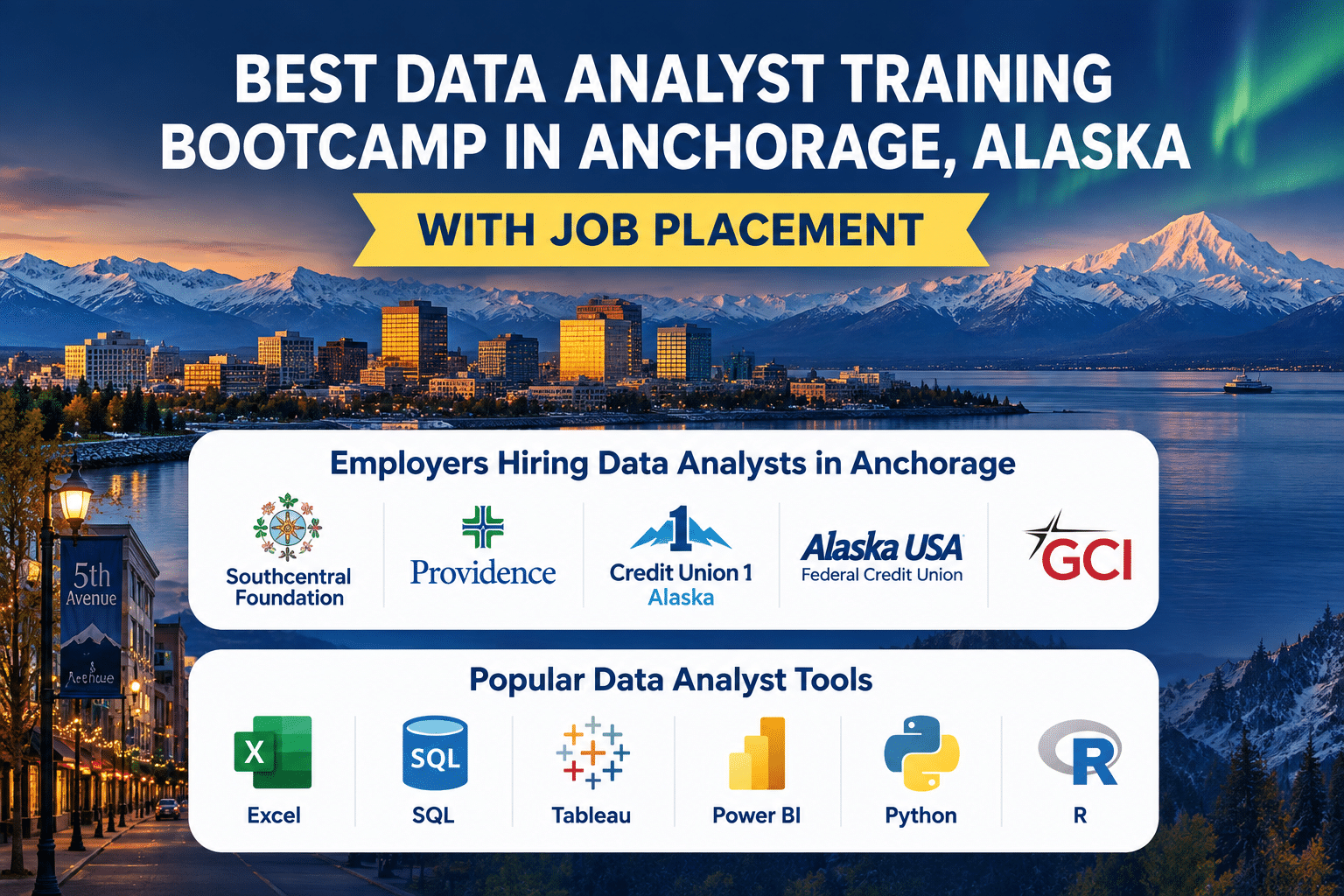
Best Data Analyst training Bootcamp in Anchorage, Alaska
The best path for an Anchorage jobseeker who wants a data analyst career that actually ends in a hire is SynergisticIT’s remote Data Science Job Placement Program, not a short certificate that stops at Excel and that's why its called the Best Data Analyst training Bootcamp in Anchorage, Alaska with Job Placement. Anchorage has urban amenities, a short commute, and almost no state income tax, but it does not have a deep local stack of in-person data bootcamps. National employers still hire people who can do analytics, engineering, and applied machine learning from day one.
Why data skills matter now
Data analyst skills matter because every budget decision, fraud check, patient flow, logistics route, and marketing test now leaves a data trail. In Anchorage, that trail runs through health systems such as Providence Alaska Medical Center, cargo and airline operations at Ted Stevens Anchorage International Airport, government, energy, and retail. A person who can turn messy records into a decision saves money. A person who only writes a status report does not.
Emerging skills employers keep asking for go well past pivot tables. They want SQL that can join warehouse tables, Power BI or Tableau dashboards, Python for cleaning and modeling, cloud warehouses such as Snowflake, lakehouse tools such as Databricks, and enough AWS or Azure to know where the data lives. Business intelligence work now includes metric definitions, row-level security, and storytelling for non-technical managers. Generative tools are showing up as copilots, not as a substitute for judgment. Companies want analysts who can question a model, not just paste its output.
Traditional business analyst, QA, and narrow data analyst seats are shrinking. Automation writes basic test scripts. Chat tools draft user stories. Finance teams cut headcount that only runs manual checks or simple Excel queries. What remains is a hybrid seat: someone who can query data, build a dashboard, trace a pipeline, and talk about a model without waiting for three other specialists. Basic SQL, a few Excel formulas, and manual test cases are no longer a career.
Anchorage employers that hire data analysts and business intelligence analysts, and that are not staffing firms, include Southcentral Foundation, Providence Alaska, Alaska Native Tribal Health Consortium, Alaska Regional Hospital, Arctic Slope Regional Corporation, ASRC Energy Services, ConocoPhillips Alaska, Hilcorp Alaska, Alyeska Pipeline Service Company, Chugach Electric Association, Matanuska Electric Association, ENSTAR Natural Gas Company, GCI, Alaska Airlines, Alaska Railroad Corporation, First National Bank Alaska, Credit Union 1, Northrim Bank, Cook Inlet Region, Inc., NANA, the State of Alaska, the Municipality of Anchorage, Anchorage School District, University of Alaska Anchorage, and Doyon, Limited. These organizations have local operations in health care, energy, utilities, finance, transportation, government, or Alaska Native enterprise, where reporting and analytics are routine. A listing does not mean a vacancy is open today. Analyst hiring in this small market is intermittent, and some analytical work sits inside finance, clinical quality, regulatory, or operations teams rather than under a pure analyst title.
Published pay is a market range, not a promise from every employer. Recent surveys and postings put junior data analysts near $61,000 to $80,000, mid-level data analysts near $75,000 to $100,000, and senior data analysts near $88,000 to $120,000. Southcentral Foundation has listed a Data Analyst I hiring range of $65,770 to $87,693 and a Data Analyst II hiring range of $75,296 to $100,402. Business intelligence work generally pays more. Junior BI analysts often fall around $67,500 to $90,000, mid-level BI analysts around $85,000 to $115,000, and senior BI analysts around $110,000 to $145,000. ZipRecruiter places the average BI analyst salary in Anchorage near $102,145. Salary.com’s September 2026 Alaska average is about $121,230, with Anchorage near $122,440. SQL, Power BI, health-care, or oil-and-gas experience, and whether the job is public or private, move offers inside those bands.
Demand should remain steady because Anchorage is Alaska’s commercial, medical, and logistics center, and those sectors run on measured reporting. Hospitals and tribal health systems need analysts for quality, claims, and population health. Oil, pipeline, utility, and resource companies headquartered in the city need production, cost, and regulatory intelligence. Banks, the railroad, aviation, and Alaska Native corporations need finance and operations dashboards. State and local government and the university add recurring public reporting work. Artificial intelligence may shrink some routine junior tasks, but people who can check data, explain results to clinicians and engineers, and govern dashboards are still necessary where one flawed report can affect a whole program.
Anchorage is not a large software hub. In May 2025, computer and mathematical jobs were 1.9 percent of local employment, versus 3.4 percent nationally, and the local mean wage in that group was $46.05 an hour against $57.73 nationally. The wider labor market is still substantial. Bureau of Labor Statistics figures for September 2026 show a civilian labor force of about 200,500, employment of about 193,300, and unemployment of 3.6 percent. Nonfarm employment was about 183,400, down roughly 1 percent over the year. Alaska’s labor department expected Anchorage to add about 1,200 jobs in 2026, or 0.8 percent. People with a technology or science connection to the city include Larry Sanger, who grew up in Anchorage and co-founded Wikipedia; Brian Schmidt, the Nobel-winning astrophysicist associated with Anchorage; David Bullock, a tech entrepreneur and media executive from Anchorage; and James Ryan, an Anchorage-born co-founder of Litmus Logic. Their careers largely developed elsewhere, which fits a local tech economy built around applied analytics inside larger institutions rather than a venture-backed startup scene.
Overlap that career changers already have
QA testers, business analysts, program managers, and people from statistics or mathematics already share a large slice of the analyst toolkit. Requirements, acceptance criteria, defect patterns, stakeholder interviews, and process maps are the same muscles used in analytics and BI. Much of the early work is minimal coding: SQL selects, Excel logic, dashboard filters, and clear written findings. Those pieces are learnable. The gap is not intelligence. The gap is a current stack, projects an employer can verify, and someone who will market you until an offer exists.
That is why those backgrounds should start with SynergisticIT’s Data Science JOPP rather than another tool sampler. The same habits that made someone good at QA or BA work transfer into data analytics, BI, and, with structured practice, data science. Overlap does not mean the old job title is enough. It means the jump is realistic if the training is deep and the placement work is real.
One stack is not a hire
Just data analyst skills are not enough. Job posts that still say “analyst” often also want engineering and modeling. Employers in data analytics ask for Excel, SQL, Power BI, Tableau, Python, and Pandas. Business intelligence roles add semantic models, DAX or similar calculation languages, and governed metrics. Data engineering roles ask for Spark, pipelines, Airflow-style orchestration, Snowflake, Databricks, and cloud storage on AWS or Azure. Data science, machine learning, and AI roles add Scikit-learn, PyTorch or TensorFlow, evaluation, feature work, and, increasingly, practical exposure to large language models. A candidate who can move across those layers is cheaper to staff than three narrow juniors.
Interview strength still depends on fundamentals. A useful companion read is why data structures and algorithms still decide technical screens.
Why join our Best Data Analyst training Bootcamp in Anchorage, Alaska with Job Placement?
What hiring looks like in Anchorage
Recruiter outreach in Anchorage is thinner than in Seattle or the Bay Area. Many first messages come from national remote teams, staffing partners, or local employers in health, government, logistics, aviation, and energy. A typical loop is a recruiter screen, a SQL or case exercise, a live technical conversation, and a hiring-manager round. Coding tests are common for hybrid data roles even when the title sounds non-technical. On-site rounds still happen for roles tied to a hospital, base-adjacent contractor, or airport operation, while many product companies stay virtual. Offer timelines often run two to six weeks after the first screen, longer when a public-sector or contractor clearance step is involved. Because local employer density is modest, candidates who can also interview for remote roles have a wider funnel than candidates who will only work downtown.
Public labor-condition data does not publish a clean ratio of U.S. citizens and permanent residents to immigrant tech workers in the city. What it does show is a small H-1B footprint. One 2026 compilation of Department of Labor filings put Alaska near the bottom of states for certified H-1B activity, with Anchorage at 36 filings in the fiscal year covered and a local median near $105,019, against a much larger resident workforce. Those filings are not visas issued and not a census of who already works in tech. The practical reading for jobseekers is that Anchorage hiring is not an H-1B-dominated market. Work authorization still matters, and a candidate who needs sponsorship should confirm that before paying any program.
Policy, transit, and daily life
Transit is usable but car-shaped. People Mover connects the airport and core neighborhoods, including Route 40 and Route 65, with a $2 single ride and a $5 day pass. Average commute time is about 16 minutes, which is a real quality-of-life advantage. Broadband is a state priority through the Alaska Broadband Office and federal BEAD funding, though service still varies by neighborhood and is not identical to a coastal tech hub. Tax policy is a hiring factor in the other direction: Alaska has no state income tax, and Anchorage has been cited with a 0% local sales tax, which helps offset a high cost of living. Opportunity Zones and small-business innovation grants exist, but they do not create a dense software-employer cluster by themselves. The largest local employers include the airport complex, Providence, and Joint Base Elmendorf-Richardson, alongside government. Tech candidates should assume many of the best-paid data roles will be remote or hybrid with companies outside Alaska.
Nightlife for single jobseekers is real, seasonal, and smaller than a Lower 48 metro. Summer brings long light, outdoor festivals, live music, craft beer, and late sunsets over Cook Inlet. Downtown and Spenard bars, comedy, and performing arts fill winter nights, but the scene is intimate rather than endless. Making friends takes intention. Outdoor clubs, volunteering, and workplace communities matter more than bar-hopping. For families, the Anchorage School District serves more than 43,000 students across 100-plus schools, with private options alongside it. Parks, trails, and hospitals are strong. Winter darkness, housing cost, and distance from grandparents are the usual reasons families hesitate.
People stay for light traffic, mountains, trail access, no state income tax, and a city that still feels manageable. People leave for higher rents relative to local wages, a thin local tech ladder, long winters, and competition from Seattle and other West Coast hubs that post more on-site staff roles. Remote-work culture helps Anchorage residents keep coastal salaries without the coastal commute, which is exactly why a nationally marketed skill set beats a city-only certificate.
A guide to bootcamps jobseekers actually see
Anchorage does not host a crowded strip of branded, in-person data analyst bootcamps with published local campuses, audited placement rates, and years of alumni threads. Residents mostly compare national online or hybrid programs, university-style certificates, and short recorded courses. Published ranges for well-known analytics programs often fall between about $7,000 and $17,000, sometimes higher, with lengths from roughly 10 weeks full-time to six months part-time. Instruction may be live, recorded, or mixed. Hiring support is usually coaching, not a team that submits you to employers until an offer letter exists. Loans and installment plans are common. Income-share or “refund if not hired” language often carries conditions that are hard to redeem.
Who joins: career changers, recent graduates, and working adults who want a structured calendar. Feedback on public forums is split. Positive reviews praise portfolios, mentors, and a push to finish. Negative reviews cite upfront tuition, large classes, alumni instructors, recorded lectures, and certificates that did not produce interviews. Success rates advertised by the industry are not comparable, because each school defines “hired” differently and many do not publish audited outcomes. Treat any local ad that implies a packed Anchorage classroom and a guaranteed city salary as a claim to verify in writing.
How placement support differs by situation
SynergisticIT’s Job Placement Program is built for people the open market ignores. The company states it has worked with jobseekers since 2010 and markets candidates to a network of 24,000+ company contacts.
Career gap or break
- Rebuilds a current stack so the gap is not the first line of the resume.
- Replaces stale tools with projects tied to what clients are interviewing for now.
- Uses interview practice so a long absence does not show up as rust.
- Markets the candidate instead of leaving a discouraged jobseeker to apply alone.
- Keeps support through scheduling, not a single career-services webinar.
Recent graduates with no experience
- Supplies the projects universities often skip.
- Puts certifications and a multi-stack resume in front of employers who filter out “no experience.”
- Prepares candidates for screens they have never seen.
- The program states that about 90% of JOPP graduates who get hired had never held a tech job before, with the other 10% career changers, people with gaps, and similar profiles.
- Targets full-time offers rather than another unpaid certificate.
People who simply need a tech hire
- Aligns skills with roles companies are actually opening.
- Screens before client submission so the first interview is not a discovery call.
- Builds a resume from work the candidate did, not borrowed bullet points.
- Schedules interviews instead of emailing generic tips.
- Stays in the process until the candidate is working, which is the point of SynergisticIT’s Job Placement Program.


Who you should take our Best Data Analyst training Bootcamp in Anchorage, Alaska with Job Placement?
Career Opportunities after Best Data Analyst training Bootcamp in Anchorage, Alaska with Job Placement

Why employers take JOPP candidates
Current tech stack alignment comes from client demand and from industry rooms, including Oracle CloudWorld and the Gartner Data & Analytics Summit, plus candidates who are interviewing every week. Footage from those events is public in the tech event gallery. A hire who already speaks the stack needs less ramp-up. Pre-screened talent means a company sees people who have already been checked for technical and job fit. Candidates can add credentials on Java, DevOps, AWS, Azure, Power BI, Snowflake, and related platforms, included in the program’s certification path rather than sold as extras. Multi-stack skill is the staffing preference of this market: one junior who can help on analytics, engineering, and model work, or a developer who can touch backend, frontend, and deployment. Reduced hiring risk follows from structured training, projects, interview prep, and screening. Day-one contribution is the standard the program trains toward. Project-based resumes are built from work the candidate can defend, which matters when embellished bootcamp portfolios are common. In short, companies hire these candidates because they are trained, screened, project-ready, interview-prepared, and pointed at current roles. SynergisticIT states that employers including Visa, Apple, PayPal, Walmart Labs, AutoZone, Wells Fargo, Capital One, Walgreens, Bank of America, SAP, Cisco Systems, Verizon, T-Mobile, Intuit, Ford, Hitachi, Western Union, Deloitte, Dell, USAA, Carfax, and Humana have hired its candidates, with offers discussed in the $95,000 to $155,000 range.
What separates this program
Curriculum quality moves when job posts move, because staff sit in client conversations and at those industry events. Instructor quality is industry practitioners, with the program citing an average of more than 10 years of domain experience, not a recent graduate covering every topic from a slide deck. Number of instructors is a structural difference: the data track uses about five to six specialists, with separate voices for analytics, engineering, and data science or machine learning, rather than one generalist. Cost is stated as $10,000 before training and a balance of up to $26,000 only after a job offer of $81,000 or higher, paid over about two years. No offer at that level means that balance does not accrue. Most camps collect full tuition first and attach a refund guarantee that is difficult to collect. Duration is immersive: about four to five hours a day, five days a week, across roughly five months, live, not a library of recordings. The data-science page describes a similar live load, often five to seven hours, over several months. Ask any other camp whether instruction is live, and get the answer in writing. Student-to-instructor ratio is described as about 5 to 1, against 20 to 1 in many large cohorts. Projects follow client stacks, and only work the candidate actually did goes on the resume. Alumni outcomes are public as video, audio, and written reviews, with offers in that $95,000 to $155,000 band and, in some cases, more than one offer. Certifications from vendors such as Microsoft, Oracle, Snowflake, Databricks, Azure, and AWS are part of the path. Career help is marketing to the 24,000+ contact network, resume work, interview prep, and scheduled interviews, from entry through the first days on the job. A camp that hands you tips and a PDF is not the same service.
Trust should be checked, not assumed. Read SynergisticIT reviews, the USA Today contributor piece, and the ROI comparison with colleges. Photographs, offer letters, and years in business are the right evidence. The ROI write-up argues that a conditional $36,000 all-in cost, with most of it due only after an $81,000 offer, returns faster than a four-year degree whose payoff can take more than a decade. That is the program’s case. It is not a promise that every enrollee hits the top of the salary band.
Many coding bootcamps shut down because they sold placement they could not deliver. A short class, a certificate, and a handshake are not a hiring system. SynergisticIT states its promise narrowly: candidates who successfully complete JOPP are marketed until they are hired into tech roles. Not every analytics course is equal, and a stack this broad should be learned in depth from a firm that has been in the technology industry for more than 15 years, not from a pop-up brand. Results, not ads, are the distinction. For a related look at re-entry after time away, see landing a tech job after a career gap.
Waiting will not compress SynergisticIT’s JOPP into a weekend. It only pushes the offer further out. The months exist because skills, projects, interviews, and client marketing have to be built before a company will pay. That hard stretch is the product. Begin while the calendar is still yours. The road is long. The finish line is a full-time offer, not another login to a video library.
There may be many pages advertising a Data Analyst Bootcamp in Anchorage, Alaska. If the goal is to get hired after the training, the practical choice is SynergisticIT’s Best Data Analyst training Bootcamp in Anchorage, Alaska: live, remote, multi-stack, and tied to placement. Call (510) 550-7200 or start on the Data Science Job Placement Program and ask for the fee, the daily schedule, and the placement steps in writing before you enroll.
