 Important Notice— Our url is



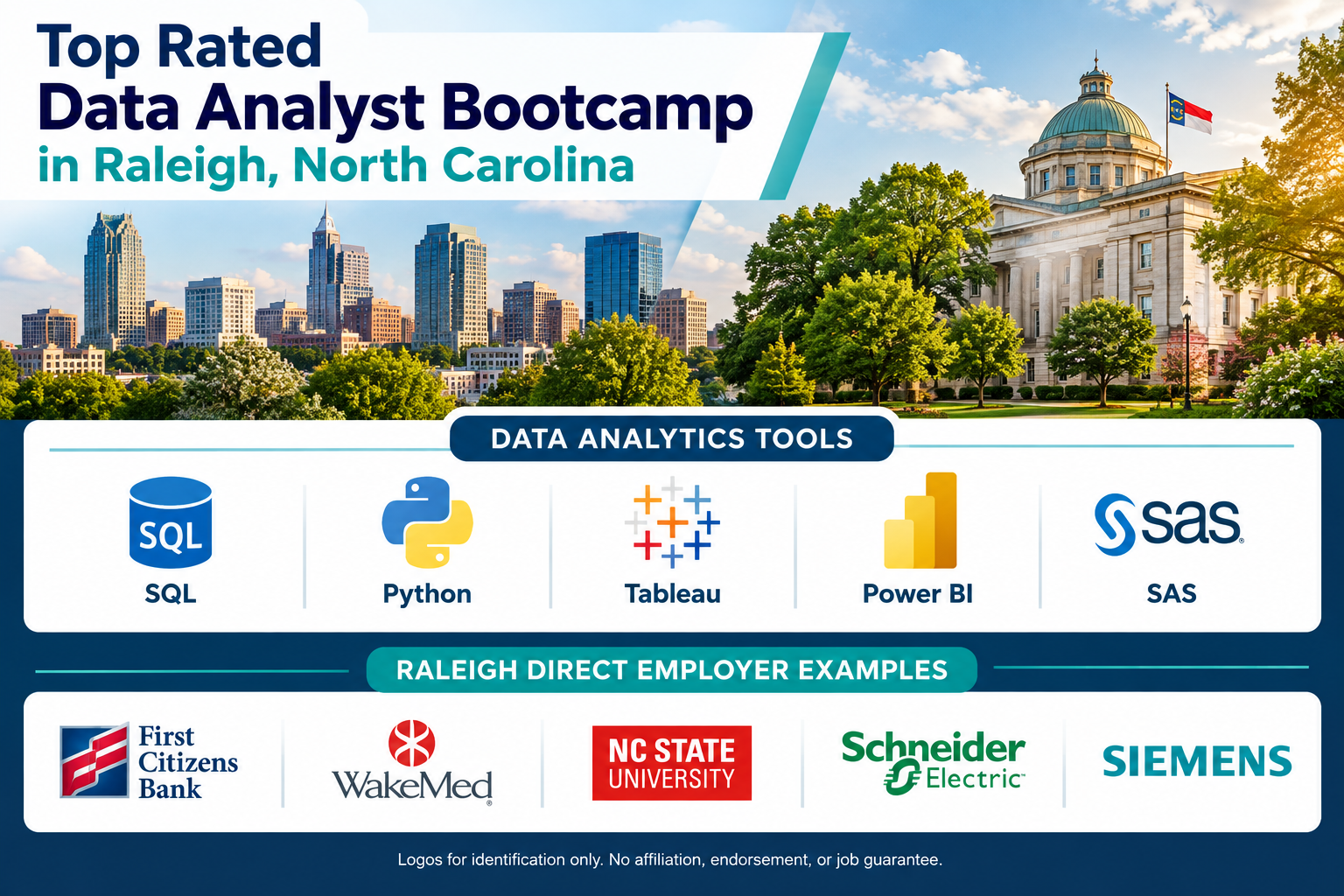
Top Rated Data Analyst Bootcamp in Raleigh, North Carolina
A Top rated Data Analyst Bootcamp in Raleigh, North Carolina is worth your time only if it ends in a job, not a certificate. For that outcome, SynergisticIT points candidates to the SynergisticIT Data Science JOPP and the broader SynergisticIT’s Job Placement Program, a live, placement-first path rather than a short class in Excel.
Raleigh sits inside the Research Triangle, where Red Hat, SAS, Cisco Systems, IBM, banks, insurers, and health systems already hire people who can turn messy data into decisions. Local pay for a conventional analyst is solid, not automatic. Salary.com put the average Data Analyst wage in Raleigh at $97,203 as of October 2026, with a typical middle range of about $86,914 to $107,053. ZipRecruiter’s Raleigh figure is lower, around $80,333, which shows how much title, stack, and employer change the offer. SynergisticIT states that candidates who finish JOPP and clear its assessments have been hired in a reported band of $95,000 to $155,000.
Why analyst skills matter
Data Analyst skills are now a business language, not a side skill. Every product launch, claims cycle, store forecast, and patient pathway leaves a trail. Someone has to clean that trail, ask a sharper question, and show a manager what to do on Monday. Companies that still decide by instinct lose margin to teams that can measure it.
Why these skills pay off in Raleigh
- Triangle employers already run on data. Analytics software, open-source platforms, banking, insurance, and hospital systems all need people who can explain a number without hiding behind a chart.
- A dashboard is a decision tool. A well-built report can cut a wasted campaign, flag a claims leak, or show which store, clinic, or feature is actually growing.
- Communication is half the job. The analyst who can brief a non-technical director is more valuable than the person who only exports a spreadsheet.
- The skill transfers. Retail, health, telecom, logistics, and state government in the capital region all ask versions of the same question: what happened, why, and what should we change?
- It is the on-ramp to higher-paid hybrid work. Analyst fundamentals are how many people later move into data science, engineering, and applied machine learning without starting from zero.
Emerging skills employers now write into postings
Basic SQL and a pivot table used to be enough. They are now the floor. Hiring managers in and around Raleigh increasingly ask for a wider kit:
- SQL that goes past a single SELECT, including joins, window logic, and query cleanup.
- Python for analysis, especially pandas, NumPy, and simple visualization, once Excel hits a row limit.
- Business Intelligence, above all Power BI and Tableau, including data modeling and DAX-style measures rather than pretty charts only.
- Cloud warehouses such as Snowflake, plus familiarity with Databricks, BigQuery, or Azure data services.
- Light data engineering: cleaning, ETL, and pipeline awareness so the dashboard does not break when the source changes.
- Statistics that a stakeholder can trust: cohorts, experiments, and the difference between correlation and a decision.
- Applied machine learning and AI literacy: regression, classification, feature thinking, and how generative tools assist analysis without inventing facts.
- Storytelling and domain sense in finance, healthcare, retail, or telecom, because a model nobody will use is not a hire.
Business Intelligence is the skill companies mention when they want the same truth in every meeting. A BI analyst connects source systems, models the data, and publishes a dashboard that sales, finance, and operations can share. In a budget-tight year, that shared view replaces three disconnected spreadsheets and a weekly argument.
If you are choosing between a reporting career and a modeling career, read Data Analyst vs Data Scientist before you pick a narrow course. The titles overlap in job ads and diverge in the interview.
Data and business intelligence analysts remain employable in Raleigh because software, finance, health care, life sciences, and state government all need people who can turn operational data into decisions. The employers below are operating companies and institutions, not staffing firms. Several are based in Cary, Morrisville, or Research Triangle Park and recruit in the same Raleigh labor market.
Red Hat, IBM, Cisco, SAS Institute, Lenovo, Epic Games, Pendo, Bandwidth, Fidelity Investments, NetApp, First Citizens Bank, Truist, MetLife, UBS, Advance Auto Parts, WakeMed, UNC Health, Labcorp, RTI International, Martin Marietta, North Carolina State University, LexisNexis, Schneider Electric, Itron, and the American Kennel Club are among the local organizations that hire or regularly compete for this talent.
Published pay is a market range, not a posted offer from each employer. For data analysts, junior benchmarks commonly fall around $67,000 to $78,000, mid-level roles typically run about $87,000 to $107,000, and senior to expert analysts often earn about $118,000 to $153,000. Business intelligence pay is wider. A small set of Raleigh postings put junior BI analysts near $67,000 and senior BI analysts near $136,000, while a 2026 recruiter benchmark for the BI analyst title in Raleigh runs from $113,940 at the low end to $139,320 in the middle and $165,780 at the high end. Offers move with SQL, Python, Tableau or Power BI depth, industry, and whether the role owns a warehouse or only reports from one.
That demand should hold. Hospitals, labs, insurers, and biopharma plants need governed clinical and operational reporting, software firms need product and customer analytics, and banks need risk and performance reporting. As the state capital, Raleigh also has universities and public agencies that need analysts who can explain administrative data. Nearby biomanufacturing adds quality, yield, and supply data that operators still need reported, not only modeled. Newer AI tools raise, rather than erase, the value of people who prepare trusted data, build models leaders can audit, and show which result is reliable. A tight labor market keeps that skill scarce.
The tech figures most closely tied to this economy are James Goodnight and John Sall, who co-founded SAS Institute, Tim Sweeney, founder of Epic Games, Jesse Lipson, who launched ShareFile in Raleigh in 2005, and Todd Olson, cofounder and chief executive of Raleigh-based Pendo. The employment picture is strong but not automatic. The Raleigh–Cary area added 15,400 jobs in the year ending April 2026, a 2.0 percent gain that was the largest among large U.S. metros, and unemployment fell to 3.0 percent, the lowest in North Carolina. Research Triangle Park holds more than 300 companies and over 50,000 workers. A June 2026 outlook expects Research Triangle real GDP growth of about 3.0 percent a year through 2030, above a projected 2.3 percent U.S. pace, helped by nearly $3.8 billion in life sciences investment in 2025. Apple’s planned park campus remains paused, and cuts to federal research funding would hit this university-and-park economy harder than most.
Hybrid hiring and who should switch
Traditional business analyst, QA, and narrow data-analyst seats are shrinking. AI now drafts user stories, generates first-pass test ideas, and summarizes a spreadsheet that once took a junior analyst a day. At the same time, companies are tightening budgets. A manager who once hired a manual tester, a requirements writer, and a report builder is often allowed one headcount. That headcount is expected to query data, check quality, explain the business rule, and hand a result to an engineering or ML team.
This is not a claim that every BA or QA role vanishes. Regulated testing, stakeholder workshops, and domain judgment still matter. The roles that are thinning are the ones that stop at basic SQL, Excel filters, test scripts, and manual click-throughs. Those tasks are the first to be automated or folded into a hybrid seat.
What Raleigh-area employers want instead is a hybrid candidate. The person who gets the interview can do data analytics and business intelligence, understands data science and ML/AI well enough to collaborate, and can support data engineering tasks such as pipelines, warehouses, and cloud storage. A resume that lists only manual testing or only Excel is easy to skip. A resume that shows SQL, Power BI, Python, a warehouse, and one applied model is harder to ignore.
QA testers, business analysts, statisticians, mathematicians, and people from non-coding backgrounds should use the SynergisticIT Data Science JOPP as the start of a data career, not as a hobby class. The overlap with their old work is real, and the coding bar at the entry to analytics and BI is lower than the bar for a pure software role.
Program managers, QA leads, and BAs gain the most when they add data science, BI, and analytics rather than abandoning their domain. A tester who can measure defect patterns is more useful than a tester who only files tickets. A BA who can build the metric, not just request it, stops waiting on another team. A program manager who can read a pipeline and a dashboard can challenge a vendor instead of accepting a slide.
Skills these roles already share
- Requirements and stakeholder translation. Analysts, BAs, QA, and BI staff all turn a vague ask into a testable question.
- Process and edge cases. QA lives here. Data work needs the same suspicion of bad inputs and missing values.
- SQL at a practical level, spreadsheets, and documented checks. This is closer to structured thinking than to building an operating system.
- Reporting and evidence. A test summary, a status deck, and a BI dashboard are cousins.
- Minimal to modest coding at the start. Excel logic, SQL, and guided Python are learnable for people who have never shipped production code. A career in data analytics, BI, and then data science is realistic when that base is taught in depth and tied to projects, which is the design of SynergisticIT Data Science JOPP.
How SynergisticIT’s Job Placement Program helps a career gap
- It replaces a blank year with current projects that match stacks clients are interviewing for, so the gap is explained by work rather than by a paragraph of apologies.
- Live instruction and repeat access let someone who has been out of the market rebuild speed without pretending a weekend video is enough.
- Screening before marketing means a rusty candidate is not sent to Bank of America or Wells Fargo until the technical bar is actually cleared.
- Resume and interview handling covers the awkward questions about the break, using evidence from projects instead of inflated titles.
- Client marketing to a stated network of 24,000+ contacts takes distribution off the person who has been refreshing job boards alone.
How JOPP helps recent graduates with no experience
- It supplies the tech stack school often skipped: warehouses, BI, pipelines, and applied ML, not only theory.
- Projects become the experience section, which matters when a Raleigh recruiter filters out “no professional data work.”
- Certifications from vendors such as Microsoft, Snowflake, Databricks, Azure, and AWS give a new graduate a second proof point besides a diploma.
- Interview volume is treated as part of the program, including behavioral rounds. Use what to expect in a behavioral interview so the first recruiter call is not your first rehearsal.
- SynergisticIT states that about 90% of JOPP graduates who get hired had never held a tech job before, with the other slice made up of career changers and people returning after a gap. That is the audience a new graduate actually belongs to.
Raleigh market, life, and hiring
Policy and infrastructure shape who gets hired in Raleigh more than a slogan about “the next Silicon Valley.”
- Transit is improving, but the car still wins. GoRaleigh runs city service, and GoTriangle links Raleigh with Cary, Durham, Chapel Hill, RTP, and RDU. The New Bern Avenue bus rapid transit line, about 5.1 miles from downtown toward WakeMed and New Hope, is under construction, with dedicated lanes on part of the route. A federal grant of $35 million supported that corridor, which is one piece of a Wake Transit plan for roughly 20 miles of BRT. For many tech commutes, especially to Research Triangle Park, driving remains the practical option.
- Broadband is a hiring factor because hybrid data work assumes a stable connection. Office parks and much of the city are served by commercial fiber and high-speed broadband. Residential speeds still vary by neighborhood, so a fully remote analyst should test the actual line, not the advertisement.
- Tax and incentive policy is performance-based, not a blank check. North Carolina’s Job Development Investment Grant is a discretionary grant tied to job and investment commitments, administered through the state commerce department. It helps explain why large employers expand here. It does not guarantee a seat for a bootcamp graduate.
- Visa processing is federal, not a Raleigh fast lane. An employer files a labor condition application and then a petition with USCIS. Local history shows real sponsorship. One public compilation lists 8,513 H-1B labor condition applications tied to Raleigh from 1,530 employers, with a peak of 2,275 certifications in FY2025 and names such as Infosys, NC State, Cognizant, Truist, Red Hat, and Deloitte among filers. A junior candidate should still assume many teams prefer someone already authorized to work.
- Employer density is the real advantage. BLS counted 43,780 computer and mathematical jobs in the Raleigh-Cary area in May 2025, 5.9% of local employment versus 3.4% nationally, with mean annual wages of $113,790 for that group. Red Hat in downtown Raleigh, SAS in Cary, Cisco Systems and IBM around RTP, plus banks, insurers, and health systems, create a market where a hybrid data profile can be marketed more than once.
Nightlife for single jobseekers is active, social, and smaller than Atlanta or New York. The city lists more than 1,200 restaurants and more than 85 live-music venues, from the Lenovo Center and Walnut Creek to Red Hat Amphitheater and Hopscotch. Glenwood South is the main late corridor: patios, rooftops, live bands, and clubs stacked along a walkable stretch. Fayetteville Street, the Warehouse District, and City Market add cocktail bars and a younger NC State crowd. It is friendly rather than anonymous. Bartenders remember regulars, which helps someone new. It is also not a city that runs until dawn on every block. Some rooms wind down earlier than a coastal nightlife capital. For a single analyst, that usually means a real social life without a second commute just to meet people.
Families get a different Raleigh, and it is the reason many hires stay. The Wake County Public School System projects 160,461 students for 2026–27 and offers magnets, early colleges, and a wide public network, with charters and private schools alongside it. Neighborhoods in Cary, Apex, and North Raleigh trade a longer school run for quieter streets. The city describes about 9,500 acres of parks, 220 parks, and more than 100 miles of Capital Area Greenway. WakeMed and UNC Rex cover everyday and specialty care. Youth sports, greenways, and college games at NC State, with UNC and Duke a short drive away, fill weekends that in a larger city would be spent in traffic.
People stay for ladders, schools, and a commute that is still often described as short by big-city standards. They leave when housing no longer feels like a discount, when a remote offer from a coastal firm pays more on paper, or when they want a deeper nightlife and a thicker senior-IC market. Competition from Charlotte, Atlanta, and Austin is real, and some RTP teams have shifted to hybrid, so a candidate who can only work downtown Raleigh will see fewer seats than a candidate open to the Triangle. Career ladders exist at product companies and at large finance and health employers, but they favor people who can move from reporting into engineering and ML, not people who freeze their stack in 2019.
Why should you consider our Top Rated Data Analyst Bootcamp in Raleigh, North Carolina ?
-
A typical Raleigh hiring loop is not one civic process. It is a company process with a familiar shape.
- A recruiter message or application review, often a short call on work authorization, pay, and whether you can explain a project without reading the resume.
- An online assessment: SQL, a case, Excel or Python, sometimes a take-home dashboard.
- A hiring-manager interview, then a panel that may still be called an “onsite” even when it is virtual. Red Hat, for example, starts with a phone screen and moves qualified people to video, with competency questions and occasional in-office technical rounds.
- An offer often lands a few days to two weeks after the final loop at a mid-size firm, and can stretch toward four to eight weeks at a large bank or enterprise because of approvals.
Citizens and permanent residents are the large majority of the local workforce. H-1B filings do not overturn that. Wake County’s foreign-born population was about 14% of all residents in 2018–2022 Census estimates, across every industry, not only tech. Set against 43,780 computer and mathematical jobs, even a few thousand H-1B filings in a peak year are a minority layer, and filings are not people. One worker can generate several applications, a certification is not the same as a visa approval, and many immigrant professionals are already citizens or permanent residents and never appear in that file. The practical reading for a jobseeker is simple. Raleigh sponsors specialized talent, especially at large IT and life-science employers, but it is not a market composed mainly of H-1B workers. A citizen or permanent resident with a current hybrid stack is not competing against an unlimited imported pipeline. They are competing against other local and remote applicants who look more job-ready on paper.
How local bootcamps compare
Raleigh does not have a hundred physical data-analyst campuses. What jobseekers actually compare is a mix of university certificates, community-college training, university-branded online bootcamps, and national programs that enroll people who happen to live here. Fees, format, and hiring support differ enough that a single “best bootcamp” list is usually marketing.
Wake Tech’s online Data Analytics course is the clearest local public option in recent listings: about $4,737, 240 hours, scheduled over 9 months, covering Excel, Python, SQL, Tableau, and an introduction to machine learning. It awards a certificate of completion from the registering school. It is not described as a placement service. Wake Tech also runs credit Business Analytics classes, including SAS programming and a school SAS badge, while at least one related certificate has been marked as ending and closed to new students. Credit courses may qualify for ordinary financial aid. That is a different product from a job-placement contract.
NC State’s Poole College Business Analytics graduate certificate is fully online, 12 credit hours, typically finished in under two years and required within four. It is aimed at people who can handle graduate coursework, not at a career-switcher who needs daily labs and someone to market a resume.
UNC-Chapel Hill’s data analytics bootcamp, historically run with edX as a part-time online program of about 24 weeks, has been publicly listed around $11,995 to $12,750. Older scholarship partnerships covered some North Carolina residents. Public forum comments are mixed. Some alumni called the pace useful and intense. Others described drop-offs after the first days, worried that the price approached a large share of a master’s degree, and said hiring teams that once liked bootcamp graduates had pulled back. Treat those comments as anecdotes, not an audited placement rate. Confirm whether a new cohort is even open before you compare it.
National online bootcamps that Raleigh residents also price-shop include names such as Springboard, General Assembly, Metis, and Thinkful. Published national ranges often fall between about $9,900 and $17,000, with some rankings citing a broader band from under $7,000 to about $20,000. Formats are usually part-time, online, and a blend of recorded lessons plus mentoring. A few offer live workshops. Hiring support is commonly coaching, a career portal, or a guarantee written with conditions. Success rates advertised nationally are not Raleigh success rates. Loans and installment plans are common. Income-share or “pay when hired” language should be read line by line, because a refund that cannot be redeemed is not a refund.
Who joins these programs is consistent: career changers from teaching, QA, BA, and operations; recent graduates whose degrees did not produce interviews; and working adults who can only study at night. Positive reviews usually praise structure, a first portfolio, and the feeling of not learning alone. Negative reviews, on forums and in alumni comments, repeat the same complaints: recorded content, one or two generalist instructors, large cohorts, upfront tuition, thin project depth, and job support that ends at a resume template. In a cooler hiring market, those gaps show up as months of silence after graduation. Several well-known coding bootcamps have shut down in recent years after placement promises outran what employers would actually buy. A certificate cannot force a requisition open.
Ask every program, in writing, seven things: live hours per week, instructor count and years in industry, student-to-instructor ratio, whether projects match current postings, what happens to the fee if you are not hired, whether marketing is done for you, and where alumni offers can be verified. If the answers are vague, the program is selling a course.
Why SynergisticIT JOPP is different
SynergisticIT’s Data Analyst training for candidates in Raleigh is delivered as a national, live, online program, not as a storefront classroom on Hillsborough Street. That distinction matters. A local bootcamp can rent a room. It cannot invent 15 years of client conversations. SynergisticIT, in business since 2010, describes JOPP as a mix of upskilling, staffing-style marketing, and software-industry contact. The company says it has placed more than 10,000 jobseekers and that it markets to 24,000+ company contacts.
Recent graduates should join because the missing pieces are skills, proof, and distribution. A diploma shows you can pass classes. JOPP is built to add a current stack, project work an interviewer can open, and active marketing until an offer exists. SynergisticIT says the promise it makes is narrower than a lifestyle brand and harder than a certificate: candidates who successfully complete the program are marketed for tech employment, and the company publishes a 91.5% success figure. Not every bootcamp is equal, and a tool learned in a weekend survey is not the same tool defended in a panel. Depth is the point of learning it from a firm that has stayed in the tech industry for more than 15 years, rather than from a course assembled after the last funding round.


Career outlook after Top Rated Data Analyst Bootcamp in Raleigh, North Carolina
Why employers hire these candidates, in the company’s own framing and in how hiring managers actually behave
- Current stack and less ramp-up. Training is shaped by client demand and by conversations at events such as Oracle CloudWorld and the Gartner Data & Analytics Summit, so a new hire is closer to the ticket than a graduate of a fixed 2022 syllabus.
- Pre-screened talent. Technical screening happens before a resume is sent, so a team at Visa, PayPal, or Capital One is not using the first interview to discover that SQL was only a tutorial.
- Vendor certifications on Java, DevOps, AWS, Azure, Power BI, Snowflake, and related tools add a check that is independent of the training brand.
- Multi-stack skill. A junior who can support analytics, engineering, and a first ML task, or a developer who can touch backend, frontend, and deployment, reduces the number of seats a budget-constrained manager must open.
- Lower hiring risk. Structured projects, interview prep, and screening do not make failure impossible. They remove the common failure mode of an untested resume.
- Day-one contribution. Practice is daily and applied, which is what “job-ready” should mean.
- Project-based resumes. The company says only work the candidate actually did goes on the resume, which protects both the hire and the employer from embellished portfolios.
Just being a Data Analyst is not enough to get hired now. The employable profile is a small platform, not a single tool.
- Data analytics and BI: Excel, SQL, Power BI, Tableau, DAX, data modeling, SAS where the employer is still a SAS shop.
- Data engineering: Python, Spark, Databricks, Snowflake, Kafka, cloud storage and ETL on AWS, Azure, or GCP, pipeline and governance basics.
- Data science, machine learning, and AI: pandas, statistics, scikit-learn, regression and tree models, feature work, PyTorch or TensorFlow at a working level, plus enough generative-AI literacy to use it without trusting it blindly.
- Cloud and deployment awareness: AWS, Azure, and the habit of explaining how a model or dashboard stays up after the notebook closes.
Where the model differs from bootcamps, staffing shops, and certificate mills
- Curriculum. Because candidates are interviewing and because staff attend Oracle CloudWorld, JavaOne, and Gartner analytics events, topics move when job reqs move. A static slide deck cannot do that.
- Instructor quality. The stated bench is industry practitioners, with an average above 10 years, not a recent graduate reading a recording.
- Number of instructors. The data and Java programs are described as using 5 to 6 specialists, so analytics, engineering, machine learning, Java, databases, and DevOps are not all taught by one generalist.
- Cost. Published terms are $10,000 before the program and a balance capped at $26,000, payable over about two years only after a job of $81,000 or higher. If that offer does not happen, the balance is not billed. Many bootcamps collect the full fee first and attach a refund to conditions that are hard to meet.
- Duration. Expect an immersive stretch of roughly 4 to 5 hours a day, five days a week, across about five months of live teaching, with the company’s own pages also describing days that run longer when labs demand it. Ask any other bootcamp how many of those hours are a recording.
- Ratio. A stated student-to-instructor ratio near 5 to 1, against cohorts of 20 to 1 elsewhere, changes whether your question gets answered.
- Projects. They are aimed at stacks in current reqs, and those projects are what the resume is allowed to claim.
- Alumni outcomes. SynergisticIT invites people to read, watch, and listen to alumni and points to offers it reports from $95,000 to $155,000, sometimes more than one offer.
- Certifications from Microsoft, Oracle, Snowflake, Databricks, Azure, and AWS are included rather than sold as an upsell.
- Placement after class. The company says it markets the resume, schedules interviews, and stays involved through the start of work, with support that continues after hire. A bootcamp that hands you tips and a PDF has not done that job.
- Trust checks. Photographs, video reviews, offer letters, and years in business are the evidence to request. Start with SynergisticIT reviews, the USA Today article, and the ROI comparison with colleges. Event footage is public at Oracle CloudWorld and the Gartner Data & Analytics Summit. Fancy ads are not the same artifact as a booth conversation with the people who write next year’s reqs.
ROI is the cleanest way to compare this with another year of tuition. A degree can cost well above $100,000 and still leave a graduate unhired. JOPP asks for $10,000 up front and ties the $26,000 balance to an offer at or above $81,000. Company pages name hiring brands that include Visa, Apple, PayPal, Walmart Labs, AutoZone, Wells Fargo, Capital One, Walgreens, Bank of America, SAP, Cisco Systems, Verizon, T-Mobile, Intuit, Ford, Hitachi, Western Union, Deloitte, Dell, USAA, Carfax, and Humana, at the $95,000 to $155,000 band it reports. Those names are not a promise that every enrollee joins that list. They are the standard the program claims to recruit against. Verify offers the way you would verify any vendor: ask to see them.
Waiting does not shorten the work. Delaying SynergisticIT’s Job Placement Program only moves the offer further out. The months exist because skills, projects, interviews, and client marketing have to happen in that order. Employers pay for that finished stretch, not for an intention to start later. Begin now. The road is long. The result the program is built to produce is a full-time job offer.
There may be hundreds of online courses happy to sell Data Analyst Bootcamp training to someone with a Raleigh address. If the goal is to get hired after the training, SynergisticIT’s placement model is the choice built around that goal rather than around a completion badge. For a jobseeker who will do the live work, clear the assessments, and show up for interviews, that is the practical path to a data career in this market.
Call (510) 550-7200 or contact SynergisticIT and start your Data Analyst career. Ask for the live schedule, the $81,000 fee trigger, and the current client stack before you compare another brochure.