 Important Notice— Our url is


Data analysts handle reporting and visualization, data scientists build predictive models, AI/ML engineers deploy production algorithms, and data engineers build pipelines. SynergisticIT, founded 2010 in Fremont, California, trains graduates in Java and Data Science, placing candidates at companies like Google, Apple, and Intel. Data science jobs are projected to grow 36% through 2033, and machine learning’s market value approaches $500 billion by 2030 — all four paths are worth pursuing through structured upskilling.
Why Are Recent Grads Confused About Data Careers?

Blurred job boundaries create most of the confusion facing new graduates. Tools once tied to a single role now overlap across analyst, scientist, engineer, and machine learning positions, turning a simple recent graduate IT career choice into a guessing game — something we see constantly among candidates weighing entry level data roles.
Why do data job titles overlap so much now?
Automated and AI-assisted tools now handle tasks once reserved for a dedicated specialist — an analyst runs scripts once tied to engineers, an engineer builds pipelines that resemble applied ML work. This convergence makes a data engineer career path harder to define by title alone, which is why we start every candidate conversation by listening to individual goals, an approach that shaped one of the more thorough IT job-oriented upskilling programs in the industry.
- A clear map of which skills belong to which role
- Honest assessment of a candidate’s current strengths
- A structured plan tied to real hiring demand, not buzzwords
What Does a Data Analyst Actually Do?

Data analysts translate raw numbers into decisions that shape product, marketing, and operations strategy. Spreadsheets built the old version of this job; Python now runs it. In a Data Analyst vs Data Scientist comparison, the line has narrowed because entry-level analysts increasingly write scripts and query databases directly.
What skills does an entry-level data analyst need?
Employers expect a working command of Python, SQL, and data visualization tools before a candidate reaches the interview stage. Strong analysts also understand business context well enough to explain what a trend means, not just report it. Analysts work inside datasets containing customer records and financial figures, so our training incorporates confidentiality and encryption practices similar to the standards we apply for our own clients.
- Writing Python or SQL queries to pull and clean data
- Building dashboards and reports for stakeholders
- Identifying trends and flagging anomalies
- Communicating findings in plain business language
How to Build a Data Analyst Skill Path

- Start with SQL — joins, CTEs, window functions, query cleanup — then Excel: pivot tables, Power Query, clean reporting.
- Go deep on one BI tool, Power BI or Tableau; Looker suits product companies.
- Add Python as a plus (Pandas, NumPy, Matplotlib/Seaborn) and cover statistics basics: distributions, hypothesis testing, A/B interpretation.
- Learn Git, and practice explaining a dashboard to a non-technical manager.
- Certifications help more here than in the other three paths, since entry hiring runs on volume and applicant tracking systems reward them — the Google Data Analytics Certificate, Microsoft PL-300, IBM Data Analyst, and Tableau Desktop Specialist are most valuable.
- Skip stacking extra certificates — one BI certificate plus 2–3 dashboards built on real data is enough.
How Is a Data Scientist Different From an Analyst?

Data scientists concentrate on analysis and modeling to convert raw numbers into insights that steer business decisions. Analysts typically stop at reporting — pulling data, building dashboards, summarizing what already happened. That gap in depth defines the Data Analyst vs Data Scientist comparison for recent graduates weighing entry-level offers, even though both paths share the same foundation of data, algorithms, and automation.
What does a data scientist actually do day to day?
A data scientist builds models that forecast outcomes, not just describe past ones — work that demands stronger statistics and programming depth than most analyst positions require.
We take a people-centric approach here — understanding a candidate’s strengths, coursework, and goals lets us recommend whether an analyst or scientist track fits better, so graduates avoid months of misaligned interviews.
How to Build a Data Scientist Skill Path

- Make Python the main language (Pandas, NumPy, scikit-learn, XGBoost/LightGBM) and learn SQL at an advanced level; it still appears in most scientist listings.
- Study statistics and experiments — regression, classification, sampling, A/B testing — and learn Jupyter, feature engineering, and metrics like precision, recall, F1, and ROC-AUC.
- Pick up one visualization tool (Tableau or Power BI) and build enough GenAI knowledge to discuss RAG, prompting, and evaluation; many 2026 scientist postings mention LLMs.
- Certifications matter less than a modeling portfolio, but help most when tied to a cloud service the employer already uses — useful ones include the Google Advanced Data Examination, IBM Data Science Professional Certificate, Microsoft Azure Data Scientist Associate (DP-100), and TensorFlow Developer Certificate.
- Only mention a certificate alongside a complete project with a business question, a model, and a result.
What Sets a Data Engineer Apart?

Data engineering today extends far beyond storing and organizing raw information. Modern data engineers now build machine learning pipelines, a shift that blurs the boundary in the ongoing Data Engineer vs AI ML Engineer comparison facing 2026 graduates.
What does a data engineer actually work on?
A data engineer career path centers on the pipes and plumbing that make data usable at scale. Our team has backed thousands of IT project requirements spanning custom application development, data management, cloud integration, and cloud platform expertise — the same domains graduates need before stepping into entry level data roles, alongside why tech companies overlook recent CS grads and structured IT staffing support.
- Data pipeline construction and maintenance, increasingly including ML pipeline components
- Cloud integration across storage and compute platforms
- Infrastructure support to keep systems reliable during technology upgrades
- Custom application development tied to data movement and access
How to Build a Data Engineer Skill Path

- Learn SQL and Python before any advanced tooling, then data modeling — keys, star schemas, warehouse table design.
- Pick one cloud platform (AWS, Azure, or GCP) including its storage and warehouse services, and learn pipeline tools: Airflow, dbt, Spark/PySpark.
- Study warehouses and lakes — Snowflake, BigQuery, Redshift, Databricks — and cover Git, Docker, and data-quality checks.
- Kafka isn’t required for junior roles; it only matters for streaming positions.
- Certifications help when they match the employer’s stack and can get you past enterprise screening — the most valuable are AWS Certified Data Engineer (DEA-C01), Google Professional Data Engineer, Microsoft Fabric Data Engineer Associate (DP-700), Databricks Data Engineer Associate, and Snowflake SnowPro Core / dbt Analytics Engineering.
- One cloud or platform certification paired with a working pipeline beats three badges with no GitHub project.
How Do You Become an AI ML Engineer?

Building a path toward how to become AI ML engineer entry level starts with mastering Python, statistics, and applied machine learning frameworks before layering in production-level engineering skills. The role has shifted fast — an AI engineer now handles modeling work that data scientists managed just a couple of years ago, reshaping the Data Engineer vs AI ML Engineer comparison. The machine learning job market is forecasted to top $500 billion in value by 2030, making the data science job market recent grads face today far more promising than a single job posting suggests.
What skills do employers expect from entry-level ML engineers?
Employers expect fluency in coding, model evaluation, and deployment basics, not just classroom theory. We prepare candidates through mock interviews and technical interview coaching, so they walk into employer conversations with interview-ready confidence rather than guesswork. A structured job placement program has connected candidates with major technology clients, including Google, Apple, and Intel.
- Strengthen Python, statistics, and ML fundamentals
- Practice technical and system-design interviews
- Build portfolio projects that mirror production pipelines
- Pursue structured placement support instead of applying solo
How to Build an AI/ML Engineer Skill Path

- Study Python to a software-engineer standard — testing, APIs, logging, organized repositories — then classic ML with scikit-learn before PyTorch or TensorFlow.
- Docker, Git, and CI/CD separate ML engineers from notebook-only candidates; pick one cloud ML platform: SageMaker, Vertex AI, or Azure ML.
- Learn MLOps tools such as MLflow, model monitoring, and a workflow tool like Airflow.
- For AI engineering roles, learn LLM tools — the OpenAI API or similar, LangChain or LlamaIndex, RAG, prompt evaluations, and a vector database like Pinecone, Weaviate, or pgvector.
- Kubernetes isn’t the first tool most grads reach for, but it helps on ML-platform teams.
- Certifications only carry weight once you can deploy something — useful ones include AWS Certified Machine Learning Engineer / ML Specialty, Google Professional Machine Learning Engineer, Microsoft Azure AI Engineer Associate, and Databricks Machine Learning or Generative AI Engineer Associate.
- A small deployed model or RAG application with real evaluation outperforms an AI certificate with no public project.
Which Role Offers Recent Graduates the Best Hiring Odds?

For recent graduates, the data analyst position generally offers the best chances of landing a first job, since more companies hire juniors and the required skills are less demanding. Data engineering carries strong demand but is harder to break into, while data scientist and AI/ML engineer roles pay more but face tougher competition for entry-level candidates.
- The data analyst is the most likely candidate to get hired first, with openings across technology, finance, healthcare, retail, consulting, and government — not just AI-focused companies.
- SQL appears in about 95% of data-related job postings, and proficiency in Excel, Power BI, or Tableau is enough for many entry-level analyst roles.
- If you already have coding skills, data engineer is the next-best bet — both AI and analytics need pipelines, so demand stays high while fewer graduates choose this path.
- Data scientist roles are harder to land, since many applicants chase the title, junior “scientist” roles often involve analyst-level work, and employers expect stronger statistics plus real projects.
- AI/ML engineer is the toughest entry-level role — pay is high, but genuine junior openings are scarce and usually require production coding alongside ML or LLM delivery.
- A computer science degree with solid GitHub projects fits a data engineer or AI engineer role better than a data scientist role, since competition is lighter for those titles.
- In a tight market, the recommended path is analyst work first, then moving into scientist, engineer, or AI/ML roles after 12 to 24 months of hands-on data experience.
- Portfolio projects carry more weight than certificates in interviews; certificates mainly help clear resume screening.
Which Data Role Fits Your Skills Best?
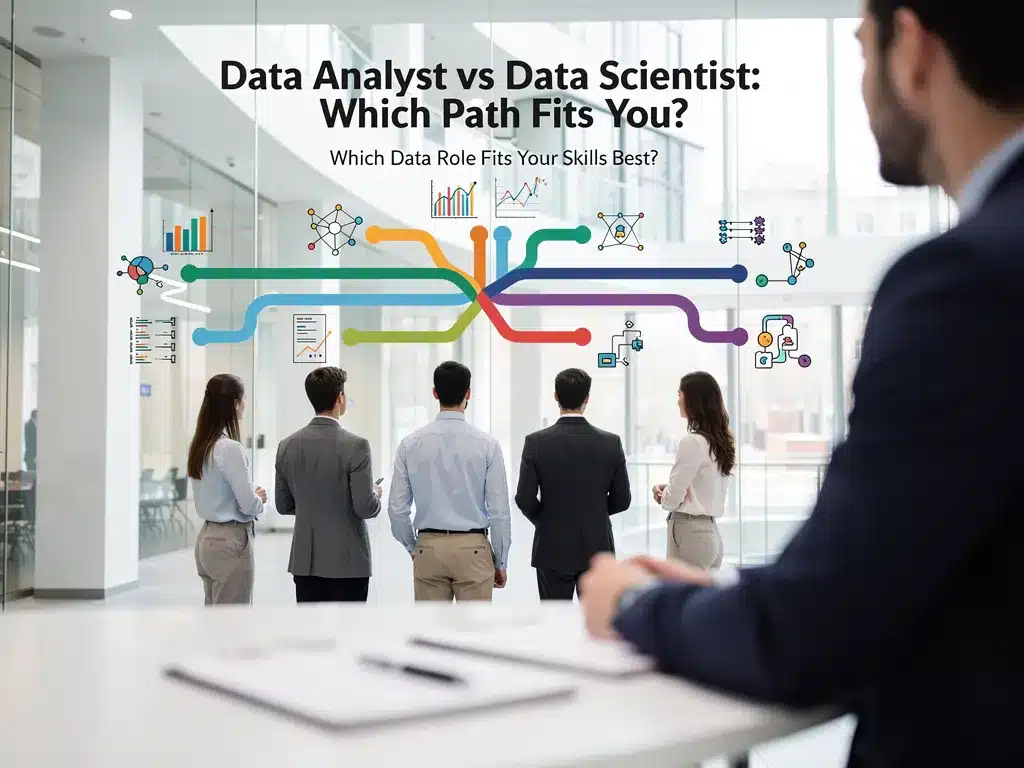
Skill fit depends on the problems a graduate enjoys solving, not just the tools listed on a syllabus. These roles overlap in the software they use, but the problems each tackles and the trajectory it leads to diverge sharply.
Data Analyst vs Data Scientist: what actually separates them?
The distinction comes down to depth of modeling versus speed of reporting. Analysts interpret existing data to answer defined business questions quickly. Scientists build predictive models and often write production-level code to test hypotheses at scale.
Data Engineer vs AI ML Engineer: which builds what?
Data Engineer vs AI ML Engineer comparisons hinge on infrastructure versus intelligence. A data engineer designs the pipelines that move and clean data reliably; an ML engineer takes that clean data and builds the models that learn from it, following a distinct data engineer career path into systems architecture. For graduates asking how to become an AI ML engineer entry level candidate, fit matters more than credentials — we assess each learner individually because we only allow a small number of candidates per class.
Which Decision Points Matter Most When Choosing a Data Path?

Rather than base their choice on job-title prestige, recent graduates should match their preferences to the type of daily work involved — math, code, or communication — and weigh that against how difficult each path is to enter. Ten decision points guide that choice:
- The problem you want to work on. Analysts answer business questions through reports; scientists run experiments and build projection models; engineers keep data reliable at scale; AI/ML engineers turn models into production systems or LLM features.
- How you spend a Tuesday. Analysts write queries and present findings; scientists work through statistics and test models; engineers write pipelines and tune warehouses; AI/ML engineers focus on serving, monitoring, RAG, and APIs.
- What draws you in. Communication points toward analyst work; statistics toward science; backend systems toward engineering; shipping products toward AI/ML.
- How hard the entry point is. Analyst roles are most accessible with SQL, Excel, and Tableau or Power BI; science needs stronger Python and statistics; engineering demands production-level coding and cloud fluency; ML engineering combines the toughest mix, though AI-engineer entry can move faster for strong coders who can deploy an LLM application.
- Pay versus competition. 2026 U.S. averages put analyst pay around $80K–$93K, while scientists and engineers often land $110K–$170K; AI/ML pay runs high, but entry-level scientist and ML seats draw more competition than analyst openings.
- How durable the demand is. The U.S. Bureau of Labor Statistics projects data scientist roles to grow 34% this decade; data engineers stay in short supply since every AI project needs pipelines built first; AI engineering is one of the fastest-growing titles.
- What belongs on your resume. Analysts show dashboards and decisions; scientists show experiments and forecasts; engineers show warehouses and ETL/ELT work; AI/ML engineers show model APIs, retraining pipelines, or agents.
- Company type over job title. Startups blend roles; larger companies separate them, with ML engineer seats concentrated at ML-mature companies and AI engineer seats opening almost everywhere shipping LLM features.
- Career ceiling and next moves. Analyst work builds a foundation toward science or engineering; scientists can move into ML/AI or research leadership; engineers can grow into architects; AI/ML engineers can move into product or infrastructure.
- What to build before you apply. Analysts need SQL projects and a BI dashboard; scientists need a statistics-heavy Python project; engineers need a pipeline deployed with Airflow and dbt; AI/ML candidates need a deployed model or a small RAG or agent application with tests. Shipped work outweighs certificates every time.
How do the four paths compare on pros and cons?
At larger companies, the Data Engineer vs AI ML Engineer distinction often splits into two seats: ML engineers own putting custom models into production, while AI engineers build LLM applications on top of APIs, RAG, and evaluations.
What’s a practical starting rule?
Graduates with a broad skill set do well starting as an analyst or a software-leaning data engineer, then specializing — toward science if statistics pulls you in, toward data engineering if systems work does, or toward AI/ML if shipping models is the goal. Chasing the highest salary without weighing genuine interest is one of the most common reasons candidates stall in interviews.
What Does the Data Job Market Look Like?

Employer demand across data and AI roles keeps climbing heading into 2026. Machine learning engineer and data scientist openings draw the heaviest attention from hiring teams, according to Intuit Blog’s coverage of the current hiring landscape, with data engineering trailing closely behind among the three most popular careers in the field.
- Data science: statistical modeling, experimentation, business-facing analysis
- Machine learning engineering: production model pipelines, deployment, scaling
- Data engineering: pipeline architecture, storage systems, infrastructure reliability
We built our staffing and upskill practice around this shifting map. Since 2010, we have matched IT talent, including data professionals, with employers ranging from early-stage startups to Fortune 500 companies — a history that gives us a direct view into which entry level data roles are genuinely opening, and why graduates researching the data science job market recent grads face should treat all three categories as active hiring targets.
How Should You Launch Your Data Career?

Launching a data career starts with pairing skill-building with a direct path into hiring companies, not one or the other. We built our model around this exact gap: staffing solutions matched with industry-leading IT skill enhancement give graduates two connected paths into leading tech employers.
Our seminars center on Java, J2EE, and Full Stack development. This core curriculum builds foundational skills that carry across multiple entry level data roles, from analytics to engineering to machine learning careers with stronger long-term growth — a strong foundation matters more than an early title, because skills transfer and titles do not.
Does mentorship actually change outcomes for new graduates?
We consistently see genuine passion for solving technical problems as the greatest benefit candidates gain from working with an experienced placement partner. That passion, built through hands-on projects and mentorship, sustains graduates through the early months of any data engineer career path or move toward how to become AI ML engineer entry level.
- Assess core programming strength through structured seminar work
- Match interests to daily tasks, not job titles
- Weigh long-term growth against the current data science job market recent grads are entering
Conclusion
In closing, choosing among data analyst, data scientist, AI/ML engineer, and data engineer paths comes down to your strengths in statistics, programming, and problem-solving, along with the career trajectory you envision. Recent graduates gain the most by pairing genuine skill-building with practical, real-world exposure rather than theory alone. SynergisticIT’s people-centric approach helps candidates identify the right specialization, sharpen relevant technical abilities, and connect with tech startups and Fortune 500 companies, turning a foundational degree into a confident, well-informed step toward a lasting data career.