 Important Notice— Our url is



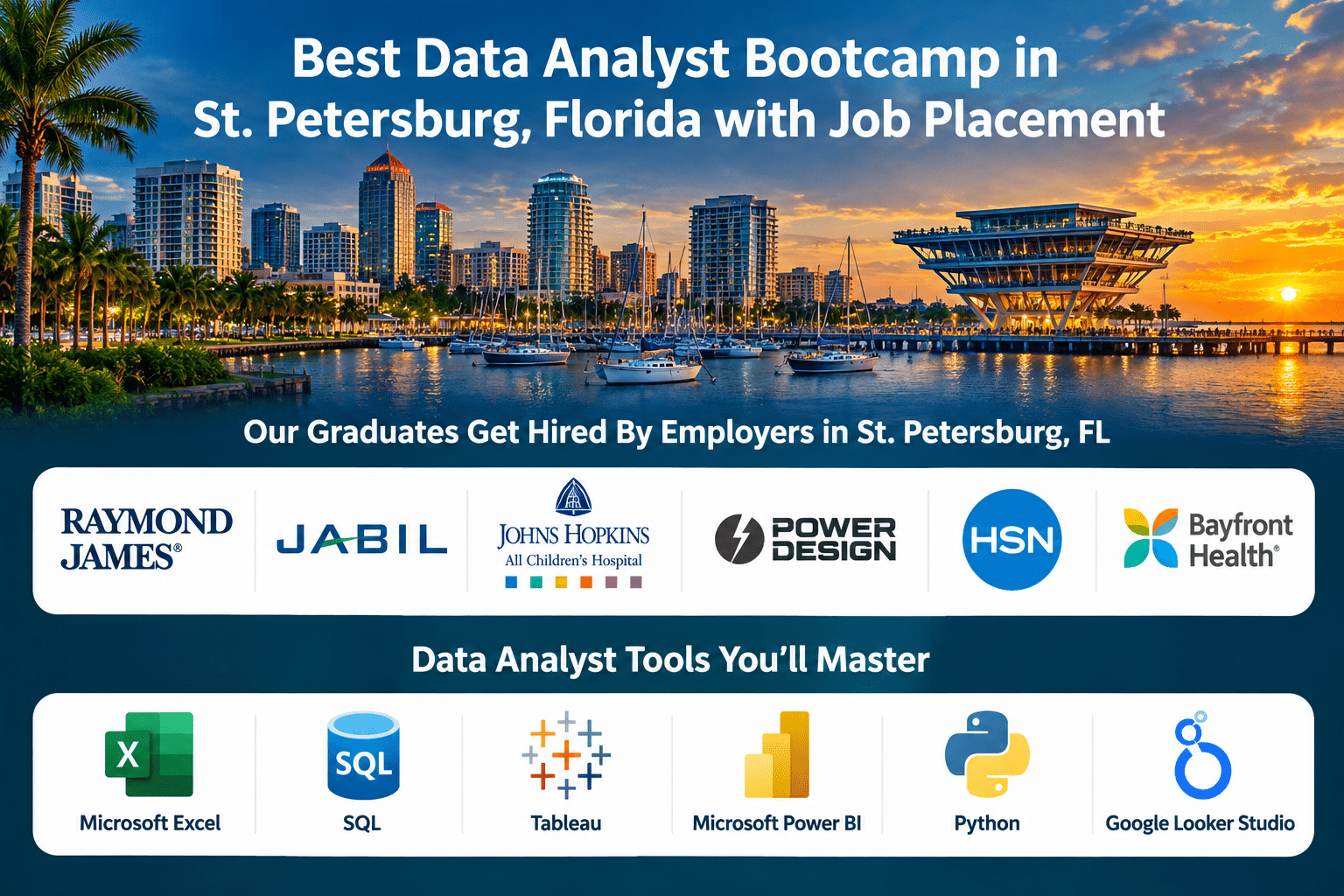
Best Data Analyst Bootcamp in St. Petersburg, Florida with Placement
The Best Data Analyst Bootcamp in St. Petersburg, Florida with Job Placement is not a short certificate class. It is SynergisticIT’s Data Science Job Placement Program, built so people who finish get marketed, interviewed, and hired. Local learners can train live from Pinellas County while SynergisticIT markets them into tech roles that often pay $95,000 to $155,000.
Why Analyst Skills Matter
Companies in St. Petersburg and across Tampa Bay no longer treat reporting as a side task. Healthcare systems, banks, retailers, and logistics teams need someone who can turn messy operational data into a decision a manager will actually use. That is why data analyst skills now sit next to finance, operations, and product work.
A strong analyst does more than export a spreadsheet. The role covers defining the metric, checking whether the source is trustworthy, and explaining what should change next week. Employers pay for that judgment because a wrong dashboard can move inventory, staffing, or customer spend in the wrong direction.
Emerging skills showing up in postings go past basic Excel. Hiring managers want advanced SQL, Power BI with DAX and data modeling, Python with pandas for cleaning, and comfort with cloud warehouses such as Snowflake. They also ask for light statistics, experiment reading, dbt-style transformation thinking, and practical use of generative AI to speed queries and narrative drafts. Business intelligence is no longer optional. It is how leaders see revenue, churn, and cost without waiting on a specialist.
Just Data Analyst skills are not enough if the goal is a durable offer. Teams want a hybrid who can also touch data engineering, data science, and applied machine learning. A narrow Excel-only profile loses to someone who can query, model, visualize, and explain.
Tools employers group by lane:
- Data analytics and BI: Excel, SQL, Power BI, Tableau, Looker, DAX, and stakeholder storytelling.
- Data engineering: Python, SQL, ETL and ELT, Snowflake, Databricks, Airflow, dbt, and cloud storage on AWS or Azure.
- Data science, machine learning, and AI: Python, pandas, scikit-learn, feature work, model evaluation, notebooks, and responsible use of AI assistants.
Roles Are Narrowing
Traditional business analyst, QA, and single-tool data analyst seats are shrinking. Automation now drafts test cases, summarizes requirements, and builds first-pass reports. At the same time, companies are tightening budgets, so one hire is expected to cover work that used to sit on three job descriptions.
Leaders want hybrid candidates. Basic SQL, a few Excel queries, manual testing, and a short test script are no longer a full career. The person who gets the interview can do analytics, support a data pipeline, and speak clearly about a simple model. QA testers, business analysts, program managers, and people from statistics, mathematics, or non-coding backgrounds should use the SynergisticIT Data Science JOPP to start a data career instead of waiting for the old job title to return.
Those backgrounds already share skills with analytics. Business analysts, QA analysts, data analysts, and BI analysts all gather requirements, notice defects in a process, write clear findings, and work from structured questions. Much of the early stack is minimal to almost no heavy software coding. SQL, dashboards, and guided Python can be learned in a coached setting. A full path into data science, data analytics, and BI analytics is realistic through SynergisticIT’s live program because the overlap is real and the missing pieces are taught on purpose.
St. Petersburg employers that recruit data analysts and business intelligence analysts include Raymond James, Jabil, Johns Hopkins All Children’s Hospital, BayCare St. Anthony’s Hospital, Orlando Health Bayfront Hospital, HCA Florida, Duke Energy, Franklin Templeton, PSCU, Power Design, Valpak, HSN, ARK Invest, Webull, Dynasty Financial Partners, Pole Star Global, PVM, Spontivly, Foot Locker, Catalent, the City of St. Petersburg, St. Petersburg College, Eckerd College, the University of South Florida St. Petersburg, and the Tampa Bay Times. These are operating companies, hospitals, colleges, publishers, and public employers, not staffing firms. Several have documented analyst hiring: Raymond James has posted enterprise data, risk-data, and technology analyst roles; Jabil has recruited quality and labor data analysts; Johns Hopkins All Children’s has sought clinical data and analytic specialists; and Valpak and Eckerd College have advertised research and decision-support analysis.
Published local estimates put junior data and BI analyst pay at roughly $49,000 to $72,000. Mid-level roles commonly fall around $73,000 to $95,000. Senior and lead roles generally run about $106,000 to $138,000, and some lead technology analyst postings at Raymond James have listed about $138,000 to $147,000. A senior clinical analytics range at Johns Hopkins All Children’s has been posted at $37.07 to $59.32 an hour, or about $77,000 to $123,000 a year. These are market estimates and posted ranges, not guaranteed offers, and bonus, hybrid work, and SQL or healthcare experience can move pay.
Demand should hold because St. Petersburg’s largest employers run businesses that cannot operate on intuition alone. Wealth management, payments, manufacturing, hospitals, utilities, retail, and city government all need dashboards, forecasts, fraud and quality checks, and regulatory reporting. The city’s Innovation District, maritime-technology firms, and incoming headquarters add new data work rather than replacing the older employer base. Healthcare alone places three hospitals among the city’s principal employers, and each needs analysts to track cost, quality, and capacity.
Technology figures connected with the city include Jimmy Wales, who lived in St. Petersburg and originally based the Wikimedia Foundation there; Cathie Wood, whose ARK Invest moved its headquarters from New York in 2021; inventor Almon Brown Strowger, a telephone-switching pioneer who died in the city; and YouTube creator Kip Kedersha, known as Kipkay. Their stories differ, but they show a long local thread from invention to internet media and innovation finance.
The wider tech economy is a metro story with a strong St. Petersburg share. CompTIA’s 2026 report counts 95,163 technology jobs and about $19.2 billion in direct annual impact across Tampa–St. Petersburg–Clearwater, plus nearly 6,700 payroll technology businesses. Raymond James and Jabil anchor Fortune 500 employment, while Webull, ARK Invest, Pole Star Global, and newer maritime and AI firms have expanded local offices. The $15.87 million ARK Innovation Center and a full spARK Labs incubator show that hiring is coming from startups as well as hospitals and banks.
Who Placement Helps
Career gap or break
- The story shifts from the gap to current projects and certifications employers recognize.
- Daily live practice rebuilds interview stamina that a long break erodes.
- SynergisticIT markets the candidate, so the search is not a solo restart.
- Screening happens before client introductions, which reduces early rejections.
- Offers are pursued until the outcome meets the program’s $81,000 threshold, not until a course end date.
Recent graduates with no experience
- Project work becomes the experience line a diploma cannot supply.
- Interview drills cover SQL cases, dashboard walk-throughs, and behavioral rounds.
- A specialist instructor model keeps each topic at hiring depth.
- Client marketing creates conversations that campus job boards rarely open.
- The first tech role is the point of the program, not a hope attached to a certificate.
Jobseekers who want tech roles
- Training tracks the stacks clients are buying now, including cloud and BI tools.
- Multi-stack skill lets one person contribute to analytics and engineering tasks.
- Resume content is limited to work actually completed.
- Interview scheduling is handled, not left as a tip sheet.
- Placement continues after class hours end.
Before those interviews, use virtual interview tips and tricks so screen presence matches the technical prep. Broader search tactics also sit on the SynergisticIT career blog.
Why should our Best Data Analyst Bootcamp in St. Petersburg, Florida with Placement?
-
What Shapes Hiring Here
St. Petersburg sits inside Pinellas County’s tech base: more than 1,000 IT companies and an 11,500-plus IT workforce, inside a Tampa–St. Petersburg–Clearwater metro that economic developers rank among the stronger southern tech markets, with median tech earnings around $92,903 and tech employment up about 24 percent since 2019. Robert Half’s technology data-analyst benchmarks for the city run from about $98,175 at the low end to $119,595 mid-market and $141,270 at the high end.
Transit is usable but not a substitute for a car. PSTA buses, the free Downtown Looper, and SunRunner bus rapid transit link downtown, USF St. Petersburg, Grand Central, and the beaches. Commutes into Tampa still depend on the Howard Frankland and Gandy bridges. Broadband in the core is mainly Spectrum and Frontier fiber, which matters because many analytics roles are hybrid. Tax policy is a hiring magnet: Florida has no state income tax, and the state plus local programs offer credits tied to capital investment and job creation. Visa processing is federal, not a city service. Employers still ask work authorization on the first screen. City-level H-1B labor-condition filings in St. Petersburg are modest in public datasets, while the wider metro shows a much larger filing base. That pattern means local seats are not defined by visa hiring alone, and U.S. citizens and permanent residents remain central to Pinellas recruiting. A single official ratio of citizens to immigrant tech workers for the city is not published, so any precise split would be a guess.
Employer density is healthcare-heavy, with names such as BayCare and Johns Hopkins All Children’s, plus education, retail, and manufacturing, and a larger corporate market across the bay. Pure software density is thinner than in Tampa’s core, which is why a national placement network matters more than a downtown campus.
Life Outside the Offer
Nightlife for single jobseekers clusters along Central Avenue. The Edge District and Grand Central mix restaurants, breweries, rooftop bars, galleries, and a visible LGBTQ+ corridor. The St. Pete Pier, waterfront parks, the Dalí Museum, and the Saturday Morning Market fill weekends that are not spent in a bar. Beaches at St. Pete Beach and Pass-a-Grille are a short drive, and SunRunner runs late on Friday and Saturday. The social scene is walkable and creative, closer to a coastal neighborhood city than to Miami nightlife.
Families get Pinellas County Schools, including magnet and fundamental choice, plus private options around Old Northeast and Snell Isle. Higher education nearby includes the University of South Florida St. Petersburg, Eckerd College, and St. Petersburg College. Parks, the Pier playground, and Boyd Hill give children outdoor time without a theme-park trip. Insurance costs and summer heat are the tradeoffs parents should price before moving.
People stay for sunshine, water, arts, and the tax advantage, and because remote or hybrid work lets a coastal salary stretch. They leave, or hesitate, when bridge commutes, storm risk, housing insurance, and a shorter local tech ladder push them toward Tampa, Orlando, or fully remote roles based elsewhere. Competition from those hubs is real. A St. Petersburg address does not by itself create a Silicon Valley career ladder.
How Local Hiring Usually Runs
A typical analytics search starts with recruiter outreach or an application screen that checks work authorization, salary expectations, and tool overlap. Next is a SQL exercise, a take-home case, or a short live query session, sometimes paired with an Excel or Power BI walk-through. A hiring-manager round tests whether the candidate can explain a metric to a non-technical lead. On-site days are less universal than they were. Many loops stay virtual, with one office visit if the team is hybrid. Offer timelines often land between two and six weeks after the first call, longer when healthcare compliance or bank background checks apply.
A Practical Bootcamp Guide
St. Petersburg does not host a dense row of independent, in-person data-analyst campuses. Most “local” options are national online brands that accept Florida students, plus college certificates. Names jobseekers compare include General Assembly, Springboard, CareerFoundry, Fullstack Academy, and Coding Temple, which markets an online path to St. Petersburg learners. Formats split into live cohorts, recorded libraries, and hybrid blends. Durations commonly run 10 to 26 weeks, or about four to eight months part-time. Published tuition often falls between roughly $7,000 and $16,500, with installments, loans, or deferred plans. Some advertise a job guarantee that still requires strict conditions.
Who joins: career changers, recent graduates, and working adults who can study nights. Success rates are uneven and often self-reported. Public reviews praise structured projects and mentor access. Negative comments repeat the same themes: recorded lectures, one or two generalist instructors, upfront fees, and placement that amounts to a resume workshop. College programs add credibility and financial aid, but they rarely market a candidate into a client interview calendar.


Prospective Careers after Best Data Analyst Bootcamp in St. Petersburg, Florida with Placement
What are the Eligibility Criteria to Enroll for Best Data Analyst Bootcamp in St. Petersburg, Florida with Placement?

Why This Program Is Different
SynergisticIT has worked in the tech industry since 2010, more than 15 years. The Job Placement Program is training plus staffing, not a class that ends with a PDF. Recent graduates should join because the outcome is skills, project proof, and interviews at companies that already hire this talent, including Visa, Apple, PayPal, Walmart Labs, AutoZone, Wells Fargo, Capital One, Walgreens, Bank of America, SAP, Cisco Systems, Verizon, T-Mobile, Intuit, Ford, Hitachi, Western Union, Deloitte, Dell, USAA, Carfax, and Humana. Reported offers for placed alumni run $95,000 to $155,000. SynergisticIT states that about 90 percent of JOPP graduates who get hired had never held a tech job before. The other slice is career changers and people returning from a gap.
Many bootcamps shut down after job promises outran their employer access. SynergisticIT states a narrower promise: candidates who successfully complete JOPP are carried into tech hiring until an offer lands. Not every bootcamp is equal. A tool should be learned in depth from a firm that still sits in client work, not from a brand built only on ads.
How SynergisticIT differs from bootcamps and staffing shops
- Curriculum: Industry contact at Oracle CloudWorld, the Gartner Data & Analytics Summit, and live candidate interviews feeds what is taught. Event footage is on the tech event gallery.
- Instructors: Industry professionals, with an average above 10 years, not a rotating alumni tutor.
- Specialists: About five to six instructors across the data track, split among analytics, engineering, and machine learning, rather than one generalist.
- Cost: $10,000 before the program and a $26,000 balance only after a job offer of $81,000 or higher, payable over two years. No offer, no further payments. Many bootcamps collect full tuition first.
- Time: About four to five hours a day, five days a week, for roughly five months, live, with no recorded-session substitute.
- Ratio: About five students per instructor, versus cohorts nearer twenty to one.
- Projects: Built to current job stacks, and only completed work goes on the resume.
- Outcomes: Alumni accounts, including ranges up to $155,000 and multiple offers, are public on SynergisticIT reviews.
- Certifications: Microsoft, Oracle, Snowflake, Databricks, Azure, and AWS paths included at no extra course fee.
- After class: Marketing to 24,000+ company contacts, resume work, interview prep, and scheduled interviews through the first day on the job.
- Trust: Photographs, video reviews, offer proof, and years in business, plus the USA Today feature and the ROI comparison with colleges. Results are the advertisement.
ROI is higher than a typical degree path because the upfront cash is $10,000, the rest is conditional, and starting pay is targeted at $81,000 and above rather than years of tuition before a first salary. The data-science track covers analytics, engineering, machine learning, and AI tools named above, including Python, SQL, Power BI, Snowflake, and cloud platforms, so one graduate can support more than one team.
Companies hire these candidates because the stack matches open roles, technical screening happens before the resume is sent, and certifications add proof. A multi-stack junior can help analytics and engineering in the same quarter. Structured projects, interview prep, and screening lower the chance of a failed hire. The aim is contribution in the first weeks, from a resume tied to real work rather than inflated claims. In short, they are trained, screened, project-ready, interview-prepared, and aligned with current reqs.
Delaying does not compress the calendar. Waiting only pushes the offer further out. The months exist to stack skills, ship projects, rehearse interviews, and run client outreach until a seat opens. Employers pay for that finished stretch. Begin now. The road is long. The finish line is a full-time offer.
There may be hundreds of Data Analyst Bootcamp options that claim Data Analyst Bootcamp training in St. Petersburg, Florida. If the goal is to get hired after the course, the practical choice is SynergisticIT’s Best Data Analyst training Bootcamp in St. Petersburg, Florida. That placement-backed path is the surest way for a jobseeker here to move from study into a tech paycheck.
Call (510) 550-7200 or start on the Job Placement Program and ask for the data-science track. Bring your timeline, work authorization, and target salary. The next step is a fit conversation, not another unread syllabus.