 Important Notice— Our url is



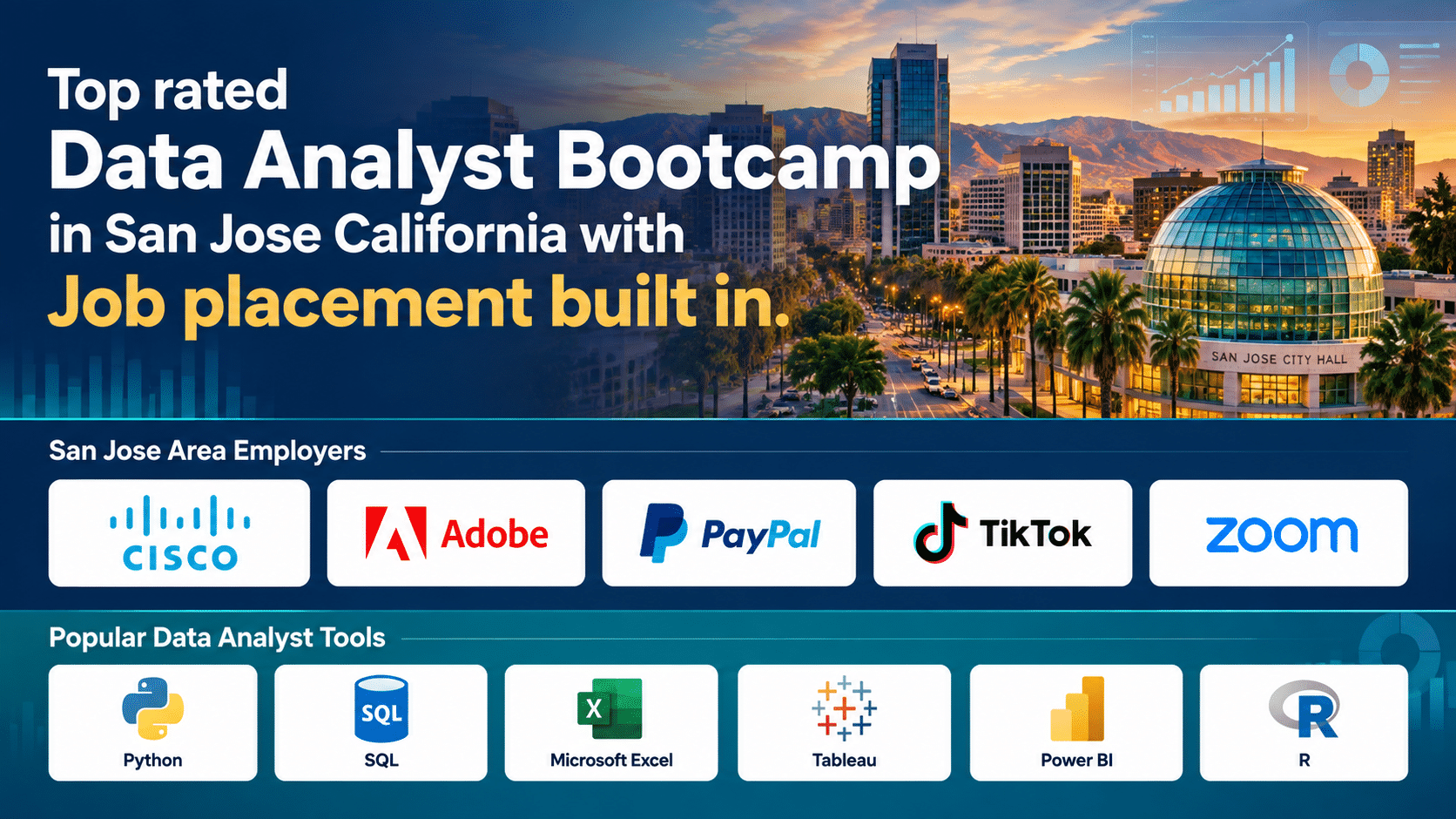
Top Rated Data Analyst Bootcamp in San Jose, California
San Jose does not hire on a spreadsheet certificate. A search for a Top rated Data Analyst Bootcamp in San Jose, California with Job placement is really a search for interviews, projects, and a full-time offer. SynergisticIT’s Data Science Job Placement Program, inside SynergisticIT’s Job Placement Program, is built for that outcome. It is live training plus candidate marketing, not a class that ends with a PDF.
Local pay shows why the bar is high. Robert Half places San Jose data analyst ranges from $127,050 to $182,820. Salary.com’s July 2026 average sits near $123,250, with a broad middle band of about $110,205 to $135,731. Indeed’s city range runs from about $82,015 to $183,150. Levels.fyi’s smaller sample puts median total compensation near $160,000. Entry postings are tougher: some Cisco analyst bands start around $78,500 to $99,200, while product-analyst roles at BILL have been posted near $95,700 to $114,400.
Why Analyst Skills Still Matter
Data analyst skills are how a company sees itself in time. Finance, product, risk, supply chain, and customer teams in the South Bay do not guess. They ask what changed, which segment moved, and which action is worth the budget. An analyst who can pull clean numbers, explain the cause, and show the chart in a meeting saves weeks of debate.
That work is not disappearing. Reported labor projections still point to strong growth in data occupations through the mid-2030s, even while routine reporting is automated. What is disappearing is the person who only refreshes a workbook. San Jose employers, from Cisco and Adobe to payments, retail, and health firms with Valley offices, want someone who can sit with a business question and also touch the pipeline behind it.
Emerging skills now show up beside classic SQL:
- Cloud warehouses such as Snowflake, BigQuery, and Redshift, not only a local database
- Power BI with DAX, semantic models, and Copilot-style natural-language questions, plus Tableau
- Python with Pandas for cleaning and checks that Excel cannot hold
- Databricks, Spark, and light orchestration so dashboards are not fed by mystery files
- dbt-style modeling, data quality tests, and documented metrics
- GenAI literacy: prompting for SQL drafts, checking hallucinations, and using LLM features inside BI tools without shipping wrong numbers
- Storytelling for executives who will not read a notebook
Business intelligence is the bridge. A BI analyst still owns KPIs, but hiring managers also ask about row-level security, incremental refresh, and whether the metric matches finance. Power BI, Snowflake, and Databricks appear together in modern analytics stacks because the chart is only the last inch of the pipe.
Data analyst and BI analyst hiring in San Jose is still active, but it sits inside a tech economy that has cooled rather than collapsed. In June 2026 the San Jose–Sunnyvale–Santa Clara metro had about 1.18 million jobs, up 16,700 from a year earlier, and unemployment was 4.0 percent, below California’s 5.2 percent. That gain came mainly from education, health care, and construction. Tech has been the weak spot: South Bay tech payrolls were still falling into 2025, and the region’s share of U.S. tech jobs slipped to about 3.84 percent, the lowest since 2013. Bay Area tech employers also cut a net 8,700 jobs in the first two months of 2025. Even so, more than one in ten San Jose workers are in tech, so the city remains a headquarters market.
Employers in San Jose that hire data analysts and BI analysts, excluding staffing firms, include Adobe, Cisco, PayPal, eBay, Zoom, Western Digital, Cadence Design Systems, NetApp, Nutanix, Zscaler, Roku, Sanmina, Bloom Energy, Super Micro Computer, Harmonic, Xperi, Samsung Semiconductor, Broadcom, Micron Technology, Arm, IBM, Coherent, Archer Aviation, the City of San Jose, and the County of Santa Clara. Adobe, Cisco, PayPal, eBay, and Zoom are among the large headquarters downtown and in North San Jose, while semiconductor, storage, energy, and public employers run their own forecasting and operations-analytics teams. A local footprint does not mean every firm is posting both titles at once.
These salary figures are 2025–2026 market ranges for base pay, not offers from each company above. For data analysts, junior roles commonly fall around $70,000 to $100,000, mid-level roles around $95,000 to $130,000, and senior roles around $125,000 to $170,000. ZipRecruiter’s 2026 junior average in San Jose was about $93,000, with many salaries between $66,800 and $95,500, and its broader data analyst average was about $96,854. PayScale put the senior data analyst average near $129,000, with an upper end around $170,000. For BI analysts, junior pay often runs about $78,000 to $110,000, mid-level pay about $100,000 to $140,000, and senior pay about $118,000 to $170,000. Robert Half’s 2026 San Jose guide showed $91,080 to $137,280 across BI levels and $118,470 to $170,280 for senior BI analysts, while Indeed’s local BI average was about $99,817. Bonus and stock at large tech firms can lift total pay above these bases.
Analysts should remain in demand because San Jose companies sell products that throw off payments, network, manufacturing, and customer data. AI can draft queries and summaries, but it does not replace people who define metrics, check data quality, and explain tradeoffs to product and finance leaders. National projections point the same way: the Bureau of Labor Statistics expects data scientist employment to grow about 34 percent from 2024 to 2034, and San Jose State faculty still describe analytics judgment as scarce after the layoffs.
Technology figures tied to the city include Apple co-founder Steve Wozniak, who was born in San Jose, and Yahoo co-founder Jerry Yang, who was raised there. Three other well-known leaders are connected through San Jose companies rather than birthplace: Shantanu Narayen of Adobe, Eric Yuan of Zoom, and John Chambers, who led Cisco while it became one of the city’s defining headquarters.
Narrow Roles Are Shrinking
Traditional business analyst, QA, and single-tool data analyst seats are thinner than they were five years ago. AI drafts user stories, generates test cases, and builds a first-pass chart. Automation covers regression packs that once justified a large manual team. At the same time, companies are tightening budgets. A manager who once hired three specialists now wants one person who can query, test a data flow, build a dashboard, and explain the result.
Basic SQL, Excel filters, test scripts, and manual testing still matter. They are no longer a full career. Teams want hybrid candidates who can move across data analytics, data science, machine learning and AI, and data engineering, then drop back to a clean query when a stakeholder asks a simple question. A junior who can do only one of those lanes loses to a junior who can contribute on two or three without a long ramp.
People from QA, business analysis, program management, statistics, mathematics, and other non-coding backgrounds should treat SynergisticIT’s Data Science JOPP as the on-ramp, not as a hobby course. The overlap is real, and the coding load at the start is smaller than a software-engineering bootcamp.
Shared skills across business analysts, QA analysts, data analysts, and BI analysts:
- Turning a vague request into a testable question
- Reading requirements, edge cases, and acceptance criteria
- Checking data quality the way a tester checks a defect
- Writing clear SQL and spreadsheet logic
- Explaining a number to a non-technical owner
- Tracking work, deadlines, and stakeholder updates
Those habits transfer. Python, warehouse modeling, and a first machine-learning project can be learned in a structured room. A career in data science, data analytics, and BI analytics does not require a prior software job if the training is deep and the placement work is real. For a wider look at analyst versus scientist paths, use the SynergisticIT career blog.
How Placement Helps Three Groups
SynergisticIT’s Job Placement Program does not hand you a certificate and a job board. It markets candidates to a stated network of 24,000+ company contacts, schedules interviews, and stays through the offer. That difference matters for three groups.
Career gap or break
- The story shifts from “time away” to current projects and a current stack
- Daily live practice rebuilds interview stamina that a gap erodes
- Resume lines come from work you can defend, not from a paused title
- Mock interviews rehearse the gap question until it is short and credible
- Client marketing starts conversations you will not get from cold applications alone
Recent graduates with no experience
- Classroom theory is replaced by tools hiring managers name in screens
- Project work becomes the experience section a new grad otherwise lacks
- Specialist instructors cover analytics, engineering, and machine learning separately
- Interview reps happen before the first recruiter call, not after a rejection
- Placement support targets full-time tech roles, which is the outcome a diploma does not schedule
People who want a tech job and keep missing
- Screening happens before you are sent out, so weak spots are fixed first
- Multi-stack training matches hybrid job posts instead of one-tool ads
- Included certification prep adds a check mark beside project work
- Offer coaching covers salary talk in a market where bands are wide
- The loop continues until a qualifying offer, rather than ending on graduation day
If a computer science path already stalled, read overcoming failure in computer science and then compare that lesson with a placement model, not another unpaid tutorial.
San Jose Hiring, Life, and Visas
Policy and infrastructure shape who gets hired here.
Transit. Most commutes are still by car. Highways 101, 280, 680, 87, and 85 clog at peak, and a typical city commute is about 29 minutes, longer if the office is in Santa Clara, Mountain View, or San Francisco. VTA runs bus and light rail. Caltrain links the Peninsula. BART reached Berryessa/North San Jose in 2020. The later BART Silicon Valley phase has a large federal funding commitment, including $5.1 billion announced in 2024, aimed at tying more South Bay residents to regional jobs. Clipper cards and employer transit passes are normal, but frequency still pushes many analysts to drive.
Broadband. The city adopted a Digital Inclusion and Broadband Strategy and has a stated aim of multi-gigabit access by 2030. Earlier telecom agreements with AT&T, Verizon, and Mobilitie were framed as hundreds of miles of fiber and thousands of small cells. That density helps remote and hybrid analysts, but access is not equal in every neighborhood, which is why city inclusion programs still exist.
Tax and incentives. California income tax and Santa Clara County housing costs are high. The city also courts data-center and AI infrastructure, citing clean-energy supply, industrial land, and a PG&E implementation deal. Officials have estimated $3 million to $6 million a year in local tax income per large new facility. Federal and state R&D credits still matter to product companies. None of that lowers your rent. It does explain why employers cluster here and why they can fund analytics teams when the product is software, payments, chips, or AI infrastructure.
Visa processing. Sponsorship is common among large Valley employers, and counsel is easy to find. Processing still follows USCIS rules, lottery timing, and employer policy. A bootcamp cannot promise a visa. It can make the technical file stronger before an employer decides whether to sponsor.
Employer density. San Jose sits inside the tightest private-sector tech cluster in the country. Cisco is headquartered in the city. Adobe, PayPal, eBay, and a long list of chip, cloud, and enterprise firms sit within a short drive, with Apple, Google, and Intel in neighboring cities. That density creates more recruiter outreach and also more competition.
Nightlife for single jobseekers. San Jose is quieter than San Francisco. Evenings cluster around San Pedro Square, the San Jose Improv, Santana Row, and rooms such as The Ritz, Miniboss, and Five Points. Food is a stronger social scene than late clubs: Vietnamese, Mexican, Chinese, and Indian kitchens make weeknights easy. Many singles treat the city as a base and take Caltrain or a rideshare north for a bigger night out.
Families and schools. Parents often pick a house around a school boundary, not a downtown bar. San Jose Unified and East Side Union High School District cover large, mixed zones. San Jose State University, San Jose City College, and Evergreen Valley College anchor adult study and a pipeline into local employers. Weekends run to Guadalupe River trails, Almaden Quicksilver, Santa Teresa, and Santa Cruz when traffic allows. Hybrid schedules, one or two office days, are how many tech parents survive the 280 and 101 peaks.
Why people stay or leave. People stay for pay, mild weather, school options, and career ladders inside a dense employer map. They leave because housing is severe, the average home price has been cited near $2 million and typical rent above $3,300, traffic is daily, nightlife is thin, and remote roles now compete with Seattle, Austin, and fully distributed teams. Earthquake risk and California tax are part of the same ledger. Career growth can be faster here than in a smaller market, but the interview bar is also higher because every neighboring hub feeds the same applicant pool.
A typical hiring path. A recruiter message or application leads to a 20- to 30-minute screen on background, work authorization, and pay. Analyst loops then add a SQL exercise, a take-home case, or a live walkthrough of a dashboard. Later rounds mix a hiring manager, a technical peer, and a stakeholder conversation. Some firms still ask for an on-site day; many keep the loop on video. Cisco tells candidates that many interview cycles finish in about two to three weeks and that a first response often lands within 7 to 10 days. Engineering-style loops at firms such as Snowflake are often quoted at two to four weeks. Silicon Valley product companies can stretch to four to eight weeks once a hiring committee and compensation review are involved. Offers then move through background checks before a start date.
Citizens, permanent residents, and H-1B workers. There is no single official ratio of U.S. citizens to permanent residents to H-1B workers for San Jose tech jobs. What is published is concentration. Pew has put the San Jose metro among the top H-1B approval regions, with more than 30,000 approvals and on the order of three approvals per 100 workers. A Hoover Institution review counted 29,578 approved petitions in the San Jose–Sunnyvale–Santa Clara metro, about 8.17% of approved H-1B petitions nationally and about 9.13 times the metro’s share of U.S. private-sector jobs. Google was the largest filer in that cut, with 3,278 petitions. Nationally, computer jobs have been about 65% of H-1B approvals, with a median reported salary of $123,600 in 2023. A city-level ranking of new petitions has also placed San Jose near the top, with 2,383 new filings in one recent count. Read those figures as filing concentration, not as “most local workers are on H-1B.” Citizens and permanent residents remain the larger share of the overall workforce. The visa is simply more visible here than in almost any other U.S. metro, which is why sponsorship experience shows up so often in recruiter screens.
Advantages of joining our Top rated Data Analyst Bootcamp in San Jose, California with Job placement
A Practical Bootcamp Guide
San Jose has employer density, not a long list of large in-person data-analyst campuses. Most residents choose a national live-online immersive, a university extension, a self-paced site, or a community-college certificate, then interview into Valley firms from home.
Kinds of programs
- Short tool certificates in Excel, SQL, or one BI product
- Part-time live cohorts of about six months
- Full-time immersives of about 12 weeks
- Self-paced libraries with optional mentors
- University and community-college certificates at places such as San Jose State University and local community colleges
- Placement-first programs that keep marketing after instruction ends
Fees, time, and format. Public price bands for well-known analytics bootcamps commonly run from about $6,000 to $16,450. General Assembly has listed a data analytics immersive at about $16,450 standard tuition, with a discounted pay-in-full figure near $10,000, full-time at roughly 12 weeks or part-time near 32 weeks, live online or on campus where a room exists, plus loans and installment plans. Springboard has been listed near $11,300 over about six months, mostly self-paced with mentorship. UC Berkeley Extension-style analytics bootcamps have been listed near $9,995 with live sessions. TripleTen has advertised about $5,950 for a part-time online analytics track of roughly four months. Subscription schools such as Dataquest charge monthly fees instead of a single tuition. Community-college routes usually cost less and take longer.
Hiring support. Some include a career coach, resume edits, and an alumni list. A few advertise a job guarantee with eligibility rules, a job-search window, and exclusions. Many issue a certificate and leave applications to you. Ask what is in writing: number of mock interviews, whether they submit you to employers, and what happens if you are not hired.
Who joins. Recent graduates, laid-off coordinators, QA testers, business analysts, career break returners, and international graduates on work authorization. Coding experience is often light. Math and domain experience are common.
Loans and installments. Climb-style loans, zero-interest plans for qualified credit, deposits plus monthly payments, and pay-in-full discounts are the usual menu. Read the refund clause. “Guarantee” language often requires full attendance, a set number of applications, and a narrow job definition before any money returns.
Outcomes and reviews. San Jose-specific audited success rates are rarely published. General Assembly has reported graduation in the low-to-mid 80 percent range on older outcomes pages, while in-field employment figures on public review sites have been incomplete or disputed. Course Report has also noted that General Assembly stopped new consumer enrollment on April 28, 2026, and continued business training. That closure pattern matches a wider bootcamp shakeout: programs sold job promises, then could not place enough graduates when hiring tightened.
Public feedback splits. Positive alumni mention daily structure, approachable teachers, and a coach who stayed after class. Negative posts describe inexperienced instructors, cancelled sessions, thin job-search help, and outcomes reports that felt unlike the writer’s search. Those are recurring forum themes, not a verdict on every cohort.
Not every bootcamp is equal. A tool can be learned from a recording. A hireable stack has to be learned in depth, from people who still see live job descriptions. SynergisticIT has been in the tech industry for more than 15 years, with placement work dated on its own pages to 2010. That is a different starting point from a school that opened for a marketing cycle and later shut the consumer door.
Why Employers Hire JOPP Candidates
Companies do not hire a logo. They hire time saved.
Current stack and shorter ramp-up. SynergisticIT adjusts training from client conversations and from events such as Oracle CloudWorld and the Gartner Data and Analytics Summit. Candidates who are already interviewing bring back what screens actually ask. A new hire may need less ramp-up because the stack was shaped by that demand, not by a two-year-old syllabus.
Pre-screened talent. People are checked for technical level and role fit before they are introduced. A hiring manager receives someone who has already been filtered, not a raw applicant pile.
Certifications on a mixed stack. Graduates prepare for credentials from Microsoft, Oracle, Snowflake, Databricks, Azure, and AWS at no extra course fee. Those badges sit beside projects, which is what adds credibility.
Multi-stack contribution. A manager may rather hire one junior who can help a backend task, a dashboard, and a deployment step than three narrow juniors. On the data side, the same logic favors a person who can support data engineering, data analytics, and ML/AI neighbors, not only a single charting tool.
Lower hiring risk. Structured training, projects, interview prep, and screening reduce the chance that week one is a surprise. No employer can be promised a risk-free human. They can be offered someone who has already been tested in a job-like routine.
Day-one usefulness. The aim is practical contribution on day one: a query, a pipeline check, a model evaluation, or a dashboard fix, not a month of orientation videos.
Project resumes. Resume lines are tied to work the candidate did. That is the opposite of a padded certificate list.
In short, firms consider JOPP candidates because they are trained, screened, project-ready, interview-prepared, and pointed at current roles.
Data analyst skills alone are not enough. A San Jose offer usually asks for more than one lane. Treat the search as a data engineering, data analytics, and data science AI build, not as a single bootcamp topic.
Data analytics and BI: SQL, Excel, Power BI, Tableau, DAX, KPI design, stakeholder reporting.
Data engineering: Python, Spark, Databricks, Snowflake, cloud storage, ETL or ELT, scheduling, and data modeling.
Data science: statistics, Pandas, experiment thinking, regression, classification, and feature checks.
Machine learning and AI: scikit-learn, PyTorch, model metrics, NLP basics, LLM and GenAI use, and enough MLOps awareness to talk about deployment.
SynergisticIT’s Data Science JOPP groups those tools so a candidate is not buying four separate courses. The program’s own pages name Python, SQL, Tableau, Databricks, Snowflake, PyTorch, LLM, GenAI, agentic AI, Power BI, machine learning, and AI, with offers discussed in the $95,000 to $154,000 or $155,000 band at firms including Apple, Google, Walmart Labs, Ford, Bank of America, Visa, Wells Fargo, Intel, PayPal, and Deloitte.

An overview of Synergisticit's Top rated Data Analyst Bootcamp in San Jose, California with Job placement
Tech Stack Included in SynergisticIT’s Data Science JOPP
The program covers:
- Data Engineering
- Data Analytics
- Data Science
- Machine Learning
- AI
- Cloud Computing
- Real‑world Projects
- Certifications
- Interview Preparation
This is why SynergisticIT’s JOPP is the best Data Analyst Bootcamp in San Jose, California—it’s not just a bootcamp, it’s a career transformation program.
What makes SynergisticIT the Top rated Data Analyst Bootcamp in San Jose, California with Job placement
Results over ads.
- a 91.5% placement rate
- typical placed salary bands frequently cited around $95k–$154k/$155k
- program structure that includes interview readiness + employer connection, not only training
Tech industry visibility through event participation and media:
Why JOPP Can Be “Expensive” and Still have Higher ROI
A common reason jobseekers waste time is bouncing between cheap programs that don’t lead to interviews or Job Offers. SynergisticIT’s JOPP model is different: $10k upfront, and the balance is only due after you get hired into a job paying $81k or higher (paid in installments over 24 months).
In other words, it’s an outcomes-aligned investment rather than “pay and hope.”
If you’re searching for:
- best Data Analyst Bootcamp In San jose, california
- Online Data Analyst/ Business Intelligence Bootcamp in San jose, california
- Data Analyst Bootcamp with job assistance in San jose, california
- Data Analyst Bootcamp with Job guarantee in San jose, california
…be careful with the “guarantee” language. Many schools market a guarantee that’s full of conditions. A more honest filter is: Does the program actively help you get interviews and convert them into offers? SynergisticIT’s JOPP is built around that placement execution model—training + marketing + interview scheduling + prep.

Tech Companies Pay More for JOPP Candidates Because They’re Built to Perform
Hiring managers are exhausted by inflated resumes, shallow portfolios, and candidates who can’t execute once hired. SynergisticIT’s JOPP completers (people who finish the full program, clear assessments, and earn relevant certs) are:
- stronger technically than typical entry-level applicants
- faster to ramp up on projects
- more likely to get promoted quickly because they can own broader responsibilities
That “multi-skilled” profile matters because businesses want to save time, reduce risk, and avoid paying double for separate specialists.
SynergisticIT JOPP candidates are hired by clients like Visa, Apple, PayPal, Walmart Labs, AutoZone, Wells Fargo, Capital One, Walgreens, Bank of America, SAP, Cisco Systems, Verizon, T-Mobile, Intuit, Ford, Hitachi, Western Union, Deloitte, Dell, USAA, Carfax, Humana, and more.
The Program You Actually Want: Training + Placement Execution
- Learn how the overall program works: SynergisticIT’s Job Placement Program (JOPP)
- Explore the data track foundation (Data Analyst/BI/Data Science/ML-AI pathway): SynergisticIT’s Data Science Job Placement Program
And because ROI matters:
- See the comparison: SynergisticIT ROI vs Colleges (SynergisticIT)
We prepare you for job interviews through psychological assessments, technical mock tests, behavioral questions, soft skill training, and cognitive interviews. Our placement team also assists you in improving your LinkedIn profile, cover letter, resume, etc.
What Sets This Program Apart
SynergisticIT’s Data Analyst Bootcamp training in San Jose, California is the data track of the Job Placement Program, taken live online from the South Bay or anywhere else in the U.S. The company office is in Fremont, not a rented classroom that disappears after the cohort. Recent graduates should look at JOPP because it stacks tech skills, project work, and the step bootcamps skip: getting hired at established tech employers. SynergisticIT states that 90% of JOPP graduates who land tech jobs had not worked a tech job before. The other 10% are career changers, people with gaps, and similar profiles.
Bootcamps fail placement when the product is tuition, the instructors are recent alumni, and the “guarantee” cannot be collected. Closures follow. JOPP is sold as a placement promise for candidates who finish the program: marketing continues until a tech offer, with the larger fee tied to being hired.
Compared with bootcamps, staffing shops, and certificate vendors
Curriculum. Because the team is in client conversations, at events such as Oracle CloudWorld and Gartner, and in live interviews, the syllabus moves when job posts move.
Instructors. Many bootcamps use graduates, recordings, or a teacher who appears a few hours a week. Here the average instructor is described as having more than 10 years in the domain.
How many teach. One or two generalists cannot cover a modern data stack well. The data and Java programs each use about 5 to 6 specialists: separate voices for analytics, engineering, and data science or machine learning, and on the Java side for core Java, databases, advanced Java, and DevOps.
Cost. $10,000 before training. The balance, $26,000, is due only after a job offer of $81,000 or higher, paid over two years. If that offer does not happen, those later payments do not start. Total investment on the published plan is $36,000. Many bootcamps collect full tuition first and attach a refund that is hard to redeem. Card payments can add a 4% surcharge.
Time in the room. About 4 to 5 hours a day, five days a week, across about five months. Live lectures. No recorded-only core. Ask any other school this question before you pay.
Ratio. About 5 students to 1 instructor, versus ratios near 20 to 1 elsewhere.
Projects. Built to current client stacks. Only work you actually do goes on the resume.
Alumni results. Written, audio, and video reviews are on the SynergisticIT reviews page. The program cites offers from $95,000 to $155,000, sometimes more than one offer. Individual stories on that page include figures such as $105,000, $110,000, about $130,000, $140,000, and $87,000, which is a reminder that outcomes vary.
Certifications. Microsoft, Oracle, Snowflake, Databricks, Azure, and AWS preparation is included.
After the last class. The team markets you, rewrites the resume, runs interview prep, and schedules interviews until you start. Most bootcamps stop at tips. Get their placement duties in writing.
Why trust the claim. Photographs, video reviews, offer letters, and years in business are public. The fee is stated up front. There is no need for a louder ad than the result. Event footage from Oracle CloudWorld, JavaOne, and Gartner-related appearances is in the tech event video channel. A USA Today contributor piece, How SynergisticIT is Changing How Tech Companies Source Talent, describes the sourcing model. The ROI case versus a long degree is laid out in the ROI comparison with colleges: a much smaller upfront amount than a degree that can pass $100,000, with the balance conditional on an $81,000 offer, against published graduate ranges of about $81,000 to $150,000.
Clients named across the Java and data placement pages include Visa, Apple, PayPal, Walmart Labs, AutoZone, Wells Fargo, Capital One, Walgreens, Bank of America, SAP, Cisco Systems, Verizon, T-Mobile, Intuit, Ford, Hitachi, Western Union, Deloitte, Dell, USAA, Carfax, Humana, and others, with discussed salaries from $95,000 to $155,000. Partial fees come first. The balance is tied to being hired at $81,000 or higher.
Waiting will not make SynergisticIT’s JOPP any shorter. It only pushes the offer further out. The months are there because skills, projects, interviews, and client marketing have to be finished before a placement is real. That hard stretch is what employers are paying for. Start now. The road is long. The reward is a full-time job offer.
There may be hundreds of programs that advertise Data Analyst Bootcamp training in San Jose, California. If the goal is to get hired after the course, the choice this model argues for is SynergisticIT’s Top rated Data Analyst training Bootcamp in San Jose, California. It is the direct route for a jobseeker who wants a hire, not another unfinished certificate.
Contact SynergisticIT or call (510) 550-7200 to start the data analyst path.