Important Notice— Our url is




Best Data Analyst Bootcamp in Jacksonville, Florida
Jacksonville jobseekers who search for the Best Data Analyst Bootcamp in Jacksonville, Florida are not looking for another slide deck on pivot tables. They want a path that ends in a paycheck. That path is SynergisticIT’s Job Placement Program and, for analytics careers, SynergisticIT’s Data Science Job Placement Program. SynergisticIT has spent more than 15 years inside the technology industry, not on the sidelines of it. The Best Data Analyst Bootcamp in Jacksonville, Florida is not a separate classroom product. It is the Data Science track of JOPP: live training, employer-shaped projects, certifications, interview scheduling, and marketing to hiring managers until a qualifying offer arrives.
People in Duval County, at the beaches, in St. Johns, and across the First Coast can join from home. The same program serves candidates anywhere in the United States. What changes for Jacksonville is the local hiring climate: a dense financial-services economy, hybrid bank technology teams, and a cost structure that makes a strong tech salary go further than it does in tighter coastal markets.
Jacksonville’s data analyst and business intelligence analyst roles should stay in demand because finance, healthcare, logistics, and a growing technology base all depend on reporting, forecasting, and operational dashboards. Oxford Economics ranked the city among North America’s top five cities to watch for 2027 and said technology accounted for 26 percent of GDP growth in 2025, when local GDP reached about $148 billion. Banks, insurers, hospitals, railroads, and digital firms still need people who can turn transaction, claims, clinical, and shipment data into decisions, even when broader hiring is uneven.
Employers that hire these analysts, and that are not staffing firms, include FIS, CSX, Florida Blue, Bank of America, Citi, JPMorgan Chase, Wells Fargo, Deutsche Bank, Mayo Clinic, Baptist Health, Johnson & Johnson, Fanatics, Newfold Digital, Availity, Intercontinental Exchange, VyStar Credit Union, Fidelity Investments, UPS, Crowley Maritime, Landstar System, Acosta, PGA TOUR, University of North Florida, Dun & Bradstreet, and SS&C.
Published Jacksonville ranges are approximate and vary by employer. For data analysts, junior pay commonly falls around $53,000 to $76,000, mid-level pay around $74,000 to $86,000, and senior pay around $90,000 to $104,000. For BI analysts, junior ranges are nearer $67,000 to $75,000, mid-level nearer $83,000 to $100,000, and senior nearer $106,000 to $128,000, with some senior postings above $138,000. Glassdoor places the average data analyst near $86,000, and ZipRecruiter places the average BI analyst near $93,000.
Jacksonville’s technology story includes Philip Don Estridge, born in the city and known as the father of the IBM PC; Norman E. Thagard, a NASA astronaut from Jacksonville; George Smoot, the Nobel Prize-winning physicist born in the Yukon area of Jacksonville; John Archibald Wheeler, the theoretical physicist born in Jacksonville; and David L. Brown, the Ponte Vedra native who built Web.com, later tied to Newfold Digital, in Jacksonville.
The employment picture is mixed but still useful for analytics skills in practice. Metro unemployment was 4.8 percent in August 2026, and employers added only about 500 nonfarm jobs over the prior year, with losses in financial activities and information. Even so, Oxford Economics expects above-average technology job gains and faster technology productivity growth than the U.S. average, which supports continued hiring of analysts who measure cost, risk, and customer performance across local employers.
Why Data Analyst Skills Are Worth Learning
Data analyst skills turn operational noise into decisions a finance, healthcare, logistics, or product leader can act on. A payments or insurance team in downtown Jacksonville does not need another person who can only export a spreadsheet. It needs someone who can trace an exception, explain why a portfolio metric moved, and show the pattern in a dashboard a risk officer will trust. That work sits under pricing, fraud, claims, inventory, customer churn, and workforce planning.
Learning analysis is also a practical door into higher-paid technical work. Excel comfort and business vocabulary are useful, but they are no longer the ceiling. Employers expect analysts to query warehouses, shape metrics, and partner with engineers who put those metrics into production. The skill matters because it sits at the junction of business language and technical systems. Candidates who can hold both conversations get pulled into projects that used to be reserved for specialists with years of tenure.
Emerging skills that keep showing up on analyst requisitions include SQL against cloud warehouses, Python for cleaning and automation, Power BI and Tableau for governed reporting, and a working grasp of GenAI so an analyst can question a dataset without inventing numbers. Companies also ask for data-modeling literacy, metric definitions, row-level security, and the judgment to say when a chart is misleading. Business intelligence is no longer a side tool. It is how operations, finance, and product teams consume a shared set of numbers. BI analysts who can build a semantic model, document a KPI, and keep a refresh reliable are being asked to sit next to data engineers, not behind them.
In Jacksonville’s payments and insurance corridors, those skills show up as concrete work: reconciling transaction files, watching claim leakage, scoring merchant risk, and explaining why a product line missed plan. Finance stakeholders still want an Excel handoff. Engineering stakeholders want the same logic in Snowflake, Databricks SQL, or a dbt model. The person who can move between those rooms is harder to automate than the person who only updates a weekly workbook.
Why Narrow BA, QA, and Analyst Roles Are Shrinking
Traditional business analyst, QA, and narrowly defined data analyst seats are thinning for two reasons that now travel together. AI and automation absorb repeatable ticket triage, scripted regression, manual test execution, and status reporting that once filled a full week. At the same time, companies are tightening budgets. A hiring manager who used to open three requisitions for a requirements writer, a manual tester, and an Excel analyst is now allowed one headcount. That seat is expected to query data, check quality, explain the business rule, and hand a clean dataset to a model or a dashboard.
The result is a preference for hybrid candidates. Basic SQL, QA checklists, Excel lookups, test scripts, and manual testing still matter, but they are the floor. Teams want people who can also do data analytics, data science, machine learning and AI, and data engineering. A candidate who can profile a table, build a feature, validate a model output, and explain the business impact covers work that used to be split across three partial roles. That is how lean analytics teams are being staffed.
This shift is an opening for people already close to the work. QA testers, business analysts, and people from statistics, mathematics, or other non-coding backgrounds should start with SynergisticIT’s Data Science Job Placement Program if they want a durable career in data. The program does not ask them to throw away domain judgment. It stacks technical range on top of that judgment, then markets the finished profile until a client interview becomes an offer.
QA analysts, business analysts, program managers, and similar coordinators gain a great deal by starting with data science, business intelligence, and data analytics. The domains already overlap. A business analyst who writes acceptance criteria already defines what “correct” means. A QA analyst who hunts defects already thinks about edge cases and data quality. A program manager who tracks delivery already translates between executives and builders. Those habits transfer. What is usually missing is the toolchain and proof of projects.
Common skills shared by business analysts, QA analysts, data analysts, and BI analysts include stakeholder interviews, process mapping, user stories, acceptance criteria, test cases, defect logs, SQL or Excel analysis, dashboard reading, KPI dictionaries, data-quality checks, and written business rules. Much of that work is minimal to almost no coding. A select query, a validation rule, or a drag-and-drop visual can be learned in a structured sequence. From that base, a career in data science, data analytics, and BI analytics is realistic through SynergisticIT Data Science JOPP, because the program adds Python, warehouses, visualization, machine learning, and interview reps instead of stopping at a certificate.
How JOPP Helps Three Kinds of Jobseekers
Jobseekers with a career gap or break
- Recent project proof replaces a blank stretch. JOPP puts current stack work on the resume, so a gap is explained by finished projects rather than by a paragraph of apologies.
- Screening happens before a client sees the profile. Candidates are checked for technical and role fit, which lowers the chance that a gap becomes the first and last topic of a recruiter call.
- Interview rehearsal targets the gap question. Coaching covers how to describe time away without underselling the skills rebuilt during the program.
- Marketing is handled, not delegated. SynergisticIT takes the profile to its client network instead of leaving a returning candidate to refresh a dormant page alone.
- The offer bar is explicit. Balance fees are tied to a job at $81,000 or higher, so the placement conversation is aimed at a real salary, not a survival contract.
Recent graduates with no experience
- A degree is treated as a start, not a finish. New graduates receive live instruction, specialist instructors, and projects that mirror what clients ask in interviews.
- The resume is built from work the candidate actually did. Only completed projects appear, which gives a first-time applicant something concrete to defend.
- Interview scheduling continues until hiring. Graduates are not handed a tip sheet and a job-board login.
- Multi-stack range beats a single class project. Employers can place a new graduate on analytics, engineering support, or model-adjacent tasks instead of waiting years for breadth.
- Nationwide client access matters in a mid-size metro. A Jacksonville graduate can be marketed to local finance-technology teams and to national employers without pretending a diploma is enough.
Readers comparing software paths can also review whether a full-stack development career is worth it before they lock a track. Graduates who want the labor-market context behind scarce junior seats should read why computer science graduates struggle to get hired.
Jobseekers who want to get hired for tech jobs
- Training is tied to roles clients are opening now. Curriculum moves with interview feedback and with what SynergisticIT hears at industry events, not with a syllabus frozen years ago.
- Certifications come with the program. Microsoft, Oracle, Snowflake, Databricks, Azure, and AWS credentials are included, so the profile carries third-party proof.
- Day-one contribution is the standard. Projects, mock interviews, and screening are designed so a new hire can join a sprint without a long shadowing period.
- One track covers the stacks employers bundle. Analytics, engineering, data science, and ML/AI are taught together, which matches hybrid requisitions better than a single-tool course.
- Support runs through the offer, not to graduation day. Resume work, interview prep, and scheduled conversations continue until the candidate is hired.
What Shapes Hiring in Jacksonville
Hiring on the First Coast is shaped by how people get to work, how reliably they can work from home, what it costs an employer to add a headcount, and how thick the local employer map is.
Transit. The Jacksonville Transportation Authority runs fixed-route buses, the First Coast Flyer bus rapid transit corridors, and downtown connections through the Jacksonville Regional Transportation Center at LaVilla, including the Skyway. Flyer stations are built to link corridors and other modes. Even so, most professional commutes in this spread-out city are by car. JAXUSA cites an average commute of about 26 minutes, which is manageable by large-metro standards, but a candidate without a car can find suburban bank and insurance campuses harder to reach than a downtown transfer point. Hybrid schedules are common because bridges, beach-to-Southbank trips, and parking add friction. A job-ready remote or hybrid skill set matters here as much as a bus pass.
Broadband. City economic-development materials list AT&T business fiber and dedicated internet, and Comcast business broadband across a wide speed range. Consumer fiber from AT&T is available in large parts of Jacksonville, with plans advertised up to 5 Gbps where the address qualifies. Independent speed testing has put the city’s median fixed broadband download in the mid-hundreds of megabits per second, which is enough for live instruction, warehouse queries, and video interviews. Coverage is not uniform in every outer suburb, so candidates should confirm fiber or cable at their address before assuming a five-hour live lab day will be smooth. For employers, that same connectivity supports hybrid analytics teams who no longer need every analyst on one floor.
Tax incentives. Florida has no personal state income tax, which helps both local hires and people relocating from higher-tax states. JAXUSA also notes no corporate franchise tax and a 5.5% corporate income tax rate. For job creation, the state’s Qualified Target Industry tax refund and Jacksonville’s Public Investment Policy target higher-wage jobs in designated industries. Under the city’s policy, a targeted-industry project that creates at least 10 new full-time jobs above the state average wage can be considered for awards of up to $5,000 per new job, paid out over time if the company performs. Those tools help explain why finance, fintech, logistics, and insurance employers keep adding specialized seats. Incentives do not hire an unprepared analyst. They increase the number of employers who can justify opening the seat.
Visa processing. Employment-visa adjudication is federal. USCIS queues, not a Jacksonville city office, set H-1B, OPT, and related timelines. Local infrastructure still matters. Large employers such as Bank of America, Wells Fargo, JPMorgan Chase, Citi, and FIS already run immigration-aware hiring, and universities including the University of North Florida and the University of Florida graduate presence downtown feed OPT and STEM pipelines. A candidate should not expect faster federal processing because the job is in Jacksonville. A candidate should expect that employer density and university pipelines make sponsorship conversations more familiar here than in a thin tech market. JOPP candidates are marketed on skills and project proof. Work authorization still has to be real. The program does not replace legal status.
Employer density. This is a financial-services city with technology wrapped around it. JAXUSA reports 53,000+ financial-services workers, 20+ Fortune Global 500 financial firms, four Fortune 500 headquarters in FIS, Fidelity National Financial, CSX, and GuideWell, and nearly 900 fintech companies and related firms. FIS opened a large downtown riverfront headquarters in 2022. Paysafe placed a North American headquarters in the region. Operations for Deutsche Bank, SoFi, ICE, SS&C, and Dun & Bradstreet sit alongside healthcare data organizations such as Florida Blue. That density creates analytics demand in payments, risk, mortgage technology, insurance, and logistics. It also creates competition. A local resume that only lists manual testing will lose to a hybrid profile that can query, model, and explain.
Why choose SynergisticIT's Best Data Analyst Bootcamp in Jacksonville, Florida ?
Why Companies Hire JOPP Candidates
Current tech stack alignment and job-ready technical skills. SynergisticIT JOPP is shaped by tech-client demand, industry interaction, and hands-on learning. Candidates may need less ramp-up because the stack was chosen from live requisitions, not from a generic catalog.
Pre-screened talent. Rigorous technical screening happens before a profile is sent out. A company receives someone already checked for technical and job fit, so the first interview is not a discovery call about whether the person can write SQL.
Certifications that add weight. JOPP candidates are certified on Java, DevOps, AWS, Azure, Power BI, Snowflake, and other platforms. Those credentials sit on top of a diverse stack and give a hiring manager a faster credibility check.
Multi-stack skill. A company may prefer one junior developer who can contribute across backend, frontend, and deployment, or a data scientist who can also work with data engineering, data analytics, and ML/AI teams. One hired person covers more of the board.
Reduced hiring risk. Structured training, projects, interview prep, and screening lower the chance of a failed hire. Employers are not gambling on a weekend course and a polished PDF.
Day-one contribution. Practical, job-ready candidates are expected to contribute from the first week, not after a quarter of shadowing.
Genuine project-based resumes. The focus is real projects and skills, not fake or embellished resumes. If the work was not done, it does not go on the page.
In short, companies hire JOPP candidates because they are trained, screened, project-ready, interview-prepared, and aligned with current tech roles.
Data analyst skills alone are not enough. To get employed, jobseekers need multiple stacks: data engineering, data analytics, data science, and an AI and machine learning range, taught as one placement track rather than four disconnected courses.
Employers ask for different tools in each lane.
Data analytics roles ask for SQL, Excel, Python, Pandas, Power BI, Tableau, and the ability to define a metric and defend it.
Business intelligence roles ask for semantic models, DAX or an equivalent calculation language, governed datasets, row-level security, and stakeholder storytelling in Power BI, Tableau, or a similar BI platform.
Data engineering roles ask for Python, SQL, Spark, orchestration, dbt, Snowflake, Databricks, cloud storage on AWS or Azure, and pipeline reliability.
Data science, machine learning, and AI roles ask for statistics, scikit-learn, TensorFlow or PyTorch, experiment design, NLP, LLMs, GenAI, and enough MLOps awareness to hand a model to production without breaking it.
SynergisticIT’s Data Analyst Bootcamp training in Jacksonville, Florida differs from coding bootcamps and training companies because placement is the product. Instruction, projects, certifications, and client marketing are one system. Most bootcamps train and then leave graduates to fend for themselves. JOPP schedules interviews, prepares candidates for those interviews, and keeps marketing until offers arrive from established technology and enterprise employers.
Recent graduates should join because JOPP supplies tech skills, project work, and the outcome that matters: getting hired into tech roles at established companies. SynergisticIT states that 90% of JOPP graduates who get hired into tech jobs have never worked a tech job before. The other 10% are career changers, candidates with career gaps, and similar profiles. The program is built for that majority, not only for people who already have quiet years inside a product team.
Bootcamps fail at hiring when they sell a certificate and a mood of urgency, then discover they have no client network and no screening standard. That is why a large number of coding bootcamps have shut down. They made promises they could not keep. SynergisticIT JOPP makes a narrower promise and organizes the work around it: candidates who successfully complete the program are marketed until they are hired into tech companies. Completion matters. A partial pass through videos is not the same product.
Not all data analyst bootcamps and coding bootcamps are equal. Any technology should be learned in depth, not sampled at a discount training shop. The place to learn it is a company that has been in the tech industry for over 15 years, which is SynergisticIT.
Tech companies hire SynergisticIT JOPP candidates at high salaries because they perform better than many experienced people who carry a title without current stack depth. They are promoted faster and move into leadership positions. A USA Today contributor feature on SynergisticIT reported that 70% of programmers and data scientists who completed the skill programs moved into leadership positions within 9 to 10 months of being hired. Companies are tired of fake or ineffective candidates. They prefer not to depend only on job boards and staffing blasts that waste a hiring manager’s week. When a manager does not want to second-guess work performance or technical skill, completed JOPP candidates are the choice. They must be actual JOPP candidates who finished the program. If they have not, they will not carry that standard.
Graduates who finish the whole program and the certifications are tested to excel on projects. That is why companies such as Visa, Apple, PayPal, Walmart Labs, AutoZone, Wells Fargo, Capital One, Walgreens, Bank of America, SAP, Cisco Systems, Verizon, T-Mobile, Intuit, Ford, Hitachi, Western Union, Deloitte, Dell, USAA, Carfax, and Humana keep hiring JOPP candidates, at salaries of $95,000 to $155,000.
These are quality candidates who compare favorably with many people who have 3 to 5 years of narrow experience. They bring a deeper multi-stack range. A client who tried to hire that same range as separate experienced specialists would often have to pay roughly twice the salary. Because JOPP candidates are multiskilled, they can take several responsibilities and return more value for the salary.
How SynergisticIT Differs from Bootcamps and Staffing Firms
Curriculum quality and relevance to actual jobs. SynergisticIT stays in tech-industry conversations at Oracle CloudWorld, the Gartner Data & Analytics Summit, and related events, and candidates are actively interviewing. Curriculum is adjusted as requisitions change. A staffing firm that only forwards resumes does not rebuild a skill. A bootcamp that froze its slides does not hear this week’s interview feedback.
Instructor quality. Many bootcamps rely on recent alumni, recorded sessions, or instructors who appear for a couple of hours a week. SynergisticIT uses industry professionals. The average instructor has more than 10 years of experience.
Number of instructors. Many bootcamps use one or two instructors for every topic, which flattens the teaching. Both the data science and Java job placement programs use 5 to 6 instructors who specialize. Data analytics, data engineering, and data science or machine learning each have a dedicated instructor. Java, databases, advanced Java, and DevOps are split the same way.
Cost and payment. The cost is transparent: $10,000 before the program and a $26,000 balance after a job offer, payable over two years. If there is no job offer, those balance payments do not accrue. The balance is tied to being hired at $81,000 or higher. Most bootcamps collect everything upfront and advertise a refund guarantee that is hard to redeem.
Duration of instruction. Training runs 4 to 5 hours each day, 5 days a week, across about 5 months. It is live. There are no recorded sessions standing in for class. Every person comparing programs should ask that question and get the answer in writing.
Student-to-instructor ratio. The ratio is about 5 to 1, compared with roughly 20 to 1 at many bootcamps.
Projects. Projects follow company requirements and current stacks. Only the projects a candidate actually completes are reflected on the resume.
Alumni success. Written, audio, and video reviews describe how alumni reached offers. Reported offers land in the range of $95,000 to $155,000, and some candidates receive more than one offer.
Certifications included. Microsoft, Oracle, Snowflake, Databricks, Azure, and AWS certifications are included at no extra cost.
Career and job placement help after the classroom work. SynergisticIT markets to a network of 24,000+ company contacts and takes over that marketing. Bootcamps often issue a certificate and leave the hunt to the enrollee. Here, support runs from entry into the program through the start of the job: resume, interview prep, and scheduled interviews. Ask any other bootcamp for specifics in writing.
Why trust the record. Photographs of alumni on the JOPP page, video reviews, offer letters, and years in business are public. SynergisticIT does not wrap guarantees in hidden clauses. Cost and job outcomes are stated in the open. Unlike programs that lead with ads, this one points to results, including participation at OCW and the Gartner Data & Analytics Summit. Watch the event gallery, the Gartner Data Analytics Summit recap, and the Oracle CloudWorld highlights. Read SynergisticIT reviews and the USA Today feature on how SynergisticIT sources talent.
What the Jacksonville Hiring Process Looks Like
A typical technology or analytics hire in Jacksonville still follows a national pattern, with extra compliance because so many employers are banks, insurers, and payment firms.
Recruiter outreach often starts on LinkedIn or through a known staffing or alumni channel. For JOPP candidates, outreach is not left to chance. The placement team presents screened profiles to client contacts, including employers that already know the program. A first call covers work authorization, location or hybrid preference, salary expectations, and a short skill check.
Coding and case tests come next. Analytics candidates should expect SQL exercises, a Python or notebook task, a dashboard critique, or a take-home that asks them to clean a messy file and explain a finding. Engineering-leaning rounds add pipeline or cloud questions. Finance employers sometimes add a business case: explain a metric movement without hiding uncertainty.
On-site or virtual panel rounds usually include a hiring manager, a peer analyst or engineer, and sometimes a risk, product, or compliance partner. Jacksonville’s large employers may split this across two or three video rounds rather than a single downtown visit. Hybrid teams at FIS, Bank of America, or insurer technology groups often care as much about communication as about syntax.
Offer timelines commonly run from about two weeks at a motivated team to six or eight weeks when background checks, vendor onboarding, or multiple approvers are involved. Payment and healthcare employers can be slower than a startup, and that delay is normal. Candidates who already have projects, certifications, and interview reps lose fewer of those weeks to rework.
JOPP Is the Jacksonville Data Analyst Bootcamp
SynergisticIT’s Data Science Job Placement Program, JOPP, is the Data Analyst Bootcamp training in Jacksonville, Florida, not a side offering. It is built for higher reported salaries, stronger placement follow-through, and broader coverage than a single-tool analyst class. Instead of paying for four or five coding bootcamps, or a cheaper training company that promises jobs and then goes quiet, a jobseeker can complete one program that covers data engineering, data analytics, machine learning and AI, and data science, plus projects, interview preparation, and certifications.
The tech stack inside Data Science JOPP includes Python, SQL, Tableau, Databricks, Snowflake, PyTorch, LLMs, GenAI, agentic AI topics, Power BI, machine learning, and related cloud tools, with certifications from Microsoft, Oracle, Snowflake, Databricks, Azure, and AWS. That is the range employers bundle when they refuse to hire a person who can only write a lookup.
SynergisticIT’s Job Placement Program can be done from anywhere in the USA. It is Data Analyst Bootcamp training in Jacksonville, Florida plus staffing, which is why it is called a job placement program and not only a Data Analyst Bootcamp. Most bootcamps train and leave students in the market alone. SynergisticIT actively markets attendees, connects them with technology employers, schedules interviews, prepares them for those interviews, and keeps that work going until they are hired. The middle of that journey is the same nationwide track described on SynergisticIT’s Job Placement Program and on SynergisticIT’s Data Science Job Placement Program.
About 30% of people who join have already tried another coding bootcamp, a Udemy or Coursera sequence, or a university extension course and still were not hired. They come to JOPP after that miss. The program costs more than a bargain course. It also avoids repeating failed bootcamps, which saves both money and months. SynergisticIT presents JOPP as the higher-ROI route compared with a long college detour for someone who already needs a job. The comparison is laid out in the ROI blog versus colleges.
Partial fees are collected before training. The balance is due only after the jobseeker is hired for a role at $81,000 or higher. Reported hire salaries for completed candidates run from $95,000 to $155,000 at employers including Visa, Apple, PayPal, Walmart Labs, AutoZone, Wells Fargo, Capital One, Walgreens, Bank of America, SAP, Cisco Systems, Verizon, T-Mobile, Intuit, Ford, Hitachi, Western Union, Deloitte, Dell, USAA, Carfax, and Humana.

Career Paths after our Best Data Analyst Bootcamp in Jacksonville, Florida
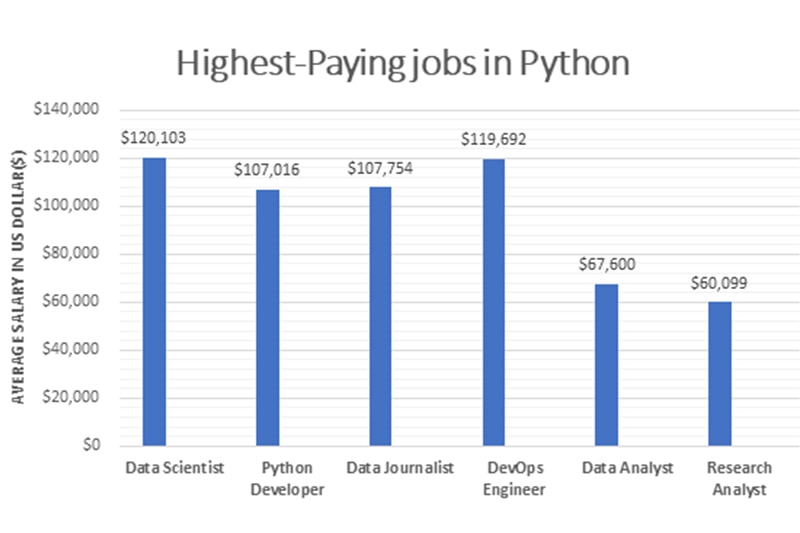
Python Developer
Software Developer
Data Engineer
Django Developer
Data Scientist
Django Developer
Application Developer
App Reliability Engineer
Research Analyst
DevOps Engineer

Who should attend our Best Data Analyst Bootcamp in Jacksonville, Florida ?
Fresher or beginner with no programming experience
College graduate or undergraduate
Coding enthusiast
Big Data professional
Aspiring Machine Learning Engineer or Data Scientist
Why People Stay in Jacksonville or Leave
People stay for a practical quality of life. JAXUSA puts the regional cost-of-living index below the U.S. baseline, and wages are not taxed by the state. Beaches, the St. Johns River, and a large financial-services workforce make the city livable for analysts who do not want a tighter coastal rent bill. A tech salary in the range JOPP candidates target can support a household here more easily than the same title in a more expensive market.
People leave, or hesitate, because of commute geography and career optics. The city is large. A Southside office, a downtown headquarters, and a home at the beach are not a short hop for everyone, even with a 26-minute average. Public transit helps downtown and First Coast Flyer corridors. It does not replace a car for many suburban tech sites. Remote-work culture is real in banking and insurance technology, yet some teams are pulling people back two or three days a week. Candidates who can work hybrid have more options than candidates who need a fully downtown bus commute.
Career ladders exist inside payments, risk, insurance analytics, and logistics technology, especially at headquarters employers. They are narrower than in Atlanta, the Bay Area, or New York. Ambitious specialists sometimes leave for those hubs, or they stay in Jacksonville and take a national remote role. Competition from Orlando, Tampa, Atlanta, and Charlotte is constant. Those markets recruit the same finance-technology talent. That competition is why a local jobseeker should not rely on a thin analyst certificate. A multi-stack, interviewed, marketed candidate can stay for the lifestyle and still clear a hiring bar set by national teams.
Waiting Only Pushes the Offer Later
Putting off SynergisticIT’s JOPP does not shrink the program. It only moves the job offer further down the calendar. The timeline is long because skills, project evidence, interview readiness, and client marketing are built in sequence until a placement holds. Employers pay for that finished stretch, not for a shortcut. Start while the requisitions are open. The road is demanding, and the result it is built to produce is a full-time job offer.
There may be hundreds of programs advertising a Data Analyst Bootcamp in Jacksonville, Florida and Data Analyst Bootcamp training in Jacksonville, Florida. If the goal is to get hired after the training, the choice that matches that goal is SynergisticIT’s Best Data Analyst training Bootcamp in Jacksonville, Florida. It is the sure route for a jobseeker who wants the training and the placement work in one place, and only after the full program is completed.
Contact SynergisticIT or call (510) 550-7200 and start the data analyst career journey with JOPP.