 Important Notice— Our url is


On October 8, 2026, the Trump administration announced that it was suspending eight technology and outsourcing companies from the Permanent Labor Certification program, referred to as PERM. Keith Sonderling, the Labor Secretary, named Cognizant, Infosys, Tata, Wipro, HCL, and Capgemini, and included Microsoft and Adobe on the list because of ongoing federal investigations. The Department of Labor stated that it would no longer accept new PERM applications and would not proceed with any pending applications involving these companies. The suspension was deemed to take effect on the day it was announced and does not, by itself, cancel any H-1B visas or green cards that had already been issued.
We prepare foreign national tech talent with in-demand Java and Data Science skills, strengthening employability and resilience regardless of shifting federal enforcement priorities or processing backlogs affecting employment-based immigration cases nationwide.
The Eight Companies And Timing
The employers in question are Cognizant, Infosys, Tata Consultancy Services (listed as Tata), Wipro, HCL, Capgemini, Microsoft, and Adobe. Infosys, Tata, Wipro, and HCL are headquartered in India, while Cognizant is based in the United States and has a major delivery operation in India. Capgemini is headquartered in France and has large operations in India. Microsoft and Adobe are also American companies and are included in the same action.
The labor certification is the step that most employers have to complete if they are to sponsor a worker for an employment-based green card. The employer has to state that there is no qualified, willing, and available US worker who could take on the position. Sonderling stated that the department would not accept any new applications and would not continue to process the existing certifications associated with these companies. JD Vance, who is Vice President, said that Microsoft’s suspension would remain in place for as long as necessary and could be made longer. No end date was published by the officials.
Treat the announcement as applying to new and pending PERM cases at these employers and check the scope in writing with both the employer and an immigration lawyer. It is important to note that news reports cannot take the place of the notice that relates to a particular case.
Ten Steps To Maintain Status

These are practical checkpoints and not legal advice; status is determined by the visa, the petition, and the facts concerning the job.
- Find out if your employer is one of the eight and also check whether a PERM had been planned, filed, or was already pending.
- It would be wrong to suppose that the H-1B, L-1, OPT, STEM OPT, or an already approved green card has been cancelled. The action that has been announced is directed at the PERM processing for these employers.
- Be sure to save your I-94, the approval notices, the pay records, the labor condition application, and any of the PERM or I-140 receipt numbers.
- Write to the employer to find out if the payroll and the authorized role will continue and also ask how they will deal with a frozen certification.
- Before you change employers, travel, or file anything new, it is advisable to consult an independent immigration attorney.
- Set the date when your status ends and begin the legal process to extend or change your status early enough to prevent a gap from occurring.
- Carry out work only for the petitioner, within the role, location, and hours that the authorization permits.
- When the job concludes, make sure you know about the grace period that applies to that particular status and don’t carry out any work without having authorization.
- If you are a US citizen, a green card holder, or in some other position that allows you to work without sponsorship, regard this as a chance to get a job and align your skills with those that employers are currently offering.
- Don’t accept fake experience, interviews carried out on someone else’s behalf, or a paper employer for whom you are not qualified to obtain a PERM. That is what the administration says it is investigating.
The Administration’s Jobs Argument
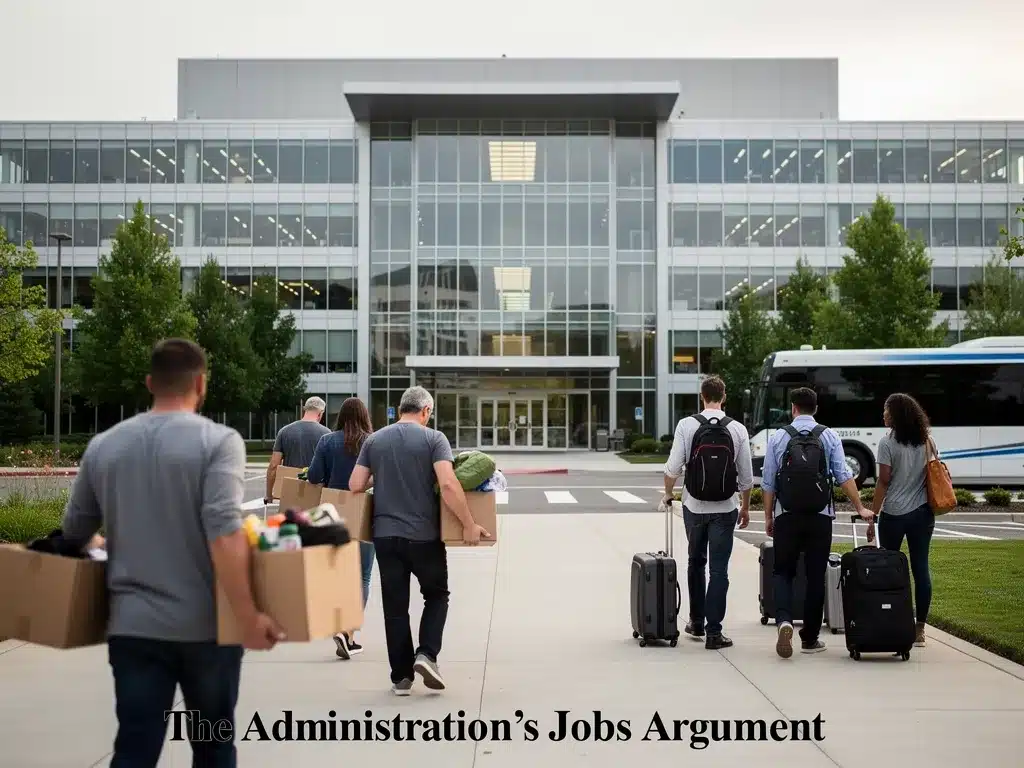
The administration argues that these programs have been set up so as to replace American workers and keep wages low, not just because the United States lacks workers with the necessary skills. Vance stated that Microsoft had laid off 6,000 workers in the U.S. last year while obtaining 6,300 H-1B visas and almost 3,000 green cards, and described this as replacing the laid-off workers with “foreign indentured servants.” His message to Microsoft was that since it is a large American company it should employ American workers.
He also maintained that the pay gap is the means by which displacement occurs; he stated that an H-1B worker earns around $20,000 less than a US citizen in the same position, and that a worker hired by a foreign outsourcing company earns approximately $48,000 less than a US citizen in a comparable role. According to this view, the visa is not a final option when a proper search has been carried out, but rather a method of carrying out the same kind of work at a lower wage, after which the company can refer to the search as evidence that Americans could not have been found.
The scale that the administration would have the public recall was provided by Sonderling. He stated that since 2009 these companies have asked for almost 3 million foreign workers, have obtained more than 230,000 H-1B approvals, and have secured more than 100,000 permanent labor certifications. He referred to those certifications as having taken hundreds of thousands of jobs away from American workers and regarded the suspension as the first move to end what the administration terms fraud and abuse.
PERM is the relevant form. It is intended to show that the employer has searched for a qualified American worker and was unable to find one. The administration argues that in some cases those certifications are not credible since the same companies are reducing their US workforce, recruiting extensively overseas, and paying less than the wage earned by citizens for similar work. The purpose of suspending PERM is to eliminate the incentive that, in the administration’s opinion, keeps this practice in place. The groups that are expected to benefit are US citizens and lawful permanent residents who should therefore be hired, kept, and paid the market rate for the job.
That is the view of the administration. The claim is based on the investigations and not the result of a court case, and the companies had not given detailed replies to the accusations when making the first report.
Why Is PERM Labor Certification Suspension Making Headlines?

The Department of Labor PERM freeze is making headlines because of its scale and speed. Eight companies, spanning US firms and outsourcing firms alike, lost PERM filing access in a single announcement, with no transition period for pending cases. That combination of breadth and immediacy is why foreign national employees and HR compliance leaders alike are paying close attention.
What actually happened with the Cognizant and Infosys suspensions?
The Cognizant Infosys PERM suspension targeted labor certification filings for both companies directly, cutting off a step that green card sponsorship depends on entirely. Labor Secretary Keith Sonderling announced the action publicly, naming Cognizant, Infosys, Tata, Wipro, HCL, and Capgemini outright, and adding Microsoft and Adobe on the basis of active federal investigations. The Department of Labor confirmed it will not accept new PERM applications or process pending ones tied to any of the eight employers.
That scope matters as much as the substance. Consider the contrast:
For employees connected to these filings, the H1B visa green card impact is immediate: stalled petitions, frozen timelines, and uncertainty about next steps, even though already-issued H-1B visas and green cards are not themselves cancelled.
We help employers and candidates navigate volatility in the sponsorship landscape. As a software solutions, development, IT upskill, and manpower planning organization based in Fremont, California, we help companies cope with fast-moving disruptions in the sponsorship landscape by offering scalable staffing and development resources that don’t depend on a single compliance pathway. That flexibility matters most when regulatory ground shifts overnight.
What Triggered The Department Of Labor PERM Freeze?

Expanded federal scrutiny of employment-based green card sponsorship triggered the current freeze. The Department of Labor, under Secretary Keith Sonderling, cited active federal investigations into alleged fraud and wage suppression tied to H-1B and green card sponsorship at the eight named employers. We track these shifts closely because they touch every employer and foreign national professional relying on sponsorship timelines.
What Does PERM Have To Do With Green Cards?
PERM labor certification suspension actions strike directly at the backbone of employment-based immigration. PERM operates as the labor certification program that US employers must complete before sponsoring a foreign worker for permanent residency. Without an approved PERM case, a green card petition cannot move forward. That makes any Department of Labor PERM freeze consequential well beyond a single employer; it stalls the pipeline for every candidate waiting behind it.
Why Does This Matter For Foreign National Professionals?
A Cognizant Infosys PERM suspension scenario illustrates how enforcement actions at large sponsoring employers ripple outward. When investigators flag an employer, every pending case tied to that employer faces delay or review. The H1B visa green card impact extends to workers who did nothing wrong but depend on their employer’s compliance standing.
Since 2010, we have focused on understanding sponsorship risks for both employers and candidates. SynergisticIT, founded in 2010 and based in Fremont, California, specializes in matching top-tier IT talent with clients ranging from startups to Fortune 500 companies. Beyond placement, we stand as an industry leader in manpower planning and IT skill enhancement, helping professionals build qualifications that hold up under heightened scrutiny rather than depending solely on a single employer’s compliance record.
How Deep Does The Cognizant Infosys PERM Suspension Go?

The Cognizant Infosys PERM suspension reaches far beyond a routine compliance check. Cognizant ranks among the largest Nasdaq-listed IT services employers in the country, and it is named alongside Infosys, Tata, Wipro, HCL, Capgemini, Microsoft, and Adobe, a list that spans offshore-model outsourcing firms and major US technology companies alike. Regulators choosing to act against employers of this size and variety signals that enforcement is no longer reserved for small or obscure sponsors. We view this as a clear marker that the Department of Labor PERM freeze extends across the entire industry, not just niche consulting shops.
The tone behind this action matters as much as the action itself. Secretary Sonderling and Vice President JD Vance delivered the announcement in blunt terms, Vance describing the displacement of laid-off American workers in stark language and Sonderling framing the certifications at stake as hundreds of thousands of jobs taken from American workers. That language is sharper than the usual bureaucratic restraint around green card processing, and it tells sponsoring employers and foreign national employees alike that the PERM labor certification suspension environment now carries real reputational and operational stakes.
Why does the size and range of the named employers matter to enforcement strategy?
Regulators targeting major employers, both outsourcing firms and US technology companies, sends a message to the entire staffing and IT services sector. Smaller firms can no longer assume they fly under the radar simply because of scale or headquarters location. Enterprise-level scrutiny suggests broader audits may follow across comparable organizations.
What does this mean for H-1B and green card timelines?
The H1B visa green card impact shows up first in processing delays and heightened documentation demands. Foreign national professionals waiting on PERM-based green card sponsorship at any of the eight named employers face longer uncertainty windows. We encourage affected professionals to strengthen their technical credentials now. Employer-side disruptions can stall individual cases regardless of personal performance.
SynergisticIT built its placement model around this volatility. We match top-tier IT talent with employers ranging from early-stage startups to Fortune 500 enterprises, operating as both a staffing partner and a job placement provider. Professionals affected by employer-level enforcement actions still have a path forward.
What Does H1B Visa Green Card Impact Look Like?

H1B visa green card impact shows up as delayed employment authorization, stalled permanent residency timelines, and growing uncertainty for skilled foreign professionals already working inside US companies. The H-1B visa allows US employers to hire skilled foreign workers in specialty occupations that require at least a bachelor’s degree or its equivalent. When the permanent residency pipeline slows, workers holding that visa face real consequences for their careers and families.
Certified Labor Condition Applications remain a required step for H-1B, H-1B1, and E-3 petitions. That means any slowdown in processing those applications ties directly to visa status for thousands of professionals. A Department of Labor PERM freeze does not stay contained to green card paperwork. It reaches into active visa petitions and renewal timing as well.
How does a PERM suspension affect someone already holding an H-1B visa?
A PERM labor certification suspension interrupts the first step of the green card process for workers who already hold H-1B status. We see this creating a ripple effect: visa renewals, employer sponsorship decisions, and long-term career planning all depend on PERM moving forward. Foreign workers and employers alike are watching closely. These disruptions touch both H-1B visas and PERM labor certifications at the same time.
Does employer-specific action change the outlook for workers?
Cases involving a Cognizant Infosys PERM suspension signal that enforcement can target individual employers, not just the system broadly. Workers sponsored by any of the eight named employers face sharper uncertainty than those at firms untouched by enforcement actions.
We built our approach around understanding what clients and candidates actually need before shaping any recruitment plan. That people-centric foundation, paired with practical US tech talent upskilling, helps professionals stay competitive regardless of where the next policy shift lands.
How Is The Government Shutdown Compounding These Delays?

A federal shutdown now layers fresh disruption onto an already strained immigration pipeline. We see the damage spreading well beyond the PERM labor certification suspension, reaching into multiple corners of the sponsorship process at once. Foreign national employees and the HR teams supporting them face a system that is slowing down on several fronts simultaneously, not just one.
The most consequential breakdown centers on the Department of Labor’s filing infrastructure. Its FLAG system, the portal employers rely on for labor condition applications, prevailing wage requests, and PERM submissions, has gone dark entirely. This outage represents a core piece of the Department of Labor PERM freeze we’ve been tracking. It blocks new filings outright rather than merely slowing them.
Are USCIS and State Department Operations Also Affected?
USCIS and the State Department continue operating because their work runs on fee-based funding rather than annual appropriations. Operational status, however, does not mean business as usual. Employers still contend with mounting delays across filings, visa processing, and new-hire onboarding, even where agencies remain technically open.
For foreign national employees already navigating the H1B visa green card impact of stalled PERM cases, these overlapping slowdowns compound uncertainty at every stage of the process. We built our staffing model specifically to absorb this kind of recurring volatility in IT policy and workforce planning. Rather than leaving candidates and client companies exposed to single points of failure, we help businesses manage change across the entire talent pipeline.
That approach includes:
- Monitoring policy shifts that affect sponsorship timelines
- Supporting clients through filing backlogs with contingency planning
- Imparting accurate, current technical knowledge so tech aspirants stay employable regardless of regulatory turbulence
We treat this knowledge-first grounding as essential, especially when government functions stall and certainty becomes scarce.
What Should IT Compliance Teams Track Right Now?

Compliance teams need to track filing freezes, documentation gaps, and vendor confidentiality safeguards simultaneously. Right now, employers cannot file Labor Condition Applications, Prevailing Wage Determinations, or PERM labor certification suspension paperwork at all, which leaves every pending green card case in limbo. We built our compliance monitoring approach around this reality, not around optimism that filings will resume on a predictable timeline.
What does the filing freeze mean for pending green card cases?
The Department of Labor PERM freeze stops new filings cold. It also creates downstream risk for cases already in process. Teams tracking the Cognizant Infosys PERM suspension headlines should treat every open PERM case at any of the eight named employers as exposed until filing systems reopen. We advise HR compliance leaders to document every delay with timestamps now, since audit trails matter more during enforcement surges.
How should compliance teams protect sensitive case data during the freeze?
Confidentiality cannot slip just because filing systems are down. Our team protects client data with current encryption standards across every engagement, a safeguard compliance leaders should demand from any staffing partner handling sensitive H1B visa green card impact cases. Weak data handling during an audit window compounds legal exposure that already exists from the freeze itself.
Practical tracking priorities for compliance teams include:
- Filing status for every pending LCA, PWD, and PERM case
- Documentation of delays, with dates and system status notes
- Vendor confidentiality practices, confirmed in writing
- Internal readiness for a potential filing surge once systems reopen
Our cluster of services, spanning software development, US tech talent upskilling, and IT staffing, gives compliance teams one coordinated point of contact rather than three disconnected vendors. We credit this coordination to taking the time to understand each client’s specific compliance and hiring goals before building a response plan. That groundwork matters more during an enforcement-heavy stretch than during calmer filing periods.
Why Should US Tech Talent Upskilling Matter Now?

US tech talent upskilling matters now because enforcement conditions around employment-based visas are shifting faster than most hiring teams can track. Foreign national professionals holding H-1B, L-1, or OPT/STEM OPT status face a market where credentials alone no longer guarantee stability. We built our training model specifically for this moment, developing one of the most thorough IT upskilling programs in the industry to prepare candidates for changing hiring conditions rather than yesterday’s job market.
Our curriculum does not chase trends. We center every seminar on **Java, J2EE, and Full Stack development**, the core skill set enterprise IT departments hire for regardless of broader policy turbulence. Candidates who master these fundamentals position themselves as dependable hires, the kind of talent companies retain even when sponsorship scrutiny increases elsewhere in the organization.
Does interview readiness really affect job placement outcomes?
Readiness changes everything once a candidate reaches the interview stage. We dedicate substantial training time to mock interviews and technical interview preparation, giving candidates the confidence to walk into real interviews without hesitation. Technical skill without interview polish still costs offers; we close that gap directly.
What has made this training approach durable since 2010?
Longevity signals results. Since our founding in 2010, our strategies have earned us a strong position across software development, IT staffing, and skill enhancement, built through consistent outcomes rather than short-term trends.
For professionals navigating uncertain sponsorship timelines, the stakes are plain:
- Outdated skills shrink the pool of employers willing to sponsor or retain talent.
- Weak interview performance erases strong technical credentials before an offer ever arrives.
- A narrow skill set limits mobility if a current employer’s compliance posture changes.
We designed our program to close each of these gaps before they cost a candidate an opportunity.
How SynergisticIT Helps Jobseekers

A PERM freeze on its own doesn’t produce a qualified local candidate. If the team still requires someone who is able to ship Java services, run cloud infrastructure, or build a data pipeline and that person is not based in the local area, the work can be sent to an offshore delivery center. This outcome can be more detrimental to US jobseekers than a sponsored hire would be, since the position never becomes available in the United States at all. The practical solution to a shortage of talent is to bring in authorized workers to match the stack of technologies that the employers are already purchasing.
That is the purpose for which SynergisticIT’s Job Placement Program, or JOPP, is designed. The company, based in Fremont, California, has been operating the program since 2010 and says it has helped more than 10,000 people start technology careers. The program is entirely online and instructor-led, with a focus on software engineering, Java, data science, machine learning, and AI. Training is live and runs about five to seven hours a day, including projects, interview preparation, and marketing to a client network of more than 24,000 contacts. We also prepare candidates for industry certifications, including Oracle Java and cloud credentials from Amazon and Microsoft, without a separate prep fee.
For a US citizen or a green card holder, the hiring advantage is straightforward: no sponsorship, no PERM, and no dependency on any of the eight suspended employers. Our published fee terms for those candidates include a partial upfront payment, with the balance tied to a job offer at or above $81,000, and a refund path for citizens and green card holders who meet attendance, assessment, relocation, and marketing conditions and are not placed. These terms carry conditions, so candidates should review them in the agreement rather than assume them from a summary.
For other people already authorized to work in the United States, including many OPT and STEM graduates, the same skills gap decides who gets the offer. An employer that can hire a work-authorized candidate with current Java, cloud, and data skills does not need to wait on a frozen certification. We market only real projects and skills the candidate has actually done, prepare coding and behavioral interviews, and support after hire. We report graduate starting pay, on our own site, in a range from the low $80,000s to about $150,000, alongside a 91.5% success figure; these are company-reported outcomes, not an independent audit.
The competitive point is the stack, not the slogan. Employers interviewing for backend, data, and AI roles are testing Spring Boot, microservices, SQL, cloud, data structures, and the ability to explain a project. A degree or an older bootcamp certificate often stops short of that list. JOPP updates its curriculum from client demand, then puts the candidate in front of employers who already hire for those roles. About 30% of participants, we find, had already finished another bootcamp without an offer and were hired after JOPP.
What Employers Gain From JOPP Candidates

- Candidates are presented as US citizens, green card holders, or others already authorized to work, so a hire does not depend on a PERM filing at a suspended employer.
- The program is built around the stacks clients are requesting, including Java, cloud computing, data engineering, and machine learning, rather than a generic survey course.
- Interview preparation covers coding, system discussion, and behavioral questions, which shortens the time a hiring manager spends on unprepared applicants.
- We have marketed technology candidates since 2010 and maintain a large client contact list, so the introduction is not a cold application.
- Reported offers cluster in professional salary bands, which is relevant for teams that need mid-level output rather than a short contract at a training wage.
- Post-hire technical support, which we provide for up to a year, reduces the risk that a newly placed hire stalls in the first months.
- For employers trying to show they looked seriously at the domestic market, a pipeline of authorized, assessed candidates is a concrete alternative to another sponsored req or an offshore handoff.
The administration has framed the PERM suspension as a way to stop replacement hiring and keep technology jobs with US citizens and green card holders. That goal only holds if those workers can do the work companies are staffing today. If they cannot, the same jobs can leave the country. Closing that gap, through current skills and a real placement process, is the part of the response that jobseekers and employers can act on now.
What Is The Next Move For Employers And Candidates?

Employers and candidates both need a connections-first strategy to navigate the current PERM labor certification suspension and its ripple effects across sponsorship pipelines. Enforcement actions tied to the Department of Labor PERM freeze and the Cognizant Infosys PERM suspension have made one fact clear: matching the right talent to the right employer now carries compliance weight, not just business value. We built our mission around making the right connections between IT professionals and the companies that need them. That mission matters more now than ever.
Our approach centers on connecting qualified IT talent with organizations that have a genuine, verifiable need for that talent. Companies sourcing candidates during this period of scrutiny rely on our recruiters to identify professionals whose skills and documentation align precisely with the role, reducing the ambiguity that invites regulatory attention.
How does staffing quality affect compliance risk?
Staffing quality directly shapes compliance exposure. Clients who work with us consistently report that our placed professionals bring strong dedication and reliability to their assignments, which supports stable, well-documented placements rather than rushed or mismatched hires.
What should candidates do while PERM filings are paused?
Candidates facing uncertainty around H1B visa green card impact should focus on strengthening technical credentials rather than waiting passively. Building verifiable, current skills reduces dependency on any single sponsorship pathway.
Our focus spans software development, staffing, and IT skill enhancement across Java, Data Science, and emerging technologies, which gives candidates a practical way to stay competitive regardless of filing delays. Concrete next steps include:
- Reviewing current sponsorship documentation against evolving Department of Labor standards.
- Treating an IT compliance visual guide as a reference point for internal audits.
- Prioritizing US tech talent upskilling in Java, Data Science, and in-demand cloud and AI skill sets.
- Partnering with staffing organizations that vet roles and candidates with equal rigor.
These steps keep employers and candidates positioned for stability as enforcement priorities continue to shift.
Conclusion

In closing, the suspension of PERM labor certification at Cognizant, Infosys, Tata, Wipro, HCL, Capgemini, Microsoft, and Adobe fundamentally reshapes how technology companies approach workforce planning and talent acquisition. Organizations must pivot toward domestic talent development and strategic staffing partnerships that bridge immediate skill gaps while building sustainable long-term capabilities. By prioritizing comprehensive IT upskilling and targeted recruitment aligned with evolving immigration policy, tech leaders position themselves to navigate uncertainty and maintain competitive advantage in an increasingly constrained talent landscape.
Ready to Move Forward?
Whether you’re a candidate strengthening your skills while PERM filings are paused, or an employer looking for authorized, work-ready talent, we’re here to help. Contact us to talk through your specific situation and find the right path forward.