 Important Notice— Our url is


Top cloud providers
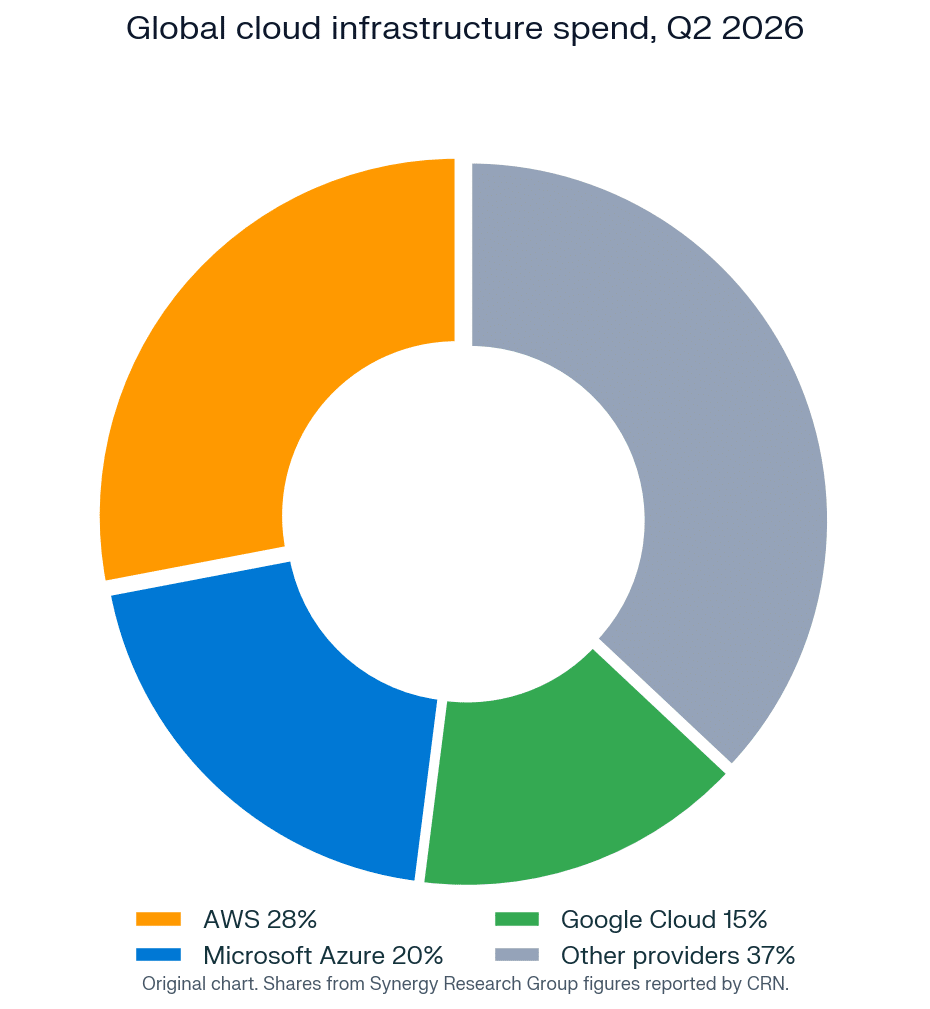
Three companies still hold the majority of global cloud infrastructure spending. In the second quarter of 2026, enterprises spent $143 billion on cloud infrastructure services, a figure that represents a 43 per cent increase compared with the previous year, according to figures from the Synergy Research Group as reported by CRN. Amazon Web Services accounted for 28 per cent of that spending. Microsoft had 20 per cent. Google Cloud achieved a record 15 per cent, an increase from 13 per cent. When these three companies’ shares are added together they make up 63 per cent. The remaining share is held by Oracle, Alibaba, IBM, Salesforce and various smaller providers. In the first quarter of 2026, Alibaba and Oracle were each about 4 per cent.
Types of Cloud Deployment Models:

- Public Cloud: This cloud model supports all users who want to use computing resources such as memory, storage, and application server on a subscription basis.
- Private Cloud: This cloud infrastructure is used by a single organization on a private internal network only for a selected group of users.
- Hybrid Cloud: This computing model connects private and public clouds into a single infrastructure.
- Community Cloud: As its name suggests, this cloud model supports various organizations sharing computing resources that are a part of one community.
The popularity of cloud computing is pacing up with an increase in the remote working environment. Earlier, Forbes predicted that in 2020, 41% of enterprise and mission-critical workload should be public-cloud based, while another 20% will run on a private-cloud platform, and nearly 22% will rely on the hybrid cloud.
Many organizations ranging from startups to MNC’s are migrating to cloud computing platforms to scale up their businesses. The jump in demand for cloud computing platforms has fueled the battle between the top cloud computing solution companies.
Even though its market share decreased, AWS still maintained its position as the leading provider in terms of volume. Its cloud revenue for that quarter was $42.2 billion, representing a 37 percent increase. Google Cloud recorded a revenue of $24.8 billion, an increase of 82 percent. The Intelligent Cloud segment at Microsoft, which is wider than Azure by itself, amounted to $39.3 billion and this was a 32 percent rise. Generative AI is causing regular cloud spending to increase as well. Synergy’s chief analyst stated that generative-AI cloud services had grown by 165 percent year on year.
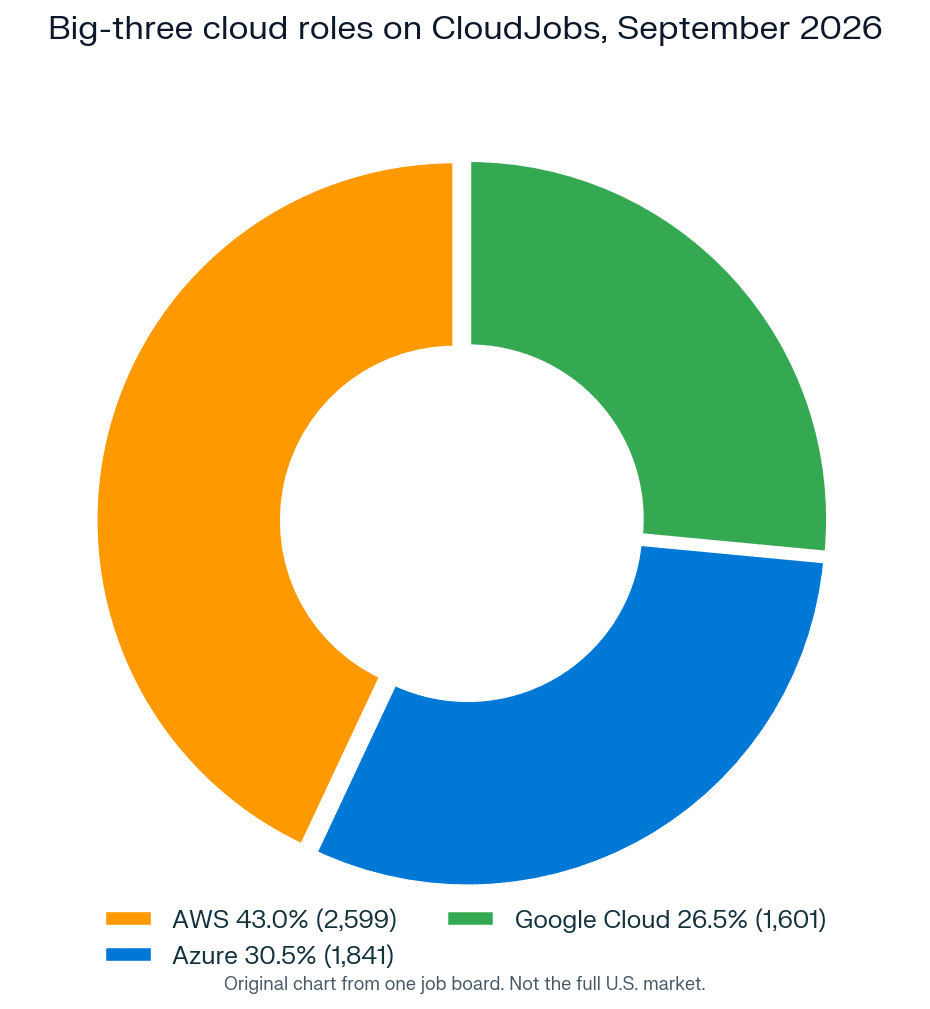
Market share can be seen as a kind of hiring map since the platform that receives the highest amount of customer spending is also the one that appears in the greatest number of specialised listings. In September 2026 on the CloudJobs board AWS had 2,599 open cloud positions, Azure had 1,841 and Google Cloud had 1,601. The median listed salary on that board was $202,000 for AWS, $202,000 for Azure and $210,000 for Google Cloud. These median figures relate to specialised listings and not to the entry-level national averages.
Major Cloud Computing Service Providers
Mainly, the battle for cloud dominance is fierce amongst 4 major cloud computing service providers i.e., AWS, Microsoft Azure, Oracle Cloud, and Google Cloud. Let’s focus on the features and advantages of each cloud giant to understand better what each environment offers in terms of the scope of work and pay scale.

1. Amazon Web Services- AWS Cloud Computing
AWS Cloud Computing is a secure platform that helps developers to build sophisticated applications with scalability & flexibility. It was launched in 2006 from the internal infrastructure of Amazon to manage its retail operations efficiently. Amazon was among the first companies to set up a pay-as-you-go cloud computing model.
Large businesses broadly adopt AWS as it offers 175 fully featured cloud services from database storage to CDN, machine learning, and computing power that help them become more agile and innovate faster. It is a cost-effective cloud computing model.

Benefits of using AWS:
- User-Friendly– Amazon Web Services is easy to use and provides access to various applications. It meets different needs, such as Hadoop Cluster or Content Delivery Network.
- Unlimited Capacity– Around 560,000 hard drives fail each month in the U.S due to limited storage issues, but AWS fixes this problem by providing unlimited server capacity. It currently powers thousands of global businesses.
- Security– AWS provides a reliable encryption & security measure that guarantees to keep your data safe & secure.
- Innovation- AWS may face competition regarding pricing, but no other cloud service provider can beat Amazon Web Services in terms of innovation.
Why Learn AWS?
Amazon Web Services continues to rule and sustain the top position among the major cloud computing providers. Indeed claims that the market share of AWS is expected to increase to $236B by the end of 2020 at a CAGR of 22%. It will create more than 380,000 cloud computing jobs. You can secure a credible job by enrolling in AWS certification.

2. Microsoft Azure Cloud Computing
Azure is a public cloud computing platform launched by Microsoft in 2010. It provides a wide range of specialized services for analytics, big data, virtual computing, mobile application development, games, DevOps- agile development pipelines, data warehousing, storage, and much more.
Microsoft Azure has served more regions globally than any other cloud service provider. It is currently available in more than 60 geographical regions and 140 countries. Azure has hybrid cloud features such as infrastructure as a Service (IaaS), Software as a Service (SaaS), and Platform as a Service (PaaS). A majority of Fortune 500 companies use this enormous network of infrastructure.
Since more businesses are shifting to Microsoft Azure Cloud Computing, the demand for skilled cloud professionals will inflate. Presently, there is a scarcity of Azure talent to fill the increasing positions in the market. Companies compete to land the best candidates by providing high wages and additional perks.
Some significant facts about Azure:
- Microsoft affirms that around 1,000 new customers sign up for Azure on a daily basis. Thus, approximately 365,000 new companies adopt Microsoft Azure each year.
- The commercial cloud revenue of Microsoft has increased by 62%, with an expected annual run rate between $11.85 billion and $12.05 billion in revenue.
- So far, 95% of Fortune 500 companies are using MS Azure.
- Microsoft Azure has received official accreditation from the government of the U.K. Moreover, the Azure Government offering is also backed by the U.S. Government.
Top Reasons to Get Microsoft Azure Certification:
In recent years, the job opportunities for Azure professionals have doubled due to its growing demand. Let’s have a look at some of the advantages of learning Azure:
- Versatile and Secure Career Options- Microsoft Azure certification is essential when pursuing a career in cloud computing. It provides flexibility to choose among various career options and helps to secure credible positions such as cloud developer, administrator, A.I. engineer, solutions architect, security engineer, DevOps engineer, and data engineer.
- Gateway to Different Industries- With the growing rate of businesses shifting their workloads to cloud computing, you get a chance to work in distinct fields. If you are an Azure-certified professional, you can manage, develop, and implement cloud services in industries of I.T., healthcare, finance, retail, banking, insurance, or marketing.
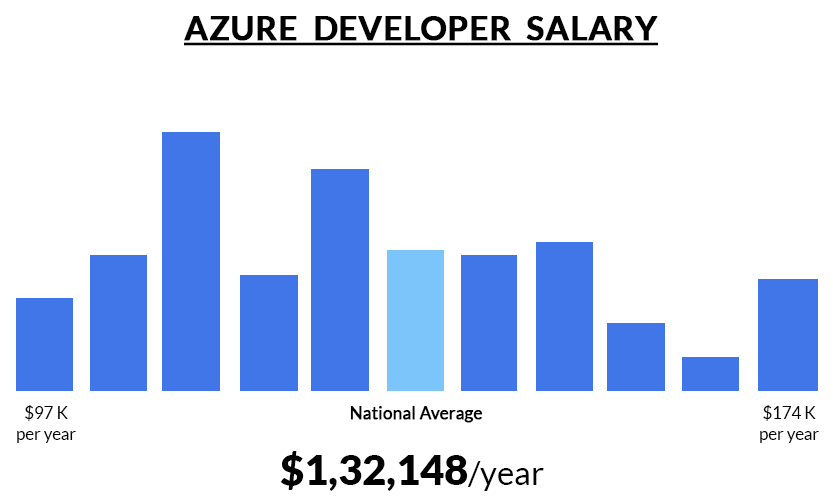
- Higher salaries– One of the biggest reasons to acquire Microsoft Azure certification is the attainability of higher salary packages and better job opportunities. According to the reports of ZipRecruiter, the average annual salary of an Azure Developer is $131,838 per year, while an Azure Architect earns around $144,866 per year. The salaries increase to $174,000 per year for the senior roles. Indeed, has posted more than 40,000 job openings for Azure experts in the U.S.
- Ease to learn– Microsoft Azure enables structured learning methods and facilitates candidates with common tools such as GitHub and Hadoop, which are easy to learn. Many online resources are available for Azure learners, including ebooks, tutorials, and courses to grasp the theoretical & practical concepts. However, to ace the hands-on practice, one must enroll in an Azure certification course from a reputed training institute and get certified in Azure services.
- Enhance DevOps Skills– Once you ace Azure services, it will automatically improve your DevOps skills. DevOps is one of the latest technologies that combine I.T. operations and software development to deliver solutions at high velocity. By acquiring DevOps skills, you can deliver more cloud services like monitoring cloud environments, designing & implementing strategies for application development, automation process, etc.

Career Options after Azure Certifications:
Microsoft Azure offers many career advancement options, such as security engineer, Azure administrator, A.I. engineer, architect, big data analyst, cloud developer, and data scientist. The cloud computing market share of Azure is 18% which is the second highest after AWS with 32%. You can have a better opportunity to land a highly paid and secured job with Azure certification. It opens the door to becoming a leading professional in the cloud market.
3. Google Cloud Computing
Google Cloud Computing is a public cloud platform that serves 20 geographical regions in North America, South America, Europe, Australia, and Asia. Unlike AWS and Azure, Google Cloud Computing provides limited cloud services but offers some specialized tools for developers.
- GCP offers storage, robust data analysis, networking, and high-level computing.
- It also provides different networking options such as cloud CDN, virtual private cloud, cloud DNS, etc.,
- Google Cloud Platform has strong capabilities in machine learning, big data analytics, and artificial intelligence.
- GCP renders its services at more reasonable prices than its competitors.
- It supports common coding languages like Java & C++.
- Google Cloud Computing Platform allows its users to create a single-purpose function that eliminates the need for management.
- It quickly writes, debugs, and deploys cloud-native applications.
- Google Cloud is a robust platform to build software and standardize CI/CD across all languages.
- It helps to automate deployments, create pipelines and get faster feedback.

Google Cloud Security Features:
Google App Engine streamlines app development and enable developers to create applications without dealing with the server. It is a complete solution for developing command line & mobile applications in an agile manner.
Though GCP holds a unique position on the list of Big Three (IaaS) offerings, cloud watchers still consider it the third-best option behind AWS and Microsoft. Google Cloud fails to compete with the massive infrastructure of AWS & Azure, but makes up for the lapses with a smoother learning curve across all kinds of deployments.
4. Oracle Cloud Computing
Oracle Cloud is a relatively new platform in the market and cannot be compared to the top three major Cloud Computing platforms i.e, AWS, Azure, and Google Cloud. Despite not sustaining top positions in the global cloud service providers, Oracle Cloud Computing has a lot to offer. It provides a broad spectrum of cloud services, such as:
- Business Intelligence (B.I.) solutions, autonomous analytics, Big Data, data visualization, and much more.
- Cloud infrastructure maintenance & setup.
- App development including database, blockchain, Internet of Things, etc.
- Data integration and management.
- Security solutions focused on compliance & safety.
- Flexible and smooth customization along with quicker deployment.
- Immediate integration of financial data.
- Fits-well with all scale of organizations from startup to MNCs.
Oracle is dynamic and gives out-of-the-box cloud solutions, but they are minimal and insufficient.
Which cloud to learn first
You should start by learning AWS unless the company you’re aiming for is already one that uses Microsoft or Google. AWS has the largest amount of spending and the greatest number of specialised cloud listings. Azure comes in second since banks, insurance companies, government departments, and organisations that use Microsoft 365 hire from that ecosystem. Google Cloud is the third and more specialist cloud; it is the best choice for teams that are native to analytics or AI, but it has a smaller number of job opportunities.
Going deeper is better than having a collection of logos. Employers will only pay for one platform being properly learned—including compute, storage, identity, networking, as well as containers and an automation tool. A second cloud is useful only after the capabilities of the first one have been demonstrated. The most suitable candidates are those who can explain how a service is deployed, secured, and monitored.
Data roles
The cloud that is essential for data science, data engineering, and analyst positions is not the same; the type of role determines the answer.
Data engineers ought to view AWS as essential. The articles in this category mention object storage, Glue, EMR, Redshift and the streaming tools more frequently than any other set of services, since that is the area in which the greatest number of data platforms currently operate. Snowflake and Databricks are built on top of the cloud and do not take the place of it. Google Cloud is a specialist addition. BigQuery still serves as the benchmark warehouse for fast analytics.
Data scientists should also begin with AWS, since SageMaker and the various data services associated with it are commonly found in the job market. For product and media teams, Google Cloud’s Vertex AI is the simpler managed machine-learning platform. Azure Machine Learning is important when the company is already using Microsoft.
Data analysts ought to change that order. Currently when hiring analysts they focus on SQL and a business-intelligence tool; in companies using Microsoft products that tool is Power BI, usually provided as part of Microsoft Fabric. A certificate in AWS architecture won’t overcome the advantage of SQL, a dashboard, and a small warehouse project. When someone has to choose just one cloud service without knowing their job title, AWS should be the safer choice in the case of engineering and science, while Azure should be the safer choice for analysts and BI applications.
Synergisticit’s Data Science Job Placement Program includes training in both AWS and Azure, which means that participants are not tied to just one provider. The course offers live classes, projects, and candidate marketing services specifically for technology companies that recruit data professionals. A data candidate could have an interview at an AWS company on Monday and at a Microsoft company on Thursday. A candidate who is able to discuss storage, pipelines, and deployment with regard to both platforms is more difficult to dismiss than one who has only completed a tutorial for a single vendor.
Java and software roles
AWS is the go-to cloud platform for Java and software developers; when talking about enterprise Java we mean Spring Boot services, relational databases, and message queues, and the cloud services associated with that technology are most frequently AWS ones—such as compute services, containers, serverless functions, managed databases, and queues. Azure comes in as the second major cloud and is important in banks, insurance companies, and any organisation that already uses Microsoft. Although Google Cloud does have its uses, it is not the first result when carrying out a general search for Java.
A Java developer who can only write features is facing off against those who can also deploy them. The listings which move more quickly request Docker, a pipeline, and one cloud service, with AWS mentioned first. Terraform or an equivalent infrastructure file distinguishes between browsing the console and having a reproducible environment. A practical set consists of one associate-level AWS certification, one deployed Spring Boot service, one pipeline, and one infrastructure file; this kind of set is more hireable than three incomplete cloud courses.
The Java DevOps Job Placement Program offered by SynergisticIT also includes training on both AWS and Azure. When tech companies hire for Java positions, they seldom look for just Java; instead, they want a service that can be developed, deployed, and maintained. Enrollees who receive training on both clouds together with the associated DevOps practices match more closely with actual job advertisements than do those who have studied the language alone. In this market, that kind of match is what makes the difference between getting a response and receiving nothing.
DevOps, MLOps, and the hiring edge
It is the DevOps and MLOps roles that are at the forefront since most candidates only go as far as the skill indicated by the job title. Developers limit themselves to writing code and data scientists stop with their notebooks, whereas hiring managers are looking for the individual who can get that work into production and then maintain it there.
DevOps involves treating the processes of building, testing, releasing, and running software as a single, continuous flow. The tools that are continually appearing are Git, a pipeline, Docker, Kubernetes, infrastructure as code, and monitoring. The title is moving in the direction of platform engineering, with the aim of providing those practices to other developers. Gartner has estimated that by the end of 2026, 80 percent of large software organisations will have platform teams, compared with 45 percent in 2022. According to a Glassdoor snapshot from August 2026, the median total pay in the United States for DevOps engineers was around $145,000 and for platform engineers around $219,000. Consider those figures as snapshots that have been reported, not as official labour statistics. The value of delivery skills exceeds that of language skills alone.
The concept of MLOps is also applied to machine learning models. Nowadays, the stage of training a model is not the rare or difficult one; rather, it is the deployment, the versioning of the data, monitoring for drift, and retraining that are the key steps. A 2026 compensation guide states that the base salary for MLOps roles ranges from $90,000 to over $257,000, with a typical national salary range of $130,000 to $165,000. As of September 23, 2026, ZipRecruiter’s running average salary for an MLOps engineer was $115,864. A candidate with the ability to deploy a model using a pipeline is no longer to be treated as equivalent to one who has only completed a course project.
Two resumes may mention Python or Java and the one which also includes a deployed service, a cloud environment, and a pipeline is the one that advances to the next stage. DevOps provides software candidates with that evidence and MLOps provides data and AI candidates with the same evidence.
Conclusion
If you want to have the broadest range of tech interviews, you should start by learning AWS and then add Azure since Microsoft companies are too big to ignore. For data engineers and data scientists, AWS should be the priority and Azure should be kept as an option. Data analysts, on the other hand, should regard Azure, Power BI, and SQL as their essentials. Java and software developers should make AWS their priority and use DevOps to demonstrate that they can deliver a product. Google Cloud is a specialist third cloud and not the first choice unless the team in question is already analytics-oriented or AI-oriented.
Since both the Data Science JOPP and the Java DevOps JOPP include coverage of AWS and Azure, the people taking the courses end up being prepared for the two cloud platforms that companies in fact hire from. This preparation gives them an advantage over other job seekers because it includes projects, deployment skills, and a technology stack that matches the job posting. In such a competitive market, a candidate who is able to deploy on either cloud is better suited to the hiring process than one who has only collected a list of course names.
Ask how the upcoming cohort maps to the role you want through the contact page, or call 510-550-7200.